Most eye clinics do not struggle because they lack services. They struggle because their messaging sounds interchangeable. Patients rarely compare clinics like insiders compare practices. They compare them through a simpler lens: “Can I trust this place, do they understand my problem, will they explain things clearly, and will this feel easy enough to book?” That matters because healthcare consumers research before they act. Google’s hospital-selection research found that 61% of patients visited two or more hospital websites before converting, 48% researched for more than two weeks before scheduling, and 84% used both online and offline resources in the process.
For eye clinics, that means differentiation is not just about having advanced diagnostics, respected doctors, or a modern office. It is about translating those strengths into patient-relevant messaging. A clinic that says “advanced technology” is describing itself. A clinic that says “we use imaging that helps catch issues earlier and explain findings more clearly” is describing why a patient should care. That difference is where stronger SEO, PPC, and conversion performance usually begins. Google Ads explicitly ties better performance to relevance and landing page usefulness, and CMS notes that patients care most about how they experience communication, coordination, and clarity in care, not superficial amenities.
What is an eye clinic differentiation strategy?
An eye clinic differentiation strategy is the process of identifying what your clinic does meaningfully better or differently, then expressing it in language patients immediately understand. It is not just branding, and it is not just advertising. It is the connection between clinical strengths, patient concerns, and the messages patients encounter on your website, service pages, ads, appointment forms, reviews, and consultations.
In practice, that means a real differentiation strategy answers three questions. First, what do we genuinely do well? Second, why does that matter to a patient with a real eye-health concern? Third, how do we communicate that consistently wherever the patient meets us? Those questions matter because many eye conditions do not present early symptoms, so trust, education, and clarity are not “nice extras” in eye care; they are part of helping patients take action before problems worsen. CDC, NEI, and AAO all emphasize that comprehensive eye exams help detect disease early, often before symptoms appear.
Why do most eye clinic marketing messages sound the same?
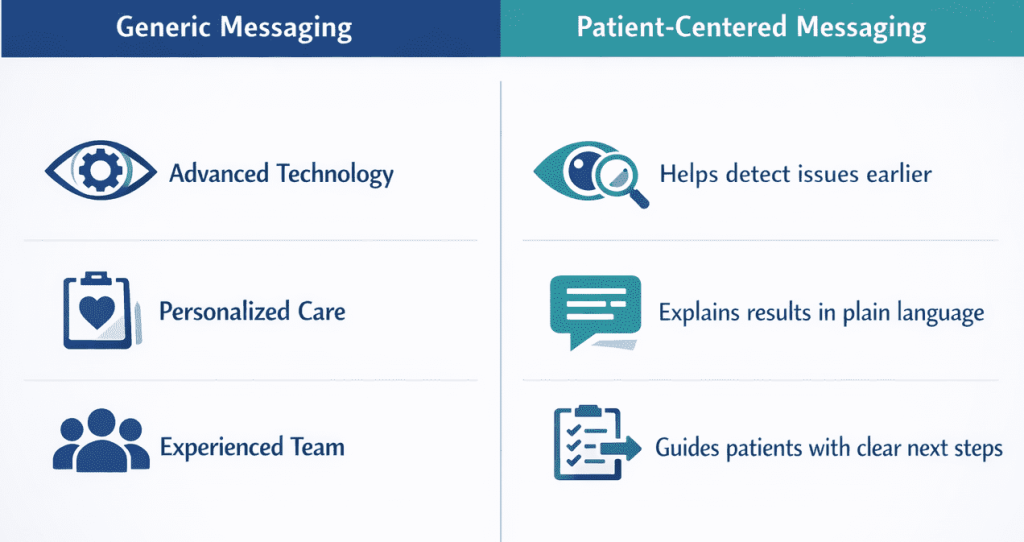
Most eye clinic messaging sounds the same because it is built from internal descriptors rather than patient decision criteria. Phrases like “quality care,” “experienced team,” “state-of-the-art technology,” and “personalized service” are not necessarily false, but they are too generic to differentiate a clinic on their own. Patients cannot tell how one clinic’s “quality care” is meaningfully different from another’s unless the message includes context, benefit, and proof.
There is also a structural reason for this sameness. Healthcare consumers research across multiple sites and sources before booking, and Google’s research shows they use search for general information, evaluation of specific features, and comparison across facilities. When many clinics publish near-identical copy, patients are pushed to decide on convenience, price, location, or whichever provider feels easiest to trust. That is exactly why broad claims underperform: they do not help patients make a confident choice.
What actually matters to patients when they compare eye clinics?
Patients usually care less about how a clinic describes itself and more about whether the clinic reduces uncertainty. CMS explains that patient experience is about critical aspects of care such as communication with doctors, understanding instructions, and coordination of needs. In other words, patients care about whether they feel informed, heard, and guided. They do not primarily judge care through amenities language.
That is especially true in eye care because eye diseases can progress quietly. CDC says some eye problems have no symptoms in the early stages, and NEI calls a dilated eye exam the best way to check for many eye diseases early, when they are easier to treat. For patients, that raises the stakes of choosing a clinic. They want a provider who appears thorough, explains findings clearly, and makes prevention feel actionable instead of abstract.
Patients also care about logistics more than many clinics realize. In Google’s healthcare research, 1 in 5 patients booked through a computer or mobile browser, roughly 1 in 3 used mobile devices daily for research or scheduling, and patients who used mobile research were more likely to make an appointment. That means convenience is not a secondary message. Easy scheduling, clear next steps, strong mobile pages, and obvious insurance or service information are all part of what makes a clinic feel more trustworthy and easier to choose.
Which messaging angles make an eye clinic stand out in a crowded market?
Expertise for a specific patient need
One of the strongest ways to stand out is to connect expertise to a defined patient concern. “Comprehensive eye care” is broad. “Dry eye care for patients frustrated by recurring irritation and blurry vision” is concrete. “Myopia management for families who want proactive long-term care” is clearer. “Diabetic eye exams focused on early detection and ongoing monitoring” gives patients a reason to believe the clinic understands their situation. Since CDC and NEI emphasize early detection for conditions that may not show symptoms at first, specificity around risk, prevention, and monitoring makes a clinic’s expertise feel more relevant and urgent.
A strong specialization message also reassures patients that the clinic sees people like them regularly. That matters because healthcare trust rises when communication supports understanding and engagement. AHRQ notes that patient-centered approaches are designed to enhance trust and foster shared decision-making, which is exactly what niche-specific messaging can signal before the first appointment happens.
Technology that improves the patient experience
Technology becomes a differentiator only when the message explains what it changes for the patient. AAO notes that tests and specialized imaging can help detect problems in the back of the eye, on the surface, or inside the eye, and can support early diagnosis. Patients already care about whether a facility uses the latest technology; Google’s hospital-selection research found 85% cited that as a factor. But technology alone is still not enough. The more persuasive message is that imaging can support earlier detection, more precise monitoring, and clearer explanations during the visit.
That framing also avoids a common trap. Listing equipment can impress peers, but it often means little to patients unless paired with a benefit. Messaging like “advanced retinal imaging that helps us monitor changes over time and show you what we see” is stronger than “we use OCT.” It translates clinical capability into patient confidence.
Personalized care and time-based attention
Patients often interpret personalization through how carefully care is explained, not through whether a clinic uses the word “personalized.” CMS emphasizes that communication and coordination are core elements of patient experience, and AHRQ links patient-centered communication with trust, engagement, and shared decision-making. For an eye clinic, that means messages around time, explanation, continuity, and tailored recommendations usually resonate more than vague promises of individualized care.
A better message might be: “We take time to explain your results, discuss treatment options in plain language, and recommend next steps based on your vision needs, lifestyle, and long-term eye health.” That sounds more credible because it describes the actual patient experience. It shows how the clinic behaves, not just how it wants to be perceived.
A smoother, more convenient patient journey
Convenience is often underestimated because clinic owners may see it as an operations issue rather than a marketing message. Patients do not separate those things. If booking is difficult, forms are unclear, mobile pages are weak, or service information is buried, the clinic feels harder to trust. Google’s data on digital healthcare research shows that search and mobile behavior play a major role before appointments are booked. Google Ads also states that landing page experience includes usefulness, relevance, ease of navigation, and whether the page matches what the user expected after clicking the ad.
For that reason, an eye clinic can differentiate with messaging such as “book online in minutes,” “clear insurance and exam information before your visit,” or “digital forms and streamlined follow-up to save time.” These are not minor details. They directly address friction that otherwise delays appointments.
A more human and reassuring experience
Clinical credibility gets patients interested, but emotional reassurance often gets them to book. Some patients are anxious about eye symptoms, worried about bad news, or overwhelmed by medical language. AHRQ notes that patient engagement and understandable design support trust and shared decision-making, while PSNet states that effective communication improves health outcomes and increases patient trust and engagement. That makes empathy, clarity, and calm explanation valid differentiators, not just brand tone choices.
Messaging can reflect that without sounding soft or generic. “We explain findings clearly and answer questions without rushing you” is concrete. “We help first-time patients feel informed and at ease” is stronger than “friendly staff.” “Multilingual support” or “care designed for seniors, families, or medically complex patients” can be even stronger when true, because it shows the clinic understands real-world patient needs.
Credibility through proof
Patients do not trust claims as much as signals. Google’s healthcare research found that reputation of the facility was a major factor in selection, and recommendations from physicians, as well as friends and family, also played a substantial role. That means proof should be built into eye clinic messaging. Doctor credentials, condition-specific experience, educational resources, testimonials where appropriate, before-and-after process explanations, and clear service-page detail all support credibility better than broad claims do.
Proof also works because it reduces ambiguity. A message like “trusted eye doctors” is weak. A message like “comprehensive diabetic eye exams with imaging and ongoing monitoring plans” is stronger because it shows the clinic has a real process. The closer your message gets to observable reality, the more differentiation it creates.
How can an eye clinic translate its real strengths into better messaging?
The first step is to list real strengths without marketing language. That may include a doctor with deep cataract experience, strong dry eye protocols, modern imaging, efficient scheduling, excellent patient education, family-friendly visits, or unusually strong continuity of care. The point is to start with reality, not slogans. Messages built on vague aspiration tend to sound generic because they are not anchored in anything patients can recognize.
The second step is to convert each strength into a patient benefit. Technology becomes earlier detection or clearer explanations. Long experience becomes confidence in managing complex cases. Easy scheduling becomes less delay and less friction. Strong communication becomes better understanding and less anxiety. AHRQ and CMS both reinforce that patients value communication, engagement, and coordination, so benefit framing should reflect those priorities rather than just technical capabilities.
The third step is to match each benefit to a patient concern. A patient with blurry vision worries about what is wrong. A parent worries whether a child’s vision issue is being missed. A diabetic patient worries about long-term damage. A dry eye patient worries they will be dismissed with a generic answer. When messaging mirrors a concern and follows it with a credible answer, it becomes more persuasive because it feels relevant. Google’s search-ad guidance supports this principle by emphasizing relevance to the user’s search terms and expectations.
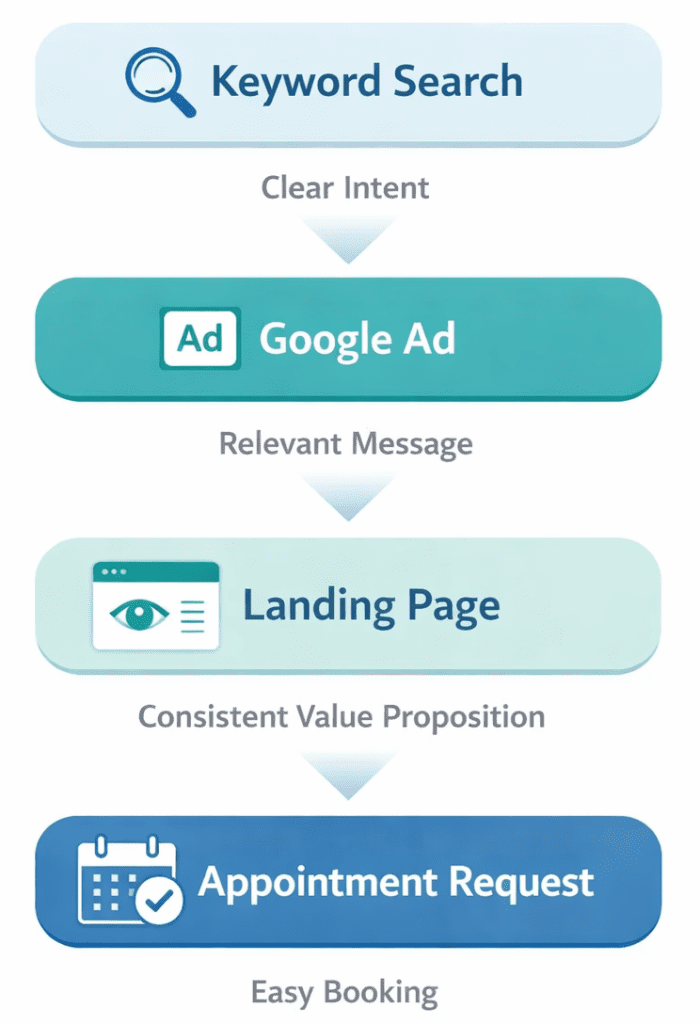
The fourth step is consistency. The same differentiator should appear in the homepage hero, key service pages, ads, local listings, consultation scripts, and follow-up messaging. Google Ads notes that landing page experience improves when the page matches the expectations created by the ad. In other words, if your PPC ad promises “same-week dry eye evaluations,” your landing page should not force users to hunt for that information. Consistent differentiation strengthens both conversion and ad efficiency.
What are examples of weak eye clinic messages versus strong differentiating messages?
A weak message often uses a broad adjective without context. “We use advanced technology” is weak because the patient has no idea what that means for their care. A stronger version is: “Our diagnostic imaging helps us catch issues earlier and show you what we see, so you leave with more clarity about your eye health.” That version connects tool, benefit, and patient experience. AAO, CDC, and NEI all support the value of exams and diagnostics in early detection.
“We provide personalized care” is another common weak statement. A stronger version is: “We take time to explain your results, answer questions, and tailor next steps to your symptoms, risk factors, and daily vision needs.” That is stronger because it demonstrates personalization through explanation and decision support, which aligns with AHRQ and CMS guidance on patient-centered care and communication.
“Experienced team” is also too broad. A stronger message is: “Our team combines clinical experience with clear guidance, so you understand what is happening, what comes next, and when follow-up matters.” Patients often respond better to this kind of wording because it tells them how experience will show up in their visit.
How should eye clinics position technology, doctors, and patient experience without sounding generic?
The best formula is simple: asset, benefit, proof. Start with the real asset, such as diagnostic imaging, subspecialty experience, efficient scheduling, or a stronger education process. Then explain the patient benefit. Then add proof or specificity. That structure prevents messaging from collapsing into empty claims.
For technology, lead with what changes for the patient. For doctors, lead with what kinds of cases or needs they help with most effectively. For patient experience, lead with what the patient will actually notice: easier booking, more time for questions, clearer explanations, smoother follow-up. This approach works because patient experience data from CMS centers on communication and coordination, while Google Ads performance guidance centers on relevance and usefulness. Good messaging sits directly at that intersection.
Can an eye clinic differentiate without being the cheapest or the biggest?
Yes. In fact, competing only on price often weakens positioning because it tells patients to compare clinics as commodities. A more durable strategy is to compete on relevance, clarity, trust, and ease. Google’s healthcare selection data shows that patients weigh reputation, accepted plans, physician recommendations, and technology heavily; that is a broader decision set than price alone.
Smaller clinics can often win by being more specific and more human. They can present a clearer niche, a more personal visit experience, more direct access, or stronger continuity of care. Since eye care often involves prevention, monitoring, and explanation over time, a clinic that communicates those strengths well can feel more valuable than a larger but more generic alternative.
How can eye clinics use differentiation across SEO, PPC, and website content?
For SEO, the biggest opportunity is service-page specificity. Instead of building generic pages about “eye care services,” create pages that answer patient questions and reflect distinct strengths: dry eye evaluations, diabetic eye exams, pediatric eye care, glaucoma monitoring, cataract evaluations, emergency symptom guidance, and similar topics. Because patients use search for general information, evaluation of specific features, and comparison, pages should not just define a service. They should explain why your clinic’s approach is useful and what a patient can expect.
For PPC, differentiation should appear in both the ad and the landing page. Google Ads says responsive search ads work by testing combinations of headlines and descriptions to show more relevant messages to customers, and it recommends providing multiple headline options. It also states that landing page experience depends on usefulness, relevance, ease of navigation, and alignment with the ad. So an eye clinic should test headlines around patient-relevant differentiators such as “Advanced Imaging for Early Detection,” “Dry Eye Care With Clear Treatment Plans,” or “Book an Eye Exam Online Today,” then send clicks to landing pages that immediately confirm those promises.
For the website overall, differentiation should be layered. The homepage should answer why this clinic is worth considering. Service pages should explain why this clinic is a strong choice for that need. Provider pages should turn credentials into patient meaning. Review generation should encourage patients to mention specifics such as clarity, kindness, thoroughness, and convenience, because specifics create more persuasive proof than star ratings alone.
What mistakes weaken an eye clinic differentiation strategy?
One major mistake is copying the language of other clinics. When everyone claims “quality care” and “advanced technology,” nobody stands out. Another mistake is describing features without explaining outcomes. Patients do not always know what an OCT, dilation protocol, or imaging workflow means. They need to know how those things help protect vision, improve understanding, or support earlier intervention.
A second mistake is trying to appeal to everyone with the same message. The more your message broadens, the less it differentiates. A diabetic patient, a parent booking for a child, and a senior worried about glaucoma do not read the same words with the same priorities. Relevance matters in search behavior and in ad performance, which is why more precise messaging usually creates stronger engagement.
A third mistake is inconsistency. If your ad promises convenience but your landing page is confusing, or your homepage emphasizes personal care but your service pages feel cold and generic, trust drops. Google Ads explicitly warns that users are more likely to leave when they do not immediately find what they expected after clicking.
How do you know whether your eye clinic’s messaging is working?
The clearest sign is that better-fit patients begin responding. You may see stronger conversion rates on service pages, more appointment requests from priority services, improved PPC lead quality, and more reviews that mention specifics like thorough explanations, smooth booking, thoughtful staff, or confidence in the exam process. Those signals suggest the market is understanding the clinic more clearly.
You should also watch whether messaging alignment improves campaign efficiency. Google Ads identifies ad relevance and landing page experience as core components of ad quality. When the language in your keyword, ad, and landing page matches the user’s intent and expectations more closely, you give campaigns a better chance to perform efficiently. That does not replace broader business metrics, but it is a useful diagnostic sign that your differentiation is becoming clearer.
What should an eye clinic say to stand out today?
An eye clinic should say what it does differently, why that difference matters to patients, and what makes the claim believable. The strongest message is usually not the most polished one. It is the most patient-relevant one. In eye care, that often means clearer language around early detection, more confidence in diagnosis, more understandable treatment discussions, more convenient access, and a more reassuring visit experience. Those are the themes patients can grasp and act on.
A clinic that sounds trustworthy is usually a clinic that sounds specific. Instead of trying to sound bigger, smarter, or more premium in the abstract, show patients how their experience will be better and why their eye health will be in capable hands. That is the kind of differentiation that is easier to rank, easier to advertise, and easier to convert.
FAQ
What is the best way to differentiate an eye clinic?
The best way is to identify real strengths, connect them to specific patient concerns, and communicate them consistently across your website, ads, and service pages. In eye care, messages around early detection, clear explanations, condition-specific expertise, and convenient access are often more persuasive than vague quality claims because they align with what patients actually evaluate in healthcare experiences.
Do patients care more about technology or experience?
They usually care about both, but in practical terms they care about what technology and experience do for them. Google’s healthcare research shows patients value technology, while CMS and AHRQ show that communication, coordination, and understanding are central to patient experience. The most effective message joins the two: better tools plus clearer, more reassuring care.
Can a small eye clinic compete with larger chains?
Yes. Smaller clinics can compete by being more focused, more specific, and more personal in their positioning. When a clinic clearly addresses a defined patient need and makes the experience easy to understand and book, it can feel more trustworthy and more relevant than a larger but less distinct competitor.
How do you write better messaging for an eye clinic website?
Start with the patient problem, not the clinic feature. Then explain how your approach helps, what the visit includes, and why patients can trust the process. Keep service pages aligned with search intent and make sure ad promises match the landing page. Google Ads guidance supports this kind of relevance and alignment as part of better landing page experience.
What makes an eye clinic feel more trustworthy online?
Specificity, clarity, and proof. Patients respond better to messages that explain what the clinic actually does, how it helps, and what they can expect. Reputation signals, detailed service information, provider credibility, and clear explanations all support trust more effectively than broad praise language.
Should eye clinics promote price or value?
Value is usually the stronger long-term position. Price may matter, but healthcare decisions are also shaped by trust, relevance, reputation, accepted plans, and perceived quality of care. Clinics that explain why their care is worth choosing often create a stronger brand and better-fit patient demand than clinics that lean too heavily on discounts.
Conclusion
An eye clinic stands out when its messaging makes the patient’s decision easier. That means turning internal strengths into external meaning: not just “we have technology,” but “we help detect issues earlier and explain findings clearly”; not just “we care about patients,” but “we take time to answer questions and guide next steps in plain language.” In a market where many clinics sound alike, the most effective differentiation is not louder branding. It is clearer relevance.
For SEO, PPC, and conversion performance, that clarity matters even more. Patients research carefully, compare options, and expect a smooth path from search to booking. The clinics that win are often the ones that communicate real expertise, real reassurance, and real convenience in language patients can understand immediately.
Why Visiclix is Your Ideal Choice for Eye Clinic Differentiation Strategy?
Visiclix is an ideal partner for eye clinics because differentiation in this category is not just a branding exercise. It requires understanding how patients evaluate care, how search behavior shapes provider selection, and how messaging has to hold together across SEO pages, paid ads, landing pages, and conversion paths. A clinic may already have strong technology, skilled doctors, and a patient-first culture, but if those strengths are not translated into clear patient-facing language, the market will not fully recognize them. Visiclix helps close that gap with messaging that is specific, strategic, and built to convert.
What makes Visiclix especially valuable is the ability to align differentiation with demand generation. Strong clinic messaging should not live only on an About page. It should shape service-page SEO, ad headlines, landing page structure, conversion copy, and review strategy. By building around the angles that actually matter to patients, such as clarity, early detection, expertise, convenience, and reassurance, Visiclix can help eye clinics attract better-fit traffic, improve conversion quality, and build a more defensible position in a crowded market.
Choose Visiclix to Build a Smarter Eye Clinic Growth Strategy
If your eye clinic sounds too similar to every other option in your market, the problem may not be your services. It may be your messaging. Visiclix can help you uncover what actually makes your clinic worth choosing, then turn that into sharper SEO content, stronger PPC messaging, and landing pages that convert with more consistency.