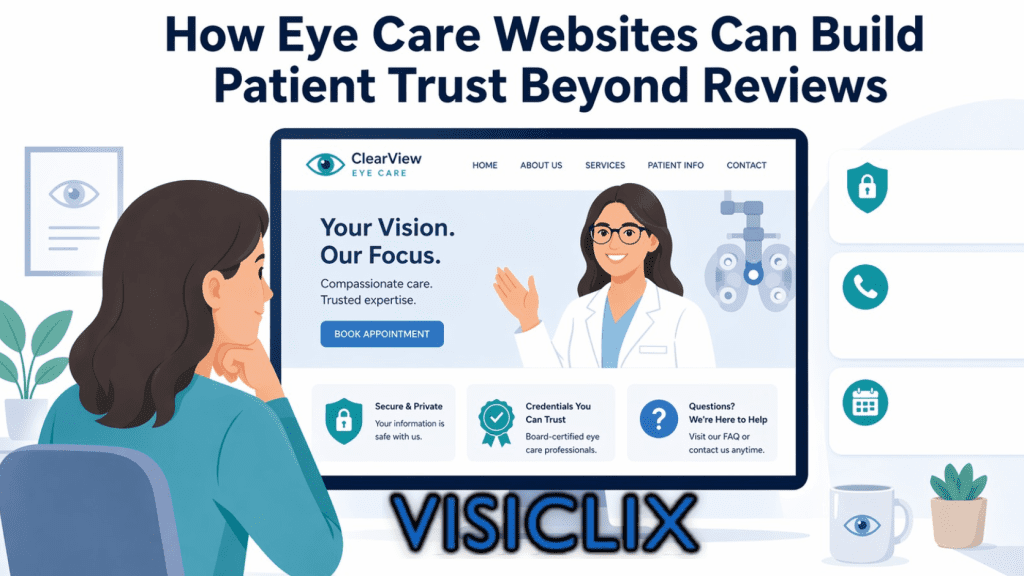
Patient reviews matter, but they are not enough to make an eye care website feel trustworthy.
When someone searches for an optometrist, ophthalmologist, LASIK provider, cataract surgeon, or optical practice, they are not only looking for positive feedback from other patients. They are also asking deeper questions: Is this provider qualified? Is this website secure? Does this practice treat my condition? Will they accept my insurance? What happens after I request an appointment? Can I trust them with my vision?
That is why trust signals for medical websites are so important. In eye care, trust is built through many small details that work together: provider credentials, secure forms, clear service pages, accurate medical content, transparent pricing or insurance information, real practice photos, accessible design, and a simple path to booking.
For eye care practices that rely on PPC, these signals are even more important. Paid visitors often compare multiple providers quickly. If your landing page does not answer their concerns right away, they may leave before calling, booking, or submitting a form.
This guide explains the best trust signals eye care websites should use beyond reviews and testimonials.
What are trust signals for medical websites?
Trust signals for medical websites are the visible credibility, safety, expertise, and transparency cues that help patients feel confident choosing a healthcare provider online.
In healthcare, trust signals carry more weight than they do in many other industries. A patient is not simply buying a product. They may be trying to understand a symptom, choose a doctor, schedule a diagnostic exam, compare treatment options, or decide whether to move forward with surgery. That decision involves health, money, privacy, comfort, and long-term outcomes.
For eye care websites, trust signals should answer four core patient concerns: Can I trust this practice with my eyes? Can I trust the provider’s expertise? Can I trust the information on this website? Can I trust the practice with my personal information?
Examples of trust signals include provider bios, professional credentials, secure appointment forms, HTTPS, medical content review dates, privacy policies, insurance information, real office photos, treatment explanations, accessibility features, and clear contact details.
Google’s guidance on helpful content emphasizes that reliable pages should be created for people first and should demonstrate qualities such as expertise, accuracy, and usefulness. For medical topics, this matters because patients need information that helps them make informed decisions rather than content written only to rank in search results.
Trust signals should not feel decorative. They should reduce uncertainty at key moments in the patient journey.
How are trust signals different from reviews and testimonials?
Reviews and testimonials show that other patients had a positive experience. Trust signals show that the practice is qualified, transparent, safe, and prepared to deliver care.
That distinction matters. Reviews are a form of social proof. They help patients see how others felt about the practice, the staff, the wait time, the communication, or the outcome. But reviews do not always explain whether a provider is licensed for a specific type of care, whether a form is secure, whether the practice treats a particular condition, or what a patient should expect during an appointment.
Trust signals work earlier and deeper in the decision process. They support the patient before they are ready to rely on reviews alone.
For example, a patient considering LASIK may want to know whether the surgeon is experienced, what technology is used, who is a good candidate, what risks exist, and what happens during the consultation. A parent looking for pediatric eye care may want to know whether the provider works with children, what age groups are treated, and how the practice makes young patients comfortable. A person with diabetes may want to know whether the practice provides dilated eye exams and monitors diabetic eye disease.
Reviews can reinforce confidence, but trust signals create the foundation for it.
Why do eye care websites need trust signals beyond reviews?
Eye care websites need trust signals beyond reviews because patients often evaluate clinical risk, cost, convenience, technology, privacy, and provider expertise before deciding to book.
Eye care is unique because it sits at the intersection of medical care, preventive care, retail, and sometimes surgery. A single practice may offer comprehensive eye exams, contact lenses, glasses, dry eye treatment, myopia management, diabetic eye exams, cataract evaluations, glaucoma care, emergency eye care, and LASIK consultations. Each service creates a different type of patient concern.
A routine eye exam patient may care most about insurance, appointment availability, location, and convenience. A cataract patient may care about surgical expertise, lens options, recovery expectations, and outcomes. A dry eye patient may want to know whether the practice offers advanced diagnostics or treatments beyond artificial tears. A diabetic patient may want reassurance that the provider understands the importance of monitoring eye health.
Clinical eye care is also connected to broader health. The CDC notes that people with diabetes are at higher risk for vision loss and eye diseases such as retinopathy, glaucoma, and cataracts, and that yearly dilated eye exams and treatment can help avoid or delay these conditions.
That means eye care websites should do more than promote appointments. They should help patients understand why care matters, what type of provider they need, and how the practice can help.
What provider credentials should an eye care website display?
An eye care website should clearly display each provider’s name, title, license type, specialties, education, clinical interests, and relevant experience.
Credentials are one of the strongest trust signals for medical websites because they help patients understand who is responsible for their care. Eye care can be confusing for patients because optometrists, ophthalmologists, and opticians have different roles. A clear website helps visitors understand whether they are booking with an OD, MD, DO, surgeon, contact lens specialist, optical team, or another care professional.
Strong provider bios should include the provider’s full name, professional designation, education, residency or fellowship training when relevant, board certification when applicable, years of experience, specialties, languages spoken, professional affiliations, and care philosophy.
For example, an optometrist’s bio might highlight experience in dry eye, contact lenses, myopia management, or diabetic eye exams. An ophthalmologist’s bio might highlight cataract surgery, glaucoma care, retina care, or LASIK. A pediatric eye care provider might include experience working with children and families.
The best provider pages explain credentials in patient-friendly language. Acronyms may impress other professionals, but patients need context. Instead of listing “FAAO” without explanation, the page can briefly explain what the designation means and why it matters.
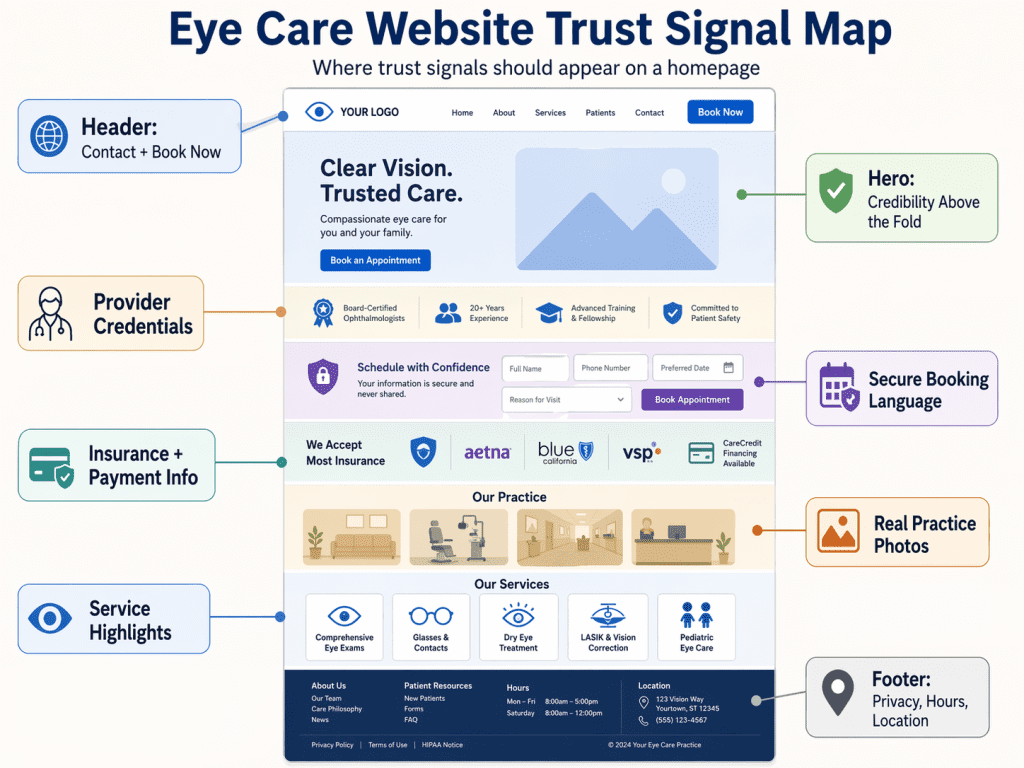
Provider credentials should appear in several places across the website, not only on one biography page. A homepage trust strip, service page sidebar, appointment page reassurance box, and PPC landing page can all use concise credential highlights to support confidence.
How can medical content build trust on an eye care website?
Medical content builds trust when it is accurate, easy to understand, reviewed by qualified professionals, and updated regularly.
Many patients visit an eye care website because they are trying to understand a symptom or condition. They may search for blurry vision, flashes and floaters, eye pain, dry eyes, headaches, double vision, cataract symptoms, diabetic eye exams, or LASIK eligibility. In these moments, content quality becomes a trust signal.
A strong medical content page should answer the patient’s question directly, explain symptoms or treatment options in plain language, clarify when professional care is needed, and avoid exaggerated claims. It should also show who wrote or reviewed the content and when it was last updated.
For eye care websites, this is especially important because symptoms can range from minor to urgent. A page about flashes and floaters, for example, should not casually reassure every reader. It should explain possible causes and encourage prompt evaluation when symptoms may indicate a serious issue. A page about LASIK should not promise perfect vision. It should explain candidacy, consultation requirements, risks, limitations, and realistic expectations.
Google’s quality rater materials identify E-E-A-T as experience, expertise, authoritativeness, and trust, with trust being a central part of page quality evaluation. This is especially relevant for health-related topics, where inaccurate or misleading content can affect important decisions.
For eye care practices, trustworthy medical content should include:
- A clear author or reviewer
- The provider’s credentials
- A last-reviewed or last-updated date
- Plain-language explanations
- Accurate descriptions of symptoms and treatments
- Links or references to credible medical sources
- A disclaimer that online content is educational and not a substitute for diagnosis
Educational content should make patients feel informed, not overwhelmed.
What website design signals make an eye care practice feel credible?
A credible eye care website uses clean design, mobile-friendly layouts, real imagery, readable content, clear navigation, and consistent branding to reduce uncertainty.
Design affects trust quickly. Patients may not consciously analyze a website’s layout, but they notice whether it feels outdated, cluttered, confusing, slow, or generic. In healthcare, those impressions can influence whether a visitor feels safe enough to continue.
Nielsen Norman Group identifies design quality, upfront disclosure, comprehensive and current content, and connection to the rest of the web as lasting credibility factors in web design. These principles are especially useful for medical websites because patients need both a professional first impression and enough information to make a confident decision.
For eye care websites, strong design trust signals include real photos of the doctors, staff, exam rooms, optical area, exterior signage, and diagnostic technology. Stock images can fill space, but they rarely build the same confidence as authentic practice photography.
Navigation should also reflect how patients search. Instead of hiding everything under generic labels, organize services around clear patient needs such as eye exams, glasses and contacts, dry eye treatment, pediatric eye care, diabetic eye exams, LASIK consultations, cataracts, glaucoma, and emergency eye care.
Accessibility is another major trust signal. Eye care websites serve users who may have low vision, visual discomfort, or other accessibility needs. W3C’s Web Accessibility Initiative provides guidance for making digital content more accessible to people with disabilities, including users with blindness, low vision, and other vision impairments.
For an eye care audience, accessibility is not just a compliance consideration. It is part of the patient experience. Readable fonts, strong contrast, descriptive buttons, alt text, keyboard-friendly navigation, and simple forms all communicate that the practice understands the needs of its patients.
How do security and privacy signals affect patient confidence?
Security and privacy signals reassure patients that their personal information, appointment details, and health-related messages are handled responsibly.
Medical website visitors are often asked to submit sensitive information. Even a basic appointment request may include a name, phone number, email address, preferred appointment time, insurance details, symptoms, or reason for visit. If the website does not feel secure, patients may hesitate before completing the form.
At a minimum, an eye care website should use HTTPS, secure forms, a visible privacy policy, and clear language explaining what happens after the form is submitted. Forms should avoid requesting unnecessary sensitive medical information unless the tool is designed and managed appropriately for that use.
The U.S. Department of Health and Human Services provides HIPAA information for healthcare professionals, including rules related to the privacy and security of health information. Healthcare practices should make sure their website forms, patient portals, communications, and vendors are aligned with applicable privacy and security requirements.
Strong security and privacy trust signals include:
- HTTPS across the full website
- Secure appointment request forms
- HIPAA-aware form and communication tools
- A clear privacy policy
- Secure patient portal links
- Secure payment indicators when online payment is available
- Simple explanations of how patient inquiries are handled
- Confirmation messages after form submission
Broken forms, browser security warnings, outdated plugins, and unclear privacy language can damage trust immediately. A patient may not understand the technical details, but they will notice when something feels unsafe.
What transparency signals help eye care patients decide faster?
Transparency signals help patients decide faster by making practical details easy to find before they contact the practice.
Many medical websites lose potential patients because they hide the information people need most. A visitor may like the provider and trust the services, but still leave because they cannot find insurance details, appointment availability, office hours, parking information, financing options, or what to expect as a new patient.
For eye care practices, transparency should cover both clinical and practical concerns.
Patients often want to know:
- What insurance plans are accepted
- Whether medical insurance or vision insurance applies
- Whether self-pay options are available
- Whether financing is offered for LASIK, premium lenses, eyewear, or specialty care
- What happens during a comprehensive eye exam
- How long appointments usually take
- What to bring to the first visit
- Whether contact lens fittings require additional time or fees
- Whether emergency eye care is available
- How quickly the office responds after a form submission
- Where to park
- Which providers are available at each location
This information does not need to make the website feel cluttered. It can be organized into short sections, FAQs, service page callouts, appointment page notes, and dedicated insurance or new patient pages.
Transparency is not only about honesty. It improves lead quality. When patients understand what the practice offers, what the process looks like, and whether the practice fits their needs, they are more likely to book the right appointment.
How can eye care websites show clinical technology without overwhelming patients?
Eye care websites should present technology as a patient benefit, not as a list of equipment names.
Many practices invest in advanced diagnostic and treatment technology. But patients may not understand technical terms such as OCT, retinal imaging, visual field testing, corneal topography, meibography, wavefront mapping, or optical biometry. If the website simply lists equipment names, the information may not build trust.
Instead, connect each technology to a patient benefit.
For example:
“Digital retinal imaging helps us monitor changes in the back of your eye over time.”
“OCT imaging gives your eye doctor a detailed view of the retina and optic nerve.”
“Corneal topography maps the surface of the cornea and can support contact lens fittings, LASIK evaluations, and keratoconus monitoring.”
This approach makes technology easier to understand. It also prevents the website from sounding like it is selling equipment instead of care.
Technology trust signals work best when paired with provider expertise. A machine may help with imaging or diagnosis, but patients still want to know that a qualified doctor is interpreting the results, explaining findings, and recommending next steps.
What trust signals should appear on appointment and contact pages?
Appointment and contact pages should include the strongest conversion-focused trust signals because they appear at the moment patients are deciding whether to act.
Many eye care websites treat the appointment page as a simple form. That is a missed opportunity. The appointment page is one of the most important trust-building pages on the website because the visitor is close to converting.
A high-trust appointment page should include the form, phone number, location, office hours, secure form language, insurance reminder, and a short explanation of what happens after submission. It should also clarify whether the form is for routine requests only and what patients should do for urgent eye symptoms.
For example, a contact page can say:
“After you submit this request, our team will contact you to confirm appointment availability. Please call the office directly if you are experiencing sudden vision loss, eye injury, severe eye pain, or other urgent symptoms.”
That kind of language helps patients understand the process and protects the practice from unclear expectations.
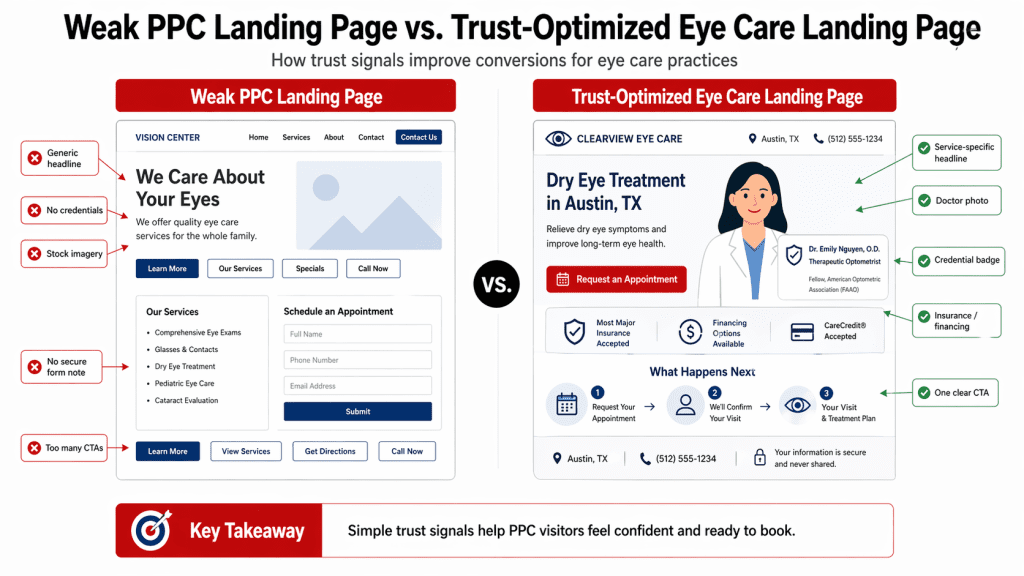
For PPC landing pages, appointment trust signals become even more important. Paid visitors often arrive from a specific ad and may not explore the full website. The landing page must quickly show that the practice is credible, relevant, local, secure, and easy to contact.
How can local trust signals improve eye care website conversions?
Local trust signals make an eye care practice feel established, accessible, and connected to the community it serves.
Eye care is usually a local decision. Patients want to know whether the practice is nearby, easy to reach, and convenient for their schedule. They also want to know whether the practice feels established and legitimate.
Strong local trust signals include real location photos, exterior signage, embedded maps, parking instructions, nearby landmarks, public transit details, office hours, phone numbers, and consistent name, address, and phone information. For multi-location practices, the website should make it easy to see which providers and services are available at each office.
Community involvement can also build trust. Local awards, school partnerships, charity events, health fairs, sponsorships, and community education can help patients feel that the practice is part of the area, not just another listing in search results.
Local trust signals are especially useful for “near me” search traffic and PPC campaigns. A landing page that clearly shows the provider, location, service, phone number, insurance details, and appointment process gives patients fewer reasons to hesitate.
What trust signals matter most for PPC landing pages?
The most important PPC landing page trust signals are immediate relevance, provider credibility, privacy assurance, clear next steps, and friction-free booking.
PPC visitors usually arrive with intent. They may have clicked an ad for “dry eye treatment,” “LASIK consultation,” “eye exam near me,” “cataract evaluation,” or “emergency eye doctor.” Once they land on the page, they need fast confirmation that they are in the right place.
A trust-optimized PPC landing page should match the ad promise. If the ad promotes dry eye treatment, the page should focus on dry eye care, not a generic homepage. If the ad promotes LASIK consultations, the page should explain candidacy, consultation steps, provider expertise, technology, financing, and realistic expectations.
The strongest trust signals should appear above the fold. These may include the service name, provider or practice credibility, location, appointment CTA, phone number, insurance or financing note, and a short reassurance statement.
The page should also avoid unnecessary distractions. PPC landing pages work best when they guide visitors toward one clear action, such as calling, booking, or requesting an appointment.
For eye care PPC campaigns, useful landing page trust signals include:
- Provider credentials related to the advertised service
- Real practice or doctor photos
- Secure form language
- Clear location details
- Insurance or financing information
- Simple “what happens next” steps
- A concise explanation of the service
- FAQs that address common objections
- A strong CTA
How can an eye care website combine trust signals into a better patient journey?
An eye care website should place the right trust signal at each stage of the patient journey, from first impression to appointment request.
Trust should not live on one page. It should be layered across the entire website so patients feel supported wherever they enter.
On the homepage, highlight the practice’s core services, providers, location, reputation, and appointment path. This page should quickly answer who the practice helps and why patients can feel confident choosing it.
On service pages, explain the condition, treatment, exam, or procedure in detail. Include provider expertise, technology, candidacy, risks or limitations where relevant, insurance or payment notes, and FAQs.
On provider pages, show credentials, specialties, education, experience, photos, and care philosophy. These pages are especially important for patients who want to know who will examine, diagnose, or treat them.
On insurance and payment pages, explain accepted plans, financing, self-pay options, and the difference between medical and vision insurance when appropriate.
On appointment pages, use secure forms, phone numbers, location details, response expectations, and urgent-care guidance.
On educational blog pages, include author or reviewer information, credible sources, update dates, and clear disclaimers.
On PPC landing pages, combine the most persuasive trust signals into a focused conversion path. The page should match the ad, reassure the visitor, and make the next step obvious.
When these signals work together, the website becomes more than an online brochure. It becomes a patient confidence system.
FAQ
What are examples of trust signals for medical websites?
Examples of trust signals for medical websites include provider credentials, secure forms, HTTPS, privacy policies, medical reviewer details, real clinic photos, insurance information, professional affiliations, accessible design, clear appointment instructions, and accurate educational content.
For eye care websites, strong trust signals also include service-specific provider experience, technology explanations, diabetic eye exam information, LASIK or cataract consultation details, optical policies, and clear guidance for urgent eye symptoms.
Are patient reviews enough to build trust online?
No. Patient reviews are helpful, but they are not enough to build complete trust online.
Reviews show what other people experienced, but patients still need proof of expertise, safety, privacy, transparency, and convenience. A patient may read five-star reviews and still hesitate if the website does not show provider credentials, accepted insurance, appointment instructions, secure forms, or clear treatment information.
Where should trust signals appear on an eye care website?
Trust signals should appear throughout the website, including the homepage, provider pages, service pages, appointment page, PPC landing pages, footer, insurance page, and educational content.
The most important trust signals should appear near high-intent actions. For example, secure form language and response expectations should appear beside appointment forms. Provider credentials should appear on service pages. Insurance and payment clarity should appear before the patient is asked to book.
What trust signals help LASIK or cataract patients most?
LASIK and cataract patients usually need trust signals related to provider expertise, technology, eligibility, risks, outcomes, financing, and consultation steps.
Helpful signals include surgeon credentials, realistic outcome language, clear candidacy criteria, explanations of diagnostic testing, descriptions of available technology, financing options, and a step-by-step explanation of what happens before and after the procedure.
How do trust signals improve PPC performance?
Trust signals improve PPC performance by reducing hesitation after the click. When visitors immediately see that the landing page is relevant, credible, secure, and easy to act on, they are more likely to call, book, or submit a form.
Trust signals can also improve lead quality. Patients who understand the service, provider, location, insurance details, and next steps are more likely to submit informed appointment requests.
What is the most overlooked trust signal on eye care websites?
The most overlooked trust signal is clear process information.
Many eye care websites explain what services they offer, but they do not explain what happens next. Patients want to know how to book, what to bring, how long the visit may take, whether insurance is accepted, when they will hear back, and what to do if symptoms are urgent. Clear process information makes the experience feel safer and easier.
Conclusion
The best eye care websites do not rely on reviews alone. Reviews can support credibility, but patients need more than social proof before trusting a provider with their vision, personal information, time, and money.
Strong trust signals for medical websites include provider credentials, accurate medical content, secure forms, privacy language, accessible design, transparent insurance information, real practice photos, local details, technology explanations, and clear appointment instructions.
For eye care practices, these trust signals should be built into the full patient journey. A homepage should create a strong first impression. Service pages should answer clinical questions. Provider pages should prove expertise. Appointment pages should reduce hesitation. PPC landing pages should deliver immediate relevance and confidence.
When trust signals are used strategically, an eye care website becomes more than a digital brochure. It becomes a conversion-focused experience that helps patients feel informed, reassured, and ready to book.
Why Visiclix is Your Ideal Choice for Trust Signals for Medical Websites?
Visiclix understands that eye care websites need more than attractive design to convert visitors into patients. A successful medical website must communicate credibility, clarity, privacy, and professionalism from the first click. By combining patient-focused content, conversion strategy, and trust-building design, Visiclix helps eye care practices create websites that support both patient confidence and business growth.
For practices investing in PPC, Visiclix can help align ad messaging, landing page structure, and website trust signals so visitors immediately understand why the practice is relevant and reliable. This matters because paid traffic moves quickly, and every missing detail can create hesitation. With the right strategy, Visiclix helps eye care providers turn more clicks into qualified appointment requests.
Build a More Trustworthy Eye Care Website With Visiclix
Ready to turn more website visitors into confident patient bookings?
Visiclix can help you build eye care websites and PPC landing pages that communicate trust, clarity, and value from the first click. Strengthen your digital presence with a website designed to reassure patients, support conversions, and help your practice grow.