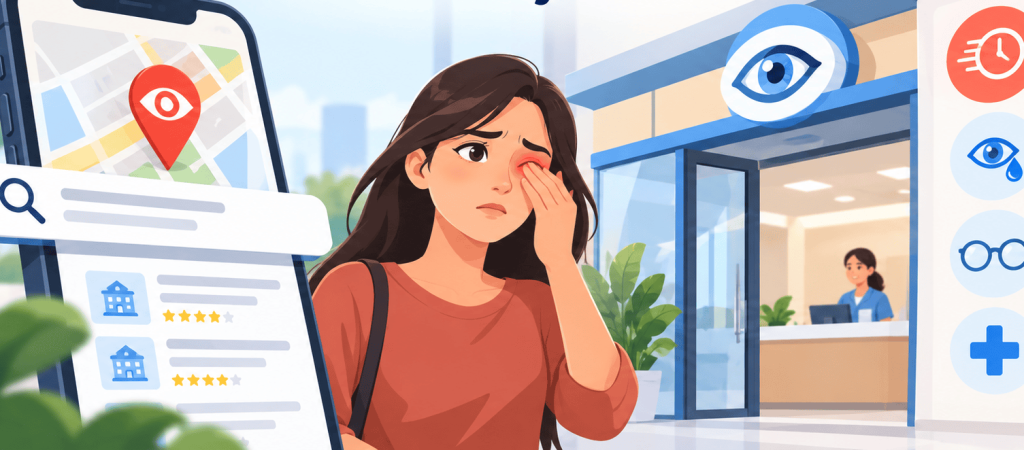
Eye clinics should build an urgent eye care page around what a patient needs to know before deciding where to get care today. That means making same-day availability, clinic hours, location, urgent services, appointment options, and the fastest way to contact the practice immediately clear.
Effective urgent eye care SEO is not simply a matter of adding phrases such as “emergency eye doctor” or “urgent eye care near me” throughout a page. The page has to match a time-sensitive search with accurate information and an obvious next step. Especially on mobile.
For an eye clinic, the goal is straightforward: help the searcher quickly determine whether the practice is available, appropriate for the problem, nearby, and able to provide the care they need.
What Search Intent Should an Urgent Eye Care Page Target?
An urgent eye care page should primarily target local, appointment-oriented searches that indicate someone may be looking for care soon, often the same day.
Examples can include searches such as “urgent eye doctor near me,” “same day eye appointment,” “eye doctor open today,” “eye pain doctor near me,” and “red eye appointment.” These searches carry a different intent from questions such as “Why is my eye red?” or “What causes eye pain?”
That distinction matters when planning the site. Visiclix’s guide to SEO keyword mapping for eye care services recommends assigning different keyword themes to the pages that best match their intent. Appointment-ready service terms generally belong on service pages, while informational questions can be handled through supporting educational content.
Avoid building several nearly identical urgent-care pages just to target slight keyword variations. A strong primary page can cover the core urgent-care intent while supporting articles address distinct patient questions.
Google also explains that local results are mainly influenced by relevance, distance, and prominence. Clinics therefore need more than keyword repetition. Their website and business information should clearly communicate what care is available and where the practice is located.
What Should Patients See Before They Scroll?
Patients should be able to understand the most important urgent-care details almost immediately.
The top portion of the page should clearly identify the urgent eye care service and display the clinic’s current hours, location, phone number, and appointment options. If same-day appointments are actually available, say so clearly. If walk-ins are accepted, explain that too.
A useful first screen may include:
- A clear urgent eye care heading
- Same-day availability when accurate
- Current clinic hours
- Address or location
- Click-to-call functionality
- Appointment or scheduling button
- Brief description of urgent problems evaluated
- Walk-in information if applicable
- A short emergency-care warning when appropriate
Accuracy is essential. Google recommends maintaining complete and current business information, including address and opening hours, because that information helps users understand where a business is and when they can visit. Google can also use website information as one of the sources for Business Profile data.
How Should Clinics Organize Symptoms Without Turning the Page Into a Medical Encyclopedia?
Clinics should briefly explain the symptoms and situations they are equipped to evaluate, then use separate educational pages for deeper medical information.
Depending on the practice’s actual clinical capabilities, examples might include red or irritated eyes, eye discomfort, foreign-body concerns, contact-lens-related problems, flashes or floaters, sudden changes in vision, or eye injuries.
The wording must reflect what the clinic can genuinely assess and manage. Some eye symptoms require immediate medical attention rather than routine scheduling. For example, the National Eye Institute identifies sudden new floaters with flashes or a curtain-like shadow as potential signs of retinal detachment, which requires immediate evaluation. MedlinePlus also advises urgent medical care for problems such as sudden vision changes, painful red eyes, penetrating injuries, and chemical exposure.
This is where content architecture becomes useful. A page about symptom-based SEO for optometrists can help a practice capture searches from people who do not yet know which service they need. Those educational pages can then guide appropriate readers toward the urgent eye care service page.
In other words, the symptom article answers the question. The urgent-care page helps the patient take action.
How Should Eye Clinics Structure the Page for Urgent Eye Care SEO?
Eye clinics should give the page one clear search purpose and organize every major element around helping a patient evaluate and access urgent care.
Start with a descriptive title tag and one clear H1. Follow it with a concise introduction that answers what the clinic offers, then explain symptoms or situations the clinic evaluates, same-day scheduling procedures, hours, provider information, location details, and what the patient should do next.
This is also where urgent eye care SEO needs restraint. More keyword mentions do not automatically make a page more useful. Google recommends people-first content that answers the visitor’s needs comprehensively rather than content created primarily to manipulate rankings.
Keep informational and appointment-driven content distinct. Visiclix’s guide to eye care service pages versus blog posts explains why commercial searches generally belong on service pages while question-based searches are better suited to supporting educational content.
A clean structure also reduces the risk of multiple URLs competing for essentially the same intent.
How Should Google Business Profile and the Website Support Each Other?
The website and Google Business Profile should provide consistent information about where the clinic is located, when it is open, and how patients can take action.
Google recommends keeping Business Profile information complete and accurate, including the address, business category, and hours. It also says local rankings are largely based on relevance, distance, and prominence.
For urgent searches, small inconsistencies can create big problems. Imagine a patient seeing “open” in Google, clicking through to the website, and discovering different hours. Or finding a same-day care page but no clear way to call.
Where eligible, Google Business Profiles can also contain links that allow customers to take actions such as booking appointments.
Make sure special and holiday hours stay current. And never use phrases such as “open now,” “same-day appointments available,” or “emergency care available” unless the practice can support those claims.
What Trust and Safety Signals Should an Urgent Eye Care Page Include?
An urgent eye care page should make it clear who provides the care, what the practice can evaluate, and when the information was reviewed.
Useful trust elements can include provider credentials, author or reviewer information, a last-reviewed date, accurate treatment scope, insurance or payment guidance, and clear instructions for situations outside the clinic’s capabilities.
Health content deserves particular care. Google describes health and safety topics as areas where strong signals of experience, expertise, authoritativeness, and trust are especially important. It also states that trust is the most important element within its E-E-A-T framework.
Clinical review can help catch inaccurate symptom descriptions, inappropriate treatment claims, and missing safety context before publication. Visiclix explains this process further in its guide to clinician-reviewed eye care content.
No dramatic promises. No vague claims that every urgent problem can be treated in-office. Clear boundaries can make the page more useful and more credible.
How Can Clinics Tell Whether the Page Is Producing Same-Day Patients?
Clinics should measure patient actions in addition to organic rankings.
Useful metrics include organic visits to the urgent-care page, phone calls, appointment submissions, click-to-call actions, conversion rate, device performance, and visibility for urgent local queries.
Search terms can reveal another layer. If a page receives impressions for same-day searches but few clicks, its title or search positioning may need improvement. If it generates traffic but few calls or bookings, the problem may be the page experience, unclear availability, weak calls to action, or a mismatch between the searcher’s needs and the clinic’s services.
Ultimately, search visibility is valuable when it contributes to patient acquisition. Visiclix’s SEO services for optometrists and ophthalmologists take that broader approach by combining search visibility with website experience and conversion performance.
What Should Eye Clinics Know About Same-Day Search Visibility?
Should an eye clinic create a separate urgent eye care page?
Usually, yes, if urgent eye care is a genuine service with different patient needs from routine eye exams. A dedicated page gives the clinic space to explain availability, symptoms evaluated, scheduling procedures, and urgent-care limitations without crowding a general services page.
Is urgent eye care the same as emergency eye care?
Not always. The terms may be used differently by practices, and certain eye problems require immediate emergency evaluation. Clinics should clearly define their capabilities and tell patients when they should seek emergency medical care instead of waiting for an office appointment.
Should urgent eye care pages target “near me” keywords?
They can address local intent without repeatedly inserting the words “near me.” Accurate location information, service relevance, Business Profile data, and the searcher’s distance from the clinic all contribute to local discovery. Google specifically identifies relevance, distance, and prominence as its main local ranking factors.
Can an urgent eye care page rank for symptom searches?
Yes, it may appear for some symptom searches, but broader informational questions are often better supported by dedicated educational content. That allows the service page to remain focused on patients deciding where to seek care.
How often should urgent eye care information be updated?
Review it whenever hours, providers, appointment procedures, services, insurance information, or care capabilities change. Time-sensitive details deserve particular attention because inaccurate information can affect whether a patient decides to contact or visit the clinic.
Is Your Urgent Eye Care Page Ready for the Patient Who Needs Help Today?
The strongest urgent-care page is not the one that repeats the most emergency-related keywords. It is the one that quickly gives a patient reliable answers.
Can someone using a phone tell where the clinic is? Whether it is open? Whether same-day care may be available? What kinds of concerns the clinic evaluates? How to call or schedule?
If those answers are difficult to find, the page still has work to do.
For eye clinics, better same-day visibility comes from aligning search intent, local information, trustworthy health content, and a fast route to care. Every element should reduce uncertainty and help the patient make an appropriate next decision.
Why Visiclix is Your Ideal Choice for Urgent Eye Care SEO?
Visiclix specializes in digital marketing for optometrists, ophthalmologists, and eye care practices, giving its team direct experience with the way patients search for eye care services. That industry focus supports more precise keyword mapping, service-page planning, local SEO, and content architecture. Rather than treating urgent eye care like another generic local-service keyword, Visiclix can build strategies around the search behavior and conversion paths that matter to eye care practices.
Visiclix also looks beyond rankings alone. Strong urgent eye care SEO should connect visibility with page usability, accurate information, calls, appointments, and measurable patient acquisition. By bringing SEO, website strategy, paid search, and conversion thinking together, Visiclix can help eye clinics turn high-intent searches into meaningful opportunities for practice growth.
Help Same-Day Patients Find Your Practice With Visiclix
Patients looking for urgent eye care are often making decisions quickly. Your website should make that decision easier.
Work with Visiclix to evaluate your urgent-care search visibility, improve the pages that patients find, and build a clearer path from search to appointment.