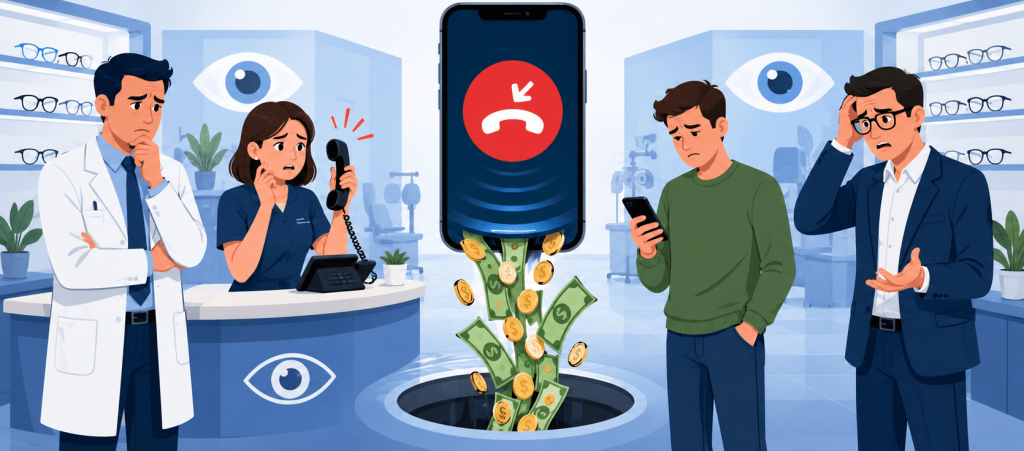
Yes, missed calls can waste your eye care marketing budget because every unanswered call breaks the path from ad click to booked appointment. Your PPC campaigns, SEO work, Google Business Profile visibility, and referral traffic may be creating real patient demand, but if those patients reach voicemail, wait too long on hold, or never receive a fast callback, the marketing spend still happens while the appointment opportunity disappears.
For eye care practices, this problem is especially expensive because many high-intent patients still prefer to call before booking. A person searching for an eye exam, LASIK consultation, cataract evaluation, dry eye treatment, contact lens fitting, or urgent eye concern is often ready to act. If that person calls and cannot reach your team, they may not wait. They may call the next provider in the search results.
This is why missed-call performance should be treated as a marketing metric, not only a front-desk issue. Google Ads allows advertisers to measure phone calls from ads as conversions, and Google specifically notes that call conversion measurement can help advertisers understand how well keywords, ads, ad groups, and campaigns are working for the business. That means unanswered calls can directly distort how a practice evaluates PPC ROI.
The missed calls medical practice marketing problem is simple: your campaigns may be producing demand, but your lead-handling system may not be capturing it. Before increasing ad spend, eye care practices should make sure the phone funnel can answer, track, route, follow up, and convert the calls already being generated.
What Are Missed Calls in Medical Practice Marketing?
Missed calls in medical practice marketing are any phone inquiries that fail to become a useful scheduling conversation. This includes calls that go unanswered, callers who hang up while on hold, voicemails that do not receive timely follow-up, after-hours inquiries without a recovery workflow, calls routed to the wrong location, and conversations that answer a patient’s question but never guide the patient toward booking.
In eye care, a missed call is often the first major leak after a successful search interaction. The patient may have already searched locally, compared reviews, checked insurance details, visited the website, read about a service, and then decided to call. At that point, the practice has already done much of the hard marketing work. The call is where patient intent should become a scheduled appointment.
That is why “missed call” should not be defined too narrowly. A call can be technically answered but still mishandled if the patient is transferred repeatedly, placed on a long hold, told to call back later, or not offered a clear next step. From a marketing ROI perspective, the question is not only whether someone picked up the phone. The question is whether the call became a booked, kept, revenue-producing visit.
For example, a LASIK lead may call after clicking a paid search ad. A cataract patient’s adult child may call during lunch to ask about evaluation availability. A parent may call after searching for a pediatric eye exam. A contact lens patient may call to ask about insurance or appointment timing. Each caller represents a different revenue path, but all of them depend on the same basic conversion moment: the practice has to capture the call.
Why Do Missed Calls Hurt Eye Care Practices More Than They Appear To?
Missed calls hurt eye care practices because they erase demand the practice already paid to create. A missed phone inquiry is not just a lost conversation. It can represent a lost exam, a lost optical purchase, a lost treatment plan, a lost referral, and a lost long-term patient relationship.
The immediate loss is the appointment that never gets scheduled. In an optometry setting, that may be a comprehensive eye exam, contact lens fitting, dry eye evaluation, myopia management consultation, or eyewear-related visit. In ophthalmology, it may be a cataract evaluation, glaucoma visit, retina referral, oculoplastics consultation, or surgical inquiry. These are not interchangeable with casual website visits. They are high-intent actions from people who are already trying to reach care.
The downstream loss is often larger. Comprehensive eye exams are a core access point for eye health, vision correction, and the detection of eye disease or related systemic issues. The American Optometric Association describes comprehensive eye exams as a key preventive way to preserve vision and assess eye health. The American Academy of Ophthalmology also publishes age-based guidance for comprehensive medical eye examinations, reinforcing that eye care access is not a one-time transaction.
There is also a brand trust loss. A patient who cannot reach the practice may assume the office is too busy, disorganized, or difficult to work with. Even if that assumption is unfair, it shapes behavior. In healthcare, access problems are often felt before the patient ever meets the provider. Experian Health’s 2024 patient access survey found a gap between provider perception and patient experience: 55% of providers said access improved, while only 28% of patients agreed.
For eye care practices investing in marketing, that trust gap matters. A polished ad, strong landing page, and five-star local reputation can still lose momentum if the patient’s first live interaction is a missed call.
How Do Missed Calls Waste PPC Budget for Eye Care Practices?
Missed calls waste PPC budget by turning paid clicks into unconverted phone leads. In a healthy paid search funnel, a patient sees an ad, clicks or taps to call, reaches the practice, talks with a trained team member, books an appointment, keeps the visit, and eventually generates revenue. If the phone rings but no one captures the patient, the campaign still spends money, but the business result disappears.
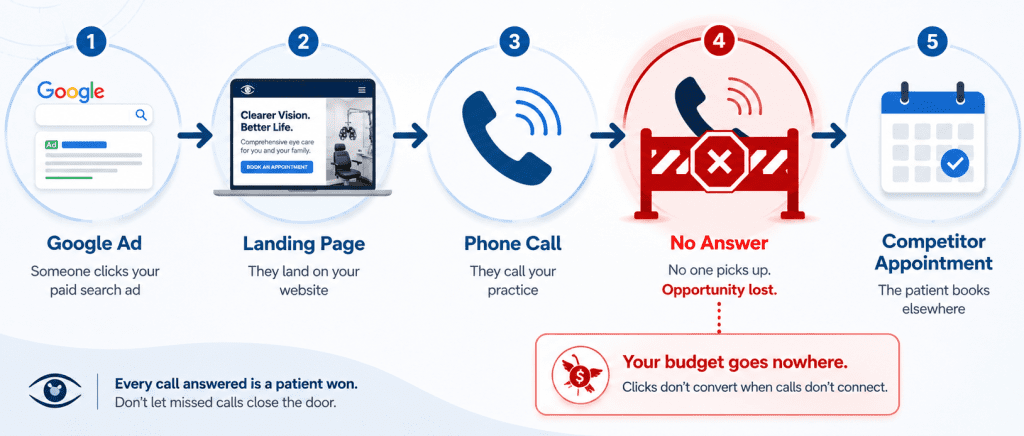
This is especially important in eye care because many PPC campaigns target high-intent searches. Someone searching for “LASIK consultation near me,” “cataract surgeon,” “dry eye specialist,” “emergency eye doctor,” or “eye exam appointment” may be much closer to booking than someone casually browsing general eye health content. When those clicks lead to phone calls, call handling becomes part of PPC performance.
Healthcare clicks are not free or casual. LocaliQ’s healthcare search advertising benchmarks reported an overall healthcare search ads average cost per click of $5.64, with opticians, glasses, and contacts showing their own benchmark data across cost per lead, cost per click, and cost per call. Benchmarks vary by market, competition, service line, and campaign quality, but the principle is consistent: every wasted call is attached to real media spend.
Google Ads call conversion measurement makes this connection measurable. Google explains that advertisers can track calls from call or location assets, count calls based on minimum duration, and use call conversion data to support automated bidding strategies such as Target CPA and Target ROAS. For an eye care practice, that means the call should not be treated as the finish line. It should be tracked through to appointment quality and business value.
Where Do Eye Care Leads Leak After the Phone Rings?
Eye care leads leak after the phone rings when the practice cannot answer, route, prioritize, or follow up with callers fast enough. The leak may happen before a staff member ever speaks to the caller, or it may happen during the conversation if the caller is not moved toward the right next step.
Peak-hour call volume is one of the most common leakage points. Many patients call before work, during lunch, or late in the afternoon. Those are also times when front-desk teams may be handling check-ins, checkouts, insurance questions, optical pickups, contact lens orders, and in-person patient needs. When everyone is busy, the phone becomes the easiest thing to lose.
After-hours demand is another problem. Many working adults cannot call during clinic hours. A cataract patient’s caregiver may research providers after dinner. A LASIK prospect may compare practices on the weekend. A parent may look for a pediatric appointment after school activities. If the only option is voicemail, the practice needs a fast recovery process or the inquiry may go cold.
Multi-location practices face additional leakage. A patient may click an ad for one location but call the central number. A caller may ask for a provider who works at a different office. A scheduling team may not know which location has the earliest availability for a specific service. Without clear routing and visibility, the caller’s intent can decay while the team searches for answers.
Google Business Profile can also create call leakage if the practice tracks visibility but not outcomes. Google’s Business Profile performance reporting shows how customers use Search and Maps to find a profile and what actions they take, including clicks and other interactions. That is useful, but practices still need to connect those actions to answered calls, appointment requests, and booked visits.
How Much Revenue Can Missed Calls Cost an Eye Care Practice?
The revenue cost of missed calls depends on call volume, missed-call rate, appointment intent, booking rate, visit value, and downstream patient value. There is no honest universal number that applies to every eye care practice. A routine exam, premium lens sale, dry eye treatment plan, LASIK consultation, cataract evaluation, and retina referral all carry different business value.
The better approach is to use a simple leakage calculator. Start with total monthly inbound calls. Multiply that by the percentage of calls missed, abandoned, or sent to voicemail. Then estimate what percentage of those callers were likely trying to book, reschedule, or ask about a high-value service. From there, apply your normal phone booking rate and average appointment value.
Here is a practical formula:
Monthly missed calls:
Total monthly calls × missed-call percentage = missed calls
Lost appointment opportunities:
Missed calls × appointment-intent percentage × expected booking rate = estimated lost appointments
Immediate lost revenue:
Estimated lost appointments × average first-visit value = estimated immediate revenue leakage
Expanded lost value:
Estimated lost appointments × first-year or lifetime patient value = broader growth leakage
For example, imagine an eye care practice receives 1,000 inbound calls per month and misses or fails to recover 12%. That is 120 missed call opportunities. If half of those callers had appointment intent and the practice normally books 60% of qualified appointment calls, that could represent 36 missed appointments in a month. The exact financial impact depends on the practice’s services, payer mix, optical capture, procedure mix, and patient retention.
The optical market context makes this worth measuring carefully. The Vision Council reported that the U.S. optical industry reached $17.4 billion in market value for Q2 2025, including categories such as eye exams, eyeglasses, frames, lenses, contact lenses, readers, and plano sunglasses. Its Q2 2025 report also noted that exam market value was 14% higher than Q2 2024 even though exam volume declined year over year.
For an individual practice, that means every missed appointment opportunity may affect more than one revenue category. A single missed comprehensive exam could also mean lost eyewear, contact lenses, follow-up care, family referrals, and future annual visits.
Why Do Eye Care Practices Miss Calls Even When the Front Desk Is Working Hard?
Eye care practices often miss calls because call demand and front-desk capacity do not match. The issue is usually not effort. It is workflow pressure. A small team may be expected to greet patients, verify insurance, manage check-ins, handle checkouts, answer clinical routing questions, support optical traffic, process payments, respond to portal messages, and answer every call in real time.
That workload is especially intense in eye care because many patient questions are not simple. Patients may ask whether their medical or vision insurance applies, whether they need a referral, whether a symptom requires urgent care, whether a specific provider treats their condition, whether contact lenses are in stock, whether glasses are ready, or whether a procedure consultation is covered. Each call can require judgment, system access, and time.
This creates a structural problem. Marketing can increase demand faster than the front desk can absorb it. A successful PPC campaign may drive more calls into the exact hours when the office is already overloaded. A high-performing Google Business Profile may create a spike in local calls, but if the practice does not adjust staffing or routing, more visibility simply creates more leakage.
The solution is not to blame staff. The better solution is to design lead handling around real call patterns. That includes knowing when calls spike, which service lines produce the most valuable inquiries, which locations miss the most calls, how long callbacks take, and whether the team has scripts that make scheduling easier.
Practices should also separate clinical urgency from marketing opportunity without letting either one get lost. A caller with flashes and floaters needs different handling than a caller asking about LASIK financing. Both calls matter, but they should not compete in an unstructured queue where the loudest or most persistent caller gets attention first.
How Should Eye Care Practices Track Missed Calls From Google Ads, SEO, and Local Listings?
Eye care practices should track missed calls by connecting each call to its source, campaign, landing page, location, service line, call outcome, and appointment status. Without this connection, the practice may know that the phone rang, but not whether marketing created a profitable patient opportunity.
For Google Ads, call conversion tracking should be configured correctly. Google’s documentation explains that phone call conversions can help advertisers measure how effectively ads with call or location assets lead to phone calls. It also notes that advertisers can use minimum call duration or Google AI analysis of call recordings to identify higher-quality leads. For medical practices, call recording and AI analysis should be reviewed carefully with privacy, consent, and compliance requirements in mind before use.
For website calls, dynamic number insertion can help attribute calls to campaigns, channels, or landing pages. A visitor from a LASIK ad, cataract SEO page, dry eye campaign, or Google Business Profile listing may all call the same practice. If every channel uses the same untracked number, the practice may not know which marketing efforts produce the best phone leads.
For Google Business Profile, tracking should include both profile performance and downstream outcomes. Google states that Business Profile performance data helps owners understand how people discover the profile and what actions they take on Search and Maps. Google also allows businesses to manage local business links that help customers take actions such as booking an appointment. Those actions are valuable only if the practice tracks whether the patient actually books and shows.
The most useful call-tracking setup does not stop at “call received.” It should classify calls into meaningful outcomes: booked appointment, existing patient question, insurance question, optical inquiry, wrong number, vendor call, missed call, abandoned hold, voicemail, callback completed, and callback not completed. Over time, this gives the practice a real view of where the funnel leaks.
For multi-location eye care groups, call tracking should be reviewed by location and service line. A campaign may look weak overall but perform very well for cataract calls at one location. Another location may generate plenty of calls but fail to book them because of staffing gaps or scheduling limitations. The marketing strategy should respond to those differences.
What Call Handling Metrics Should Eye Care Practices Monitor?
The most important call handling metrics for eye care practices are missed-call rate, answer rate, speed to answer, hold abandonment, callback time, booking rate, and cost per booked appointment. These metrics show whether marketing-generated demand is turning into real patient access.
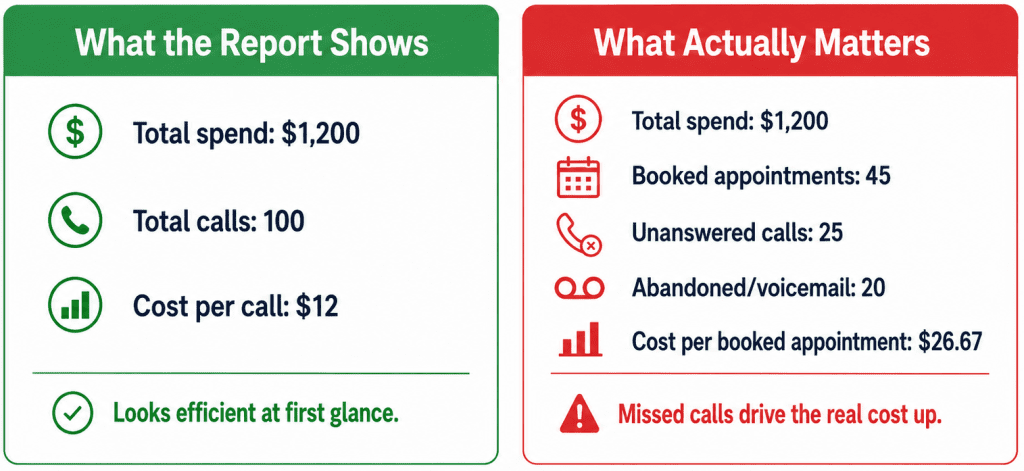
Traditional PPC reports often emphasize impressions, clicks, click-through rate, cost per click, conversions, and cost per lead. Those numbers matter, but they do not show whether the front desk converted the opportunity. A campaign can generate a strong call volume and still underperform if calls are unanswered, abandoned, or not scheduled.
Eye care practices should monitor total inbound calls, missed calls, abandoned calls, average speed to answer, average hold time, after-hours call volume, callback time, call source, call reason, new patient versus existing patient mix, booked appointment rate, no-show rate, and revenue per booked call. The most useful metric is often not cost per call. It is cost per booked and kept appointment.
A practice should also review call data by time of day. If calls spike from 8:00 to 10:00 a.m., during lunch, or after 4:00 p.m., staffing and routing should reflect that. If after-hours calls frequently come from LASIK, cataract, or urgent care campaigns, those service lines may deserve special coverage or faster recovery workflows.
Marketing and operations teams should review these metrics together. If PPC spend rises but booked appointments do not, the problem may not be ad quality. It may be call handling. If call volume rises but callback completion is weak, the practice may need a better missed-call recovery system before launching more campaigns.
How Can Eye Care Practices Reduce Missed Calls Without Overloading Staff?
Eye care practices can reduce missed calls by improving coverage, routing, callbacks, scripts, online booking, and campaign timing. The goal is not to ask the same team to do more with less. The goal is to design a system that captures high-intent demand more reliably.
Start with call pattern analysis. Identify the days and hours with the highest missed-call volume, longest hold times, and weakest booking rates. Then align staffing around those periods rather than spreading coverage evenly across the day. Even small schedule adjustments can help if they are based on actual call data.
Next, improve routing. A new LASIK inquiry should not move through the same path as a glasses pickup question. A cataract evaluation should not be lost in a general queue if the practice has a surgical counseling team. A multi-location group should make it easy to identify which office can serve the patient fastest. Routing should reduce friction, not add transfers.
Fast callback rules are also essential. A missed call should trigger a defined workflow: who owns it, how quickly it must be returned, what script is used, whether text follow-up is allowed, and how the outcome is recorded. A classic Harvard Business Review article on online sales leads found that many companies fail to respond fast enough to internet-generated leads, supporting the broader principle that speed matters when prospects are actively comparing options.
Online booking can help, but it should not be treated as a complete replacement for phone handling. A 2024 Journal of Medical Internet Research study found that online appointment booking awareness and use vary by patient and practice characteristics, and that older patients in the study preferred the telephone. In eye care, many patients still call because they have insurance questions, symptoms, procedure concerns, or provider-specific questions that a booking form cannot fully answer.
Practices should also consider campaign scheduling. If the office cannot answer calls after hours, it may be worth adjusting call-focused PPC campaigns, adding after-hours lead capture, or routing high-value service-line calls to a trained response team. Spending aggressively when no one can answer is one of the fastest ways to turn marketing budget into leakage.
When Should an Eye Care Practice Reevaluate Its Marketing Funnel?
An eye care practice should reevaluate its marketing funnel when call volume is rising but appointments, consultations, or revenue are not increasing proportionally. This is the clearest sign that the practice may not have a demand-generation problem. It may have a demand-capture problem.
One warning sign is high PPC spend with flat appointment volume. If ads are generating clicks and calls but the schedule is not filling, the practice should review call recordings, missed-call logs, callback speed, landing page phone behavior, and booked appointment rates. Cutting the campaign too quickly may hide the real problem. Increasing the budget may make the leak worse.
Another warning sign is patient feedback. If patients say they tried to call but could not reach anyone, that feedback should be treated as funnel data. The same applies to online reviews that mention phone frustration, hold times, unanswered calls, or scheduling difficulty. Those comments often reveal the patient experience more clearly than internal assumptions.
Multi-location inconsistency is another reason to reevaluate the funnel. One location may answer quickly and book efficiently while another misses calls during peak hours. One provider’s service line may convert well while another receives many inquiries but few scheduled visits. Without source-level and location-level reporting, the practice may average away the problem.
A funnel review should also happen before major budget increases. If a practice plans to scale PPC for LASIK, cataracts, dry eye, myopia management, emergency eye care, or routine exams, it should first confirm that call tracking, scheduling workflows, staff coverage, and follow-up systems can handle the added demand.
How Can Eye Care Practices Turn More Calls Into Booked Appointments?
Eye care practices can turn more calls into booked appointments by treating every phone inquiry as part of the patient acquisition funnel. That means the call should be captured, answered quickly, handled with intent, documented clearly, and connected back to marketing performance.
The first step is source visibility. The practice should know whether a call came from Google Ads, organic search, Google Business Profile, referral traffic, a landing page, direct traffic, or another campaign. Without source visibility, marketing decisions are based on incomplete information. With source visibility, the practice can identify which campaigns produce appointment-ready calls.
The second step is conversation quality. Staff should be trained to identify the caller’s intent, answer the immediate question, and guide the patient toward the right appointment. A good phone conversation is not pushy. It is helpful, clear, and scheduling-oriented. For example, instead of only answering, “Yes, we take that insurance,” the team can follow with, “Let’s find the right appointment type and location for you.”
The third step is outcome tracking. A call should be marked as booked, not booked, existing patient issue, insurance question, clinical triage, optical inquiry, voicemail, abandoned, or follow-up needed. This allows the marketing team to distinguish between low-quality call volume and valuable appointment demand.
The fourth step is recovery. Missed calls should not disappear into a general voicemail box. They should enter a visible queue with ownership, timing standards, and documented outcomes. If the caller does not answer the callback, the practice may need an approved text follow-up or second attempt workflow.
The fifth step is optimization. Once calls are connected to appointments and revenue, the practice can make smarter decisions. It can invest more in campaigns that produce booked patients, adjust ads that produce unqualified calls, change landing pages that create confusion, and improve staffing where demand is strongest.
FAQ
How many missed calls is too many for an eye care practice?
Any missed call from a new patient, paid ad, referral source, or high-value service line deserves attention. The practical goal is not perfection. The goal is to identify patterns, reduce preventable misses, and recover valuable calls quickly. A practice should review missed calls by time of day, service line, location, and source so the team can fix the biggest leaks first.
Do missed calls affect Google Ads performance?
Yes. Missed calls can make Google Ads look less profitable because the campaign may generate the click or call interaction, but the practice fails to capture the appointment. Google Ads call conversion measurement can help advertisers understand how ads, keywords, ad groups, and campaigns are driving phone calls, and that data can support ROI-focused bidding strategies.
Should eye care practices use voicemail for new patient calls?
Voicemail is better than losing the caller completely, but it should not be treated as a complete lead-handling system. A high-intent patient may keep searching and call another provider before your team returns the message. If voicemail is used, it should feed into a fast, tracked callback workflow.
What is the best way to track missed calls from PPC campaigns?
The best approach is to combine Google Ads call conversion tracking, website call tracking, campaign-level attribution, and appointment outcome reporting. The practice should know which campaign generated the call, whether the call was answered, what the caller wanted, whether the appointment was booked, and whether the patient showed up.
Can online booking solve missed-call problems?
Online booking can reduce friction for some patients, but it does not eliminate phone demand. Some patients prefer online scheduling, while others need help with symptoms, insurance, appointment type, provider selection, location options, or procedure questions. Research on online appointment booking shows that patient use varies by age, health status, practice factors, and awareness, so phone access and online booking should work together.
Why do eye care practices miss calls during business hours?
Eye care practices often miss calls during business hours because the front desk is balancing phone calls with in-person patients, insurance verification, optical questions, check-ins, checkouts, referrals, records, and clinical coordination. The problem is usually capacity and workflow, not effort. Call data can show where staffing, routing, and follow-up need improvement.
Conclusion
Missed calls are not a small administrative issue for eye care practices. They are a hidden growth problem that can drain the value of PPC, SEO, Google Business Profile visibility, referrals, and local search demand. When a high-intent patient calls and cannot reach the practice, the marketing budget has already done its job, but the funnel has failed to capture the opportunity.
The most successful eye care marketing systems do not stop at generating traffic or calls. They track what happens after the phone rings. They measure answer rate, missed-call rate, callback speed, booking rate, cost per booked appointment, and revenue from phone leads. That gives the practice a clearer view of whether growth is being created, captured, or quietly lost.
Before increasing ad spend, eye care practices should make sure their lead-handling system can support the demand they already have. Better phone visibility, faster follow-up, smarter routing, stronger scheduling conversations, and campaign-level call tracking can turn more search intent into booked care.
Why Visiclix is Your Ideal Choice for Eye Care Marketing?
Visiclix understands that growth in eye care does not stop at clicks, impressions, or website traffic. A successful campaign must connect search intent to real patient action, which means tracking how leads move from Google Ads, local search, landing pages, and phone calls into booked appointments. That makes missed-call visibility a core part of smarter medical practice marketing, not an afterthought.
For eye care practices, Visiclix helps align marketing strategy with lead-handling performance so growth does not leak at the front desk. By focusing on PPC quality, conversion tracking, call-source visibility, and funnel improvement, Visiclix helps practices understand where opportunities are being lost and how to recover them. The result is a more accountable marketing system built around booked appointments, stronger ROI, and sustainable patient growth.
Stop Letting Missed Calls Drain Your Eye Care Growth With Visiclix
Your marketing may already be creating patient demand. Make sure your practice is capturing it. Partner with Visiclix to identify where calls, leads, and appointments are leaking from your eye care marketing funnel—and turn more high-intent searches into booked patients.