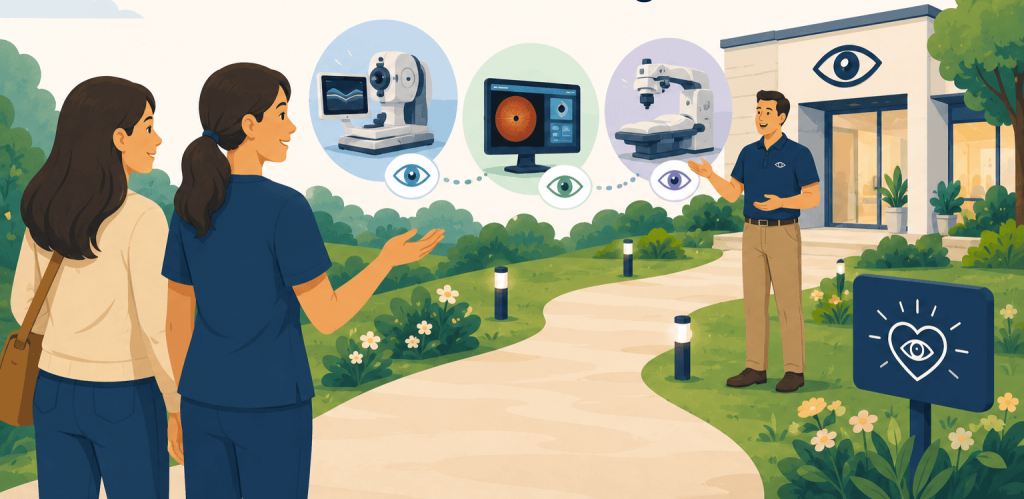
Eye care practices can market advanced technology effectively by focusing first on what the technology means for the patient—not on specifications, model names, or complicated clinical terminology. A strong eye care technology marketing strategy translates sophisticated capabilities into simple benefits, explains what patients can expect, and provides more detail only when it helps someone make an informed decision.
That matters because even impressive equipment can become difficult to appreciate when the marketing reads like a product manual. AHRQ recommends plain language in healthcare communication because even people who understand complex terminology generally require less effort to process simpler wording.
The goal, then, is not to make advanced technology sound basic. It is to make its value obvious.
Why Does Technical Marketing Often Create More Questions Than Confidence?
Technical marketing becomes confusing when the practice asks patients to understand the equipment before telling them why they should care.
Consider messaging such as “next-generation multimodal imaging with enhanced resolution.” It may be technically meaningful to an eye care professional, but a patient could still wonder: What does this do for me? Is the exam uncomfortable? Why would my doctor recommend it?
That is the communication gap.
Instead of leading with specifications, begin with the problem the technology helps the practice evaluate, monitor, or address. Then explain the technology in plain language. CDC health-literacy guidance supports communication approaches that use plain language alongside written information, verbal explanations, or demonstrations to improve understanding.
Also avoid leaning too heavily on phrases such as “cutting-edge,” “revolutionary,” or “the latest technology.” They sound impressive, but without context, they give patients little information about the actual experience or benefit.
What Do Patients Actually Need to Know About New Eye Care Technology?
Most patients do not need an engineering-level explanation. They need answers to four practical questions:
- What does this technology help the doctor examine, measure, monitor, or treat?
- Why could that matter to my eye care?
- What should I expect during the appointment?
- Why does this practice use the technology?
Take optical coherence tomography, or OCT, as an example. The National Eye Institute explains OCT in straightforward terms as a test in which an eye doctor takes pictures of the inside of the eye with a special machine. A patient-facing page can build from that simple foundation instead of immediately diving into wavelengths, scan patterns, or hardware specifications.
Technical details can still have a place farther down the page for patients who want them. The key is information hierarchy: benefit first, explanation second, deeper detail third.
And claims need discipline. The FTC states that health-related advertising claims require appropriate substantiation, so practices should avoid implying that a device guarantees a diagnosis, treatment result, or superior clinical outcome unless the claim can be properly supported.
How Can Eye Care Technology Marketing Turn Complex Features Into Clear Patient Benefits?
A useful framework is:
Feature → Meaning → Patient Benefit → Proof
Suppose a practice has invested in advanced retinal imaging.
Feature: Detailed retinal imaging capability.
Meaning: The equipment gives the doctor additional images of structures inside the eye.
Patient benefit: The doctor has more information available when evaluating or monitoring appropriate eye-health concerns.
Proof: Explain how the practice uses the technology, what the appointment involves, and which patients may be candidates.
The difference is subtle but important.
Instead of saying:
“Our office now offers the XYZ-5000 ultra-high-resolution imaging platform.”
Try:
“Our retinal imaging technology gives your eye doctor detailed images of structures inside your eye, providing additional information that can support your examination when appropriate.”
Now the technology has context.
The same framework works for diagnostic systems, laser technology, digital measurement devices, telehealth tools, AI-supported technologies, and specialty-treatment equipment. Start with the human question—Why should I care?—and then provide the technical explanation.
Where Should Practices Explain Technology Across the Patient Journey?
The amount of information should change depending on how close the patient is to making a decision. That is where eye care technology marketing becomes more effective than repeating the same technical description everywhere.
PPC and Search Ads
Keep search ads focused. One relevant patient need, one understandable benefit, and one logical next step.
Someone searching for a specific eye condition, procedure, or diagnostic service should not have to decode the technology before understanding the offer. Google Ads specifically recommends keeping landing pages closely aligned with the ad and keyword because users are more likely to leave when they do not immediately find what they expected.
Practices running campaigns can use specialized Google Ads management for eye care practices to align targeting, messaging, landing pages, and conversion goals.
Website and Landing Pages
A website provides room to educate.
Lead with a patient-centered headline, explain the technology in everyday language, add a short “what to expect” section, answer common questions, and provide an obvious appointment action.
Good website design and hosting for eye care practices can also make those explanations easier to navigate across phones, tablets, and desktops. For organic visibility, practices can connect technology-focused service pages with an appropriate eye care SEO strategy so patients can find relevant information when researching their options.
Social Media and Video
Some technologies are easier to show than describe.
A short clip of an eye doctor explaining the purpose of a device can feel far more approachable than several paragraphs of specifications. Practices can use social media marketing for brief education and video advertising to demonstrate the patient experience visually.
Keep it simple. What it does. What patients experience. Why the practice uses it.
How Can Practices Use Proof Without Making Technology Sound Intimidating?
Technology becomes more credible when it is paired with human expertise.
Show the doctor explaining the equipment. Include authentic practice photography. Create a short “what happens during the test?” video. Answer the questions patients commonly ask at the front desk.
Patient reviews can reinforce trust as well, particularly when they naturally speak to communication, comfort, professionalism, or the overall experience. A structured reputation management strategy can help practices monitor and manage that feedback.
There are boundaries. The FTC requires endorsements and testimonials used in advertising to be truthful and not misleading, and advertisers need to consider whether a testimonial creates claims about results or typical experiences.
In other words, let technology support the story. Do not make it responsible for promises it cannot independently guarantee.
How Can Practices Tell Whether Their Technology Messaging Is Working?
Measure actions, not just visibility.
A technology campaign may generate impressions, but the more important question is whether qualified patients move closer to scheduling. Monitor landing-page engagement, click-through rate, appointment conversions, calls, completed forms, cost per qualified lead, and the questions prospective patients ask.
Google recommends evaluating Quality Score alongside metrics such as click-through rate, conversion rate, and site engagement rather than treating one metric as the full picture.
Testing can reveal what patients understand best. Compare a feature-led ad with a benefit-led version, for example, while keeping the rest of the campaign reasonably consistent.
Small changes. Measurable results. Clearer decisions.
What Are Common Questions About Marketing Eye Care Technology?
Should every new eye care technology be featured in marketing?
No. Promote technology when it supports a patient need, differentiates a meaningful service, or helps explain the quality and experience of care. Equipment that has little relevance to patient decision-making may not need a major campaign.
How much technical detail should patients see online?
Give patients enough information to understand what the technology does, why it may be used, and what they can expect. Additional clinical or technical details can appear farther down the page for readers who want to explore them.
Can advanced technology help differentiate an eye care practice?
Yes, but technology alone is rarely the complete differentiator. The stronger message connects the equipment with the practice’s clinical expertise, patient experience, communication, and approach to care.
Which marketing channels work best for explaining eye care technology?
Websites and landing pages work well for detailed explanations, while search ads capture active intent. Video and social content can make unfamiliar equipment easier to visualize. The strongest mix depends on the service, target patient, and campaign goal.
What Should Your Practice Do Next?
Review one of your current technology pages or advertisements and ask a simple question:
Does this tell patients what our equipment is, or does it clearly explain why they should care?
If the answer is mostly specifications, start translating. Lead with the patient’s concern. Explain the practical value. Show what the experience looks like. Then give interested patients a clear way to learn more or request an appointment.
Advanced technology can strengthen your practice’s story without dominating it. Patients do not need to become experts in your equipment. They need enough clarity to feel confident taking the next step.
Why Visiclix Is Your Ideal Choice for Eye Care Technology Marketing?
Visiclix specializes in digital marketing for optometrists, ophthalmologists, and eye care practices, allowing campaigns to be built around the way eye care patients actually search and evaluate providers. Its digital marketing services for eye care include PPC, SEO, web design, reputation management, social media, display advertising, and video marketing. That industry focus can help practices turn sophisticated services into messaging centered on relevant patient questions rather than generic healthcare advertising.
Just as importantly, Visiclix can connect those messages across multiple patient touchpoints. Search ads can introduce the benefit, landing pages can explain it, video can demonstrate the experience, and reputation-building efforts can reinforce trust. Visiclix also states that its approach uses measurable digital strategies and real-time performance tracking to help eye care practices evaluate results.
Ready to Make Advanced Care Clearer With Visiclix?
Your practice invested in advanced technology for a reason. Make sure prospective patients can understand that reason.
Contact Visiclix for a free consultation and explore how clearer, patient-focused digital campaigns can turn sophisticated eye care services into messages that inform, reassure, and encourage action.