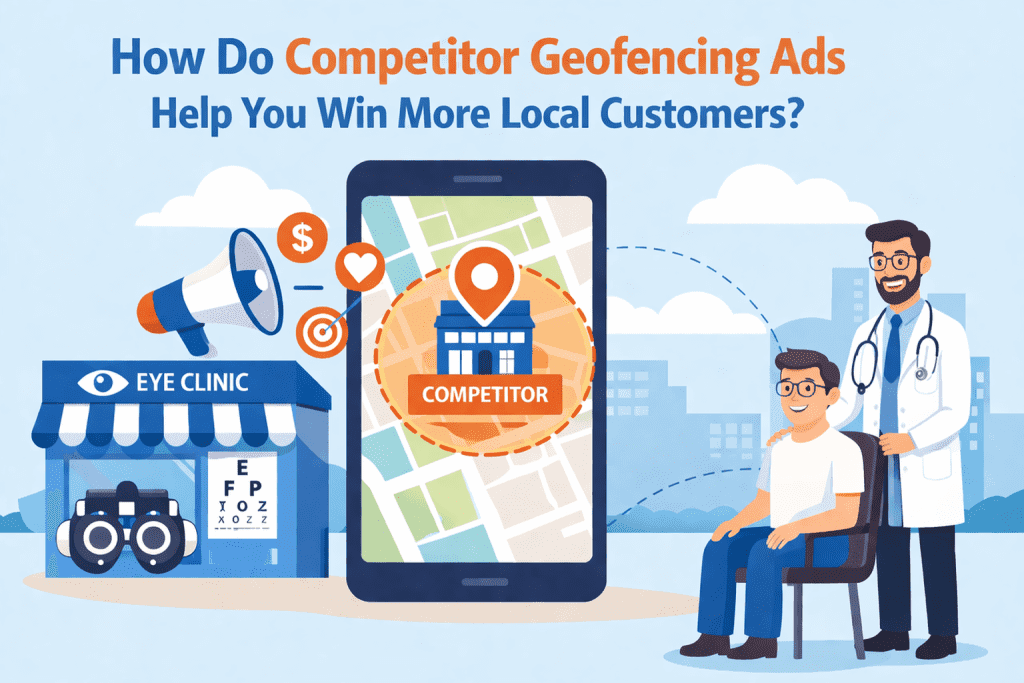
Competitor geofencing ads help you reach people who are physically near, inside, or recently connected to a competing location, then serve them ads designed to influence the next step in their buying journey. In practice, that makes geofencing a useful conquesting tactic for local brands that want to intercept active demand instead of waiting for prospects to discover them on their own. Salesforce defines geofencing marketing as creating virtual boundaries around real-world areas and triggering marketing actions when a mobile device enters or exits those boundaries.
That does not mean every geofencing campaign is automatically efficient. Google notes that location targeting relies on multiple signals and is a “best effort,” not a guarantee of perfect precision, which is why campaign structure, exclusions, and performance review matter so much. The businesses that win with competitor geofencing usually pair tight location strategy with strong offers, relevant creative, and landing pages built to convert.
What Are Competitor Geofencing Ads?
Competitor geofencing ads are location-based display ads used to target consumers who enter, dwell near, or recently visited a competitor’s store, office, event venue, or other physical point of interest. The goal is simple: put your brand in front of people who have already shown real-world buying intent, not just passive browsing behavior.
You will also see this tactic called geo-conquesting. In everyday marketing usage, the two terms are often treated as near-synonyms. Creative Solutions describes geo-conquesting as location-based mobile advertising that directs consumers toward a business while they are physically in a competitor’s location, which matches how most advertisers use the phrase in the field.
How Do Competitor Geofencing Ads Work?
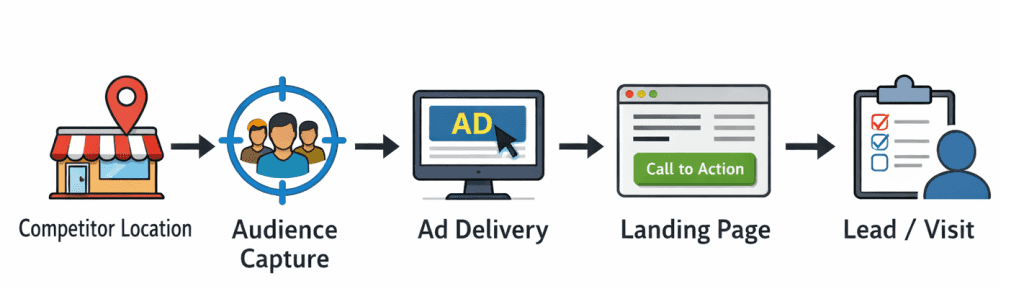
The process usually starts with competitor selection. A campaign team identifies the rival locations, event venues, parking lots, or surrounding trade areas that matter most, then builds virtual boundaries around those areas. Salesforce explains that geofencing commonly relies on GPS, Wi-Fi, or cellular data to define those boundaries and trigger actions when a device enters or exits them.
After that, the campaign serves ads to the captured audience during the visit window or afterward, depending on the platform and data method. Creative Solutions highlights both real-time and post-visit digital targeting as part of conquesting, while Feathr’s event playbook shows a simpler version: choose the competitor event venue, define the campaign dates, and run mobile ads while that audience is gathered.
The final step is where many campaigns either pay off or fall apart: the click destination and measurement setup. Google’s official Display guidance stresses conversion tracking and measuring the full value of Display, which means your ads should point to a dedicated landing page and your reporting should capture outcomes like calls, forms, appointments, or store visits rather than clicks alone.
Why Do Businesses Use Competitor Geofencing Ads?
Businesses use competitor geofencing because it puts advertising in front of people who are already in-market. A person standing at a competitor dealership, clinic, gym, or event venue is often much closer to a decision than someone who merely fits a demographic profile. Silver Spoon’s conquesting examples make this point directly, arguing that the tactic works because it reaches customers close to the final stage of the buying journey.
This tactic is also attractive because it complements, rather than replaces, other PPC channels. Paid search captures declared intent when someone types a query. Competitor geofencing can influence that same buyer before the search, between searches, or while they are physically comparing providers. Google’s location-targeting documentation and Display optimization guidance support that broader view of location-aware audience strategy.
Are Competitor Geofencing Ads the Same as Geo-Conquesting?
For most practical purposes, yes. “Competitor geofencing ads” describes the tactic in plain language, while “geo-conquesting” is the more specialized industry term often used for targeting competitor locations specifically. The distinction is usually more about wording than campaign mechanics.
Where marketers get confused is assuming all location targeting is conquesting. It is not. Google location targeting can include countries, cities, radius targeting, and location groups such as places of interest or business locations. Geo-conquesting is narrower: it is a competitive use case within the wider location-targeting family.
When Do Competitor Geofencing Ads Work Best?
Competitor geofencing works best when the market is local, the buyer is comparison-shopping, and your offer gives them a clear reason to switch. That is why this tactic often fits industries like automotive, fitness, healthcare, restaurants, retail, home services, and multi-location brands. Silver Spoon’s dealership example is especially telling because car buyers commonly visit multiple lots before deciding, making conquesting a natural fit.
It also performs well when timing matters. Feathr’s event-focused example shows how a campaign can capitalize on concentrated audience moments, while Silver Spoon recommends aligning conquesting efforts with competitors’ peak business hours to maximize impact. In other words, the tactic is strongest when demand is already gathering somewhere physical and visible.
What Makes a Competitor Geofencing Campaign Effective?
Precision is the first lever. Broad fences create waste, especially in dense commercial areas where one competitor sits next to unrelated businesses. Creative Solutions argues that more precise location methods help marketers isolate a specific store or parking lot without overlapping other businesses, and Google separately reminds advertisers that location signals are not perfectly accurate, which makes disciplined targeting even more important.
Message is the second lever. Feathr’s playbook recommends keeping the creative focused on the one thing a new audience should understand in two seconds, whether that is a differentiator, a testimonial, or a compelling offer. Silver Spoon similarly emphasizes that the value proposition has to be strong enough to make someone reconsider their immediate plan.
The third lever is conversion design. Google’s Display guidance recommends setting up conversion tracking early and measuring beyond surface metrics. In practice, that means a conquesting ad should lead to a page that matches the ad promise, reduces friction, and offers a clear action such as book now, get a quote, claim an incentive, or schedule a visit.
How Do You Build a Competitor Geofencing Strategy That Converts?
Start with the right competitors. Do not target every rival in your market just because you can. Target the ones whose customers overlap most with your ideal buyers, whose locations draw meaningful traffic, and whose offer you can credibly beat. Kobe Digital’s page repeatedly references competitor-location analysis and recency targeting, which points in the right direction, but the stronger strategic principle is selectivity.
Then decide how tight the fence should be. Google’s own radius targeting for location campaigns starts at 1 km, which is useful context for broad platform settings, but conquesting often needs tighter operational thinking than a generic local radius. Salesforce’s geofence setup guidance for its own product recommends at least 150 meters as a practical radius baseline in that environment, which underscores the broader point: fence size should match the site, surrounding density, and likelihood of spillover traffic.
Next, align the creative with the moment. Someone at a competitor location does not need a vague brand-awareness ad. They need a reason to care now: better pricing, faster service, a stronger guarantee, a more convenient location, superior inventory, or a limited-time incentive. Feathr’s examples center on fast message recognition, while Silver Spoon’s conquesting examples show why timing plus incentive can shift decisions close to purchase.
Finally, send traffic to a landing page built for this audience segment. Google’s Display documentation emphasizes conversion tracking and optimizing for performance; the practical extension is message match. If the ad promises a trade-in bonus, consultation, discount, or comparison advantage, the landing page should make that benefit obvious immediately.
What Are the Biggest Mistakes to Avoid With Competitor Geofencing Ads?
The biggest mistake is assuming location alone creates relevance. It does not. A weak offer aimed at the right location can still fail. Feathr explicitly frames geofencing as top-of-funnel awareness in many cases, which means advertisers should be realistic: not every exposed user will convert right away, and some campaigns are better judged by awareness and assisted actions than by last-click sales alone.
Another common mistake is using poor measurement. The Media Rating Council’s location-based advertising guidelines were created to improve definitions, disclosures, controls, and research quality for location-based measurement, which is a reminder that visitation and location metrics require rigor rather than blind trust. If your reporting vendor cannot explain methodology, attribution windows, invalid-traffic controls, and data limitations, you should be cautious.
A third mistake is ignoring privacy and sensitive-location risk. The FTC has recently emphasized that location data is sensitive personal information and has pursued cases involving the sale or misuse of data tied to visits to medical facilities and places of worship. NAI’s 2024 updated standards likewise prohibit participating members from using, selling, or transferring U.S. precise location information tied to sensitive points of interest such as religious sites, certain health care treatment centers, correctional facilities, and schools or childcare locations.
Can Competitor Geofencing Ads Improve ROI?
Yes, they can improve ROI when the campaign reaches a genuinely relevant audience and drives them into a credible conversion path. Google explicitly says location targeting can help businesses focus ads and improve ROI, and its Display best-practice guidance pairs that with conversion tracking and optimization. The key is not geofencing by itself; the key is disciplined execution.
The best way to think about ROI here is relative efficiency. Compared with broad display awareness, competitor geofencing can reduce waste because the audience has already signaled intent through physical behavior. Compared with search, it can create earlier influence. Compared with retargeting, it can reach people before they ever visit your site. Those are strategic advantages, but they only become profitable when matched with strong targeting, relevant creative, and honest measurement.
How Do You Measure Success With Competitor Geofencing Ads?
Success should be measured in layers. At the top, impressions and reach matter because geofencing often introduces your brand to new, qualified audiences. Feathr explicitly calls impressions a key metric for top-of-funnel geofencing campaigns, especially in event settings.
The middle layer is engagement: click-through rate, engaged sessions, calls, map opens, quote requests, and landing-page conversion rate. The bottom layer is business impact: booked appointments, qualified leads, store visits, test drives, consultation requests, or revenue. Google’s official guidance to set up and routinely test conversion tracking is central here, because conquesting campaigns should be judged by measurable actions, not vanity metrics.
Are Competitor Geofencing Ads Better Than Paid Search?
Not better across the board, just different. Paid search is usually stronger when someone already knows what they want and actively searches for it. Competitor geofencing is stronger when you want to influence buyers in the physical world before, during, or between those intent signals.
| Channel | Intent type | Timing | Strengths | Limitations | Best-fit use cases |
|---|---|---|---|---|---|
| Organic Search / SEO | Active intent | Mid to long term | Captures people already looking, builds compounding visibility, strong trust | Slower to ramp, dependent on competition and content quality | Evergreen lead generation, local discovery, educational content, service pages |
| Paid Search / PPC | Active intent | Immediate to short term | Fast visibility, precise targeting, measurable conversions, good for high-intent traffic | Costs scale with competition, stops when budget stops, needs active optimization | Lead generation, urgent campaigns, location/service targeting, offer testing |
| Social Media (Organic) | Passive to interest-based intent | Ongoing / mid to long term | Builds brand familiarity, community, repeat touchpoints, supports trust | Lower direct conversion intent, algorithm dependence, requires consistency | Brand awareness, thought leadership, culture content, audience nurturing |
| Social Media Ads | Passive to demand-generation intent | Immediate to short term | Strong audience targeting, scalable reach, creative testing, retargeting support | Often lower intent than search, creative fatigue, ongoing spend required | Awareness campaigns, retargeting, lead magnets, event promotion, offer amplification |
| Email Marketing | Warm / known-audience intent | Immediate and ongoing | High ROI, direct communication, strong nurture and retention channel | Needs list quality, deliverability management, limited for new audience acquisition | Lead nurture, re-engagement, newsletters, promotions, client retention |
| Website / Landing Pages | Conversion intent | Immediate once live | Central conversion hub, measurable UX, flexible messaging, supports all channels | Needs traffic from other channels, weak pages reduce results across campaigns | Booking pages, lead capture, campaign destinations, service explanations |
| Google Business Profile / Local Listings | Local active intent | Short to mid term | Strong local visibility, map exposure, review support, high commercial intent | Limited customization, depends on review quality and profile upkeep | Local discovery, calls/directions, reputation support, nearby service searches |
| Content Marketing / Blogs | Informational intent | Mid to long term | Supports SEO, builds authority, answers buyer questions, reusable across channels | Slow payoff, requires consistent production and strategy | Top-of-funnel education, GEO/SEO support, FAQs, trust-building resources |
| Video / Podcast | Passive to educational intent | Mid to long term | Strong authority and trust, high engagement, repurposable content | Higher production effort, weaker direct-response performance by itself | Education, brand building, expert positioning, audience nurturing |
| Referral / Review Channels | Trust-based intent | Ongoing | High credibility, strong conversion support, boosts local performance | Harder to scale directly, depends on client experience and follow-through | Reputation building, social proof, local conversion support, warm lead conversion |
| Retargeting | Warm intent | Short term | Re-engages interested users, improves conversion efficiency, reinforces messaging | Requires existing traffic volume, can feel repetitive if overused | Cart/lead recovery, website visitor follow-up, multi-touch campaigns |
A Comprehensive Comparison Table.
The strongest local acquisition programs often use both. Search captures demand when it is verbalized. Geofencing helps shape demand when it is still situational and location-driven. For many Visiclix clients, the smarter question is not “which one wins,” but “how do these channels work together to move more local buyers into action?” That is usually where the best performance gains appear. This last point is an inference based on how Google separates campaign goals, audience reach, and measurement across location-targeted and Display programs.
Who Should Use Competitor Geofencing Ads?
This tactic is a strong fit for brands with clear local competition, strong differentiation, and a measurable conversion path. That includes local service businesses, multi-location retailers, dealerships, clinics, gyms, restaurants, and event marketers. It is especially effective where buyers compare providers before making a decision.
It is a weaker fit for businesses with unclear offers, poor landing pages, no tracking discipline, or products that require little local comparison. If you cannot explain why a prospect should choose you over the nearby competitor, geofencing will not solve that strategic problem for you.
Conclusion
Competitor geofencing ads can be a smart conquesting tactic because they target real-world intent, not just abstract audience categories. When used well, they help local businesses show up at exactly the moment a buyer is comparing options, visiting a competitor, or attending a rival event.
But the tactic works best when the fundamentals are right: precise targeting, persuasive offers, landing pages that match the message, careful measurement, and privacy-aware execution. Businesses that treat competitor geofencing as a strategic channel rather than a gimmick are the ones most likely to turn location-based advertising into real local growth.
FAQ
How small should a competitor geofence be?
There is no universal ideal size. Google’s radius targeting starts at 1 km for its own location settings, while other platforms and tools may support much tighter boundaries. The right answer depends on the property layout, nearby businesses, and how much spillover traffic you can tolerate.
Can competitor geofencing ads target events as well as stores?
Yes. Feathr’s competitor-event playbook is a clear example of using geofencing around a rival venue to reach a concentrated audience during event dates.
How long after a competitor visit can ads be shown?
That depends on the provider, platform, and data method. Some approaches support real-time ad serving, while others also allow post-visit targeting windows.
Do competitor geofencing ads only work on mobile devices?
Mobile is central because location signals are often device-driven, but the overall campaign can extend beyond the moment of mobile exposure depending on the platform and audience strategy. Creative Solutions, for example, describes both on-location and post-visit targeting approaches.
Are competitor geofencing ads privacy-compliant?
They can be, but only when the data source, consent practices, and sensitive-location rules are handled properly. FTC enforcement and NAI standards both show why advertisers need to be careful with precise location data, especially around sensitive points of interest.
How much do competitor geofencing ads cost?
Pricing varies widely based on market size, inventory, audience volume, creative needs, and measurement setup. The more useful question is whether the campaign can deliver an efficient cost per qualified action, not the lowest media rate.
Can competitor geofencing ads work for B2B companies?
Yes, especially for conferences, trade shows, dealerships, distributors, and location-based B2B buying environments. Feathr’s competing-event example is effectively a B2B-compatible conquesting use case.
Why Visiclix Is Your Ideal Choice for Competitor Geofencing Ads?
Visiclix is built for the part of geofencing that matters most: turning local intent into measurable action. A strong conquesting campaign is not just about drawing circles on a map. It requires selecting the right competitors, setting intelligent targeting boundaries, developing offers that can change a buyer’s mind, and sending traffic to pages that convert. Visiclix approaches competitor geofencing with that broader performance mindset, so campaigns are designed around outcomes rather than impressions alone.
Just as important, Visiclix can help businesses avoid the mistakes that make conquesting expensive. That means tighter segmentation, clearer creative strategy, cleaner reporting, and a realistic view of what location-based advertising can and cannot prove. For brands that want a practical, ROI-focused geofencing partner instead of generic display management, Visiclix is positioned to build campaigns that are both competitive and accountable.
Ready to Launch Competitor Geofencing Ads With Visiclix?
If you want to win more local customers from nearby competitors, Visiclix can help you build a conquesting strategy grounded in precision, message fit, and measurable conversion goals. The opportunity is not just to appear near your rivals. It is to give buyers a better reason to choose you.