Private eye care has never been “just healthcare.” It’s healthcare and a local service business and (for many clinics) a retail experience through optical. That mix is exactly why marketing can feel confusing: you’re trying to build medical trust, show convenience, and communicate value—without sounding salesy.
If you want to market a private eye clinic in a way that reliably produces booked exams, the fastest path is a simple system:
- Earn trust quickly (proof, clarity, credibility)
- Capture existing demand (Maps + Search)
- Convert with low friction (booking + follow-up)
- Compound results (reviews, referrals, recall)
The rest of this article breaks that system down into practical steps you can apply—even if you’re starting from scratch.
What does it really take to market a private eye clinic in 2026?
It takes focus. Most clinics don’t have a “marketing problem”—they have a priority problem. They spread effort across too many channels, then wonder why nothing moves.
In 2026, the clinics that grow consistently are the ones that treat marketing as a patient journey you can measure: someone searches, checks trust signals, compares options, and chooses the clinic that makes the next step feel easiest and safest.
This matters because the modern patient is a heavy researcher. In a 2025 patient survey by rater8, 84% of patients reported checking online reviews before choosing a new provider, and many read multiple reviews. That means your marketing doesn’t start with ads—it starts with how you look when someone vets you.
Who exactly are you trying to attract when you market a private eye clinic?
Trying to appeal to “everyone” usually leads to generic messaging that converts no one particularly well. Instead, pick 3–5 patient segments that fit your capacity and economics, then tailor your pages and campaigns to the language those patients use.
A practical set for many private eye clinics:
- Comprehensive exam patients who value thorough care and clear next steps
- Families who care about convenience and a comfortable experience
- Contact lens wearers who want comfort, renewals, and problem-solving
- Dry eye / specialty needs where patients want relief and a credible process
- Premium eyewear buyers who want selection, styling help, and lens guidance
You don’t need separate “branding” for each segment. You need clear entry points—pages and ads that match why they’re searching in the first place.
What should your clinic’s positioning be so you don’t compete on price?
If your only message is “eye exams available” you force patients to choose based on convenience and cost. Strong positioning gives patients a better reason to pick you.
Three positioning lanes work particularly well for private clinics:
Experience-led: unrushed exams, modern diagnostics, patient-first explanations.
Specialty-led: dry eye, myopia management, specialty lenses, medical eye care.
Outcome-led: comfort, clarity, confidence—how life improves after care.
Then prove it. In healthcare SEO guidance, the consistent theme is that medical sites need clear trust signals and expert credibility (often discussed under Google’s E-E-A-T expectations). In real terms, that means:
- clinician bios that feel human and competent (not a resume dump)
- “what to expect” pages that reduce anxiety and uncertainty
- photos of the team and space that make the visit feel familiar
- review recency and thoughtful responses that show you’re present
Which channels actually drive the highest ROI for private eye clinics?
For most clinics, the highest-ROI channels are the ones that capture people who are already looking:
- Google Business Profile (GBP) and Maps
- Local SEO (service pages that match high-intent searches)
- Google Search Ads for immediate demand capture
- Reviews + referrals + recall to compound growth
Social media can help, but usually as a trust layer (proof, familiarity, human presence) rather than the primary acquisition engine—especially if your goal is booked exams this month.
How do you turn your website into a booking engine?
Most clinic sites fail for one reason: they make the patient do too much work.
A high-converting clinic website answers four questions fast:
- Do you treat what I need?
- Can I trust you?
- Is it convenient?
- What do I do next?
Start with these changes:
Make one primary call-to-action unavoidable. “Book an Eye Exam” (plus click-to-call on mobile).
Match navigation to patient intent. Eye exam, dry eye relief, contacts, glasses—whatever your clinic actually wants to grow.
Add clarity that reduces fear. Time estimates, what happens during an exam, what to bring, insurance basics.
Build proof into the page. Reviews, photos, provider credibility, and “what patients say” snippets.
If you run paid search, don’t send every click to the homepage. Use landing pages that match the query. Someone searching “dry eye treatment” should land on a dry-eye page with a dry-eye booking CTA—not a generic clinic overview.
How do you optimize Google Business Profile to win “near me” searches?
GBP is often your true homepage because it’s what patients see before they visit your site.
Google’s own documentation emphasizes that a Business Profile helps you show accurate details across Search and Maps, and that you can edit key information directly on Google. It also notes that your categories affect local ranking, which makes category choice a strategic decision, not a formality.
A GBP that converts typically has:
- the best-fit primary category (and sensible secondary categories)
- services filled out in patient language (not internal jargon)
- fresh, real photos (team, exam room, optical, exterior signage)
- review responses that are calm, consistent, and helpful
- occasional posts that reflect what’s happening now (availability, seasonal reminders), using Google’s posting feature appropriately
A simple cadence that works: do a small GBP “maintenance loop” weekly (photos + reviews), and a deeper audit monthly (hours, links, services, category fit).
How do you build local SEO that ranks without spammy location pages?
Local SEO isn’t about repeating your city name. It’s about matching real search intent with genuinely helpful pages.
Healthcare SEO guidance consistently recommends building strong service content, demonstrating trust, and earning authority—especially because healthcare queries are sensitive and competitive.
For a private eye clinic, that means:
- a strong “Eye Exam” page that explains what happens, who it’s for, and what the patient should do next
- separate pages for key growth services (dry eye, contacts, myopia management, specialty lenses)
- supporting pages that reduce friction (insurance info, first visit, pricing guidance/ranges when appropriate)
- clean technical basics (mobile speed, clear titles, proper internal linking)
You’ll rank better long-term with a handful of excellent, deeply useful pages than dozens of thin “location variants” that feel copy-pasted.
How should you structure Google Ads when your goal is to book eye exams?
If you want Google Ads to be predictable, structure it around intent—not “all services in one campaign.”
A reliable framework:
- Brand (protect your clinic name)
- Non-brand exams (high intent)
- Specialty services (dry eye, myopia, medical care)
- Contacts / eyewear (only if the economics support it)
Then track what matters.
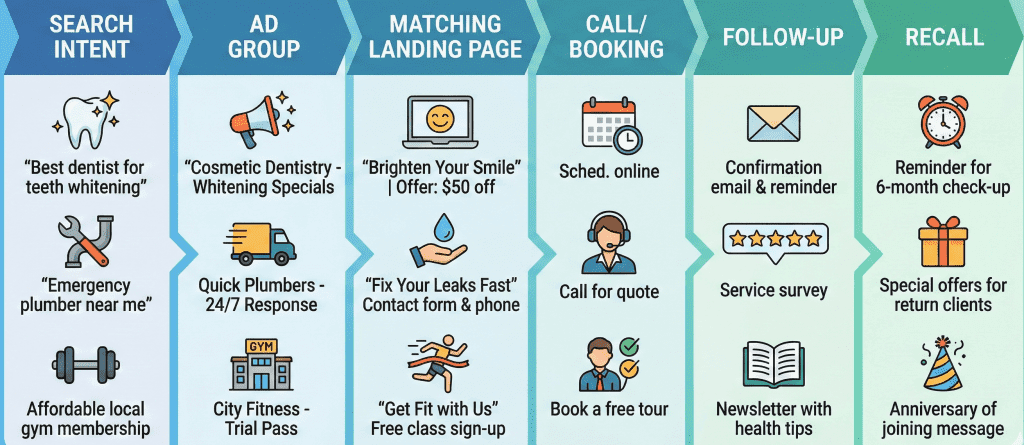
Google’s Ads Help Center explains that you can track calls from your website that happen after an ad click (website call conversions) and that call conversion tracking helps you measure how effectively ads lead to phone calls. Google also explains that call conversion solutions often use Google forwarding numbers and that you can set minimum call durations to filter low-quality calls.
In practice, clinics win when they:
- track calls + forms + bookings
- define a “qualified conversion” (e.g., booked appointment or calls over 60 seconds)
- build a follow-up process so leads don’t leak (missed calls and slow callbacks quietly destroy ROI)
What offers work best without discounting your expertise?
The best offers reduce uncertainty. The worst offers train patients to shop on price.
Clinic-safe, value-forward offers tend to be:
- “New patient comprehensive exam + clear care plan”
- “Dry eye assessment + treatment roadmap”
- optical bundles that keep clinical care premium (second pair, lens upgrade packages)
If you do price-based incentives, consider keeping them anchored to products (frames/lenses) rather than discounting the exam itself, which can unintentionally cheapen the clinical experience.
How do reviews, referrals, and recall systems create compounding growth?
Reviews don’t just influence click-through. They influence whether someone calls at all.
The rater8 study and summary coverage emphasize how central reviews have become in healthcare selection behavior, while also noting that many patients don’t leave reviews unless prompted. That creates a simple opportunity: clinics with a consistent, respectful review request process often outpace clinics that “hope reviews happen.”
A practical review system:
- ask at the moment of satisfaction (after the exam explanation or a great optical experience)
- make it easy (QR at checkout + short SMS/email)
- respond to every review professionally
Then compound that with:
- referrals (family prompts, “bring someone you care about” moments)
- recall/reactivation (overdue exams, contact lens renewals, follow-ups)
This is where growth becomes steadier—because you’re not only buying new demand; you’re creating repeatable demand.
How do you build partnerships that consistently send patients?
Partnerships work when the audience overlaps and the value is obvious.
Good partners for many private eye clinics:
- pediatric and family medicine practices
- dermatology/allergy clinics (dry eye overlaps)
- schools and sports clubs
- local employers and HR wellness programs
Lead with patient benefit (“here’s when to refer” and “what your patient can expect”), not with marketing hype. Keep a simple tracking field in intake (“How did you hear about us?”) so you can quantify which partnerships actually perform.
What should you measure so marketing decisions match clinic reality?
Leads are not the goal. Booked-and-showed appointments are the goal.
Build a measurement ladder:
impressions → clicks → leads → booked → showed → revenue → retention
Then make decisions on what moves booked and showed—not what looks good in a dashboard.
If calls are a main conversion path (they often are), call tracking is not optional; Google Ads provides multiple call measurement approaches (from ads, from websites, and via imports).
What’s a practical 90-day plan to market a private eye clinic?
A 90-day plan should sequence work so you don’t pour money into a leaky funnel.
Days 1–30: Foundation
Fix GBP, tighten your site’s conversion path, set up call/form tracking, and implement a review request process.
Days 31–60: Capture
Launch Search Ads around one or two core intent clusters (exams + one specialty), and publish or improve the matching service pages for local SEO.
Days 61–90: Scale
Add specialty campaigns, start 3–5 partnerships, refine follow-up and reactivation, and optimize using booked/showed data.
Conclusion
To market a private eye clinic effectively, you don’t need more tactics—you need a clearer system. Build trust signals that hold up under scrutiny, capture demand where people are actively searching, remove friction from booking, and then compound growth with reviews, referrals, and recall.
When those pieces work together, marketing stops feeling like guesswork and starts behaving like a predictable pipeline.
Why Visiclix is Your Ideal Choice for Marketing a Private Eye Clinic?
Visiclix builds clinic growth around how patients actually choose care today: they search, compare, verify trust, and book the clinic that makes the decision feel safe and simple. That’s why Visiclix focuses on high-intent demand capture (Maps + Search), conversion-first landing experiences, and measurement tied to booked appointments—so you’re not “buying traffic,” you’re building a booking engine.
Just as importantly, Visiclix treats compounding as part of marketing—not an afterthought. Reviews, recall, and reactivation are integrated into the growth plan so you’re not constantly paying for the same patient twice. The result is a strategy that protects premium positioning while improving the numbers that actually matter: booked exams, show rate, and sustainable clinic revenue.
Ready to Market Smarter with Visiclix?
If you want a clear plan to grow bookings without discounting your expertise, Visiclix can help you:
- tighten your Maps + website conversion flow
- structure Google Ads around high-intent clusters
- install call + booking tracking that matches clinic reality
- build compounding loops through reviews and recall