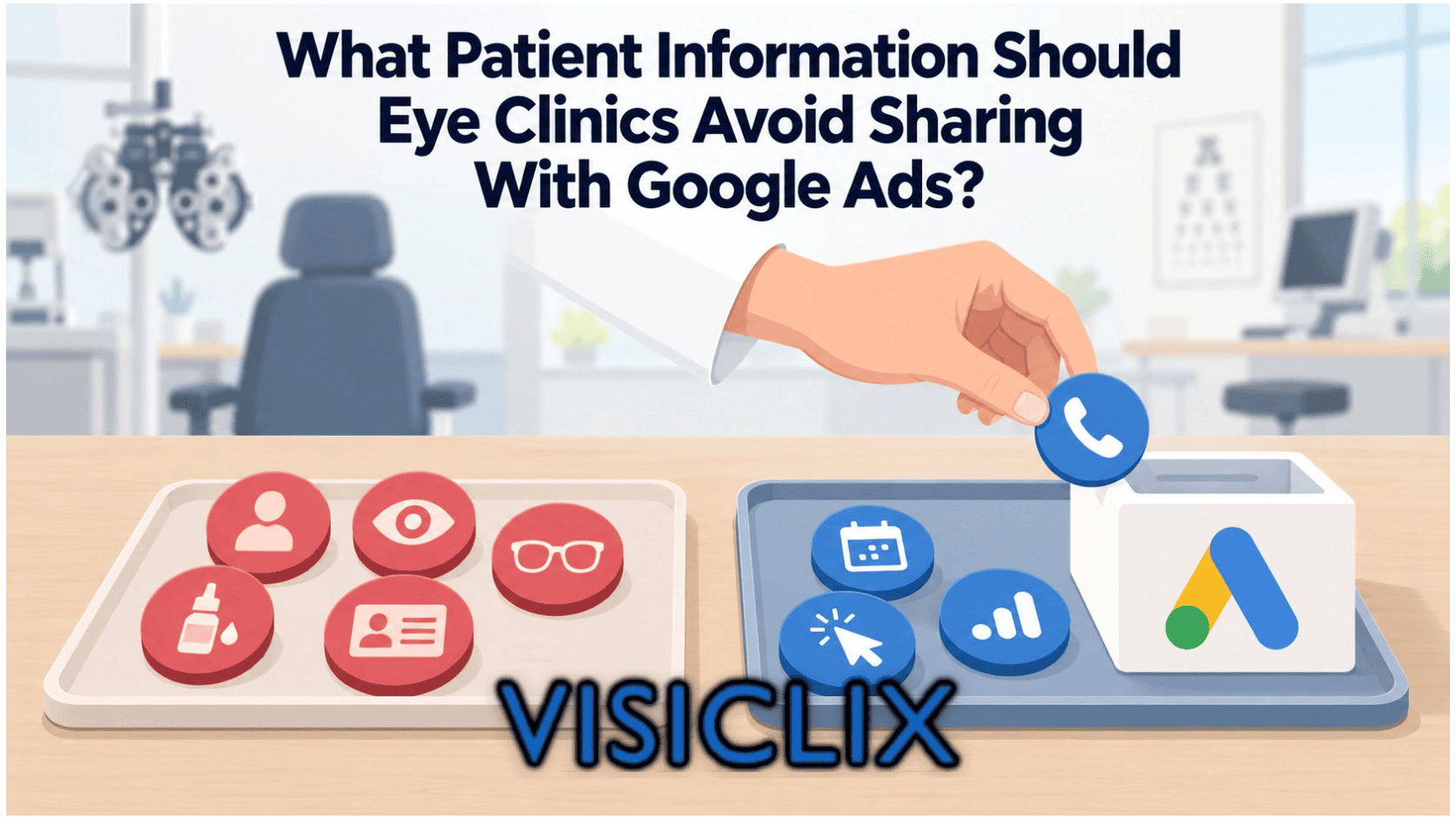

Eye clinics can track marketing conversions without violating HIPAA by keeping protected health information (PHI) separate from advertising platforms, measuring appropriate website interactions, and using aggregated appointment data to evaluate campaign performance. The key is to collect only the information needed for marketing decisions while preventing unauthorized access to identifiable patient information.
For optometrists and ophthalmologists, privacy-safe measurement makes it possible to evaluate advertising spend, understand patient acquisition trends, and improve marketing ROI. However, successful HIPAA marketing analytics for an eye clinic requires more than installing tracking software. It demands careful consideration of what information is collected, where it goes, and who can access it.
What Patient Information Can Become PHI in Eye Clinic Marketing Analytics?
Protected health information includes individually identifiable information related to a person’s health, health care, or payment for care when handled by a HIPAA-covered entity or its business associate.
In eye care marketing, this may include appointment requests containing patient names, contact details, or treatment information. For example, a website form identifying someone seeking glaucoma treatment could reveal both their identity and health care needs. Data from patient portals and online appointment scheduling systems also requires careful protection.
Not every website visit automatically involves PHI. A federal court ruling in June 2024 invalidated part of federal guidance that treated an IP address combined with a visit to certain public health-related webpages as sufficient to trigger HIPAA obligations. However, tracking systems that collect identifiable appointment details or health information can still create compliance risks.
The distinction matters. Eye clinics should evaluate the information collected and disclosed rather than assuming every website interaction is either protected or unrestricted.
Which Website Tracking Practices Create the Greatest HIPAA Risks?
Website tracking creates HIPAA risks when technologies collect or transmit identifiable health information to vendors without appropriate authorization or another lawful basis.
Common concerns include advertising pixels, analytics scripts, session-recording tools, call-tracking platforms, and form-tracking software. These technologies may automatically capture page addresses, user identifiers, form entries, or appointment information.
For example, a conversion pixel on an appointment confirmation page could reveal that an identifiable individual requested an eye examination. Removing the person’s name may not resolve the problem if other transmitted information still identifies them.
Privacy-focused website design for eye care practices should therefore consider both conversion performance and data protection.
Cookie banners, IP masking, and server-side tracking are not automatic HIPAA compliance solutions. Clinics must examine actual data transfers and determine whether vendors are permitted to receive the information.
How Can Eye Clinics Build a Privacy-Safe Conversion Tracking Process?
A privacy-safe tracking process starts with identifying useful conversion metrics, assessing data flows, and separating patient records from marketing platforms.
Identify the Conversions Worth Measuring
Focus on meaningful outcomes such as appointment inquiries, incoming calls, booking requests, and completed appointments.
Distinguish early interactions from confirmed results. A button click indicates interest, while a completed appointment represents a more valuable business outcome.
Both can inform decisions, but the measurement method must match the privacy risk associated with each event.
Audit the Data Collected by Every Marketing Tool
Review analytics tags, advertising pixels, website forms, call-tracking systems, and booking integrations.
Check whether sensitive information appears in URLs, event parameters, cookies, or information transmitted to external services. Use technical testing to confirm what vendors actually receive.
If a tool collects unnecessary patient information, restrict or remove the tracking until an appropriate configuration is established.
Separate Patient Records From Advertising Reports
Keep identifiable patient and appointment information within appropriately secured clinical systems.
Marketing dashboards can display non-identifying website activity and aggregated business results without transferring patient-level records to advertising platforms.
For example, a clinic could internally report that paid search contributed 25 appointments during a month without uploading patient names, email addresses, or appointment details.
Review Vendors and Reporting Controls
Determine whether vendors handle PHI on the clinic’s behalf and require business associate agreements when applicable.
Apply appropriate access restrictions, maintain documentation, and verify that any claimed de-identification meets HIPAA requirements. Simply hashing an email address or removing names does not automatically make data de-identified.
Privacy and compliance professionals should approve the final measurement configuration.
Can Eye Clinics Use Google Analytics 4 and Google Ads for Conversion Tracking?
Eye clinics may use Google Analytics 4 (GA4) and Google Ads for appropriately configured, non-PHI measurement. However, neither platform should receive protected health information through ordinary marketing tracking implementations.
Google Analytics does not offer a HIPAA business associate agreement. Clinics must therefore ensure GA4 does not collect PHI and restrict its use to pages and information that have been reviewed for compliance.
Google Ads also restricts personalized advertising involving sensitive health interests. Advertiser-created audiences based on patients seeking specific eye treatments can create additional privacy and platform-policy concerns.
Through carefully planned Google Ads management for eye care practices, clinics can evaluate appropriate advertising metrics such as campaign spend, impressions, and clicks while measuring patient bookings separately within controlled systems.
Server-side tracking is not an exemption. If identifiable health information reaches an advertising provider, changing the transmission method does not eliminate the underlying risk.
Which Conversion Metrics Help Eye Clinics Measure Marketing ROI Safely?
Eye clinics can evaluate marketing performance using appropriately aggregated metrics that reveal campaign effectiveness without identifying individual patients.
Useful measurements include:
- Cost per inquiry: Advertising spend divided by qualified inquiries.
- Appointment conversion rate: Confirmed bookings divided by qualified inquiries.
- Cost per booked appointment: Campaign spend divided by appointments attributed internally to that campaign.
- Channel performance: Comparison of search advertising, organic traffic, and other acquisition sources.
- Return on marketing investment: Financial return evaluated against marketing costs using appropriately aggregated internal data.
Consider an eye clinic spending $1,200 on advertising and internally attributing 30 booked appointments to that campaign. Its cost per booked appointment would be $40.
The clinic can use that figure for budgeting without transferring identifiable booking records to the advertising provider.
The same approach can support SEO strategies for eye doctors by comparing organic search performance with paid advertising. However, small reporting groups and detailed combinations of information should be reviewed for re-identification risks before sharing.
When Should Eye Clinics Review Their Analytics and Tracking Setup?
Eye clinics should review tracking configurations regularly and whenever they introduce new marketing technologies or patient-facing website features.
Important review points include installing advertising pixels, launching appointment forms, updating booking platforms, or connecting new analytics vendors. Even minor website changes can introduce unexpected data transmissions.
A practical process includes periodic technical audits, access reviews, vendor assessments, and documented corrective actions.
Marketing teams should also coordinate with privacy officers and technical specialists before enabling new conversion events. The objective is consistent oversight, not a one-time compliance checklist.
Frequently Asked Questions
Is Google Analytics HIPAA compliant for eye clinics?
Google Analytics is not a HIPAA-compliant solution for collecting PHI and does not offer a business associate agreement. Eye clinics should only use it for appropriately reviewed activities that do not disclose PHI.
Can an optometry practice track appointment button clicks?
Yes, in appropriate circumstances. However, clinics must review what the tracking event reveals and whether identifiable health information reaches a third party.
Are IP addresses always considered protected health information?
No. Whether an IP address contributes to PHI depends on the circumstances and associated information. An IP address alone does not automatically establish that a HIPAA disclosure occurred.
Does server-side conversion tracking guarantee HIPAA compliance?
No. Server-side tracking changes how information is processed or transmitted, but clinics must still assess what data vendors receive and whether disclosures are permitted.
Can an eye clinic use patient data for Google Ads remarketing?
Patient-based remarketing involving sensitive health information raises HIPAA and Google Ads policy concerns. Clinics should avoid uploading PHI or creating restricted health-based audiences.
What Should Your Eye Clinic Do Next?
Reliable marketing measurement does not require unrestricted access to patient information. It requires a thoughtful approach to collecting useful data, protecting sensitive records, and understanding which campaigns generate meaningful outcomes.
Start by reviewing your existing tracking tools, identifying unnecessary data collection, and evaluating whether your reporting delivers actionable insights.
Better visibility into marketing performance should strengthen patient trust, not compromise it.
Why Visiclix is Your Ideal Choice for Privacy-Safe Eye Clinic Marketing?
Visiclix specializes in digital marketing for optometrists and ophthalmologists, helping eye care practices improve online visibility and attract prospective patients. Its services cover website development, search engine optimization, and paid advertising strategies tailored to the eye care industry. By focusing on measurable marketing objectives, Visiclix helps practices better understand how their digital campaigns contribute to business growth.
Through its digital marketing services for eye care professionals, Visiclix supports coordinated marketing strategies that prioritize meaningful performance insights. Its eye care industry focus helps connect campaign planning, website usability, and conversion measurement with practice goals. Working alongside a clinic’s privacy and compliance professionals, Visiclix can help align marketing performance objectives with appropriate data-handling requirements.
Make Smarter Eye Care Marketing Decisions With Visiclix
Your eye clinic deserves marketing strategies that generate meaningful results while respecting patient privacy.
Discover opportunities to improve campaign visibility, refine conversion measurement, and make more informed marketing investments.
Contact Visiclix to discuss your eye care marketing goals and explore a more effective approach to measuring growth.