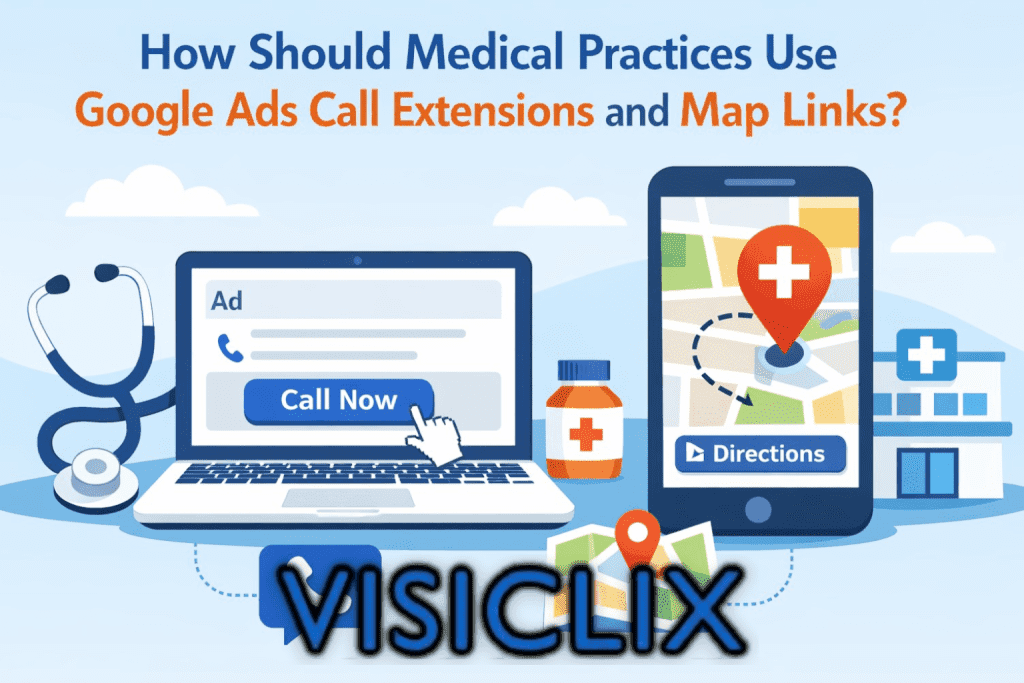
Patients searching for a doctor, clinic, imaging center, or urgent care provider often want one of two things immediately: a phone number they can trust or a nearby location they can reach. That is exactly why Google Ads call extensions and map links matter in medical PPC. In current Google Ads terminology, “call extensions” are now called call assets, and “map links” usually come from location assets tied to a Google Business Profile. Call assets let people call directly from the ad, while location assets can show an address, map, or distance to the business.
For medical practices, those features do more than improve visibility. They reduce friction at the exact moment a prospective patient is ready to act. A patient with urgent symptoms may want to call before booking. A parent searching for a nearby pediatric clinic may want directions right away. A high-intent searcher comparing specialists may use both the phone number and the clinic location as trust signals before deciding whom to contact. Competitor articles on medical Google Ads tend to discuss these assets only briefly inside broader “Google Ads for doctors” guides, which leaves a gap for a more practical, conversion-focused approach.
What Is a Google Ads Call Extension for Medical Practices?
A Google Ads call extension, now called a call asset, is a phone-number enhancement that makes it easier for a patient to contact your practice directly from the ad. Google says call assets allow people to tap or click to call your business, and they can also help advertisers track valuable call conversions. For a medical practice, that means your ad can do more than drive traffic to a landing page. It can create an immediate path to scheduling, triage, insurance verification, or service questions.
This matters because medical intent is often high and time-sensitive. Someone searching “urgent care near me,” “dentist open today,” or “MRI scheduling phone number” may be far more likely to convert through a call than through a long web form. Even competitor content that stays broad still emphasizes that Google Ads can generate fast patient acquisition when campaigns match real search intent. The difference is that call assets shorten the path even further by turning a search into a live conversation.
There is also an important compliance detail here. Google’s help documentation notes that call assets are the proper way to include a phone number with an ad, and that putting phone numbers elsewhere in ad text can lead to disapproval. For medical advertisers, where policy issues can already be more sensitive than in many other industries, using the approved asset format is not just cleaner. It is safer.
What Are Map Links in Google Ads, and How Do They Help Local Healthcare Providers?
In practice, “map links” in Google Ads are usually driven by location assets. Google explains that location assets can display a business address, a map to the location, or approximate travel distance, helping people find the business more easily. For a clinic, lab, imaging center, med spa, or specialist office, that makes the ad more actionable for local searchers who are deciding where to go.
This is especially valuable in healthcare because location is not a minor detail. It is often part of the conversion decision. Patients may compare providers based on convenience, proximity to work or home, parking, office hours, or how quickly they can get there. A visible location signal can reassure the searcher that the practice is real, nearby, and easy to reach. That trust effect is one reason local medical searches often behave differently from broader B2B or ecommerce searches.
Competitor articles mention location extensions, but they rarely build out the local patient journey in depth. That is a missed opportunity. In medical PPC, location visibility is not just a nice add-on. It is often part of what moves a patient from consideration to action, especially for urgent care, dental, diagnostics, physical therapy, and neighborhood-based specialty practices.
How Do Call Extensions and Map Links Work Together in Medical PPC?
Call assets and location assets work together because they support the two strongest local actions in healthcare search: call now and get directions. A patient who wants reassurance, pricing, or appointment availability may prefer to call first. A patient who already knows the clinic and simply wants the fastest path to the office may use the map or address details. Together, these assets make the ad more useful for both behaviors.
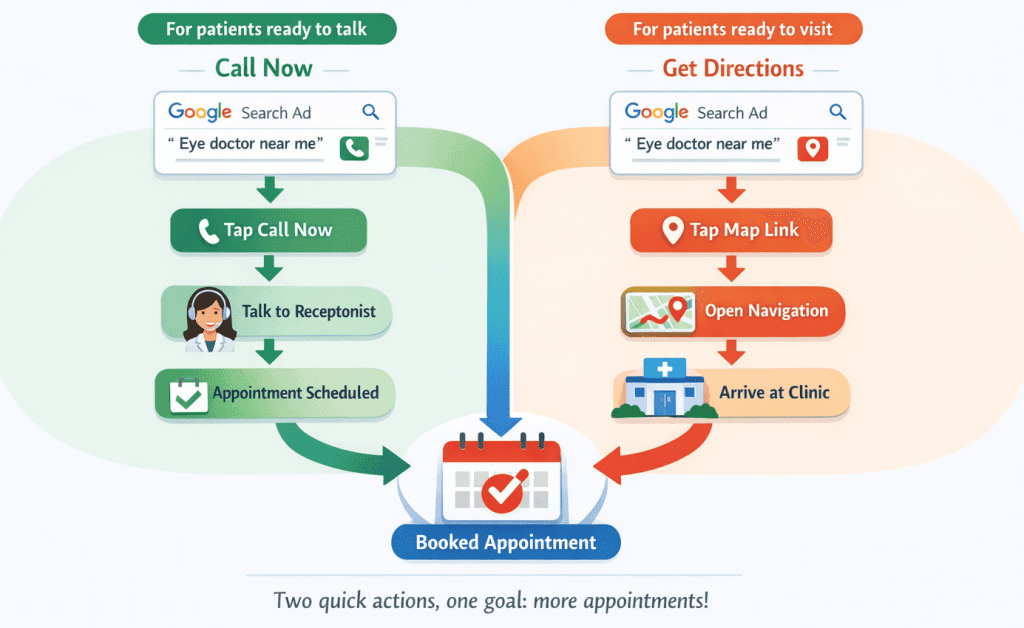
This pairing is particularly effective for bottom-funnel searches. Someone searching for “walk in clinic open now,” “dermatologist near me,” or “same day dentist appointment” often has immediate intent. If the ad offers both a clickable phone option and a location cue, the patient can choose the path that feels easiest. That reduces hesitation and helps capture demand that might otherwise leak to another advertiser with a more convenient-looking ad. This is a stronger angle than the broader competitor pages, which typically cover Google Ads strategy without fully developing the dual-action local conversion model.
For multi-location providers, the combination can be even more important. The right phone number and the right office location need to line up, or the user experience breaks down fast. If an ad shows the wrong location or routes a call to the wrong office, conversion rates drop and trust can suffer. In healthcare, that is more damaging than in many other verticals because the searcher is often stressed, short on time, or trying to solve an urgent need.
Why Are Call Extensions Important for High-Intent Medical Searches?
Call extensions are important in medical PPC because many healthcare decisions still happen through live conversation. Patients often want to confirm accepted insurance, appointment availability, provider specialties, referral requirements, preparation instructions, or whether a service is appropriate for their condition. A form can collect information, but a phone call often resolves uncertainty faster and increases the chance of booking.
This is one area where medical advertisers differ from many other local businesses. In healthcare, the emotional context matters. Patients may feel anxious, confused, or under time pressure. A prominent call option can create confidence because it promises immediate human help. Broad competitor guides on Google Ads for doctors repeatedly stress that the channel works well for intent-driven acquisition. The next logical step is recognizing that the highest-intent medical clicks often convert best when they become calls, not just website visits.
There is also a measurement upside. Google’s call reporting and phone call conversion tracking can show call duration, start and end times, caller area code, and whether the call connected. That gives practices a better way to judge lead quality than click-through rate alone. A short burst of low-quality clicks may look good in surface metrics, but a campaign that consistently drives qualified appointment calls is far more valuable.
Which Medical Businesses Benefit Most From Google Ads Call Extensions?
Medical businesses benefit most from call assets when patients are likely to have questions, need scheduling help, or want fast reassurance before booking. That includes urgent care, dental practices, dermatology clinics, orthopedic providers, primary care groups, med spas, behavioral health providers, physical therapy clinics, imaging centers, and many specialty clinics. In each of these categories, a live call can remove friction that a landing page alone may not resolve.
Urgent care and dental practices often see especially strong fit because intent can be both local and urgent. Imaging centers and specialty clinics also benefit because patients frequently call to ask about referrals, prep instructions, insurance coverage, or the nearest available appointment. Concierge and direct primary care practices can gain from call assets as well, since prospects often want to understand membership, pricing, and access before committing. That specialty angle appears in competitor content, but not with much depth around call handling.
The main lesson is that call assets are most valuable when the phone conversation itself moves the lead meaningfully closer to revenue. If a practice depends on human qualification, calendar coordination, or trust-building before booking, call assets should not be treated as optional. They should be part of core campaign design.
How Do You Set Up Google Ads Call Extensions for a Medical Practice?
Google is actively steering advertisers toward responsive search ads with call assets rather than relying on older call-ad workflows. Google’s transition guidance states that call ads are being replaced by responsive search ads with call assets, and that advertisers should add call assets through the RSA setup flow. That means a modern medical search campaign should be built with the phone strategy integrated into the ad and asset structure from the start.
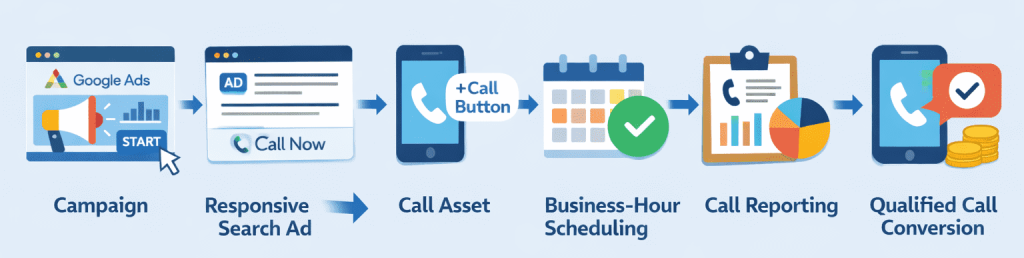
The practical setup process is straightforward. First, create or update the relevant responsive search ad in the right campaign or ad group. Second, add the correct practice phone number as a call asset at the appropriate level. Google notes that if call assets exist at multiple levels, the most specific one is used, so practices with several locations or service lines should organize assets carefully. Third, align the ad copy to appointment or consultation intent so the click and the call feel like part of the same journey.
From there, configure the operational settings that matter most in healthcare. Set call asset schedules so the asset runs when the front desk or intake team can answer. Enable call reporting and define phone call conversion tracking so the account records meaningful call outcomes. If the practice has multiple locations, use the structure that best preserves correct routing by office or specialty. These steps are simple, but they are where many advertisers lose efficiency because the asset is enabled without a real call-management plan behind it.
How Do You Add Map Links or Location Assets to Medical Google Ads?
Google says there are two main ways to set up location assets, including linking a Google Business Profile. For most medical practices, that Business Profile connection is the most relevant route because it allows Google Ads to use verified location data associated with the clinic. That helps ads show trusted local information such as address and map details.
In practice, setup should begin with clean location data. Confirm that the practice name, address, phone number, and office hours are accurate in the Business Profile. Then link the profile to Google Ads and attach the location assets at the right level. For a single-location practice, this is usually simple. For a multi-location group, it requires more care so the correct office appears for the correct campaign geography and service intent.
This is an area where medical advertisers should be strict. An outdated suite number, old office hours, or wrong phone number can damage both conversion rate and credibility. Because patients rely on healthcare providers for accurate information, inconsistent location data creates more friction than it might in other industries. A map link only helps when the information behind it is dependable.
What Are the Best Practices for Medical Google Ads Call Extensions?
The best practice is simple: only make the phone prominent when the practice is prepared to answer. Google recommends using business hours with call assets, and competitor guidance from Quo also emphasizes separating the call asset schedule from the broader campaign schedule. That distinction matters. A campaign may sensibly run all day, but the call asset should usually run only when someone can respond effectively.
The second best practice is to define what a good call actually is. Google’s phone call conversion tools allow advertisers to track calls and use thresholds such as duration. In a medical setting, that threshold should reflect qualified intent, not vanity metrics. A five-second misdial is not equal to a two-minute new-patient scheduling call. Setting a sensible duration rule helps the account optimize toward outcomes that matter.
The third best practice is message match. Ads promoting urgent appointments, same-day care, consultations, or insurance verification should make that intent clear in the copy and route callers to staff who can handle those questions. Practices that mix new-patient PPC calls with general switchboard traffic often waste ad spend because the caller experience becomes slow or confusing. The account structure, front-desk process, and call routing should all reinforce the same conversion goal. This operational layer is where many generic Google Ads guides stop too early.
What Are the Best Practices for Google Ads Map Links in Healthcare Campaigns?
The best practice for map links is accuracy first. Google’s policy guidance for location assets notes that they can include business address, phone number, business hours, and other location details, and that Business Profile is commonly used to provide the data. For medical advertisers, this means the local profile is not a side task. It is part of ad performance.
Practices should keep their name, address, phone number, and hours consistent across the Business Profile, website, landing pages, and ad experience. They should also make sure location-specific campaigns point to pages that clearly match the office shown in the ad. When a patient clicks an ad for a nearby clinic and lands on a generic page with unclear location information, confidence drops. The cleaner and more consistent the local experience, the stronger the conversion path.
A second best practice is to reserve location emphasis for campaigns where local convenience truly influences the decision. This is especially relevant for urgent care, dentistry, physical therapy, primary care, imaging, and service lines where the nearest location is a major selection factor. Competitor articles mention location extensions, but they rarely explain this strategy with enough local-search nuance.
Are Google Ads Call Extensions Allowed for Medical Advertising?
Yes, call assets themselves are allowed for medical advertising. The key issue is not whether a practice can show a phone number. The issue is whether the advertiser, service, claims, and targeting comply with Google’s healthcare and medicines policies and any required certification process. Google’s healthcare-related advertising flow shows that some categories, such as prescription drug services, telemedicine involving prescription-related terms, addiction services, and certain other regulated offerings, may require eligibility review or certification depending on the country and use case.
That distinction matters because many legitimate medical businesses assume asset approval is separate from policy review. In reality, the asset sits inside the larger ad and account ecosystem. If the promoted service falls into a restricted healthcare category, the fact that the ad uses a compliant call asset does not remove the need to satisfy the relevant policy requirements.
This is one of the areas where broader competitor content is directionally helpful, especially StubGroup’s emphasis on healthcare policy pitfalls. Visiclix can improve on that by connecting policy awareness directly to the practical setup of call and location assets rather than treating compliance as a separate topic.
What Policy Risks Can Affect Medical Call Extensions and Map Links?
The biggest policy risks usually come from the medical offer itself, not from the asset type alone. Google’s healthcare and medicines policy states that some healthcare-related content cannot be advertised at all, while other categories are allowed only with certification and only in approved locations. That means medical advertisers need to review not just their phone number and location data, but also the promoted treatments, keyword set, landing page language, and ad claims.
For call assets, a common risk is inconsistency. If the phone number routes to a different entity, creates a misleading experience, or conflicts with the business identity shown elsewhere, performance and trust both suffer. For location assets, policy and experience risks increase when the location data is inaccurate, unverifiable, or mismatched with the business being advertised. Google’s location asset requirements explicitly tie these assets to business location information and standard ad policies.
Medical advertisers should also be careful with ad language that implies guaranteed outcomes, inappropriate diagnoses, or prohibited medical claims. In healthcare PPC, a harmless-looking headline can cause trouble if it overpromises or crosses into restricted territory. That is why local asset optimization has to sit alongside policy review, not replace it.
How Should Medical Practices Track Calls From Google Ads?
Medical practices should track calls at two levels: Google Ads call data and business-quality outcomes. Google’s call reporting can show call duration, caller area code, connection status, and related reporting that helps advertisers evaluate ad-driven calls. Google also supports phone call conversion tracking and imported call conversions, which can provide more control over what counts as a real lead or a real booking outcome.
The most useful KPI is rarely raw call volume. A better measurement stack includes cost per qualified call, booked appointment rate, missed-call rate, answer speed, call duration, and downstream patient value where possible. Google’s qualified leads and converted leads guidance also supports a broader idea here: advertisers should distinguish between the initial lead and the lead that becomes meaningfully qualified offline. The same principle applies to medical phone leads.
For more advanced setups, practices can import offline outcomes from a CRM or call-tracking system so optimization reflects real business value, not just call counts. That matters in healthcare because not every call is equal. A short inquiry from an existing patient, a vendor call, and a new-patient consultation request should not all be treated as the same conversion.
How Can You Improve Conversion Rates From Medical Call Extensions?
The fastest way to improve conversion rate is to tighten the connection between ad intent and call handling. If the ad promises same-day availability, the phone team should be ready to handle same-day booking questions. If the campaign targets a high-value specialty, the caller should reach someone who understands that specialty’s intake process. Many campaigns underperform not because the click was wrong, but because the call experience was generic.
Scheduling also matters. Running call assets outside real answer hours can inflate wasted interactions and hurt efficiency. So can broad keyword targeting that attracts research-only users when the practice needs booking-ready leads. Better results usually come from pairing precise keyword intent, local targeting, staffed call hours, and stronger negative keyword control. Those are standard PPC ideas, but they become more valuable when the conversion path depends on a live human response.
Finally, practices should review missed calls and short calls, not just successful ones. Those signals often reveal operational leaks: poor routing, slow answer times, off-hour demand, unclear ad copy, or service mismatches. Small improvements in phone operations can produce outsized revenue gains because each qualified call may represent a high-value patient opportunity.
Can Medical Practices Use Call Extensions Without a Physical Clinic Location?
Yes. A medical advertiser can use call assets without using location assets. The phone number is its own asset type, and it does not require map-based visibility to function. This can be useful for telehealth models, centralized intake teams, or service lines where the primary goal is consultation by phone first.
However, map-link visibility generally depends on valid location setup, usually through Business Profile or another supported location-asset path. So while a practice can absolutely prioritize calls without highlighting a physical address, it should not expect the same local map-style cues unless the business meets the location asset requirements and maintains accurate local data.
For hybrid or telemedicine organizations, the added consideration is policy. Google’s healthcare-related advertising rules show that some telemedicine and prescription-related use cases require review or certification depending on what is being promoted and where. So the absence of a clinic location does not automatically create a problem, but the advertised service type may still require closer compliance review.
When Should a Medical Advertiser Prioritize Calls Over Form Leads?
Medical advertisers should prioritize calls when urgency is high, when a live conversation improves close rate, or when patients commonly need clarification before committing. That includes urgent care, time-sensitive dental work, imaging, specialty consultations, treatments with insurance questions, and services where appointment inventory changes quickly. In those cases, a phone call can remove uncertainty in real time and bring the prospect closer to revenue faster than a form.
Forms can still work well for low-urgency services, research-heavy decisions, content offers, or after-hours lead capture. The smartest strategy is often not choosing one or the other universally. It is deciding which path deserves priority for each campaign. Medical PPC performs best when the conversion method matches the patient’s urgency, the service complexity, and the practice’s actual intake process.
FAQ
What is the difference between a Google Ads call extension and a call asset?
There is no practical difference in function. “Call extension” is the older term people still use, while Google now uses the term call asset in current documentation and setup flows.
Can a medical practice show both a phone number and directions in the same ad?
Yes. Call assets and location assets can appear together when the account and campaign are eligible, allowing the ad to support both direct phone calls and local navigation actions.
Do map links in Google Ads come from Google Business Profile?
Often, yes. Google says a common setup method for location assets is linking a Business Profile, which then provides the location data used in ads.
How do I track booked appointments from Google Ads phone calls?
Start with call reporting and phone call conversion tracking in Google Ads, then connect offline qualification or CRM outcomes so the account reflects not just calls, but booked and qualified calls where possible.
Are call extensions better than contact forms for medical PPC?
Often yes for high-intent and urgent searches, but not always. Calls usually win when patients need fast answers or reassurance. Forms can still be useful for lower-urgency inquiries or after-hours capture.
Can telehealth providers use Google Ads call extensions?
Yes, but the promoted services may be subject to healthcare policy restrictions or certification requirements depending on what is advertised and where.
Why are my medical Google Ads disapproved even when my clinic is legitimate?
Because legitimacy alone does not guarantee policy compliance. Disapprovals can stem from restricted healthcare categories, unsupported claims, certification requirements, or inconsistencies in ad, landing page, phone, or location information.
Conclusion
Google Ads call extensions and map links are most effective in medical PPC when they are treated as part of a real patient-acquisition system, not just as extra ad features. Call assets help patients reach your team at the moment of highest intent. Location assets reinforce local trust and help patients find the right office quickly. When those assets are paired with accurate local data, staffed phone coverage, proper call tracking, and policy-aware campaign design, they can turn more expensive clicks into booked appointments and qualified patient opportunities.
Why Visiclix is Your Ideal Choice for Google Ads Call Extension Medical?
Visiclix is built for the part of PPC that many agencies oversimplify: turning search demand into real patient conversations. It is not enough to add a phone number to an ad and hope for the best. Medical campaigns need the right keyword intent, the right local visibility, the right asset structure, and the right intake flow behind them. Visiclix approaches call-driven PPC as a complete conversion system, helping practices align ad messaging, call assets, location assets, scheduling, and measurement so the campaign supports actual patient acquisition rather than surface-level lead metrics.
Visiclix also understands that healthcare advertising requires more than generic best practices. Medical PPC sits at the intersection of compliance, local trust, and operational reality. A campaign can generate clicks and still underperform if the phones are routed poorly, the wrong office appears, or the service line falls into a more restricted policy category. Visiclix helps practices avoid those gaps by building campaigns that are both performance-focused and policy-aware, with a stronger emphasis on qualified calls, booked appointments, and local conversion efficiency.
Ready to Turn More Google Ads Clicks Into Patient Calls With Visiclix?
If your practice is investing in Google Ads but not getting enough qualified calls, Visiclix can help you tighten the path from search to appointment. A smarter mix of call assets, location assets, local targeting, and conversion tracking can make your media spend work much harder.