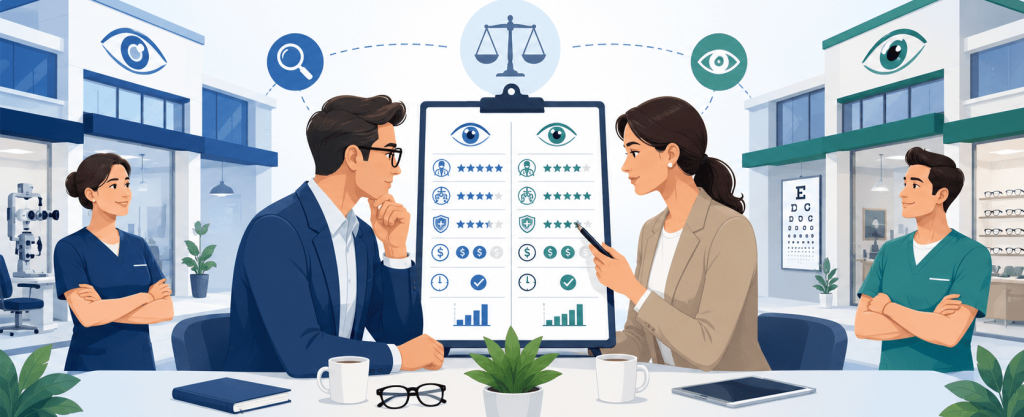
To evaluate competing eye clinics, compare how they attract patients, build trust, explain services, appear in local search, run ads, collect reviews, and convert visitors into appointments. The goal is not to copy another clinic’s website, discounts, social media posts, or Google Ads strategy. The goal is to understand what patients are seeing in your market, then decide which opportunities fit your clinic’s strengths, services, margins, and growth goals.
For optometry practices, competitive analysis for optometry marketing should connect visibility with business reality. A competing clinic may rank above you, run more ads, offer cheaper exams, or promote a specialty service more aggressively. But that does not mean its strategy is profitable, sustainable, or right for your practice. Strong competitor analysis helps you separate useful market signals from tactics that could waste budget or weaken your positioning.
Competitor research is especially valuable because optometry is no longer competing only on clinical care. Practices also compete on convenience, online search visibility, patient experience, eyewear retail, specialty services, and trust. Scotiabank notes that optometrists face increasing competition from online services and retailers, while Research and Markets identifies growth drivers such as aging populations, preventive care, digital screen use, technology, and demand for comprehensive eye exams.
What Should Eye Clinics Compare First When Studying Competitors?
Eye clinics should first compare the factors patients notice before booking: search visibility, reviews, website clarity, services, convenience, trust signals, and appointment friction. These elements shape the patient’s first impression long before they speak with your team.
Start by looking at which clinics appear repeatedly in Google Maps, organic results, and paid search for high-intent terms like “eye exam near me,” “optometrist near me,” “dry eye treatment,” “contact lens exam,” or “pediatric eye doctor.” Then review what those clinics emphasize. Some may lead with same-day appointments. Others may focus on advanced technology, family care, specialty treatment, insurance acceptance, or eyewear brands.
A useful competitor review should answer five practical questions: Who is easiest to find? Who looks most trustworthy? Who explains services most clearly? Who makes booking easiest? Who appears to have the clearest market position? Corporate Optometry’s competitor analysis guidance makes a similar point: researching competitors can help practices identify market strengths and weaknesses and build a stronger unique value proposition.
Do not stop at surface-level observations. A competitor with a polished website may still have weak calls to action. A clinic with many reviews may have recurring complaints. A practice with aggressive ads may be paying too much for low-quality leads. The purpose of comparison is to find strategic gaps, not to imitate whoever looks the busiest.
How Do You Identify Your Real Optometry Competitors?
Your real competitors are the clinics, retailers, advertisers, and specialty providers that patients compare against you before choosing care. They are not always the practices closest to your office.
There are several types of competitors to evaluate. Local SEO competitors are the clinics that appear in Google Maps and organic results. PPC competitors are advertisers appearing in the same paid search auctions. Service competitors are practices promoting dry eye care, myopia management, scleral lenses, pediatric eye care, emergency visits, diabetic eye exams, or eyewear. Retail competitors may include optical chains, big-box providers, online eyewear brands, and contact lens sellers.
This distinction matters because each competitor may affect a different part of your business. A national optical retailer might not compete with you for complex dry eye care, but it may compete for eyewear and convenience-focused searches. A nearby ophthalmology group may not be a direct substitute for routine exams, but it may influence medical eye care referrals. A specialty clinic across town may compete for high-value procedures even if it is not in your immediate neighborhood.
Scotiabank highlights that optometry practices have a retail component, with revenue often coming from professional fees, spectacle lenses, and contact lenses. That means competitor analysis should consider both care delivery and product-driven competition.
What Website Signals Reveal a Competitor’s Marketing Strategy?
A competitor’s website reveals how the clinic wants patients to think, feel, and act before booking. The most important signals are the homepage message, service-page depth, doctor credibility, appointment flow, insurance clarity, reviews, and calls to action.
Start above the fold. What does the clinic promise first? It may be convenience, affordability, advanced diagnostics, family care, designer eyewear, emergency availability, or specialty expertise. That first message often shows the clinic’s primary positioning. Then review the navigation. If dry eye, myopia management, contact lenses, and pediatric care each have dedicated pages, the clinic may be investing in service-specific patient acquisition.
Booking experience is another major clue. Sightview describes an optometry website as a “digital front door” where patients learn about services, check insurance coverage, and schedule appointments. It also recommends that optometry websites be fast, mobile-friendly, easy to navigate, clear about services, and equipped with online scheduling.
Look for friction. Is the phone number easy to tap on mobile? Is online booking visible? Are forms short and simple? Are hours, insurance, doctor bios, and location details easy to find? If a competitor ranks well but makes booking difficult, your clinic may not need to copy its content strategy. You may win by creating a smoother patient journey.
Also study what competitors fail to explain. Many clinics list services without answering patient questions. A dry eye page may not explain symptoms, treatment options, appointment expectations, or insurance considerations. A myopia management page may not clarify who qualifies, when parents should act, or what results to expect. These gaps can become stronger content and landing page opportunities for your clinic.
How Can Local SEO Show Which Eye Clinics Patients Find First?
Local SEO shows which eye clinics patients are most likely to discover when they search nearby. It also reveals how Google and patients interpret relevance, distance, and prominence in your market.
Google’s local ranking guidance says local results are mainly based on relevance, distance, and prominence. Google also states that complete and accurate business information can help local visibility, while positive reviews and helpful replies can help a business stand out.
For competitor analysis, review the clinics that appear in the local pack for your most valuable searches. Compare their Google Business Profile categories, business descriptions, services, photos, hours, review volume, review recency, and owner responses. Then compare their websites. Clinics with strong local visibility often connect their Google profile to clear service pages, strong location information, and trust-building content.
Be careful with location content. A competitor may have dozens of thin city pages that repeat the same phrases with different place names. That may look like an SEO shortcut, but it can weaken trust if the content feels generic. Google’s people-first content guidance emphasizes original information, comprehensive value, trust, and avoiding content that simply copies or rewrites other sources.
A better approach is natural local relevance. Explain nearby communities served, parking, accessibility, emergency availability, accepted insurance, school or workplace proximity, and common patient needs in the area. That type of local content helps patients make decisions instead of simply signaling a location to search engines.
How Should Eye Clinics Analyze Competitor PPC Activity?
Eye clinics should analyze PPC competitors by reviewing who appears in the same auctions, which services trigger ads, what offers competitors promote, and whether competing directly would support profitable patient acquisition. Ranking above a competitor is not always the same as winning.
Google Ads Auction Insights is one of the most useful tools for this work. For Search campaigns, Google’s Auction Insights report includes impression share, overlap rate, outranking share, position above rate, top-of-page rate, and absolute top-of-page rate. Google also explains that impression share reflects impressions received divided by estimated eligible impressions, while overlap rate shows how often another advertiser’s ad received an impression when your ad also received one.
These metrics help answer practical questions. Are the same competitors showing up again and again? Are they appearing above your ads only occasionally or consistently? Are you losing visibility because of budget limits, ad rank, or campaign structure? Are competitors stronger on routine eye exam terms but weaker on specialty care terms?
The wrong response is to start a bidding war automatically. A competing clinic may have a larger budget, different margins, weaker ROI standards, or campaigns that look visible but do not produce profitable appointments. Instead, use PPC data to decide where to compete, where to reposition, and where to avoid waste.
For example, if routine “eye exam near me” terms are crowded and expensive, your clinic may find better ROI by building campaigns around higher-value services such as dry eye evaluations, specialty contact lenses, pediatric exams, or medical eye care. The best PPC strategy is not always the loudest. It is the one that connects search intent, landing page quality, tracking, and booked appointments.
What Review Signals Matter Most When Comparing Eye Clinics?
The most important review signals are volume, recency, sentiment, recurring themes, response quality, and the specific reasons patients praise or criticize each clinic. A five-star average alone does not tell the full story.
Read competitor reviews like patient research. Look for patterns. Patients may repeatedly mention friendly staff, clear explanations, short wait times, help with insurance, convenient scheduling, advanced equipment, frame selection, or child-friendly care. Negative reviews may reveal issues with billing confusion, rushed exams, long waits, poor follow-up, difficulty reaching the office, or unclear pricing.
Sightview notes that reviews play a major role in how new patients choose an optometrist and recommends encouraging satisfied patients to leave reviews while responding professionally to both positive and negative feedback. Google also states that replying to reviews shows that a business values customer feedback and that positive reviews and helpful replies can help a business stand out.
Use reviews to improve your own messaging. If patients in your market complain about rushed appointments, emphasize thorough exams and clear explanations. If competitors receive praise for convenience, improve your booking process before claiming convenience in ads. If patients frequently ask about insurance, make coverage information easier to find on your website and landing pages.
Reviews also reveal emotional buying triggers. In eye care, patients are not only choosing a provider. They are choosing who to trust with vision, family care, health concerns, and often a retail purchase. Your competitor analysis should capture those trust signals and turn them into better service, content, and conversion strategy.
How Do You Compare Competitor Positioning Without Copying Their Brand?
Compare competitor positioning by identifying what each clinic wants to be known for, then deciding what your clinic can credibly own. The strongest position is not the most popular message in the market. It is the message your clinic can prove.
Common optometry positions include convenience, affordability, advanced technology, family care, pediatric expertise, medical eye care, dry eye treatment, eyewear fashion, contact lens specialty, emergency availability, or long-term community relationships. Each position attracts a different patient expectation. A convenience-led clinic must make scheduling easy. A specialty-care clinic must demonstrate expertise. A premium eyewear clinic must show product quality and style.
RevolutionEHR’s social media marketing guidance recommends defining the target audience and brand voice before creating content. That same principle applies to competitor analysis. Your clinic should not copy another practice’s tone, offers, or content style unless it fits your audience and patient experience.
Positioning should be grounded in evidence. If you claim specialty care, show doctor expertise, technology, treatment options, FAQs, and patient education. If you claim convenience, show online scheduling, clear hours, fast contact options, parking information, and insurance details. If you claim family care, show pediatric-friendly content, parent FAQs, and a warm patient experience.
Copying a competitor’s brand creates sameness. Learning from competitor positioning helps you become clearer. The difference is important: imitation blends in, while strategic differentiation gives patients a reason to choose you.
What Competitor Tactics Should Eye Clinics Avoid Copying?
Eye clinics should avoid copying tactics that do not match their business model, margins, patient mix, clinical strengths, or brand promise. A tactic can look successful from the outside while performing poorly behind the scenes.
Low-cost exam promotions are a common example. A discount offer may work for a high-volume optical model that earns revenue from eyewear purchases, but it may not fit a clinic focused on specialty care, advanced diagnostics, or a premium patient experience. Scotiabank’s discussion of optometry’s mix of professional fees, spectacle lenses, and contact lens revenue shows why business model matters when evaluating competitor offers.
Aggressive PPC bidding is another tactic to treat carefully. A competitor appearing at the top of ads may be spending heavily, but Auction Insights does not reveal profitability, close rate, show rate, or patient lifetime value. Use the data to understand pressure, not to assume the top advertiser has the best strategy.
Avoid copying generic messaging, too. Phrases like “best eye doctor near me,” “quality care,” and “friendly staff” do little unless supported by proof. Instead, convert competitor research into more specific claims: advanced dry eye testing, easier online booking, pediatric-friendly appointments, clearer insurance guidance, or specialty contact lens expertise.
Also avoid copying social media content involving patients without proper consent. RevolutionEHR warns that sharing patient stories or photos requires explicit written consent when patients are identifiable, and HHS explains that the HIPAA Privacy Rule protects individually identifiable health information and sets limits on uses and disclosures without authorization.
How Can Eye Clinics Turn Competitive Research Into a Better Marketing Plan?
Eye clinics can turn competitive research into a better marketing plan by converting observations into priorities, campaigns, landing pages, and measurable outcomes. Competitor analysis should lead to decisions, not just notes.
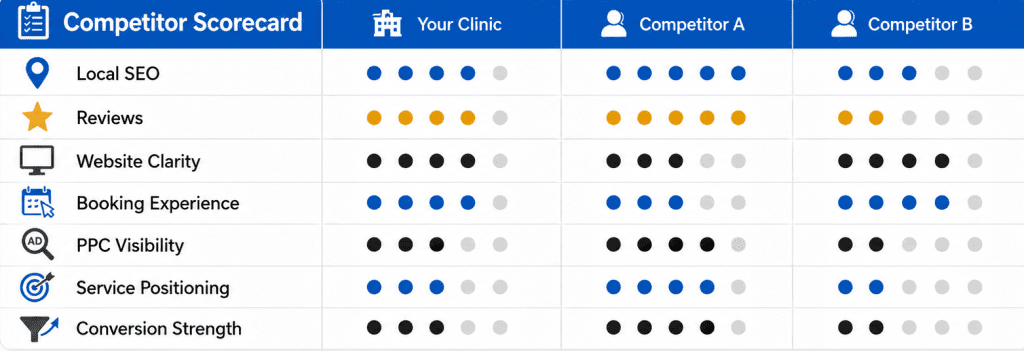
Start with a simple scorecard. Compare each competitor across local SEO visibility, review strength, website clarity, booking experience, service-page depth, PPC presence, positioning, and patient friction. Then identify the gaps that matter most. A gap is only useful if your clinic can act on it and benefit from it.
Next, connect each opportunity to practice economics. A service gap may look attractive, but it should be evaluated against appointment capacity, reimbursement, patient lifetime value, treatment profitability, doctor availability, and operational readiness. For example, building a campaign around dry eye care only works if the clinic has the technology, treatment workflow, staff training, and follow-up process to support those patients.
Then build focused campaigns. If competitors under-explain specialty care, create stronger service pages and PPC landing pages. If reviews show patients want convenience, simplify booking and highlight scheduling options. If competitors dominate broad eye exam terms, test more specific campaigns around higher-intent services.
Finally, measure outcomes beyond clicks. Track qualified calls, appointment requests, booked exams, cost per booked patient, no-show rate, conversion rate, revenue contribution, and repeat visits. Sightview recommends tracking ad performance and adjusting campaigns based on what generates appointments, which is the right mindset for competitor-informed marketing.
What Tools Help With Competitive Analysis for Optometry Marketing?
The best tools for competitive analysis for optometry marketing help clinics compare search visibility, paid search pressure, reviews, website performance, and real patient outcomes. No single tool tells the full story.
Google Ads Auction Insights is useful for PPC visibility because it shows how your campaigns compare with other advertisers in the same auctions. Google Business Profile and Google Maps are useful for evaluating local visibility, review strength, business categories, services, photos, and completeness. Google’s own local ranking guidance confirms the importance of complete business information, reviews, relevance, distance, and prominence.
SEO platforms such as Semrush, Ahrefs, Moz, or similar tools can help identify competitor keywords, backlinks, ranking pages, and content gaps. Website analytics can show how your own visitors behave after arriving from organic search, ads, or local listings. Call tracking and CRM data can connect marketing activity to booked appointments instead of stopping at traffic or impressions.
Do not treat tools as the strategy. Tools show patterns, but they do not know your clinic’s margins, schedule capacity, staffing, positioning, or patient experience. The strategy comes from interpreting the data through your business goals.
For Visiclix, this is where competitive research becomes a growth system. The point is not to collect more reports. The point is to understand where your clinic can win profitably, where competitors are vulnerable, and which campaigns deserve investment.
FAQ
What is competitive analysis for optometry marketing?
Competitive analysis for optometry marketing is the process of evaluating how competing eye clinics attract, persuade, and convert patients through local SEO, PPC, reviews, websites, service pages, social media, and patient experience. It helps clinics make better marketing decisions without copying tactics that may not fit their business.
How often should an eye clinic review competitors?
An eye clinic should review competitors at least quarterly and whenever launching a new service, changing PPC budgets, updating a website, expanding locations, or seeing a drop in leads. PPC and local search competitors can change quickly, so high-value campaigns may need more frequent monitoring.
Should eye clinics copy competitor ads?
No. Eye clinics should study competitor ads to understand positioning, offers, and search intent, but they should not copy them directly. A competitor’s ad may not be profitable, compliant, or aligned with your clinic’s services and margins.
How do I know if a competing eye clinic’s marketing is working?
You usually cannot know from the outside with certainty. Visibility, reviews, and ad presence are signals, not proof of profit. The best approach is to compare what competitors are doing with your own conversion tracking, booked appointments, cost per patient, and revenue data.
What should I compare on a competitor’s website?
Compare the homepage message, service pages, doctor bios, reviews, insurance information, online booking, calls to action, mobile usability, page speed, trust signals, and patient education. The best insights often come from what competitors fail to explain clearly.
Can Google Ads show which eye clinics compete with me?
Yes. Google Ads Auction Insights can show other advertisers participating in the same auctions when campaigns meet reporting thresholds. For Search campaigns, the report includes metrics such as impression share, overlap rate, outranking share, position above rate, top-of-page rate, and absolute top-of-page rate.
Why do some eye clinics rank higher on Google Maps?
Google says local rankings are mainly based on relevance, distance, and prominence. Complete business information, accurate details, positive reviews, helpful replies, and strong prominence signals can help a business stand out in local results.
What is the biggest mistake in optometry competitor analysis?
The biggest mistake is assuming that visible competitor activity equals a profitable strategy. A clinic may rank well, advertise heavily, or promote discounts without generating strong ROI. Competitor analysis should guide smarter decisions, not reactive imitation.
Conclusion
Evaluating competing eye clinics is not about copying the practice that ranks first, spends the most, or promotes the biggest discount. It is about understanding how patients compare clinics and identifying where your own practice can stand out with clarity, trust, convenience, and profitable growth.
A strong competitive analysis should examine websites, local SEO, Google Business Profiles, reviews, PPC auctions, service positioning, social media, and conversion paths. It should also connect those findings to real business factors: patient value, appointment capacity, service margins, staff readiness, and long-term growth goals.
When done well, competitive analysis for optometry marketing helps your clinic avoid wasteful imitation. It gives you a clearer strategy for attracting better-fit patients, improving marketing ROI, and building a stronger position in your local market.
Why Visiclix is Your Ideal Choice for Competitive Analysis for Optometry Marketing?
Visiclix helps eye clinics turn competitor research into practical marketing decisions. Instead of copying another practice’s ads, website structure, or promotions, Visiclix evaluates what is actually relevant to your market, your services, your patients, and your revenue goals.
With PPC-focused insight, local search analysis, landing page strategy, and conversion tracking, Visiclix helps optometry practices understand where competitors are gaining visibility and where better opportunities exist. This gives your clinic a clearer path to attract qualified patients, improve campaign performance, and compete with confidence.
Visiclix also helps practices avoid the most common competitor-analysis mistake: chasing visibility without measuring patient outcomes. By connecting competitive insights to booked appointments, lead quality, and campaign ROI, Visiclix helps eye clinics build marketing strategies that are not only visible, but commercially sound.
Build a Smarter Eye Clinic Marketing Strategy With Visiclix
Ready to understand what competing eye clinics are doing without copying the wrong strategy? Visiclix can help your practice uncover smarter opportunities, improve PPC performance, strengthen local visibility, and turn competitive analysis into measurable patient growth.