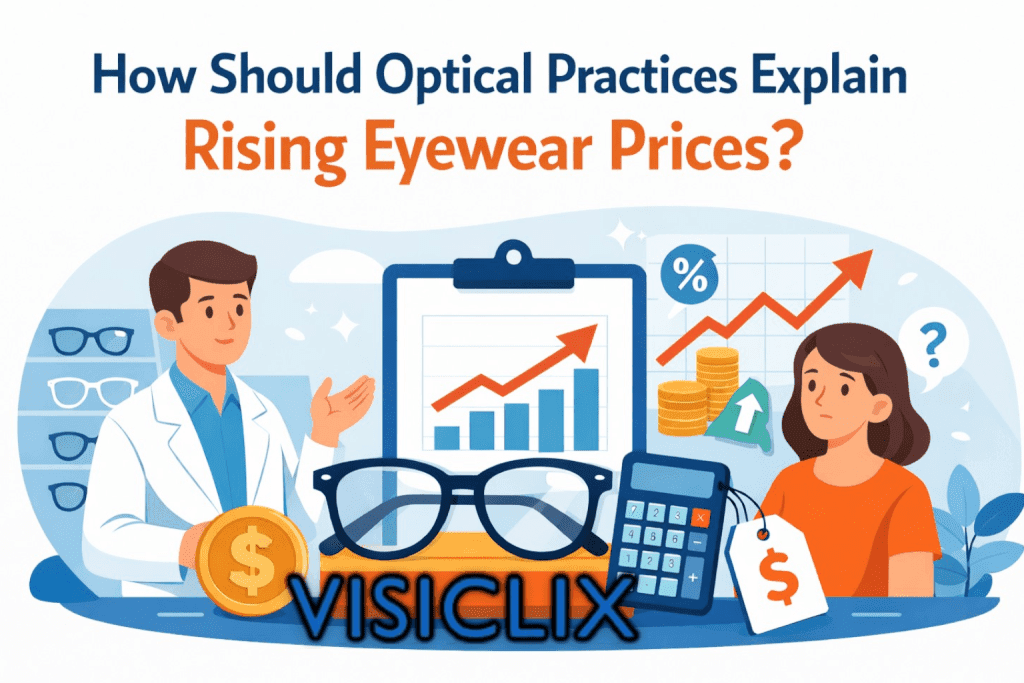
When eyewear prices move up, most patients do not want a lesson on trade policy. They want a straightforward answer, reassurance that they still have good options, and confidence that your practice is being fair. That is where optical tariffs marketing matters.
Tariffs have become a real pricing pressure across the optical category. In 2025, The Vision Council said tariff changes were affecting the cost and availability of optical products including frames, lenses, and equipment, while its later provider research found that 62% of eyecare providers said tariffs had already affected their practices and 66% expected continued or worsening impact through the end of the year.
For optical practices, that creates a messaging challenge as much as a margin challenge. If your website, paid ads, front-desk staff, and optical team explain pricing poorly, patients may assume your practice is vague, defensive, or simply raising prices without justification. If your communication is clear, calm, and consistent, you can protect trust even in a volatile pricing environment.
This guide explains how to talk about tariff-related pricing changes in a way that is honest, patient-friendly, and strong enough for PPC landing pages, promotions, and in-office conversations.
What is optical tariffs marketing?
Optical tariffs marketing is the way an optical practice explains tariff-related pricing pressure to patients across its marketing and patient journey. That includes website copy, paid search landing pages, promotional language, appointment reminders, staff talking points, financing pages, and in-store signage.
The goal is not to turn tariffs into a scare tactic. It is to make price communication more transparent and more credible. Patients should understand that prices can change because of broader supply-chain and import costs, but they should also hear that your practice is still focused on value, choice, and access to care.
In other words, optical tariffs marketing is not about blaming tariffs for every price increase. It is about giving patients enough context to understand why prices may be shifting, without overwhelming them with policy details or making the experience feel political.
How do tariffs affect eyewear, lenses, and optical pricing?
Tariffs affect optical pricing by raising the cost of imported goods or components somewhere in the supply chain. The Vision Council said in April 2025 that changing tariff regulations would significantly affect the cost and availability of optical products including frames, lenses, and equipment. It also said newly imposed reciprocal tariffs increased import duties on goods from nearly all countries by at least 10%, with especially significant impact on companies importing eyewear and optical products from China and other higher-rate countries.

Vision Monday reported in March 2025 that tariffs on imports from Mexico and Canada took effect at 25%, while imports from China faced an added 20% surcharge on top of existing duties. The same report, using Vision Council analysis of U.S. International Trade Commission import data, said China was the main importer of frames and mountings, sunglasses, and other glasses categories such as readers and goggles, while Mexico was the top importer of non-glass spectacle lenses.
That matters because pricing pressure does not always hit every product line at once or in the same way. Some practices may feel it first in frame costs, some in lens categories, some in accessories, and some in equipment or wholesale supply pricing. The business reality is that even when a practice tries to absorb part of the increase, sustained import pressure usually forces some combination of price adjustment, sourcing changes, product mix changes, or offer changes over time. The Vision Council’s August 2025 provider research supports that broader business impact, showing tariffs were already affecting practices across the market.
Why do patients react negatively when price increases are explained poorly?
Patients rarely react to price alone. They react to surprise, uncertainty, and the feeling that something is being hidden. When the explanation is vague, the patient often fills in the gaps with suspicion.
That is especially important in digital marketing. Google’s Misrepresentation policy says ads and destinations that deceive users by excluding relevant product information or by providing misleading information can compromise user trust, and the policy is designed to ensure ads are clear, honest, and give users the information they need to make informed decisions. Google also flags “unavailable offers” and dishonest pricing practices as problems.
The same principle applies offline. If your ad suggests one thing, your landing page implies another, and your staff explains a third version in person, the patient does not experience nuance. They experience inconsistency. That inconsistency makes even a reasonable price increase feel harder to accept.
How should optical practices explain price changes to patients clearly and calmly?
The best explanation is usually short. Start with the truth, remove the drama, and move quickly to options.
A strong framework looks like this:
Your prices may have changed because supplier and import costs have shifted across parts of the optical market. We are keeping our product quality high, reviewing pricing carefully, and offering options at different price points so you can choose what works best for your vision needs and budget.
That works because it does four things at once. It acknowledges the change. It explains the change in plain English. It reassures the patient that quality and care still matter. And it shifts the conversation toward choice instead of conflict.
A weaker version sounds like this: “Everything is more expensive because of tariffs.” That may be partially true, but it is too broad and too defensive. It also invites argument because it sounds like a blanket excuse.
A stronger version sounds like this: “Some eyewear and lens categories have become more expensive due to supplier and import-cost changes, so we’ve updated pricing selectively. We’ll walk you through the best options for your prescription and budget.” That wording is more precise, more patient-centered, and easier for staff to repeat consistently.
What should patient-facing tariff messaging say on your website?
Your website should not become a tariff news hub. It should become a clarity tool.
On service pages, product pages, or pricing-related FAQs, use concise language that explains that pricing and product availability may change as supplier and import conditions evolve. Keep the tone neutral. Patients do not need a running commentary on trade policy. They need to know that your practice is proactive, transparent, and ready with alternatives.
On PPC landing pages, do not promise aggressive price points unless the destination page supports them clearly. Google’s destination and promotion rules emphasize that destinations should be functional, useful, and easy to navigate, and that products or services should be priced accurately, easily found at the ad’s destination, and match the ad’s headers and descriptions.
That means a practice advertising “affordable eyewear” or “frame specials” should make the offer easy to understand on the landing page. If there are exclusions, timing limits, or product-tier differences, they should be visible early rather than buried late in the path.
A useful website message could say:
“Eyewear pricing can vary as product and supplier costs change. We keep our pricing as clear as possible and offer a range of frame and lens options to help you find the right fit.”
That language is simple enough for patients and safe enough for performance marketing.
Are tariffs the only reason eyewear prices go up?
No. Tariffs can be one driver, but they are not the only one.
Even within the optical category, The Vision Council’s provider research grouped tariffs with broader economic pressures such as inflation, and practices reported that both were affecting operations.
That distinction matters in patient messaging. If you overstate tariffs as the single cause of every price adjustment, your message can become brittle. Patients may hear another explanation elsewhere and conclude your practice is exaggerating. A better approach is to say that prices may change due to supplier costs, import duties, sourcing conditions, and other market pressures.
That keeps your messaging accurate and durable. It also prevents your brand from sounding reactive every time the trade environment changes again.
How can optical practices talk about higher prices without sounding defensive?
The trick is to explain, not justify. Explanation feels helpful. Justification feels nervous.
Use calm, factual language. Avoid emotionally loaded phrases such as “we had no choice” or “everything is out of control.” Those phrases turn the patient conversation into a debate. Instead, keep the focus on what the patient needs to know right now.
A good tone has four qualities. It is brief. It is specific. It is empathetic. And it is solution-oriented.
For example:
“We’ve seen cost changes in some eyewear categories, so some prices have been updated. We still have strong options across different price points, and we’ll help you compare them.”
That tone works because it does not ask the patient to sympathize with your business. It keeps the conversation centered on patient value and next steps.
What pricing options can practices offer when patients feel cost pressure?
When patients feel cost pressure, clarity alone is not enough. They also need choices.
The most useful options are usually practical rather than flashy: good-better-best frame selections, flexible lens package recommendations, second-pair strategies where they are genuinely valuable, help understanding insurance benefits, and payment or financing pathways when appropriate.
The key is that these options must be real. FTC pricing guidance warns against deceptive comparisons and fictitious “former price” claims. The eCFR text for 16 CFR Part 233 says a former price used in bargain advertising must be an actual, bona fide price offered on a regular basis for a reasonably substantial period, and that inflated or fictitious former prices create false bargains. It also says “free,” “2-for-1,” “50% off,” and similar offers must have their terms and conditions made clear at the outset.
So if your practice introduces promotions to offset patient objections, they should be honest promotions, not marketing bandages. A second-pair offer can work. A questionable “was/now” claim that does not reflect real pricing history can damage trust.
How should staff answer common patient questions about tariff-related price increases?
Staff scripts should be short enough to remember and flexible enough to sound human. The goal is consistency, not robotic phrasing.
Here are examples Visiclix-style practices can use:
- Why did my glasses cost more this year?
“Some eyewear categories have seen supplier and import-cost increases, so certain prices have changed. We’re reviewing pricing carefully and still offer options at different price points.” - Are all frames going up?
“No. It depends on the brand, supplier, and product category. We can show you comparable styles at a few different budgets.” - Can I choose a lower-cost option?
“Absolutely. We can walk through frames and lens choices that fit your prescription and budget without compromising the essentials.” - Should I buy now or wait?
“If you need glasses now, it usually makes sense to choose based on your vision needs and budget today. We can help you compare current options clearly.” - Is quality changing too?
“Our focus is still on helping you get the right product for your needs. If you want alternatives at different price levels, we’ll show you the differences clearly.”
What makes these answers effective is that they acknowledge the issue without turning the interaction into a tariff seminar. They also give the patient a path forward in the same breath.
Why is consistency across marketing, front-desk messaging, and optical staff so important?
Because inconsistency creates friction faster than almost any single price increase.
A patient who clicks a paid ad, lands on a page with vague pricing language, and then hears a different explanation in store is likely to feel misled. Google’s policies reflect the same user-experience principle: ads should be clear and honest, destinations should be useful and easy to navigate, and promoted offers should match what users actually find.
In practice, that means your paid media team, website team, front desk, and opticians should all work from the same messaging framework. They do not need identical scripts, but they do need aligned ideas:
- Prices may shift in some categories.
- The practice is being transparent.
- Patients still have options.
- Quality and care remain the priority.
When those ideas line up, the patient journey feels coherent. And coherent experiences convert better than clever copy that collapses under follow-up questions.
How can practices update PPC and landing page messaging when pricing conditions change?
Start by reviewing every active promise in your campaigns. Look at headlines, sitelinks, promotion assets, callouts, structured snippets, landing pages, and any financing copy tied to eyewear pricing.
Then separate your messaging into two buckets. The first bucket is evergreen value messaging, such as eye exams, frame selection, insurance help, and expert fitting. The second bucket is price-sensitive messaging, such as specials, starting prices, bundle claims, or “affordable” positioning. The second bucket needs the closest review when tariff conditions or supplier pricing change.
Google’s policy framework is useful here. Misrepresentation rules require clear and honest information, while promotion-related policy pages say prices should be accurate, easily found at the destination, and consistent with the ad.
That leads to a simple PPC checklist:
- Pause ads with outdated price anchors.
- Update landing pages before scaling traffic again.
- Clarify exclusions and qualifiers near the offer, not after the click.
- Use trust-building language instead of urgency if inventory or pricing is variable.
- Keep the destination experience simple and relevant.
For example, “Explore frame options across multiple budgets” is often stronger than a hard price-led claim you may need to revise again. It attracts qualified clicks without increasing bait-and-switch risk.
What mistakes should practices avoid in optical tariffs marketing?
The first mistake is blaming tariffs for everything. Patients do not need a sweeping macroeconomic explanation, and broad blame language makes your practice sound reactive.
The second mistake is becoming political. Tariffs may originate in policy, but patient communication should stay focused on prices, product availability, and options. Most brands gain nothing by turning a pricing explanation into a political statement.
The third mistake is using weak promotions to mask price increases. FTC deceptive pricing guidance and the Guides Against Deceptive Pricing make it clear that fictitious “sale” comparisons and unclear bargain terms are risky.
The fourth mistake is letting each staff member improvise. That creates unnecessary variation in how patients hear the story.
The fifth mistake is burying affordability support. If patients have lower-cost frame lines, insurance guidance, or payment options available, that should be part of the conversation early.
Can transparent pricing communication actually improve patient trust and retention?
Yes. Transparent pricing communication can strengthen trust because it reduces uncertainty.
Patients do not expect optical practices to control global trade conditions. They do expect a straightforward explanation of what affects them and what their options are. When your message is accurate, calm, and solution-focused, the patient is less likely to feel ambushed.
There is also a compliance and performance advantage to transparency. Google’s policy language repeatedly ties ad quality to clarity, honesty, accurate offer information, and relevant destinations.
That does not guarantee higher conversion rates on its own, but it does create the kind of friction-reducing experience that supports better lead quality, stronger appointment confidence, and fewer objections once the patient arrives.
What is the best patient messaging framework for optical practices right now?
The strongest framework for most practices is this:
- Explain simply.
- Reassure quality.
- Offer choices.
- Stay consistent.
- Update messaging as conditions change.
In practice, that sounds like this:
“Some eyewear prices have changed as supplier and import costs have shifted. We’re committed to clear pricing, quality products, and helping you compare options that fit your needs and budget.”
That one statement does almost everything you need. It acknowledges reality without dramatizing it. It avoids overclaiming. It supports website copy, ad copy, email copy, and live conversations. And it gives your team a repeatable foundation.
FAQ
Do tariffs always lead to immediate eyewear price increases?
No. Tariffs raise cost pressure, but the timing and size of any patient-facing price change depend on inventory, supplier contracts, sourcing mix, and how much of the increase a practice or supplier absorbs first. Still, 2025 optical-industry reporting and Vision Council research show that tariffs have been materially affecting product costs and practice operations.
Should optical practices mention tariffs in ads?
Usually not in the headline unless tariffs are central to the query or message. In most cases, practices are better off using patient-centered language about clear pricing, product options, and honest communication. If you do reference price changes or promotions in ads, Google requires that the offer be accurate and consistent with the landing page.
How much detail should staff give patients about tariffs?
Only enough to explain the price change clearly. Most patients need a simple explanation that supplier and import costs have affected some eyewear categories. Staff should then move to options and recommendations.
Is it better to raise prices quietly or explain them openly?
Openly, as long as the explanation is brief and useful. Silence often creates more suspicion than a clear explanation. Honest communication also aligns better with ad and pricing transparency principles from Google and the FTC.
What pages on an optical website should be updated first?
Start with the highest-traffic and highest-intent pages: PPC landing pages, offer pages, frame or lens pages, financing pages, and FAQs. Those are the places where a mismatch between ads, prices, and explanations causes the most friction. Google’s destination and offer policies reinforce the importance of relevance and visible price accuracy.
Can tariff messaging help reduce patient objections?
Yes, when it is done well. Good messaging does not eliminate objections, but it can reduce surprise and make the conversation feel more fair. The combination that works best is simple explanation plus visible alternatives.
Conclusion
Optical practices do not need to become experts in public trade messaging to handle tariff-related pricing well. They need a better patient communication system.
The real opportunity in optical tariffs marketing is not to talk more about tariffs. It is to talk better about prices. Patients want transparency, not complexity. They want confidence, not defensiveness. And they want to know that even if some eyewear categories cost more, your practice can still help them make a smart decision for their vision and budget.
Practices that communicate this well will not just protect trust during a volatile pricing cycle. They will build a stronger brand long after the tariff headlines change.
Why Visiclix is Your Ideal Choice for Optical Tariffs Marketing?
Visiclix is uniquely positioned to help optical practices handle tariff-related pricing communication because this challenge sits at the intersection of patient psychology, search marketing, and optical conversion strategy. It is not enough to understand that tariffs affect frames, lenses, and supply costs. Your messaging also has to work inside Google Ads, on landing pages, in appointment funnels, and in real staff conversations where trust is either reinforced or lost.
That is where Visiclix brings value. Instead of treating pricing communication as a one-off copy edit, Visiclix can help align your PPC messaging, website language, patient education, and in-practice scripts into one coherent experience. The result is a clearer path from click to conversation to purchase, with fewer surprises for patients and fewer weak points in your funnel when market conditions shift.
How Visiclix Can Help You Strengthen Optical Pricing Messaging
If your practice needs to update its eyewear pricing communication, promotional language, or tariff-related patient messaging, Visiclix can help you build a strategy that protects trust and supports conversions. From PPC landing pages to FAQ copy to staff-ready talking points, Visiclix helps optical brands communicate price changes clearly, credibly, and in a way patients can actually understand.