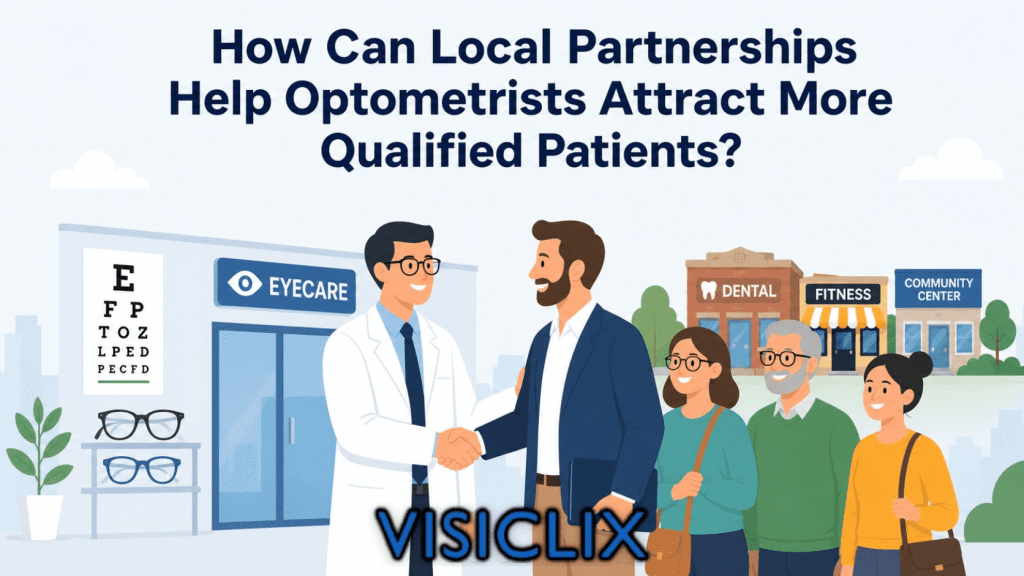
For many optometry practices, patient growth depends on the same crowded channels: Google Ads, insurance directories, local search, social media, word-of-mouth, and occasional referral relationships. Those channels matter, but they work best when the practice is already trusted in the community. That is where local partnerships for optometrists can become a powerful growth strategy.
Local partnerships help optometry practices reach people through organizations, professionals, and businesses their patients already know. A parent may trust a pediatrician’s recommendation. An employee may act on a workplace wellness reminder. A senior community resident may book an exam after an educational session on glaucoma, cataracts, or diabetic eye health. These are not random impressions; they are contextual moments where eye care feels relevant.
For optometrists, the goal is not simply to “network more.” The goal is to build ethical, measurable, patient-centered relationships that send better-fit patients into the practice. When local partnerships are paired with PPC, landing pages, tracking systems, and clear service-line messaging, they can help practices generate more qualified demand instead of relying only on broad visibility.
What Are Local Partnerships for Optometrists?
Local partnerships for optometrists are strategic relationships with nearby healthcare providers, schools, employers, senior communities, wellness businesses, local organizations, and specialty care providers that help connect the practice with people who need eye care. These partnerships may produce direct referrals, community education opportunities, co-hosted events, or awareness campaigns tied to specific patient needs.
A local partnership can be clinical, such as a referral relationship with a primary care office, pediatrician, ophthalmologist, retina specialist, or diabetes care provider. It can also be community-based, such as working with schools, HR teams, senior living facilities, gyms, or family-focused organizations. The best partnerships are not built around vague promotion. They are built around a clear overlap between the partner’s audience and the optometry practice’s ideal patients.
For example, a pediatrician’s office may regularly see parents concerned about reading, headaches, squinting, or school performance. A senior community may serve residents who are at higher risk for age-related vision concerns. A local employer may have teams experiencing screen-related eye strain. Each partner has a natural reason to educate its audience about eye health, and the optometry practice can provide expertise that makes that conversation easier.
The most valuable partnerships are repeatable. Instead of one coffee meeting or one flyer drop-off, the practice creates a simple system: identify the audience, offer useful education, make the referral pathway clear, track outcomes, and maintain the relationship over time.
Why Do Local Partnerships Bring in More Qualified Optometry Patients?
Local partnerships can bring in more qualified optometry patients because the introduction often happens through a trusted source and a specific need. A patient who hears about an optometrist from a pediatrician, employer, school, diabetes educator, or senior living coordinator may already understand why an appointment matters. That is very different from a patient who casually clicks an ad with no immediate context.
The American Optometric Association recommends comprehensive eye exams at key intervals for children, including before first grade and annually afterward for school-age children, while at-risk patients may need exams more frequently. That creates a strong reason for pediatric, school, and family-focused partnerships: the need is real, recurring, and easy to explain in parent-friendly language.
Partnerships can also support medical need-based referrals. The CDC notes that people with diabetes are at higher risk of eye diseases including retinopathy, glaucoma, and cataracts, and that yearly dilated eye exams and treatment can help avoid or delay these conditions. This makes primary care offices, diabetes educators, endocrinology groups, and community health organizations especially relevant partners for optometry practices that provide diabetic eye exams.
From a marketing perspective, partnership-driven patients are often more informed before they contact the practice. They may already know the reason for the exam, the type of service they need, or why waiting is not ideal. That can improve appointment intent, reduce price shopping, and help front-desk teams have more productive scheduling conversations.
Local partnerships can also strengthen PPC performance indirectly. When people hear about a practice offline and later search for it online, branded search demand can increase. When landing pages mention relevant community programs, educational events, or specific patient needs, paid traffic may feel more credible. In other words, partnerships can create trust before the click, while PPC captures demand when the patient is ready to act.
Which Local Businesses Make the Best Partnership Opportunities for Optometrists?
The best local partners are organizations that already serve people who may need eye exams, vision correction, specialty care, or eye-health education. A strong partner does not need to be another eye care provider. It simply needs to have a trusted relationship with an audience that overlaps with the practice’s ideal patients.
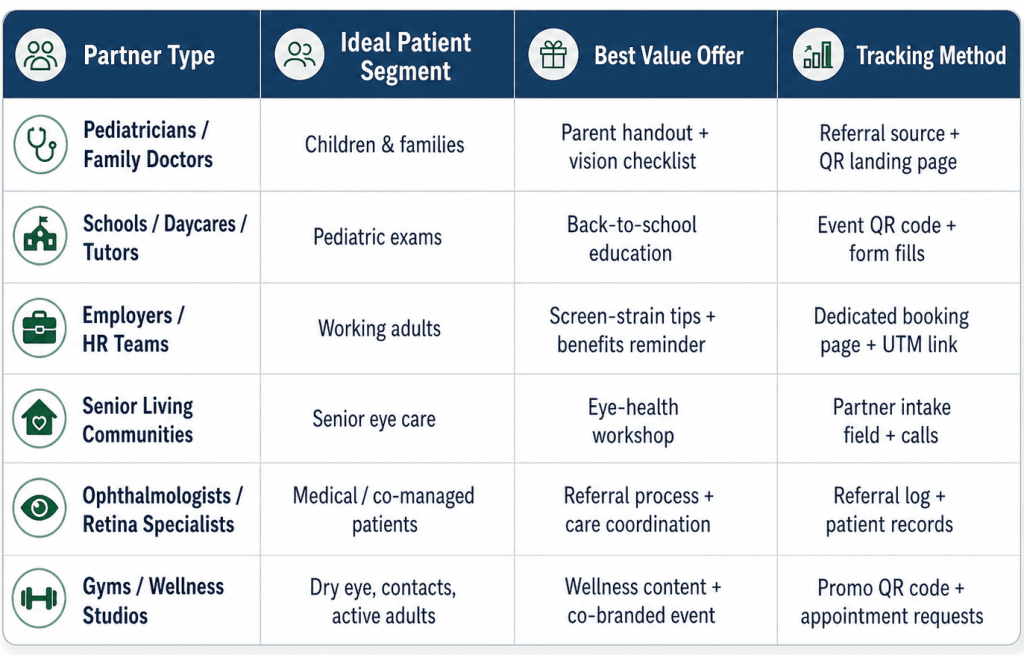
Optometrists should start by looking at their highest-value patient segments. A practice focused on pediatric care will prioritize different partners than a practice growing dry eye, specialty contact lenses, diabetic eye exams, myopia management, senior eye care, or premium eyewear. The right partner is the one that can help the practice reach the right patient at the right moment.
Pediatricians and Family Doctors
Pediatricians and family doctors are strong partners because they see children and families regularly. They may hear concerns about headaches, squinting, reading difficulty, attention challenges, or screen fatigue. While those symptoms are not always caused by vision problems, they can be a reason to recommend a comprehensive eye exam.
This partnership works best when the optometry practice offers simple resources, such as a parent handout on signs a child may need an eye exam or a back-to-school vision checklist. The goal is to make it easier for the medical office to educate families without turning the relationship into a sales pitch.
Ophthalmologists and Retina Specialists
Ophthalmologists and retina specialists can be important clinical partners for co-management, referrals, and continuity of care. Optometrists may refer patients who need surgical evaluation, retinal disease management, or advanced medical treatment. Specialists may refer patients back for routine care, prescription management, contact lenses, or ongoing monitoring when appropriate.
This kind of partnership depends on clarity. Both sides need to understand when referrals are appropriate, how patient records are shared, how follow-up communication works, and how the patient experience is protected.
Schools, Daycares, and Tutoring Centers
Schools, daycares, and tutoring centers are valuable partners because vision can affect learning, reading comfort, classroom participation, and parent concern. The AOA notes that school-age children’s visual systems face increased demands from learning, play, virtual learning, and electronic device use, making comprehensive eye and vision examinations important for assessing functions such as binocular vision, eye movement, and accommodation.
Optometrists can support these partners with parent education, back-to-school campaigns, teacher-facing resources, and age-appropriate awareness materials. Practices should be careful not to overstate claims or imply that all learning challenges are vision-related, but they can responsibly explain when an eye exam may be helpful.
Employers and HR Teams
Employers and HR teams can be strong partners for practices that want to reach working adults. Office teams, remote employees, warehouse staff, drivers, healthcare workers, and screen-heavy professionals may all have eye-care needs. Workplace partnerships can focus on digital eye strain education, safety eyewear, benefits reminders, annual eye exam awareness, or contact lens comfort.
These partnerships work well when the optometry practice gives HR teams a ready-to-use resource, such as a short newsletter blurb, lunch-and-learn topic, benefits-season reminder, or dedicated booking page for employees.
Senior Living Communities
Senior living communities, assisted living facilities, retirement communities, and local aging organizations can be strong partners for practices offering senior eye care. Residents may need education around cataracts, glaucoma, macular degeneration, diabetic eye disease, low vision, medication-related concerns, or transportation-friendly appointments.
A good senior-focused partnership should be practical. The practice can provide educational sessions, simple appointment instructions, caregiver-friendly materials, and clear communication about what the exam includes. The relationship should reduce friction for residents and families, not simply promote the practice.
Gyms, Wellness Studios, and Lifestyle Businesses
Gyms, wellness studios, yoga studios, sports clubs, and lifestyle businesses can support partnerships around performance, comfort, and prevention. These audiences may be interested in contact lenses, sports eyewear, dry eye symptoms, UV protection, or eye health as part of broader wellness.
These partnerships are usually best for awareness rather than direct medical referrals. They can work through educational content, local events, co-branded wellness campaigns, or member perks that are compliant and transparent.
How Can Optometrists Choose the Right Local Partnership Strategy?
Optometrists should choose a partnership strategy based on patient fit, service-line goals, referral potential, compliance, and trackability. A nearby business is not automatically a good partner. The relationship only makes sense if the partner serves people who are likely to need the practice’s services and if the practice can provide real value in return.
A useful starting point is to define the patient type the practice wants more of. For example, a practice may want more pediatric exams, diabetic eye exams, dry eye consultations, specialty contact lens patients, annual family exams, or senior eye health visits. Once that segment is clear, it becomes easier to identify partners who already influence that audience.
The next filter is natural relevance. A pediatrician has a natural reason to discuss children’s vision. An HR manager has a natural reason to discuss screen fatigue or benefits utilization. A senior community has a natural reason to host eye-health education. A random restaurant or unrelated retailer may offer visibility, but it may not produce qualified patient intent.
Practices should also consider operational readiness. A partnership can fail if the front desk does not know how to handle referred patients, if appointment availability is limited, or if no one tracks the referral source. Before launching outreach, the practice should make sure its team can answer partner-specific questions, route patients correctly, and document where inquiries came from.
Compliance must be part of the decision. Healthcare marketing and referrals can involve privacy, advertising, endorsement, and incentive rules. HHS explains that HIPAA generally requires authorization for uses or disclosures of protected health information for marketing purposes, with certain exceptions for treatment and healthcare operations. The FTC also provides guidance around endorsements, reviews, and testimonials, including the need for honest, transparent advertising practices.
How Do You Start a Local Partnership Without Sounding Salesy?
The best way to start a local partnership is to lead with shared patient value instead of asking for referrals. Most local businesses and healthcare providers do not want to feel like they are being used as a lead source. They are more likely to respond when the optometry practice offers something useful for their patients, customers, employees, or community.
A strong first message might focus on a specific audience need. For a pediatric office, the message could be about helping parents understand when a child may need a comprehensive eye exam. For an employer, it could be about helping employees manage screen-related discomfort and understand their vision benefits. For a senior community, it could be about providing an educational session on age-related eye health.
The outreach should be brief, specific, and easy to say yes to. Instead of saying, “We would love to partner and exchange referrals,” the practice might say, “We created a one-page guide for parents on signs that a child may need an eye exam. Would your team find this useful for families who ask about reading discomfort, squinting, or headaches?” That framing gives value first.
Once interest exists, the practice can suggest a simple next step. That may be a lunch-and-learn, handout, QR code to a dedicated education page, staff training session, community event, or referral process discussion. The practice should avoid making the relationship feel complicated at the beginning.
A good partnership also needs follow-up. After the first resource or event, the optometry practice should thank the partner, ask what questions came up, provide additional materials if useful, and share non-private performance insights when appropriate. The relationship becomes stronger when the partner sees that the practice is organized, responsive, and patient-centered.
What Should Optometrists Offer Local Partners in Return?
Optometrists should offer partners practical value that helps their audience, not improper incentives. The strongest value exchange is usually education, convenience, expertise, and trust. A partner should feel that the relationship makes them more helpful to their own patients, clients, residents, employees, or families.
Educational content is one of the simplest offers. The practice can provide handouts, short videos, newsletter blurbs, event slides, checklists, or FAQs. These materials can explain when to schedule an eye exam, what to expect during a visit, how vision benefits work, or why certain patients may need specialized care.
For healthcare partners, value may come from clear communication. That can include referral forms, secure record-sharing processes, care summaries, direct points of contact, and timely updates. For community partners, value may come from accessible programming, such as workshops, screenings where appropriate, or family education nights.
Cross-promotion can be useful, but it should be handled carefully. If a practice features a partner in a newsletter or social post, the relationship should be honest and transparent. If any incentive, compensation, or endorsement is involved, the practice should understand applicable advertising and healthcare rules. The FTC’s endorsement guidance emphasizes that advertising involving endorsements and reviews must meet standards for truthfulness and transparency.
The practice should also think beyond “what can we give?” and ask “what friction can we remove?” A partner may value simple scheduling instructions, a dedicated landing page, clear insurance information, or a contact person more than a promotional flyer. The easier the process, the more likely the partnership is to produce real patient action.
How Can Local Partnerships Support PPC and Digital Marketing Campaigns?
Local partnerships can support PPC by strengthening trust, improving message relevance, and giving campaigns more specific angles. A generic ad for “eye exams near me” may reach active searchers, but a campaign tied to back-to-school exams, workplace screen fatigue, diabetic eye exams, or senior eye health can speak to a clearer patient need.
Google Ads location assets can show information such as a business address, map details, and approximate travel distance, helping people find a physical location. For optometry practices, this matters because patient acquisition often depends on local convenience as well as clinical fit. Google also notes that conversion measurement can help advertisers understand valuable actions such as purchases, sign-ups, phone calls, and other business goals.
A partnership can give PPC campaigns a stronger landing page strategy. For example, an employer partnership might use a dedicated page about digital eye strain and annual exams. A pediatric partnership might use a page about children’s eye exams and back-to-school readiness. A diabetes-focused partnership might use a page explaining the importance of diabetic eye exams and how to schedule one.
Partnerships can also improve local search behavior. Google Business Profile guidance says local ranking is influenced by relevance, distance, and prominence, and that complete, accurate business information can make a business more likely to appear in local search results. When a practice becomes more visible in the community, people may be more likely to search for the practice by name, read reviews, click map results, or respond to branded ads.
The best PPC strategy connects offline trust with online conversion. A school event should have a QR code. A senior community session should have a simple appointment page. An HR email should link to a relevant landing page. A pediatrician handout should use a trackable URL or call source. That way, partnership activity does not disappear into vague “word-of-mouth” performance.
How Can Optometrists Track Whether Partnerships Are Actually Working?
Optometrists should track partnerships the same way they track marketing campaigns: by source, appointment quality, conversion, revenue, and follow-up behavior. A partnership that generates many conversations but few booked appointments may need a clearer offer. A partnership that sends fewer patients but produces high-value, high-retention patients may be worth expanding.
The most basic tracking method is a required referral-source field during scheduling or intake. The front desk should ask every new patient how they heard about the practice and record the answer consistently. Partner names should be standardized so reports do not become fragmented across variations like “school,” “local school,” and “Lincoln Elementary.”
The practice can also use partner-specific landing pages, QR codes, UTM-tagged links, dedicated call tracking numbers, event registration pages, or appointment request forms. Google Ads also supports phone call conversion setup, helping advertisers connect call data to campaigns and identify which ads drive valuable phone leads.
Tracking should go beyond the first appointment. Practices should look at show rate, new patient conversion rate, revenue per patient, service line, eyewear or contact lens purchases, follow-up appointment rate, and long-term retention. A partnership that produces patients who return annually or bring family members may be more valuable than one that generates one-time discount seekers.
For PPC-connected partnerships, practices should monitor branded searches, landing page conversion rates, map actions, phone calls, and appointment requests. Google’s store visit conversion guidance explains that offline visits can help measure the full value of online ads when physical location visits matter. While eligibility and setup vary, the principle is important: optometry marketing should connect online activity with offline patient behavior wherever possible.
What Mistakes Should Optometrists Avoid With Local Partnerships?
The biggest mistake is treating partnerships as one-time introductions instead of ongoing systems. A single meeting, flyer, or event rarely creates a reliable patient channel by itself. Partnerships need consistent communication, clear expectations, easy referral pathways, and periodic review.
Another common mistake is choosing partners based only on proximity. A business across the street may be convenient, but it may not serve the right patient segment. A more relevant partner two miles away may produce better results if its audience matches the practice’s services.
Optometrists should also avoid asking for referrals too soon. A practice that leads with “send us patients” may weaken trust before the relationship begins. It is usually more effective to start with education, resources, or shared community value, then build toward a referral process once the partner sees credibility.
Compliance is another area where practices need caution. Partnerships should not involve improper incentives, careless patient data sharing, misleading claims, or undisclosed endorsements. HHS guidance on HIPAA marketing and FTC guidance on endorsements should be treated as reminders that healthcare growth must be handled ethically and transparently.
Finally, practices should not let partnerships live only in the owner’s head. If only the doctor knows about the relationship, the front desk may mishandle referred patients, marketers may miss tracking opportunities, and follow-up may never happen. The partnership should be documented, trained, and reviewed like any other growth channel.
When Should an Optometry Practice Invest More Seriously in Partnership Marketing?
An optometry practice should invest more seriously in partnership marketing when it wants sustainable local growth, better patient quality, and stronger trust beyond standard advertising. Partnership marketing is especially useful when a practice has specific services it wants to grow, such as pediatric eye care, dry eye treatment, myopia management, diabetic eye exams, specialty contact lenses, senior eye health, or annual family exams.
Partnership marketing is also valuable when a practice is opening a new location or trying to stand out in a competitive area. Paid ads can generate clicks quickly, but local relationships can help build recognition and credibility in the surrounding community. This is especially important when patients have many nearby options and need a reason to choose one practice over another.
A practice should also consider partnerships when PPC leads are inconsistent or too broad. If campaigns are generating low-intent calls, insurance-only shoppers, or poorly matched patients, partnerships can help refine demand. Instead of targeting everyone searching for eye exams, the practice can build campaigns around specific audiences and needs.
Partnerships are also useful before seasonal demand periods. Back-to-school season, benefits renewal periods, workplace wellness initiatives, diabetes awareness campaigns, and senior health events can all become structured marketing opportunities. The earlier the practice builds partner relationships, the easier it is to activate them at the right time.
Can Local Partnerships Replace Paid Advertising for Optometrists?
Local partnerships usually should not replace paid advertising, but they can make paid advertising more effective. Partnerships are strong for trust, education, and community credibility. PPC is strong for capturing demand when patients are actively searching, comparing options, or ready to book.
A patient may first hear about the practice through a pediatrician, school event, HR email, senior living session, or community resource. Later, that same patient may search the practice name, click a Google ad, visit the website, read reviews, and schedule online. In that journey, the partnership created trust, while digital marketing captured the appointment.
The reverse can also happen. A patient may click an ad first but feel more confident because the landing page mentions local education programs, community partners, or relevant service expertise. In competitive markets, that added credibility can help the practice stand out from clinics that only show generic ad copy.
The strongest growth strategy combines both. Partnerships create local relevance. PPC captures intent. Local SEO supports discovery. Landing pages convert interest. Tracking reveals which relationships and campaigns produce the best patients. Together, these channels create a more balanced acquisition system than relying on any single source.
How Can Optometrists Build a Repeatable Local Partnership Plan?
Optometrists can build a repeatable local partnership plan by turning relationship-building into a structured marketing process. The first step is to define the patient segments the practice wants to grow. A practice should not simply say, “We want more patients.” It should clarify whether it wants more families, children, contact lens wearers, diabetic patients, seniors, dry eye patients, or annual exam bookings.
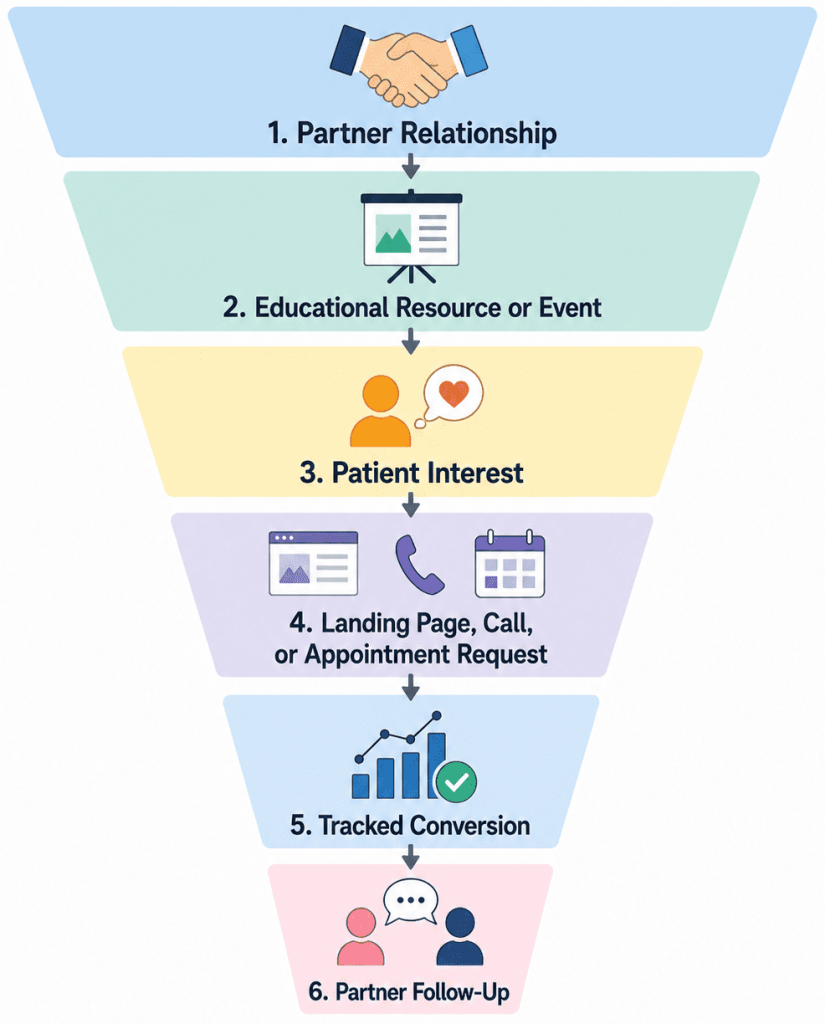
The second step is to map each patient segment to likely local partners. Pediatric exams may connect to pediatricians, schools, daycares, tutoring centers, and parent organizations. Diabetic eye exams may connect to primary care offices, diabetes educators, endocrinology practices, pharmacies, and local health groups. Senior eye care may connect to senior living communities, caregiver organizations, and local retirement groups.
The third step is to create one valuable offer for each partner type. That might be a handout, workshop, landing page, staff training, checklist, co-hosted event, or newsletter article. The offer should be specific enough to make the partner’s life easier and relevant enough to motivate patients to act.
The fourth step is outreach. The practice can create a simple script that introduces the shared audience need, explains the resource, and suggests a low-pressure next step. Outreach should be personal, not mass-produced. A good message shows that the practice understands the partner’s audience.
The fifth step is tracking. Every partnership should have a referral-source field, QR code, landing page, call tracking setup, or other measurement method. Without tracking, the practice may continue investing in relationships that feel productive but do not generate results.
The final step is quarterly review. The practice should look at which partners generated appointments, which produced high-quality patients, which need a better offer, and which should be paused. Over time, the practice can double down on the relationships that support real growth.
FAQ
What are the best local partnerships for optometrists?
The best local partnerships for optometrists are relationships with organizations that already serve people who may need eye care. These often include pediatricians, family doctors, schools, employers, senior living communities, ophthalmologists, retina specialists, diabetes care providers, and wellness organizations.
The best choice depends on the practice’s goals. A pediatric-focused practice should prioritize schools and pediatric offices. A practice growing diabetic eye exams should prioritize primary care, diabetes educators, and community health groups. A practice focused on working adults may benefit from employer and HR partnerships.
How do optometrists ask local businesses for referrals?
Optometrists should not start by directly asking for referrals. A better approach is to offer something useful, such as an educational guide, staff training, event, newsletter resource, or patient-friendly checklist. This positions the practice as a helpful local expert rather than a business asking for leads.
Once trust is established, the practice can discuss how to make referrals simple and appropriate. That may include a dedicated landing page, QR code, referral form, phone number, or clear instructions for patients.
Are healthcare referral partnerships allowed for optometry practices?
Healthcare referral partnerships can be appropriate, but they must be handled carefully. Practices should avoid improper incentives, misleading claims, careless patient data sharing, or undisclosed promotional arrangements. HIPAA, state healthcare rules, professional ethics, and advertising regulations may all apply depending on the relationship.
HHS explains that HIPAA generally requires authorization for uses or disclosures of protected health information for marketing, with certain exceptions. Practices should consult qualified legal or compliance guidance before creating referral arrangements involving compensation, patient information, or co-marketing.
How long does it take for local partnerships to generate patients?
Some partnerships may generate appointments quickly, especially if they are tied to a specific event, seasonal campaign, or urgent patient need. Others take longer because trust must develop before referrals become consistent.
Practices should usually evaluate partnerships over several months rather than after one interaction. The most important question is not only how many patients came in, but whether those patients were qualified, showed up, accepted care, returned, and referred others.
Should optometrists partner with schools?
Yes, schools can be valuable partners for optometrists, especially for pediatric and family eye care. School partnerships can support parent education, back-to-school campaigns, and awareness around signs that a child may need an eye exam.
However, practices should keep school partnerships educational and appropriate. They should avoid making exaggerated claims or creating pressure-based promotions. The strongest school partnerships help parents understand when a comprehensive eye exam may be useful.
How can optometrists track offline referrals from local partners?
Optometrists can track offline referrals by using intake questions, referral-source fields, partner-specific QR codes, landing pages, call tracking numbers, event forms, and CRM notes. The key is consistency. Every team member should know how to ask and record where a patient came from.
Practices should also track appointment quality. A partner that sends fewer but better-fit patients may be more valuable than one that produces many low-intent inquiries.
Do local partnerships help with Google Ads performance?
Local partnerships can help Google Ads performance indirectly by increasing trust, improving landing page relevance, and creating more specific campaign themes. A patient who has already heard about the practice through a trusted source may be more likely to search, click, call, or book.
Partnerships also give practices better PPC angles. Instead of only running generic eye exam ads, a practice can build campaigns around back-to-school exams, workplace eye strain, diabetic eye exams, senior eye health, or contact lens comfort.
Conclusion
Local partnerships help optometry practices grow by creating trust before the patient ever searches, clicks, calls, or books. When partnerships are chosen strategically, they can connect the practice with people who already have a relevant reason to care about eye health.
The strongest local partnerships are specific, ethical, measurable, and patient-centered. They are not just about visibility or networking. They are about building reliable pathways between the practice and the people most likely to benefit from its services.
For optometrists, the opportunity is clear: combine local trust with digital marketing discipline. Use partnerships to create awareness and credibility. Use PPC and local SEO to capture demand. Use tracking to understand what works. When these pieces work together, patient acquisition becomes more qualified, more efficient, and more sustainable.
Why Visiclix is Your Ideal Choice for Local Partnerships for Optometrists?
Visiclix helps optometry practices turn local visibility into measurable patient growth. Instead of treating partnerships, PPC, and local search as separate efforts, Visiclix helps practices connect them into one smarter acquisition strategy. That means identifying the right patient segments, shaping campaigns around real community demand, and creating digital pathways that turn local trust into booked appointments.
For practices investing in local partnerships for optometrists, Visiclix brings the marketing structure needed to make those relationships perform. A partnership with a school, employer, senior community, or healthcare provider should not end with a handshake or a flyer. It should connect to the right message, landing page, tracking setup, and follow-up process so the practice can see which relationships are actually producing qualified patients.
Visiclix also understands that optometry growth is not just about generating more clicks. It is about attracting patients who fit the practice’s services, schedule appointments, show up, accept care, and return over time. By combining PPC strategy, local campaign planning, and conversion-focused execution, Visiclix helps optometry practices build growth systems that are both visible and accountable.
Build Smarter Patient Growth With Visiclix
Local partnerships can open the door to better patient relationships, but they work best when supported by a clear digital strategy. Visiclix helps optometry practices create PPC and local marketing campaigns that turn community trust into measurable growth.
If your practice wants more qualified patients from smarter local visibility, partnership-driven campaigns, and better conversion strategy, Visiclix can help you build the system to support it.