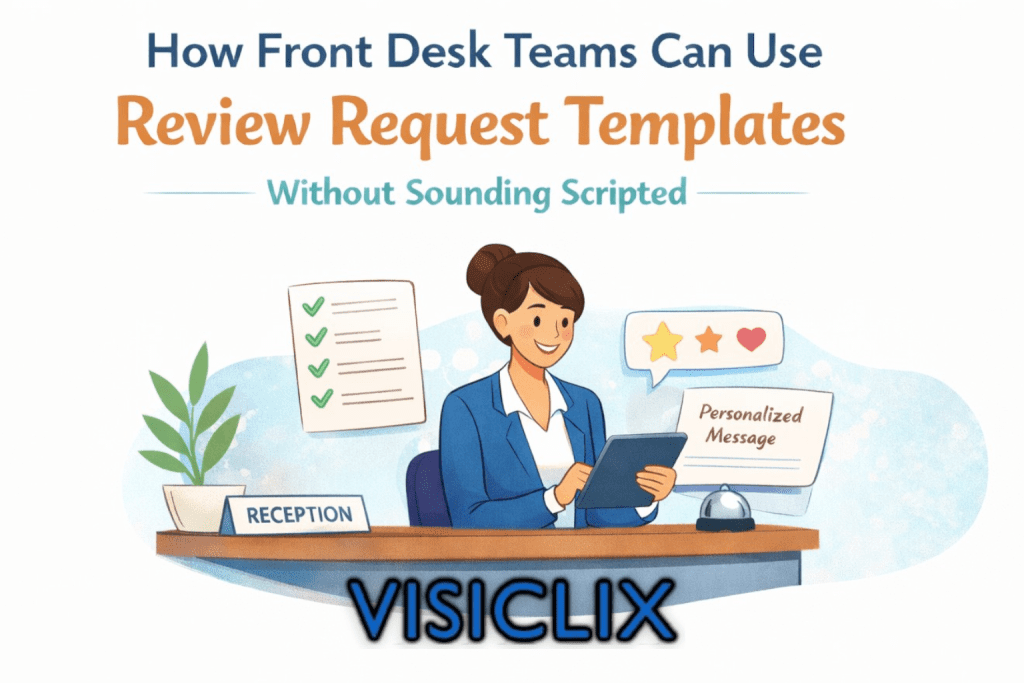
If your front desk team interacts with customers all day, they are sitting on one of the best opportunities to generate more online reviews.
The problem is that most staff either do not ask at all, or they ask in a way that feels awkward, forced, or overly rehearsed. That usually happens when businesses rely on stiff scripts that sound more like policy than conversation.
The good news is that front desk teams do not need to sound salesy to get results. They just need the right review request templates, clear timing, and a simple process they can use naturally in real customer interactions.
In this guide, we will walk through how front desk teams can ask for reviews confidently, what makes a template effective, which channels work best, and how to train staff to turn more positive interactions into authentic online feedback.
What Are Review Request Templates for Front Desk Teams?
Review request templates are ready-to-use messages and talking points that help front desk staff ask customers for reviews in a consistent and professional way.
These can be used in several formats, including:
- in-person scripts
- text messages
- follow-up emails
- QR code handoffs
- post-visit reminders
For front desk teams, templates are especially helpful because they remove uncertainty. Instead of wondering what to say, staff can follow a simple structure that feels natural and keeps the request short.
A good template does not make employees sound robotic. It gives them a starting point they can adapt to the moment. That is what makes the difference between a review request that feels genuine and one that feels scripted.
Why Front Desk Teams Matter So Much in Review Generation
Front desk employees are often the last people a customer speaks with before leaving. That final interaction matters.
Whether it is a receptionist at a dental office, a hotel front desk associate, a salon coordinator, or a service business administrator, the person at the desk often controls the closing moment of the experience. If that moment is positive, it creates the perfect opening for a review request.
Customers are much more likely to leave a review when:
- the experience is still fresh
- the request feels personal
- the process is easy
- the timing feels natural
That gives front desk teams a major advantage over delayed follow-up alone. They can identify positive moments in real time and guide customers toward the easiest next step.
How to Ask for Reviews Without Sounding Robotic
The easiest way to avoid sounding scripted is to stop thinking of templates as speeches.
Front desk staff should not feel like they have to recite a fixed paragraph word for word. Instead, they should use a simple formula:
thank the customer, make the ask, and offer one easy action
That is all.
For example, a front desk team member does not need to say something long and polished. A short, conversational line works much better:
“Thanks so much for coming in today. If you have a minute, we’d really appreciate a quick review.”
That sounds human because it is brief, polite, and connected to the actual interaction.
To keep requests natural, front desk teams should:
- keep the wording short
- speak like a real person, not a brand statement
- mention the visit or appointment when relevant
- avoid pushing for a certain rating
- make it easy to complete the review right away
The best template is the one staff can actually say with confidence.
When Is the Best Time to Ask for a Review?
Timing has a huge impact on whether a customer follows through.
The best time to ask is right after a positive moment, such as:
- at checkout
- after a successful appointment
- after a smooth stay or visit
- after resolving a problem
- when a customer says thank you or compliments the service
This works because the experience is still top of mind. The customer does not have to remember how they felt three days later. They are already in the moment.
That said, not every interaction is the right one. Front desk teams should avoid asking when:
- the customer seems rushed
- the customer is frustrated
- the issue is unresolved
- the environment is too busy or chaotic
- the request would feel out of place
A review request should feel like a natural extension of a good experience, not an automatic task staff force into every conversation.
Which Channels Work Best for Front Desk Review Requests?
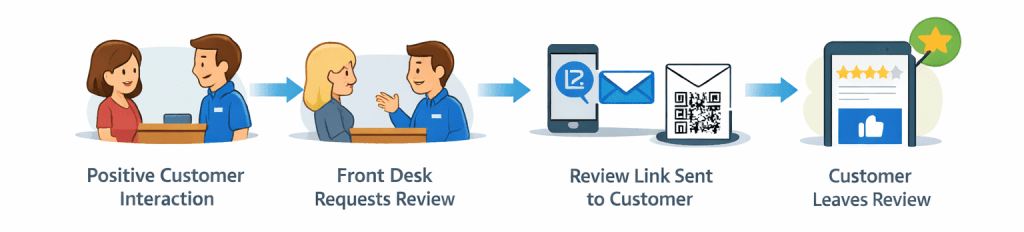
The best review strategies use the front desk to start the request and a digital channel to make completion easier.
In-person requests
These work well because they feel warm and personal. A face-to-face ask can create immediate buy-in, especially after a positive interaction.
SMS review requests
Text messages are often the fastest way to get reviews because customers can tap the link on their phone and complete the action quickly.
Email review requests
Email works well when the business wants a slightly more polished follow-up or when a customer is less likely to respond by text.
QR codes
QR codes are great for front desk spaces, waiting areas, counters, and reception desks. They make it easy for customers to scan and leave a review without searching for the business manually.
In most cases, the strongest setup is not choosing only one channel. It is combining them in a simple workflow. The front desk starts the ask, and the customer gets a fast way to follow through.
What Every Strong Review Request Template Should Include
A high-performing review request template does not need to be clever. It needs to be clear.
The strongest templates usually include four things:
- A quick thank-you
Start with appreciation. It makes the message feel more natural and less transactional. - A simple request
Do not overexplain. Ask for a review in one sentence. - One clear next step
Include one link, one QR code, or one clear action. Too many choices create friction. - A natural tone
The message should sound like something a front desk employee would actually say out loud.
The best templates also feel specific to the experience. Even a small detail like “after your appointment today” or “about your stay with us” can make the message feel far more personal.
Review Request Templates for Front Desk Teams
Here are blog-ready templates your team can use and adapt.
Simple in-person review request template
“Thanks so much for coming in today. If you have a minute, we’d really appreciate an honest review about your experience.”
This is a great everyday option because it is short, polite, and easy to say naturally.
Checkout desk review request template
“We’re glad we could help today. If you’d like, you can leave a quick review using this link or QR code.”
This works well when the customer is checking out and the visit ended on a positive note.
Front desk SMS review request template
“Hi [First Name], thanks for visiting [Business Name] today. If you have a moment, we’d appreciate your feedback here: [Review Link]”
This is one of the most effective formats because it is fast, convenient, and easy to complete.
Front desk email review request template
Subject: Thanks for visiting [Business Name]
Hi [First Name],
Thank you for visiting [Business Name] today. We hope you had a great experience. If you have a moment, we’d really appreciate a quick review here: [Review Link]
Thank you,
[Team Name]
This works well for businesses that already use email as part of their post-visit communication.
QR code handoff template
“If you’d like to leave feedback about your visit, you can scan this QR code anytime. We really appreciate it.”
This is ideal for walk-in traffic, hotel desks, salons, clinics, and other reception-heavy businesses.
Hotel front desk review request template
“Thank you for staying with us. If you enjoyed your visit, we’d love it if you shared a quick review about your experience.”
This feels guest-friendly and fits the tone of hospitality environments.
Dental or healthcare front desk review request template
“Thank you for visiting us today. If you’d like to share feedback about your experience, we’d really appreciate a quick review here: [Review Link]”
This keeps the language general and professional.
Salon or spa front desk review request template
“Thanks for coming in today. If you enjoyed your visit, we’d love a quick review. It really helps our team.”
This works because it feels warm, personal, and service-oriented.
Service business appointment template
“Thanks for meeting with us today. If you have a minute, we’d appreciate your feedback in a quick review here: [Review Link]”
This is a good fit for appointment-based businesses that want a more neutral tone.
Issue-resolution review request template
“Thank you for giving us the chance to make this right today. If you’d like to share feedback about the experience, here’s the link: [Review Link]”
Only use this after the issue has clearly been resolved and the customer seems satisfied.
Second follow-up template
“Hi [First Name], just a quick follow-up to thank you again for visiting [Business Name]. If you’d still like to leave feedback, here’s the link: [Review Link]”
This works best as a gentle reminder, not a repeated push.
How to Personalize Review Request Templates at Scale
Personalization does not need to mean writing every message from scratch.
The easiest way to scale personalization is to build templates with a few flexible fields, such as:
- customer name
- business name
- location
- appointment type
- visit type
- staff name
- review link
That gives staff enough room to make the message feel relevant without creating inconsistency.
For example, instead of sending the same generic message every time, a team can adjust the wording slightly:
- “Thanks for visiting us today”
- “Thanks for coming in for your consultation today”
- “Thanks for staying with us this weekend”
Those small changes make the request feel more human without making the process harder.
How to Train Front Desk Teams to Use Templates Well
Templates only work when staff know how to use them in real conversations.
That is why training matters just as much as the wording itself.
Managers should focus on:
- timing
- delivery
- reading customer cues
- knowing when not to ask
- understanding which template fits which situation
Roleplay is one of the best ways to train this. Staff should practice common scenarios such as:
- a smooth checkout
- a grateful customer
- a rushed customer
- a neutral interaction
- a recently resolved complaint
This helps employees get comfortable using the language naturally rather than sounding like they are reading a memorized script.
The goal is consistency, not sameness. Every front desk employee can sound a little different, as long as the message stays professional, clear, and easy to act on.
Common Mistakes Front Desk Teams Should Avoid
Even strong templates can fail if they are used poorly.
Some of the most common mistakes include asking:
- at the wrong time
- with too much pressure
- with generic, awkward wording
- without a direct link or QR code
- before a problem is resolved
- in a way that feels transactional
Another mistake is assuming every customer should get the exact same script. Front desk interactions vary too much for that. Teams need structure, but they also need judgment.
One more major mistake is turning review requests into a numbers-only activity. Customers can tell when they are being pushed. The most effective review generation feels like part of good service, not a sales tactic.
How to Measure Whether Your Review Request Templates Are Working
If you want better results, you need to track what is actually happening.
Start by measuring:
- how many requests are being made
- which channels are being used
- how many reviews are completed
- which locations or staff members are getting the best response
- how quickly reviews are coming in after the request
This helps you answer important questions.
Are text messages outperforming email?
Are some staff members asking more naturally than others?
Are customers responding better after check-out than after follow-up?
Is one template clearly stronger than another?
Over time, this data helps you improve both the message and the workflow.
Can Review Request Templates Help With Reputation and Visibility?
Yes, absolutely.
Review request templates help businesses earn more consistent customer feedback, and that matters for two big reasons.
First, reviews build trust. When potential customers see recent feedback from real people, they feel more confident choosing your business.
Second, reviews support local visibility. Businesses with a steady stream of authentic reviews tend to look more active, more credible, and more appealing to people comparing options online.
Templates are not a shortcut. They are a system. And when front desk teams use that system well, it becomes much easier to turn positive customer experiences into public proof.
Conclusion
Front desk teams do not need to sound rehearsed to generate more reviews. They just need the right structure, the right timing, and a process that feels easy to use in real customer interactions.
The best review request templates are simple, conversational, and built for the way front desk teams actually work. When staff know when to ask, how to ask, and what channel to use next, review generation becomes far more consistent.
That is what makes the biggest difference. Not more scripts. Not longer messages. Just a smarter, more natural way to turn good service into authentic customer feedback.
Why Visiclix Is Your Ideal Choice for Review Generation and Reputation Growth?
Visiclix helps businesses turn review generation into a practical, repeatable process instead of leaving it up to chance. For front desk teams, that matters because success does not come from having a few generic templates saved in a folder. It comes from having the right message, the right workflow, and the right system in place to make asking for reviews feel easy and consistent.
With a smarter review strategy, businesses can support staff with natural templates, reduce friction for customers, and create a stronger flow of authentic feedback over time. Visiclix can help businesses build a review process that supports reputation growth, improves customer trust, and makes every positive interaction more valuable.
Ready to Grow More Reviews With Visiclix?
If your front desk team is already creating positive customer experiences, Visiclix can help you turn more of those moments into real online reviews that strengthen your reputation and support long-term growth.