If you’ve ever run “local” display and watched it turn into a broad awareness spend, you already know the problem: location targeting finds where people are, but it doesn’t reliably tell you why they’re there or whether they’re ready to buy. The fix is pairing location with intent signals so your ads show up for the right people in the right places—and you can measure outcomes, not just clicks.
Below is a practical, ROI-first playbook you can use to build, structure, and optimize a location + intent approach.
What is targeted display advertising, and what makes it “targeted”?
Targeted display advertising is display advertising that uses specific signals (audiences, behaviors, content context, location, and first-party data) to decide who should see your ads and where they appear—rather than buying broad, untargeted reach.
In practice, “targeted” usually means you’re using one or more of these levers:
- Audience segments (e.g., in-market, affinity, custom segments) and your data (remarketing / first-party audiences).
- Location targeting (countries, cities, ZIP/postal codes, radius targeting, business locations).
- Optimization systems that use your signals as a starting point to find more converters (when enabled).
The reason this matters for PPC-minded teams: display can be extremely efficient—if your targeting logic is designed to prioritize buying intent and conversion probability.
Why does “location + intent” outperform location-only targeting?
Because location-only answers “nearby,” not “ready.” A radius around a store catches commuters, employees, tourists, and accidental passersby. Intent signals narrow that reach toward people who are actually in-market now (or close enough to now that your offer can close the gap).
A simple way to think about it:
- Location targeting = relevance
- Intent targeting = readiness
- Location + intent = relevance and readiness
When you combine them, you typically get:
- Less wasted spend on low-propensity impressions
- Better landing-page alignment (message matches what the user likely wants)
- Cleaner optimization (conversion data is less “noisy,” so bidding/learning improves faster)
What counts as “intent” for display targeting (and which signals are strongest)?
Intent is any signal that indicates someone is actively considering a purchase or solution—not just interested in the topic.
Strong intent signals (use these first)
- Your data (remarketing / first-party audiences): people who have already visited key pages, started forms, viewed product pages, etc. Google positions this as “re-engaging people who previously interacted with your brand.”
- In-market segments: people who are actively researching or comparing products/services in a category.
- Custom segments: you define the seed signals (often keywords/URLs/apps) so the platform can find people with relevant interests or purchase intentions.
“Intent-ish” signals (useful, but typically weaker)
- Affinity / interest segments: good for awareness and education, but usually less efficient for lead-gen unless paired with strong offers and conversion filters.
- Contextual intent: showing ads on pages whose content strongly matches the buying moment (e.g., “cost to replace a water heater” content). This can perform well when your first-party data is limited—especially in regulated categories where audience targeting is restricted.
How does location targeting work in display campaigns?
Location targeting lets you choose where ads can serve—anything from countries down to radius-based areas—so you can focus spend on markets you can actually serve.
The important nuance most teams miss
Many ad platforms let you decide whether you’re targeting:
- people physically in a location,
- people interested in a location,
- or both.
This matters because “interested in” can dramatically widen reach (useful for travel or destination-driven services, risky for hyperlocal lead-gen). Google’s own help documentation emphasizes this targeting choice and its impact.
How do you combine location and intent into a clean targeting structure?
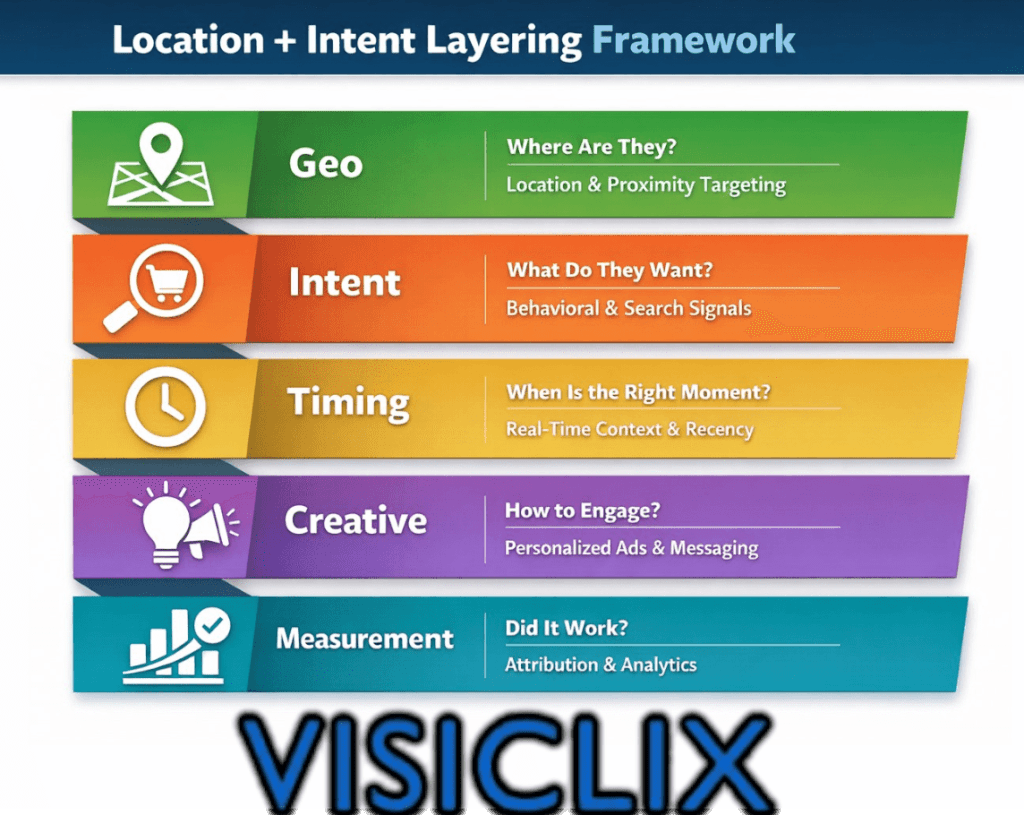
Here’s the simplest layering model that stays scalable:
- Choose where you can win (geo)
- Start with serviceable zones (cities, ZIPs, radii).
- Add exclusions (areas you can’t serve, low-quality pockets, competitor-only areas you’re not ready to conquest).
- Choose who is likely to buy (intent)
Use a 3-tier model:
- Tier 1: Your data (highest intent)
- Tier 2: In-market/custom segments (mid-high intent)
- Tier 3: Contextual/affinity (testing + top-of-funnel support)
- Choose when to show up (timing + recency)
- Dayparting (if you rely on calls or appointment booking)
- Recency windows for remarketing (e.g., “visited pricing page last 7–14 days”)
Campaign structure that usually works best
- Split by geo when markets behave differently (different offers, different CPAs, different seasonality).
- Split by intent tier when measurement discipline matters (so Tier 1 doesn’t get “starved” by broad audiences).
If you use automated expansion features, treat your chosen signals as the “starting point,” not the full boundary—because that’s literally how optimized systems operate.
What are the best location + intent targeting tactics (with examples)?
Below are tactics that consistently map to ROI goals when executed with strong landing-page alignment.
1) Geo + your data (remarketing)
Best for: highest ROI baseline, fastest learning
How it works: retarget high-intent page visitors inside your service area.
Watch-outs: cap frequency and refresh creative to avoid fatigue.
2) Geo + in-market segments
Best for: lead gen, high-consideration services
How it works: target people actively researching your category, then narrow to your markets.
3) Geo + custom segments (keyword/URL-defined)
Best for: niche offers, B2B, and categories where in-market isn’t specific enough
How it works: seed the segment with keywords/URLs tied to buying moments, then layer geo.
4) Geo-fencing around specific places (with intent overlays where possible)
Best for: events, competitor conquesting, retail foot-traffic strategies
How it works: build virtual boundaries around POIs; devices in/near those areas become eligible. Many explanations describe geofencing as using GPS/Wi-Fi/cellular signals to trigger eligibility within a defined perimeter.
Watch-outs: geofencing alone can be noisy—pair it with recency/dwell-time logic or follow-up remarketing.
5) “Local intent sequencing” (educate → convert)
Best for: expensive services where buyers need proof
How it works:
- Stage A: geo + contextual/in-market with proof-led creative
- Stage B: geo + your data with offer-led creative
Then measure both click-through and view-through impact (especially if people see ads but convert later).
How do you build a “local intent” audience when you don’t have much first-party data yet?
When you’re starting cold, you don’t need a giant dataset—you need a clean system that creates one.
Cold-start plan:
- Launch geo + in-market/custom (mid-high intent) to drive qualified traffic.
- Make your landing pages “audience builders”:
- one clear conversion (call, quote, book)
- secondary actions that indicate intent (pricing views, “service area” clicks, directions)
- Stand up your data audiences as soon as you have volume, because re-engaging warm users is foundational.
What creatives work best for high-intent local display (and what fails)?
What works: specific, proof-based, and location-relevant creative that matches the intent tier.
High performers usually include:
- Proof near the top: rating snippet, “X+ customers,” certification, turnaround time
- A clear local promise: service radius, response time, “same-week install,” etc.
- One action: call, book, get quote, check availability
What fails:
- Generic “brand awareness” banners aimed at bottom-funnel audiences
- Vague CTAs (“Learn more”) when the user is in-market
- Creative that doesn’t match the landing page (offer mismatch destroys conversion rate)
How do you measure success for location + intent display (beyond CTR)?
CTR is a weak KPI for local intent because many people see display and convert later without clicking.
A better measurement stack:
- Primary: CPA / CPL / ROAS (depending on goal)
- Quality: conversion rate by intent tier, lead qualification rate, call quality
- Assist / influence: view-through conversions (conversions that occur after an impression without a click).
If you’re selling local services, view-through can be especially important for understanding whether your “proof” ads are working even when users don’t click immediately.
What budget, bidding, and frequency rules keep targeted display profitable?
Two controls protect ROI more than almost anything else: tiered budgets and frequency caps.
Budget rules that keep the system honest
- Protect Tier 1 (your data) budget first.
- Give Tier 2 (in-market/custom) stable spend so it can learn.
- Treat Tier 3 (context/affinity) as controlled exploration.
Frequency capping (do this early)
Frequency capping limits how often the same person sees your ads, and it’s available for Display campaigns.
Start conservative for cold audiences, and allow higher frequency for short-window remarketing—then adjust based on CPA and incremental lift.
What pitfalls should you avoid with targeted display advertising in 2026?
1) Assuming identifiers behave the same everywhere
Browser privacy differences mean audience fidelity and measurement can vary. The industry is also still digesting Google’s evolving third-party cookie stance and related changes.
2) Over-layering until delivery collapses
Geo + age + device + narrow custom segment + aggressive frequency caps can starve the campaign. Use intent tiers instead of stacking everything in one place.
3) Letting automated expansion spend outside your logic
Optimization can be powerful, but remember: systems may “explore” beyond your signals to find converters. Make sure your reporting can separate what you explicitly targeted vs. what was expanded.
4) Treating geofencing as a strategy by itself
Geofencing is a collection method. The strategy is how you qualify, sequence, and measure the audience afterward.
Which industries benefit most from location + intent display (and why)?
- Local services (HVAC, dental, legal, home improvement): people search/research locally, and intent spikes are obvious.
- Multi-location retail/QSR: geo relevance is high; remarketing + local offers can drive store action.
- Real estate / property services: location matters, but intent filters are essential to avoid wasted reach.
- B2B with territories: custom segments + geo-by-territory is often cleaner than broad LinkedIn-style interest targeting alone.
How do you launch your first campaign in 7 steps (a practical checklist)?
- Define conversions + lead quality rules (what counts as a good lead?)
- Build geo targets + exclusions (where you can truly deliver)
- Set up intent tiers (your data → in-market/custom → contextual)
- Create landing pages that match each tier (proof-led vs offer-led)
- Produce 3–5 creatives per tier (test proof, offer, CTA)
- Apply frequency caps early to prevent waste
- Track click-through + view-through and optimize by tier, not by blended averages
FAQ
Is geo-fencing the same as geo-targeting?
No. Geo-targeting usually means selecting a geographic area for delivery, while geofencing typically refers to creating a virtual boundary where device presence (often via GPS/Wi-Fi/cellular signals) triggers eligibility.
Can targeted display advertising drive leads without retargeting?
Yes—if you use in-market or custom intent signals plus strong landing-page alignment. But retargeting (“your data”) is often the fastest path to efficiency once you have traffic.
What’s a good frequency cap for local display campaigns?
There isn’t one universal number; start conservative for cold audiences and adjust based on CPA and conversion rate. The key is using frequency capping intentionally to limit repeated impressions.
How do I know if my intent targeting is too narrow?
If delivery is inconsistent, reach is tiny, and performance swings wildly day to day, you likely over-layered. Widen by moving from Tier 1-only to Tier 1 + Tier 2, or relax geo tightness before you relax intent.
Does location targeting work on desktop as well as mobile?
Yes, but the underlying signals and accuracy can differ. Plan measurement and expectations accordingly, and watch performance by device segment where possible.
What should I do if CTR is high but conversions are low?
Treat that as a message/landing mismatch or weak intent signal. Tighten intent tiers, add proof, simplify the CTA, and evaluate view-through conversions to understand influence that doesn’t show up in clicks.
Conclusion
Location-based display can be powerful, but location alone is not a buying signal. The consistent winners layer geo with intent tiers, align creatives to those tiers, and measure outcomes using both click-through and view-through value. When your structure protects high-intent spend and your reporting separates tier performance, you get a channel you can scale—not just “extra impressions.”
Why Visiclix is Your Ideal Choice for Targeted Display Advertising?
Visiclix builds display programs the way performance teams actually operate: starting with clean geo strategy, then layering intent tiers that make spend accountable. Instead of one blended campaign that hides what’s working, Visiclix can structure campaigns so remarketing, in-market/custom intent, and contextual expansion each have clear budgets, KPIs, and creative that matches the user’s readiness.
Just as importantly, Visiclix approaches measurement like a business case, not a dashboard. That means tracking conversions properly, incorporating view-through impact where it matters, and applying practical controls like frequency caps to prevent waste and creative fatigue. The result is a location + intent display system you can optimize weekly—and explain confidently to stakeholders.
Get a Location + Intent Display Plan from Visiclix
If you want a display strategy that targets the right local buyers and proves ROI, Visiclix can map your markets, define intent tiers, and build a launch-ready campaign structure with measurement guardrails.