If your eyes burn, feel gritty, or your vision comes and goes, it’s natural to search “dry eye treatment near me” and hope for fast relief. Dry eye is common, and the right plan usually combines smart at-home habits with targeted in-office care based on what’s actually causing your symptoms.
Medical note: This page is for education and can’t replace an exam. If you have sudden vision loss, severe eye pain, or a new injury/chemical exposure, seek urgent care.
What is dry eye and why does it happen?
Dry eye happens when your eyes don’t make enough tears, your tears evaporate too quickly, or your tear film isn’t working correctly—which can lead to discomfort and sometimes blurry vision.
Many cases fall into two broad patterns:
- Aqueous-deficient dry eye: not enough watery tears are produced.
- Evaporative dry eye: tears evaporate too quickly, often linked to meibomian gland dysfunction (MGD).
Transition: Once you know what dry eye is, the next step is spotting the signs that mean it’s time to get evaluated.
Visual idea: Simple diagram of the tear film layers + “aqueous-deficient vs evaporative” comparison.
What are the most common symptoms that mean you should search “dry eye treatment near me”?
Dry eye symptoms aren’t always just “dryness.” Many people also notice burning, stinging, a scratchy/gritty sensation, light sensitivity, or blurry/fluctuating vision.
Common signs include:
- Scratchy feeling (like something is stuck in your eye)
- Burning/stinging
- Redness
- Sensitivity to light
- Watery eyes (which can happen when the tear film is unstable)
If symptoms persist, recur often, or interfere with work/screen time, you’ll usually get better results from a structured plan than from “trying random drops” for months.
Transition: Symptoms tell you something’s off—diagnosis tells you what kind of dry eye you have and what will actually help.
Visual idea: Symptom checklist graphic patients can screenshot.
How does an eye doctor diagnose dry eye?
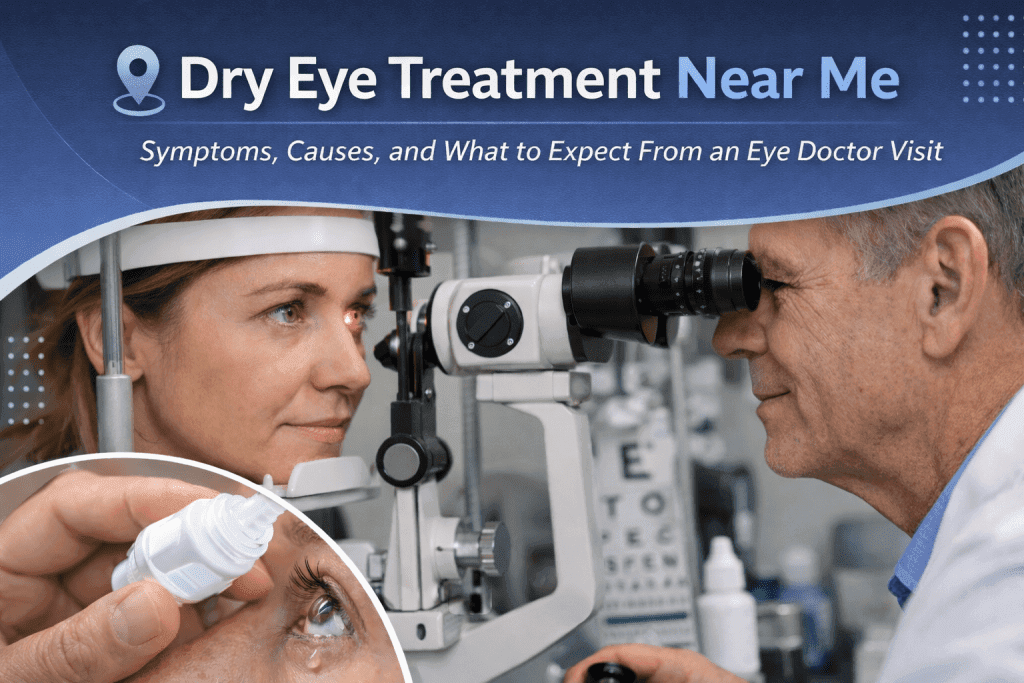
A dry eye visit typically starts with a discussion of your symptoms, triggers, medications, and overall health—then an eye exam to evaluate tear quality and the ocular surface.
Testing may include:
- Slit lamp exam to look at the eye surface and lids
- Schirmer’s test to measure tear production
- Tear breakup time (TBUT) to see how quickly tears evaporate
- A comprehensive dilated exam may also be used to check for dry eye and other eye problems.
Local SEO template tip: Add a short “What to bring to your appointment” section with bullets (med list, contact lens brand, screenshot of symptoms, prior eye records) and a simple booking module.
Transition: While you’re arranging care, a few safe habits can reduce irritation and improve comfort.
Visual idea: “What happens at your first visit” timeline (10–15 minutes intake, exam, testing, plan).
How to get relief at home while you wait for an appointment?
First, use the right OTC lubrication strategy. Many people do well with artificial tears for mild symptoms.
Next, if you need drops frequently, consider preservative-free options (often recommended when using drops more than ~4x/day).
Then, add warm compresses to support the eyelids/oil glands and reduce irritation.
Finally, reduce environmental triggers like wind/AC drafts and consider a humidifier if indoor air is dry.
Other practical tips commonly recommended:
- Take screen breaks and blink more intentionally
- Wear wraparound sunglasses outdoors
- If you’re using “redness relief” drops often, ask your eye doctor—some guidance advises avoiding them as a dry-eye solution.
Transition: Home care helps, but persistent dry eye often improves most when treatment matches the underlying cause.
Visual idea: “Home relief routine” one-page printable (AM/PM steps).
What dry eye treatment options can a local eye doctor offer?
Treatment depends on severity and cause—many people need to try more than one approach to find the best fit.
Foundational options (often first-line)
- Artificial tears / gels / ointments for lubrication and comfort
- Guidance on which drops match your tear-film needs (because the wrong product or overuse can backfire for some patients)
Prescription therapies (when OTC isn’t enough)
- Prescription anti-inflammatory eye drops are used for some people with more significant dry eye. NEI lists cyclosporine (Restasis) and lifitegrast (Xiidra) as examples.
- Mayo Clinic also describes options that may include prescription therapies and other targeted approaches depending on the cause and severity.
Tear conservation and advanced options
- Punctal plugs (tear duct plugs) can help when tears drain too quickly.
- Scleral lenses may protect and lubricate the eye surface in some cases.
- Treating contributing eyelid conditions and inflammation can be part of the plan, including eyelid hygiene and other therapies.
Local SEO template tip: Add a short “Treatments we offer” grid and only list what your clinic truly provides. Include an internal link to each treatment subpage.
Transition: With options on the table, the key is choosing a clinic that diagnoses why you’re dry—not just selling drops.
Visual idea: Treatment ladder graphic (OTC → prescription → tear conservation → specialty options).
How to choose the right clinic for dry eye treatment near me?
When comparing clinics, focus on diagnostic clarity and customization, not hype.
Look for a clinic that:
- Explains whether your dry eye is more aqueous-deficient or evaporative/MGD-related
- Uses appropriate testing (tear stability, tear production, eyelid evaluation)
- Provides a step-by-step plan you can follow at home and in-office
- Reviews medications and lifestyle triggers that may worsen symptoms
Local SEO template fields to add on-page (replace brackets):
- Service areas: [City], [Neighborhood], [Nearby City 1], [Nearby City 2]
- Clinic info block: Address, phone, hours, parking, landmark directions
- Appointment CTA: “Book a Dry Eye Evaluation” + click-to-call on mobile
- Trust elements: doctor credentials, review snippets, insurance list (if applicable)
Transition: Next, let’s cover the red flags—when you shouldn’t wait for a routine appointment.
Visual idea: “Clinic checklist” comparison table (tests, plan, follow-up, education).
When should you see a dry eye specialist urgently?
Schedule sooner (or seek urgent care) if you have:
- Symptoms that are persistent, painful, or worsening despite consistent home care
- New or severe light sensitivity, significant redness, or concern for infection
- Any sudden vision changes (especially if dramatic)
Even without emergencies, chronic symptoms deserve evaluation because untreated severe dry eye can sometimes affect the cornea.
Visual idea: “Urgent vs routine” decision tree.
FAQ
Can dry eye cause watery eyes?
Yes. Some people get reflex tearing when the tear film is unstable or evaporates too fast, so the eyes try to compensate.
Are artificial tears enough for everyone?
Not always. Artificial tears can help mild cases, but persistent symptoms may require diagnosis and a targeted plan.
What tests might I receive at a dry eye appointment?
Common tests include a slit lamp exam, Schirmer’s test, and tear breakup time testing, along with a broader eye exam.
Do tear duct plugs help?
They can, especially if tears drain too quickly. They’re one option your eye doctor may discuss based on your case.
What lifestyle changes can reduce dry eye symptoms?
Avoiding smoke/wind/AC drafts, using a humidifier, taking screen breaks, and wearing wraparound sunglasses are commonly recommended strategies.
Conclusion
Searching “dry eye treatment near me” is often the first step toward real relief—but the biggest improvement usually comes when treatment matches the cause (tear production, evaporation/MGD, environment, or inflammation). Start with safe home steps like lubrication, warm compresses, and trigger control, then book an evaluation for testing and a personalized plan.
Why Visiclix is Your Ideal Choice for Dry Eye Treatment Near Me?
Visiclix is built for patients who want clarity and a plan—not guesswork. We focus on identifying why your eyes are uncomfortable by combining symptom history with clinically grounded evaluation, so your treatment is matched to the root cause rather than just the feeling of dryness.
We also believe follow-through matters as much as diagnosis. Visiclix supports you with simple routines, education on triggers, and treatment options that scale from at-home relief to in-office care—so you’re not stuck cycling through random drops without progress.
Call Visiclix to Book a Dry Eye Evaluation
Ready to stop guessing? Contact Visiclix to schedule your dry eye evaluation and get a step-by-step plan tailored to your symptoms and lifestyle.