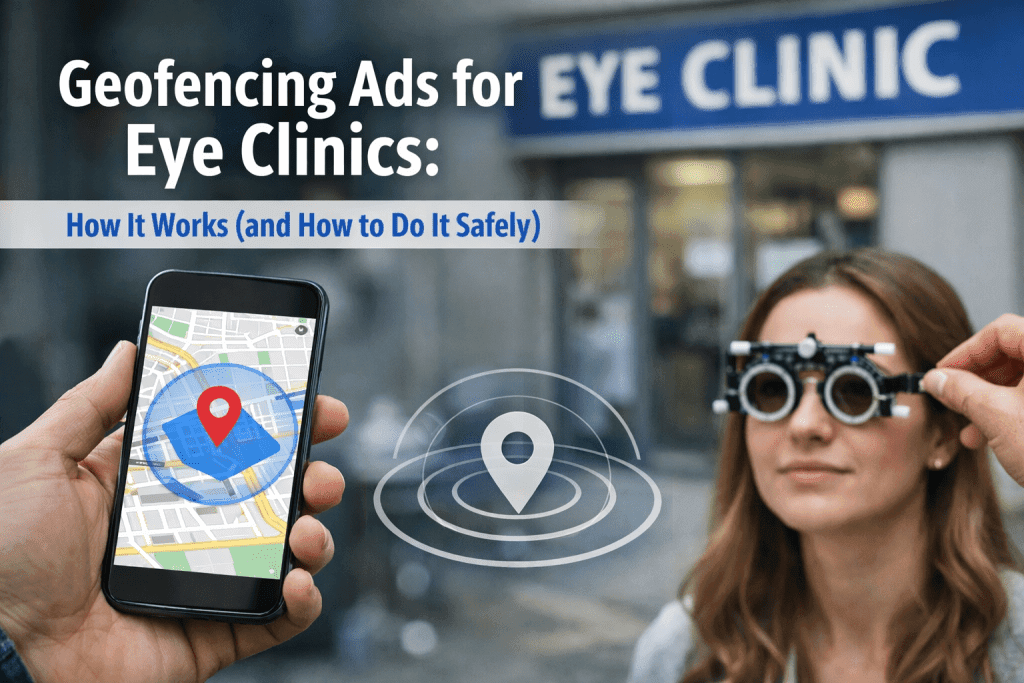
If you’re trying to grow appointments locally, geofencing can be a strong “in-market” display tactic—because it lets you show ads to people based on where they go, not just what they search.
In this guide, we’ll break down how geofencing advertising eye clinic campaigns work, what to target (and what to avoid), and a practical launch plan you can run without wasting budget or creating privacy risk.
Visual idea: A simple “local patient journey” map showing: Visit nearby location → See ad → Click → Book exam.
What is geofencing advertising for an eye clinic?
Geofencing advertising is a location-based strategy where you set a virtual boundary around a real-world area (a “geofence”). When devices are detected inside that area (or after being in it), they can be served ads across apps and websites via programmatic ad delivery.
For an eye clinic, that means you can build campaigns around high-intent local contexts like:
- Retail optical corridors (frames, lenses, contacts)
- Nearby pharmacies and big-box stores
- Senior community hubs (for cataract and medical eye care messaging)
- Competitor “trade areas” (handled carefully—more on compliance below)
Transition: Once you understand what it is, the next question is what’s actually happening behind the scenes when a geofence “fires.”
Visual idea: A diagram of a circle geofence around a shopping center with arrows to “Ad Exchange → Mobile Apps → Display Ads.”
How does geofencing work for patient acquisition?
In most advertising use cases, geofencing works like this:
- You pick a location (or list of locations) and define a radius/polygon.
- Devices observed in the zone are added to an audience pool (typically via mobile advertising IDs or other permitted identifiers, depending on vendor and platform).
- Ads are served later (often for days/weeks) as those devices browse apps/sites in the ad network.
- Clicks and conversions (calls, form fills, bookings) are measured like other display campaigns, with additional location/context reporting if available.
A key nuance: geofencing is often used via programmatic display networks rather than search, because search ads already respond to intent signals (keywords). Geofencing is more about creating demand and capturing nearby intent at the right moment.
Transition: Now let’s make this specific to eye care, because “what to fence” is where most ROI is won or lost.
Visual idea: A funnel graphic: Geofenced audience → Retargeting → Landing page → Booking.
What locations should an eye clinic geofence to attract high-intent patients?
The best geofences are places that strongly correlate with eye-care intent—without crossing into “creepy” or sensitive territory.
High-performing location buckets to test:
- Optical retail zones: malls with eyewear stores, retail optical chains, vision centers. (Great for comprehensive exams, contacts, glasses upgrades.)
- Pharmacies and big-box stores: useful for dry eye messaging, “annual eye exam” reminders, insurance-friendly offers.
- Senior lifestyle areas: community centers, senior residences in your service area for cataract consults and medical eye care.
- Workplace clusters: business parks/campuses for lunchtime exams and convenience messaging.
- Local events: health fairs, community expos, school events (pediatric optometry) where appropriate.
Many competitor guides emphasize that geofencing performs best when it’s hyper-local and paired with a clear offer and landing page path.
Transition: Targeting is only half the strategy—next is how to structure campaigns so the budget doesn’t leak.
Visual idea: A local map screenshot mock showing “fence clusters” (Retail / Senior / Workplace) with different colors.
How do you set up a geofencing ad campaign for an eye clinic step by step?
Here’s a practical setup sequence you can run for Visiclix clients (or in-house), built to control spend and prove ROI.
- First, define the service + conversion goal
- Examples: “Comprehensive eye exam booking,” “LASIK consult request,” “Cataract evaluation call.”
- Choose one primary conversion per campaign.
- Next, pick 10–30 starting locations
- Start tight. You can expand later.
- Group locations into 2–4 themes (Optical / Pharmacy / Senior / Workplace).
- Then, build 1 landing page per theme
- Match the message to the context (“Near [mall name]? Same-week appointments available.”)
- Keep forms short; add click-to-call for mobile.
- Then, create 3–5 ad angles per theme
- Convenience: “Same-week exams.”
- Offer: “New patient special / insurance check.”
- Proof: reviews, doctor credibility, years in practice.
- Outcome: “See clearly again—modern diagnostic exams.”
- Next, set frequency and recency rules
- Cap frequency to reduce fatigue.
- Use recency windows (e.g., 7–30 days) and compare performance.
- Finally, measure and optimize weekly
- Cut fences that don’t convert.
- Shift budget to top themes, then duplicate winners into nearby micro-areas.
This “start narrow → prove → expand” approach is repeatedly recommended in mainstream geofencing explainers because it prevents broad, low-intent reach.
Transition: Setup is the easy part. The next section is what most clinics overlook: compliance and privacy guardrails.
Visual idea: A checklist graphic: Goal → Locations → Landing pages → Creative → Caps → Reporting.
Why is privacy and compliance especially important for geofencing in healthcare?
Healthcare geofencing is effective—but it’s also one of the quickest ways to create reputational risk if handled carelessly.
Here’s why the bar is higher:
- Regulators have taken action related to sensitive location data and the ability to infer visits to healthcare facilities.
- Massachusetts’ AG settlement (Copley) is frequently cited as a warning: geofencing near healthcare facilities to infer health status can trigger consumer protection concerns.
- Industry self-regulatory bodies have developed standards around “sensitive points of interest” for precise location data.
And separately, if you’re a HIPAA covered entity (or working with one), marketing rules and the handling of PHI matter. The HHS HIPAA marketing guidance is clear that communications that meet HIPAA’s definition of “marketing” may require authorization unless an exception applies.
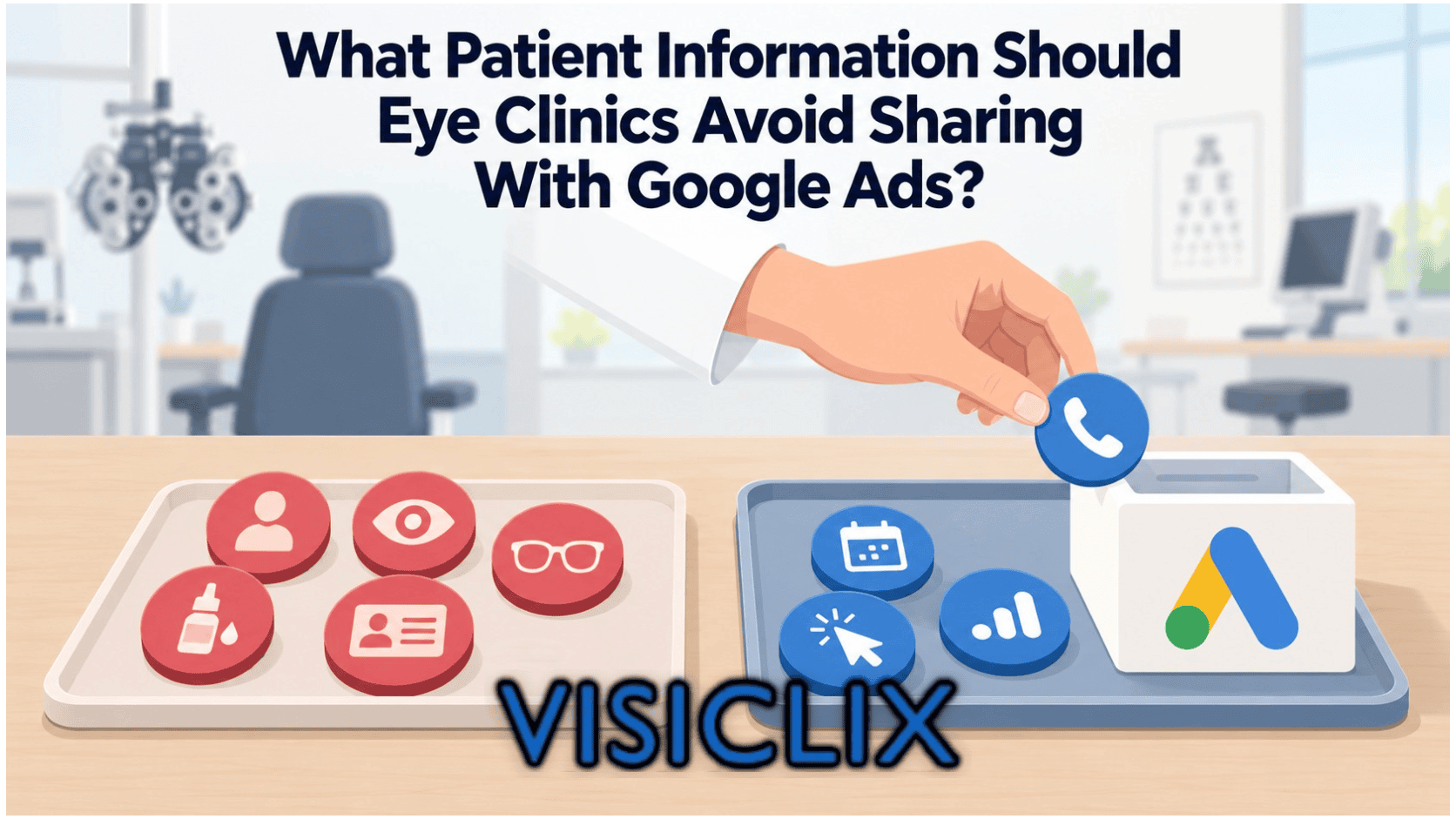
Practical safety rule for eye clinics:
Avoid strategies that look like “We saw you at a clinic, so here’s an ad about your condition.” Instead, use location context to place general awareness offers that don’t imply knowledge of anyone’s health.
Transition: With those guardrails in mind, let’s get specific about what not to geofence—and safer alternatives.
Visual idea: A “Do / Don’t” graphic: Do: retail + community areas; Don’t: hospitals/clinics to infer conditions.
What should eye clinics avoid geofencing (and what to do instead)?
Avoid these high-risk approaches:
- Geofencing hospitals, medical centers, or specialty clinics in a way that could imply a person’s condition or treatment.
- Condition-forward creative tied to sensitive locations (“Dry eye relief for people leaving X clinic”).
- Overly tight fences around medical buildings that make the intent obvious.
Safer alternatives that still work:
- Fence commercial areas where people shop for eyewear (malls, retail corridors).
- Fence general community venues (events, business districts) with messaging like “Annual eye exams available this week.”
- Use geo-targeting (city/ZIP/radius) for Search and Demand Gen where the targeting model is platform-native and less “surveillance-y.” (Google explains location targeting controls and options in its Ads Help docs.)
Also note: platform policies can affect what targeting is permitted, especially around health-related personalization. Google has updated clarifications to its Personalized advertising policy regarding health-sensitive categories.
Transition: Now let’s talk performance—what actually moves ROI for geofencing ads in eye care.
Visual idea: A matrix showing High intent / Low risk vs High risk / Low reward location types.
How do geofencing ads improve ROI for eye clinics?
Geofencing tends to improve ROI when it’s used to filter for local intent and support conversion actions (calls/bookings), not just impressions.
The ROI drivers usually come from:
- Less waste outside your service area (hyper-local delivery vs broad interest audiences).
- Better message match (the ad matches the context: eyewear shopping, convenience, insurance acceptance).
- More repetition in a short window (controlled frequency can lift recall when people are actively considering options).
And if you’re pairing geofencing with Google Ads location controls (for search campaigns supporting the same offer), Google notes there are meaningful reach/conversion implications between advanced location options like “Presence” vs “Presence or interest.”
Transition: Of course, ROI only counts if you can measure it. Next: tracking that’s realistic for clinics.
Visual idea: KPI dashboard mock: CTR, Calls, Bookings, Cost/Booking, Assisted Conversions.
How can an eye clinic measure geofencing performance accurately?
Measurement should be built around appointments, not clicks.
A practical measurement stack:
- Call tracking: dynamic number insertion on landing pages.
- Form conversions: “Request appointment” submissions, with spam filtering.
- Booking confirmations: if you have online scheduling, track completed bookings as a primary conversion.
- Assisted conversions: geofencing often assists other channels (Search/Direct). Use attribution windows and compare lift.
Also add:
- Fence-level reporting: which zones produce calls/bookings.
- Creative-level reporting: which message angles generate qualified leads.
Transition: Once measurement is in place, the last lever is creative—what you say (and how you say it) matters a lot in healthcare.
Visual idea: A sample reporting table: Fence Theme → Spend → Calls → Bookings → CPA.
What ad creative works best for geofencing ads in eye care?
Eye clinics typically win with clarity + convenience + proof.
High-performing creative elements to test:
- Same-week availability (if true)
- Insurance compatibility (“We accept most major vision plans”)
- Trust signals (years in practice, certifications, star ratings)
- Specific services without implying diagnosis (eye exams, contact lens fittings, LASIK consults, cataract evaluations)
- Strong CTA (“Book an eye exam,” “Call now,” “Check appointment times”)
Keep the tone reassuring. Geofencing is already “close to home,” so the creative should feel helpful, not invasive.
Visual idea: 3 ad mockups (Exam / LASIK / Cataract) with different CTAs.
FAQ
Can geofencing advertising eye clinic campaigns work without discounts?
Yes. Clinics often succeed with convenience-first offers (same-week slots), insurance messaging, and strong proof (reviews/credentials) instead of price cuts.
Is geofencing the same as geo-targeting?
Not exactly. Geo-targeting usually means targeting people in a region (city/ZIP/radius). Geofencing is typically tied to presence in a specific place and then serving ads after that.
How big should a geofence be for an eye clinic?
Start small enough to match the intent of the location (often a venue, shopping area, or corridor). Many guides recommend starting tight, then expanding based on results.
Should eye clinics geofence competitor locations?
It can be risky if it implies sensitive inference or targets healthcare facilities in a way regulators view as problematic. A safer approach is fencing commercial trade areas and using general eye exam messaging, not condition-based targeting.
Does Google allow health-related ad targeting?
Google Ads policies and personalized advertising restrictions can apply, especially around health-sensitive categories. Always align targeting and creative to current platform policy.
Conclusion
Geofencing can be a practical growth lever for eye clinics when you treat it like a local intent filter—not a surveillance trick. The clinics that win start with a tight set of high-intent locations, match the message to context, and measure success by calls and bookings (not clicks). Just as important: they apply healthcare-grade privacy judgment so campaigns feel helpful and compliant.
Why Visiclix is Your Ideal Choice for Geofencing Ads for Eye Clinics?
Visiclix builds geofencing campaigns the way clinics actually need them: localized, measurable, and conversion-first. Instead of scattering budget across generic “nearby” audiences, we structure fences into clear intent themes (optical retail, pharmacy corridors, workplace clusters) and align each to a landing page built to drive calls and bookings.
We also treat privacy and platform policy as part of performance—not a checkbox. Visiclix focuses on safer targeting strategies, careful creative messaging, and clean measurement so your clinic can scale patient acquisition confidently while protecting trust.
Get Visiclix to Build Your Eye Clinic Geofencing Campaign
Want a geofencing plan that’s built around appointments and ROI (not vanity metrics)? Visiclix can map high-intent local fences, launch compliant creative, and optimize toward booked visits—so your display budget turns into predictable patient growth.