Most eye clinics already have marketing data. The problem is that the data often lives in too many places: Google Ads, Google Analytics 4, Google Business Profile, call tracking software, online booking tools, review platforms, and the practice management system. When those numbers are separated, it becomes difficult to answer the questions that actually matter: Which campaigns are bringing in qualified patients? Which services are growing? Where is ad spend being wasted? Are calls turning into appointments?
An eye clinic marketing dashboard should not be a decorative report filled with clicks, impressions, and charts. It should be a practical decision-making tool that connects marketing activity to patient acquisition, booked appointments, service-line demand, and revenue opportunities. Google’s own conversion documentation reinforces this logic: web conversion measurement is designed to analyze specific actions people take after interacting with ads, which helps advertisers understand user behavior and campaign performance.
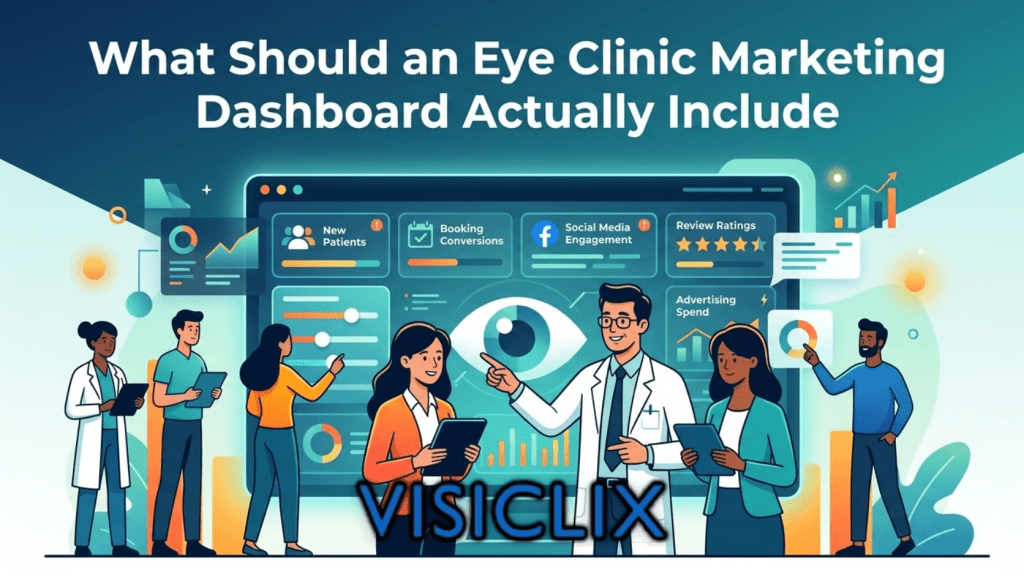
For eye clinics, the best dashboard shows the full path from visibility to appointment. That includes PPC performance, local SEO, phone calls, online bookings, landing page conversions, review trends, service-line performance, and patient acquisition cost. The goal is simple: help the clinic make better marketing decisions faster.
What Is an Eye Clinic Marketing Dashboard?
An eye clinic marketing dashboard is a centralized reporting view that tracks the marketing metrics most closely tied to patient growth. It brings together the numbers that show how people discover the clinic, how they engage with ads or local listings, how they contact the practice, and whether those interactions turn into booked appointments.
This is different from a clinical or operational healthcare dashboard. A clinical dashboard may track patient outcomes, wait times, staffing, claims, or care delivery. A marketing dashboard focuses on demand generation: calls, forms, bookings, conversion rates, ad spend, local visibility, reviews, and patient acquisition cost. Google Business Profile performance reporting, for example, shows how customers discover a profile on Search and Maps and what actions they take after finding it.
For an optometry, ophthalmology, LASIK, or multi-location eye care practice, the dashboard should reflect real business priorities. That might include comprehensive eye exams, cataract evaluations, LASIK consultations, dry eye appointments, contact lens exams, pediatric eye care, myopia management, optical sales, or emergency eye care visits.
A useful dashboard usually pulls from Google Ads, GA4, Google Business Profile, call tracking software, CRM or patient management systems, online booking tools, form tracking, review platforms, and SEO rank tracking. The important part is not how many platforms are connected. The important part is whether the dashboard helps the clinic understand what is driving patient demand.
Why Does an Eye Clinic Need a Marketing Dashboard?
An eye clinic needs a marketing dashboard because marketing performance is difficult to improve when clicks, calls, appointments, reviews, and revenue signals are scattered across different systems. Without one clear view, a clinic may know that ads generated leads, but not whether those leads became scheduled appointments.
This matters because PPC and local search decisions need speed. If cost per lead rises, call volume drops, a landing page stops converting, or a campaign starts attracting the wrong type of patient, the clinic should not have to wait until the end of the month to find out. Google Ads conversion tracking is specifically designed to show what happens after someone interacts with an ad, including website actions and phone calls.
A dashboard also improves accountability. Practice owners and administrators should be able to see where the budget is going, which channels are producing appointments, and which service lines are gaining traction. This is especially important in competitive eye care markets where clinics may be advertising for routine exams, LASIK, cataract surgery, dry eye treatment, and optical services at the same time.
The best dashboard does more than report what happened. It helps the clinic decide what to do next: increase budget, pause a weak campaign, improve phone handling, revise a landing page, request more reviews, or shift focus toward a higher-value service line.
What Patient Acquisition Metrics Should an Eye Clinic Marketing Dashboard Include?
An eye clinic marketing dashboard should include new patient leads, booked appointments, lead source, cost per lead, cost per booked appointment, conversion rate, and patient acquisition cost. These metrics connect marketing activity to actual practice growth.
Lead volume is useful, but it can be misleading by itself. A clinic may receive many form submissions from people who are outside the service area, not ready to schedule, looking for unsupported insurance, or asking questions that do not become appointments. That is why the dashboard should separate raw leads from qualified leads and booked appointments.
The core patient acquisition metrics should include total leads by source, new patient inquiries, booked appointments, cost per lead, cost per booked appointment, new patient acquisition cost, lead-to-appointment conversion rate, appointment show rate, and no-show or cancellation rate by source.
For example, a LASIK campaign may produce fewer leads than a routine eye exam campaign, but those leads may have higher revenue potential. A cataract evaluation campaign may have a higher cost per lead but still be profitable if consultations turn into procedures. A good dashboard prevents the clinic from treating every lead as equal.
This is especially important because PPC benchmarks vary by industry and campaign type. WordStream’s 2025 Google Ads benchmark report found that the average cost per lead across Google Ads industries was $70.11, while the “Dentists & Dental Services” category was $83.93 and “Health & Fitness” was $62.80. These are broad benchmarks, not eye-clinic-specific rules, but they show why every clinic should measure its own lead quality and cost per booked appointment instead of relying only on generic averages.
How Should an Eye Clinic Track Google Ads and PPC Performance?
An eye clinic should track Google Ads performance from impression to booked appointment, not just from click to lead. PPC metrics are helpful only when they show whether ad spend is creating qualified patient demand.
The dashboard should include impressions, clicks, click-through rate, cost per click, conversion rate, cost per conversion, phone call conversions, form submissions, online booking starts, online booking completions, cost per booked appointment, search term performance, campaign performance by service line, location performance, device performance, and landing page performance.
Google Ads allows advertisers to measure website actions after ad interactions, and Google also provides call conversion measurement for calls generated from call or location assets. Call conversions can be counted based on criteria such as calls lasting longer than a minimum duration, which helps filter out calls that are less likely to represent valuable business actions.
For eye clinics, PPC reporting should be segmented by intent. Someone searching “eye exam near me” may behave differently from someone searching “LASIK consultation,” “cataract surgeon,” “dry eye treatment,” or “pediatric optometrist.” Each search has a different urgency level, patient value, and appointment path.
The dashboard should also separate campaign performance by service line. If all PPC campaigns are blended together, a clinic may make poor decisions. A high-cost cataract campaign may be more valuable than a low-cost general exam campaign. A dry eye campaign may need more education before conversion. A LASIK campaign may depend heavily on consultation booking rate and follow-up quality.
Directional eye-care PPC benchmarks can be helpful, but they should not replace clinic-specific data. One vision and eye care benchmark source reported 2025 data across seven accounts with a 1.10% CTR, 16.20% conversion rate, $2.05 CPC, and $12.61 CPA; however, because this is based on a limited sample from one provider, it should be used as a comparison point rather than a universal standard.
What Website and Landing Page Metrics Matter Most?
The most important website and landing page metrics are the ones that show whether visitors can find the right service, trust the clinic, and take action. Traffic alone is not enough.
The dashboard should include sessions by source, landing page conversion rate, service page traffic, appointment button clicks, phone number clicks, form submissions, online booking completions, engagement rate, mobile performance, top entry pages, and exit pages. For PPC landing pages, it should also show campaign, keyword, device, and location-level performance.
Google Analytics 4 allows businesses to create conversions from key events so they can measure important actions across Google Ads and Analytics. Google says this can help advertisers report on consistent conversion counts, understand campaign performance, and bid against conversions in ad campaigns.
For an eye clinic, this means the dashboard should identify which pages actually generate patient action. A cataract page may get strong organic traffic but few calls. A LASIK landing page may get clicks but weak consultation bookings. A dry eye page may attract visitors who need more education before scheduling.
The dashboard should help diagnose why. Common issues include weak calls to action, unclear insurance or payment information, lack of provider trust signals, poor mobile layout, slow page experience, confusing booking options, or missing location details.
How Should Call Tracking Be Included in an Eye Clinic Marketing Dashboard?
Call tracking should show which campaigns, keywords, pages, and locations generate phone calls—and whether those calls turn into appointments. For many eye clinics, phone calls are one of the most important conversion paths.
The dashboard should include total calls, first-time callers, calls by channel, calls by campaign, calls by landing page, missed calls, call answer rate, average call duration, qualified calls, appointment-booked calls, and estimated revenue opportunity from missed calls.
This matters because many patients still prefer to call before booking. They may have questions about insurance, appointment availability, symptoms, provider availability, contact lenses, LASIK eligibility, cataract surgery, or urgent eye issues. If the dashboard only tracks forms, it may underreport the true value of PPC and local SEO.
Google Ads call conversion tracking can help measure how effectively ads with call or location assets lead to calls. Google notes that advertisers can count calls as conversions by using criteria such as call duration, helping distinguish potentially valuable calls from less meaningful ones.
A practical example: A campaign may look weak because it has few form submissions, but call tracking may reveal that it generated many booked appointments by phone. Without that data, the clinic could mistakenly pause a profitable campaign.
What Local SEO and Google Business Profile Metrics Should Be Included?
An eye clinic marketing dashboard should include local visibility, Google Business Profile actions, map rankings, calls, direction requests, website clicks, appointment clicks, and reviews. Local SEO is especially important because many patients search for eye care near their home, workplace, or school.
Google Business Profile performance data shows how people discover a business on Search and Maps and what actions they take after finding it. Google says performance reports can include interactions, searches, views, and other customer actions, though available metrics may vary by business.
The dashboard should include local keyword rankings, Business Profile views, calls from the profile, direction requests, website clicks, appointment link clicks, photo views, review count, average rating, review velocity, review response rate, and location-level performance.
For multi-location eye clinics, this data should not be blended into one average. One location may be getting strong map visibility but weak calls. Another may be getting calls but poor direction requests. Another may be underperforming because of weak reviews or incomplete profile information.
The dashboard should also account for structured location data on the website. Google’s LocalBusiness structured data documentation explains that structured data can tell Google about business details such as hours, departments, and other local business information, and Google recommends validating structured data with its Rich Results Test.
How Should Reviews and Reputation Be Displayed?
Reviews should be displayed as both a trust metric and a local visibility metric. A strong review profile can help patients feel more confident before they call, book, or request a consultation.
The dashboard should include average rating, total review count, new reviews per month, review response rate, negative review trends, review sentiment themes, reviews by provider, reviews by location, and reviews by service line when possible.
This is especially important in eye care because patients often evaluate trust before making an appointment. A patient considering LASIK, cataract surgery, pediatric eye care, or glaucoma treatment may spend more time reading reviews than someone booking a routine exam.
The dashboard should not just show review count. It should identify patterns. Are patients praising the doctors but complaining about wait times? Are negative reviews concentrated at one location? Are LASIK patients mentioning confidence and communication? Are optical patients mentioning pricing, frame selection, or service delays?
These insights can improve both marketing and operations. If ads are driving traffic but reviews create hesitation, conversion rates may suffer. If reviews consistently mention long wait times, the clinic may need to address scheduling or set clearer expectations on landing pages.
What Revenue and ROI Metrics Should an Eye Clinic Marketing Dashboard Include?
An eye clinic marketing dashboard should include the financial metrics needed to connect marketing spend with patient and service-line value. The core metrics are marketing spend by channel, cost per lead, cost per booked appointment, estimated revenue by service line, return on ad spend, patient acquisition cost, lifetime patient value estimates, and revenue by campaign when attribution is available.
ROI measurement in healthcare is rarely perfect. Patients may call instead of booking online. They may schedule days or weeks after the first search. A consultation may not become a procedure immediately. Privacy requirements may limit what can be tracked and shared across platforms. Still, the dashboard should provide a directional view of performance.
HHS guidance on online tracking technologies is an important reminder that healthcare organizations must treat tracking carefully. The HHS page notes that a 2024 court decision vacated part of its guidance related to IP addresses and unauthenticated public webpages, and HHS says it is evaluating next steps. This area is legally sensitive, so clinics should involve qualified compliance counsel when configuring analytics, pixels, call tracking, forms, and advertising integrations.
The dashboard should also avoid treating every conversion as equally valuable. A routine eye exam, contact lens fitting, optical sale, LASIK consultation, cataract evaluation, and dry eye treatment plan may all have different revenue implications. A strong dashboard helps the clinic understand which services are generating profitable demand.
How Should an Eye Clinic Dashboard Separate Metrics by Service Line?
An eye clinic dashboard should separate performance by major service category so the practice can see which services are creating demand, appointments, and revenue. Service-line segmentation prevents misleading averages.
Recommended service-line categories include comprehensive eye exams, contact lens exams, optical and eyewear, LASIK, cataracts, dry eye, glaucoma, retina, pediatric eye care, myopia management, and emergency eye care.
This matters because each service line has a different funnel. Routine eye exams may convert quickly from local search. LASIK patients may compare multiple providers and need more education. Cataract patients may research surgeon credentials, insurance, and procedure options. Dry eye patients may need symptom-based content before they understand treatment options.
A blended dashboard can hide these differences. If the overall cost per lead looks acceptable, the clinic may miss the fact that one high-value service line is underperforming. If overall conversion rate looks low, the clinic may miss that one campaign is driving strong booked appointments while another is dragging down the average.
The dashboard should show service-line traffic, leads, calls, booked appointments, cost per booked appointment, conversion rate, and estimated revenue. This allows the clinic to make smarter budget decisions.
What Appointment Funnel Metrics Should Be Included?
The dashboard should show the full path from marketing interaction to booked and attended appointment. Many dashboards stop at leads, but eye clinics need to know where the funnel leaks.
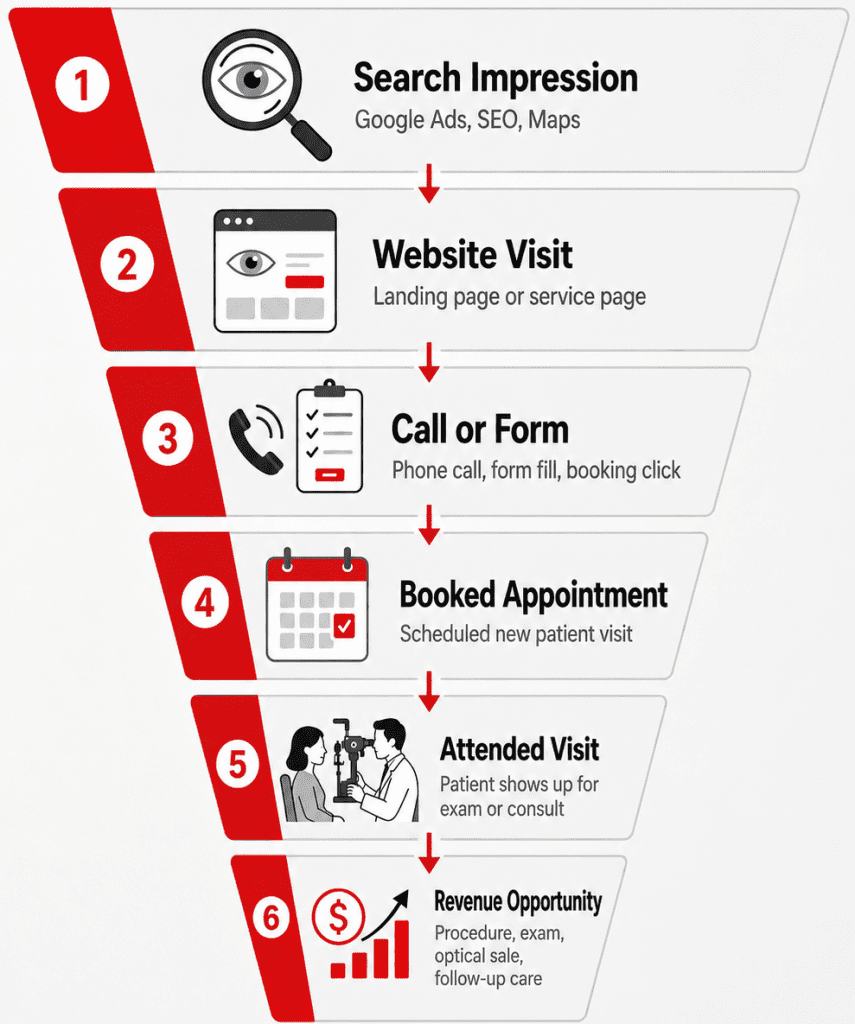
The funnel should include impressions or local search visibility, website visits or Business Profile interactions, calls/forms/booking clicks, qualified leads, scheduled appointments, attended appointments, exams or consultations, procedures or optical purchases, and follow-up opportunities.
This funnel view helps answer practical questions. Are ads getting clicks but not calls? Are calls coming in but not being answered? Are leads booking appointments but not showing up? Are LASIK consultations happening but not converting into procedures? Are cataract campaigns producing evaluations but not enough surgical volume?
Google’s conversion documentation supports this type of measurement mindset because it focuses on tracking meaningful actions after users interact with ads. GA4 conversions based on key events can also help create more consistent conversion measurement between Analytics and Google Ads.
For eye clinics, the strongest dashboard is not just a traffic report. It is an appointment funnel report.
How Often Should an Eye Clinic Marketing Dashboard Be Reviewed?
PPC and lead metrics should be reviewed weekly, while SEO, reviews, service-line growth, and ROI should be reviewed monthly or quarterly. Not every metric needs daily attention.
Daily or near-real-time monitoring is useful for urgent issues such as broken tracking, sudden drops in calls, disapproved ads, landing page errors, or major budget pacing problems. Weekly review is useful for PPC performance, lead quality, missed calls, cost per appointment, and search term trends.
Monthly review is better for SEO, reviews, local visibility, landing page performance, and service-line demand. Quarterly review is best for budget allocation, patient acquisition cost, return on investment, expansion planning, and broader growth strategy.
The dashboard should make urgent issues easy to spot without encouraging overreaction. A single bad day should not automatically trigger a campaign overhaul. A repeated trend should.
What Should an Eye Clinic Marketing Dashboard Not Include?
An eye clinic marketing dashboard should not include vanity metrics, disconnected data, or clinical details that do not support marketing decisions. The main dashboard should be focused, not cluttered.
Examples of weak dashboard metrics include raw impressions with no context, social likes with no conversion connection, blended leads from all services, rankings with no traffic or appointment impact, website traffic without conversion tracking, and clinical KPIs that do not relate to marketing or patient acquisition.
That does not mean those numbers are never useful. It means they should not dominate the main dashboard. A practice owner or administrator should be able to open the dashboard and quickly understand what is working, what is not, and what needs attention.
A simple rule works well: if a metric does not help the clinic make a better decision, improve patient acquisition, understand ROI, or identify a conversion problem, it probably does not belong in the main view.
What Does a Strong Eye Clinic Marketing Dashboard Layout Look Like?
A strong dashboard layout starts with executive growth metrics, then breaks performance down by channel, service line, location, and conversion funnel. The design should move from the big picture to the details.
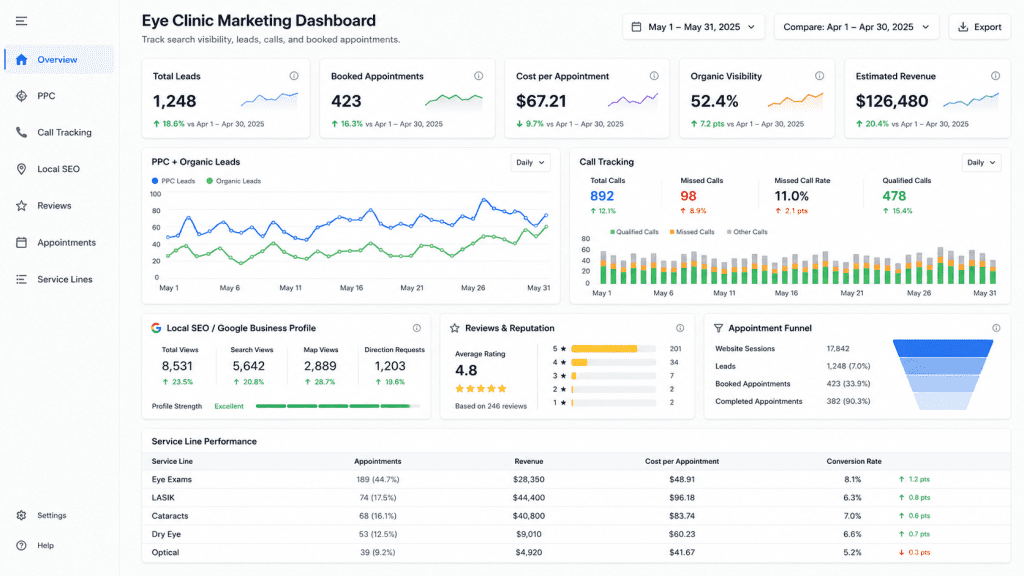
The top section should show the executive snapshot: total leads, booked appointments, cost per booked appointment, marketing spend, estimated revenue or ROI, top-performing channel, and the biggest issue or opportunity.
The channel section should show performance for Google Ads, local SEO, organic search, Google Business Profile, paid social, email, referral campaigns, and patient reactivation campaigns. Google Business Profile reporting is especially useful here because it shows how customers find the profile on Search and Maps and which actions they take afterward.
The conversion section should show calls, forms, online bookings, missed calls, lead quality, and appointment booking rate. The service-line section should break out exams, LASIK, cataracts, dry eye, optical, and other priority services.
For multi-location practices, the location section should show performance by clinic location, reviews by location, calls by location, local rankings by location, and cost per appointment by location.
The final section should be insight-driven. It should answer three questions: What changed? Why did it change? What should we do next?
How Can Eye Clinics Turn Dashboard Data Into Better Marketing Decisions?
Eye clinics can turn dashboard data into better marketing decisions by using it to decide where to spend, what to fix, which services to promote, and how to improve appointment conversion.
For example, if LASIK search terms generate strong consultation bookings, the clinic may increase budget or build stronger landing pages. If a cataract page receives traffic but few calls, the clinic may improve the call to action, add surgeon trust signals, clarify next steps, or make mobile booking easier.
If missed calls are high, the issue may not be marketing at all. The campaign may be generating demand, but the front desk may need better coverage, call routing, or follow-up processes. If Google Business Profile calls are increasing but reviews are weak, the clinic may need a stronger review generation and response process.
The dashboard should also help identify waste. A campaign with cheap leads may not be valuable if those leads do not book. A campaign with a higher cost per lead may deserve more budget if it produces qualified appointments for a high-value service line.
The point is not to collect more data. The point is to use the right data to make better decisions.
FAQ
What is the most important metric in an eye clinic marketing dashboard?
Booked appointments are often the most important metric because they connect marketing activity to real patient growth. Leads, clicks, and calls matter, but they should ultimately be evaluated by whether they help create scheduled appointments.
Cost per booked appointment is also critical. A clinic may have a low cost per lead but a high cost per appointment if many leads are unqualified or never schedule. That is why booked appointments, lead quality, and show rate should be reviewed together.
Should an eye clinic track calls or forms more closely?
An eye clinic should track both, but calls often deserve special attention. Many patients prefer calling when they have insurance questions, urgent symptoms, appointment availability concerns, or procedure-specific questions.
Call tracking can reveal campaign value that form tracking misses. Google Ads provides call conversion measurement for calls from ads and location assets, which helps advertisers understand how ads contribute to phone inquiries.
How many KPIs should an eye clinic dashboard include?
The main dashboard should focus on a concise set of decision-driving KPIs. A good executive view may include leads, booked appointments, cost per booked appointment, ad spend, calls, missed calls, conversion rate, reviews, and top-performing service lines.
More detailed metrics can live in deeper tabs. The goal is to keep the main view clear enough for quick decisions while still allowing deeper analysis when needed.
Can a marketing dashboard show ROI for LASIK or cataract campaigns?
Yes, but ROI tracking depends on how well the clinic connects marketing leads to consultations, procedures, and revenue. This often requires clean call tracking, form tracking, appointment source tracking, and practice management or CRM data.
Attribution may not be perfect because patients can move between devices, call offline, or schedule after multiple touchpoints. The dashboard should still provide a directional view of which campaigns are creating profitable opportunities.
Should multi-location eye clinics have separate dashboards for each location?
Yes, or at least location-level dashboard views. Blended reporting can hide underperforming locations and make strong locations look average.
Each location should be evaluated by calls, booked appointments, local rankings, Google Business Profile actions, reviews, cost per appointment, and service-line performance. Google Business Profile performance can be accessed for individual or multiple profiles, which supports location-level reporting.
How often should Visiclix review dashboard performance with an eye clinic?
Visiclix should typically review dashboard performance monthly with the clinic, while monitoring PPC and lead generation signals weekly. This gives the clinic enough visibility to act quickly without overreacting to daily noise.
Weekly monitoring is useful for ad spend, lead flow, call volume, missed calls, and campaign issues. Monthly review is better for strategic decisions such as service-line budget allocation, landing page improvements, SEO growth, reputation trends, and ROI.
Conclusion
An eye clinic marketing dashboard should not be a collection of disconnected charts. It should show how marketing creates patient demand, booked appointments, service-line growth, and smarter budget decisions.
The most useful dashboard connects PPC, SEO, Google Business Profile, calls, landing pages, reviews, appointment outcomes, and financial performance in one clear view. It should help the clinic understand which campaigns are working, which services are growing, where the funnel is leaking, and how marketing spend is translating into patient acquisition.
If a metric does not help the clinic make a better decision, improve appointment growth, or understand ROI, it probably does not belong in the main dashboard. The best dashboard is not the one with the most data. It is the one that helps the clinic act with confidence.
Why Visiclix is Your Ideal Choice for Eye Clinic Marketing Dashboards?
Visiclix understands that eye clinic marketing is not just about generating clicks or traffic. It is about connecting every campaign to meaningful outcomes such as booked appointments, qualified patient inquiries, high-value service lines, and measurable growth. With a dashboard built around the realities of eye care, Visiclix helps clinics see what is working, what is wasting budget, and where the next growth opportunity is hiding.
Visiclix also brings the PPC-focused discipline that many eye clinics need to make better marketing decisions. Instead of reporting vanity metrics, Visiclix helps practices understand cost per appointment, campaign quality, call performance, local visibility, and service-line ROI. That gives clinic owners and administrators a clearer path from marketing spend to patient growth.
Build a Smarter Eye Clinic Marketing Dashboard With Visiclix
Ready to see which campaigns are actually helping your eye clinic grow? Visiclix can help you build a marketing dashboard that connects ad spend, calls, appointments, and ROI in one clear view.
Schedule a consultation with Visiclix and start making better marketing decisions with data you can trust.