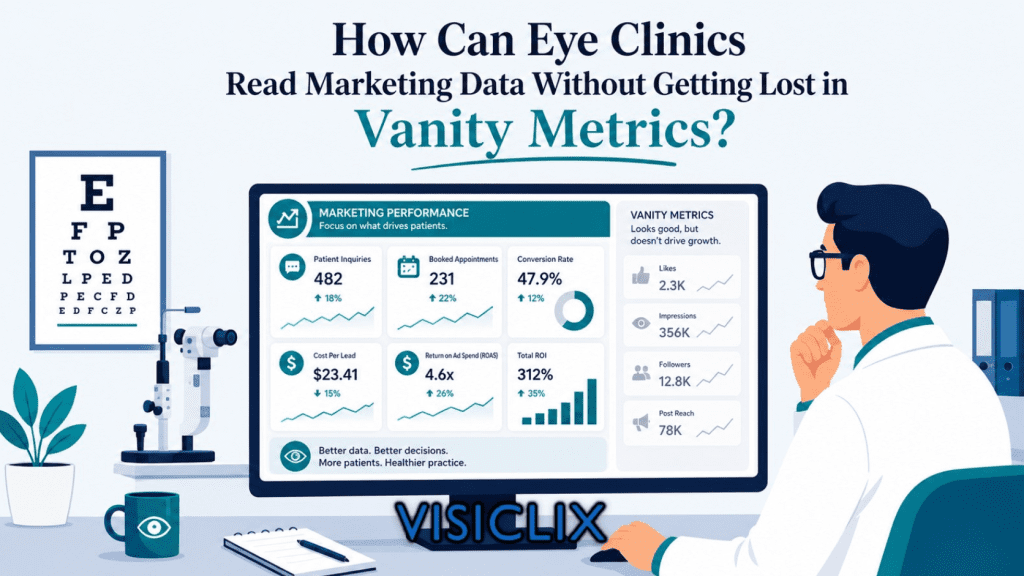
Marketing reports can look impressive without saying much. A monthly dashboard may show more impressions, more clicks, more website traffic, or better social engagement, but those numbers do not automatically mean your eye clinic is getting more qualified patients, booked appointments, or profitable service-line growth.
That is where marketing analytics for eye clinics becomes valuable. The goal is not to collect more numbers. The goal is to understand which marketing activities are helping patients find your practice, contact your team, schedule care, and move forward with services such as routine eye exams, cataract evaluations, LASIK consultations, dry eye treatment, myopia management, contact lenses, optical purchases, or specialty ophthalmology care.
Good analytics should make decision-making easier. It should help your clinic know what to keep, what to fix, what to stop, and where to invest next.
What Are Marketing Analytics for Eye Clinics?
Marketing analytics for eye clinics are the systems, reports, and performance indicators used to understand how marketing efforts influence patient discovery, engagement, appointment requests, and business growth.
For an eye clinic, analytics may include website data, Google Ads results, local SEO performance, call tracking, form submissions, online booking activity, Google Business Profile actions, email campaign results, review trends, CRM data, and practice management system insights. Google Analytics 4, for example, allows businesses to define “key events,” which are actions important to business success, such as appointment requests, form submissions, or other meaningful website interactions.
Marketing analytics should not be treated as paperwork that arrives at the end of the month. For eye clinics, it should answer practical questions: Which campaigns are generating new patient calls? Which services are attracting the most interest? Which location is converting best? Which landing pages need improvement? Which paid search campaigns are wasting budget?
The most useful analytics connect digital activity to patient behavior. A clinic does not simply need to know that a page received 1,000 visits. It needs to know whether those visits came from people in the clinic’s service area, whether they were searching for a high-intent service, whether they called or booked, and whether those inquiries turned into actual appointments.
Why Do Vanity Metrics Mislead Eye Clinics?
Vanity metrics mislead eye clinics because they make marketing look active or successful without proving that the activity is creating patient demand, booked appointments, or revenue-related outcomes.
A vanity metric is not always a bad number. Impressions, clicks, reach, sessions, likes, and rankings can all provide useful context. The problem happens when these numbers are treated as business outcomes. For example, a Google Ads campaign may generate thousands of impressions, but if those impressions come from broad searches with little booking intent, the clinic may not see meaningful patient growth.
The same issue applies to website traffic. More traffic sounds positive, but an eye clinic needs to know whether that traffic is relevant. A spike from a low-intent blog topic may inflate reporting while doing little for LASIK consultations, cataract evaluations, or new patient exams. Social media engagement can also be misleading if posts receive likes from people who are unlikely to become patients.
For PPC campaigns, vanity metrics are especially risky because they can hide wasted spend. A campaign with a low cost per click may appear efficient, but cheap clicks are not valuable if they come from the wrong geography, the wrong service intent, or people looking for information rather than care. Google Ads call conversion tracking is designed to help advertisers understand which keywords, ads, ad groups, and campaigns drive valuable phone calls and support better ad spend decisions.
The key is context. A metric becomes useful when it helps the clinic make a better decision. It becomes vanity when it makes performance look good without showing whether the practice is growing.
How Can Eye Clinics Tell the Difference Between Useful Metrics and Vanity Metrics?
Eye clinics can separate useful metrics from vanity metrics by asking whether each number explains patient intent, conversion quality, revenue potential, or a clear next step.
A useful metric helps answer a decision-making question. Are patients calling after clicking our ads? Are dry eye visitors submitting forms? Are cataract leads more expensive but more valuable? Are calls being answered? Are we getting appointment requests from the right service area? These questions move analytics closer to business impact.
A vanity metric usually stops too early in the patient journey. It tells you that someone saw, clicked, watched, opened, or visited something, but it does not explain whether that person became a lead, scheduled an appointment, or showed meaningful intent.
| Metric | Vanity Use | Better Use |
| Impressions | “More people saw us.” | Are impressions coming from high-intent searches in our market? |
| Clicks | “Traffic increased.” | Did clicks lead to calls, forms, or online bookings? |
| Cost per click | “Clicks are cheap.” | Are those clicks producing qualified patient inquiries? |
| Website sessions | “Traffic is up.” | Which pages convert visitors into appointment requests? |
| Social engagement | “People liked the post.” | Did engagement support trust, education, retargeting, or booking intent? |
| Keyword rankings | “We rank well.” | Are rankings tied to services that matter to clinic growth? |
| Form fills | “Leads increased.” | Were the forms legitimate, qualified, and appointment-ready? |
A simple rule helps: if a metric does not guide an action, it should not dominate the report. Visibility and engagement numbers can stay in the dashboard, but the clinic should evaluate them alongside conversions and appointment outcomes.
What Marketing Metrics Should Eye Clinics Track First?
Eye clinics should first track the metrics closest to patient acquisition and revenue impact before focusing on broader awareness or engagement data.
The most important starting metrics usually include new patient calls, appointment request forms, online booking actions, cost per lead, cost per booked appointment, lead-to-appointment conversion rate, landing page conversion rate, Google Ads conversion rate, call answer rate, missed call rate, and patient acquisition cost.
These numbers help a clinic see whether marketing is producing actual opportunities. A campaign that generates 100 clicks and no calls needs investigation. A campaign that generates fewer clicks but more booked consultations may deserve more budget. For healthcare and local service advertisers, benchmarks can vary widely by specialty, market, and campaign type, which is why comparing performance to your own cost per booked appointment is usually more useful than relying only on generic industry averages. LocaliQ’s healthcare search advertising benchmark data, for instance, separates performance across healthcare markets because costs and conversion behavior differ by specialty.
The “right” metrics also depend on the clinic’s business model. A general optometry clinic may care most about new patient exams, optical sales, contact lens appointments, and recall campaigns. A LASIK center may prioritize consultation requests, lead quality, eligibility, and cost per booked consult. An ophthalmology group may track cataract evaluations, retina referrals, glaucoma care, diabetic eye exams, and location-level performance.
The goal is not to create one universal report for every eye clinic. The goal is to build a dashboard around the outcomes that matter most to that specific practice.
How Should Eye Clinics Measure PPC Performance?
Eye clinics should measure PPC performance by tracking whether paid campaigns generate qualified calls, appointment requests, booked consultations, and profitable service-line growth, not just clicks or impressions.
PPC is easy to misread because the platforms provide many activity-based metrics. Click-through rate, impressions, average cost per click, and search impression share can help diagnose campaign health, but they do not prove business impact by themselves. The clinic needs conversion tracking that shows what happens after the click.
At minimum, PPC reporting should include calls from ads, calls from landing pages, form submissions, online booking actions, campaign-level conversion rate, cost per qualified lead, cost per booked appointment, location performance, keyword performance, and search term quality. Google Ads supports phone call conversion tracking so businesses can see how ad interactions lead to different types of calls, including calls from ads and calls to a number on the website.
Keyword intent matters. A search for “LASIK consultation near me” usually signals stronger commercial intent than “how does LASIK work.” A search for “cataract surgeon near me” may be more valuable than “what are cataracts.” Informational searches can still support education and retargeting, but they should not be judged the same way as high-intent appointment searches.
Eye clinics should also avoid assuming that lower cost always means better performance. A cataract campaign or LASIK campaign may have a higher cost per lead because the competition is stronger and the patient value is higher. A low-cost campaign for routine informational searches may look efficient but contribute little to booked care.
The best PPC analytics answer four questions: Which campaigns are producing qualified inquiries? Which inquiries are becoming appointments? Which services justify more budget? Which searches are wasting spend?
How Can Eye Clinics Connect Marketing Data to Booked Appointments?
Eye clinics can connect marketing data to booked appointments by tracking the full path from marketing source to call, form, scheduling action, confirmed visit, and patient outcome.
A simple patient journey may look like this: a patient searches for a service, clicks an ad or organic result, lands on a service page, calls or submits a form, speaks with staff, schedules an appointment, arrives for the visit, and moves forward with care. Marketing analytics becomes more useful when each step is measured.
Many eye clinics have tracking gaps. They may know how many calls came from Google Ads but not how many were answered. They may know how many forms were submitted but not whether those leads were qualified. They may know how many website visitors reached a LASIK page but not how many scheduled consultations. They may count all leads equally even though some are existing patients, spam, out-of-area inquiries, or unrelated questions.
This is why appointment-level reporting matters. “Conversions” are useful, but for a clinic, the more meaningful question is often “How many booked appointments did those conversions create?” Google Analytics can track important website actions as key events, but clinics still need internal processes to connect those digital events to scheduling outcomes.
The clinic’s front desk or call center plays a major role in this data chain. If staff members do not categorize calls, mark outcomes, or note whether a caller became a patient, the report stops too early. That makes it harder to know whether the issue is marketing performance, lead quality, scheduling process, staffing, or follow-up.
Why Should Eye Clinics Track Calls, Not Just Website Forms?
Eye clinics should track calls because many high-intent patients still prefer to call before booking, especially when they have medical questions, insurance concerns, surgical questions, urgent symptoms, or scheduling needs.
For many practices, phone calls are one of the strongest indicators of patient intent. Someone who calls about cataract surgery, LASIK eligibility, worsening vision, dry eye symptoms, or insurance coverage may be much closer to booking than someone who casually browses a blog post. If calls are missing from the report, the clinic may underestimate which channels are working.
Call analytics should include call volume by source, first-time callers, missed calls, call duration, time of day, location, service requested, call outcome, and booked appointment status. Google’s own call conversion tracking documentation emphasizes that phone calls can be essential and that tracking them helps advertisers understand which ads and campaigns drive valuable calls.
Call tracking can also reveal operational problems. A campaign may be generating qualified patients, but the practice may lose them because calls are missed, hold times are too long, staff members are not trained to handle specific service inquiries, or follow-up is inconsistent. In that case, cutting the campaign would be the wrong move. The better decision may be improving call handling, scheduling workflows, or after-hours response.
For healthcare organizations, call tracking and analytics must also be handled carefully. HHS guidance explains that tracking technologies can collect information about how users interact with regulated entities’ websites and apps, and HIPAA rules apply when collected or disclosed information includes protected health information.
How Can Eye Clinics Use Analytics to Improve Local SEO?
Eye clinics can use analytics to improve local SEO by measuring how local search visibility turns into patient actions such as calls, website visits, direction requests, bookings, and service-page engagement.
Local SEO is especially important for eye clinics because most patients search within a practical travel area. A clinic may want to appear for searches such as “eye doctor near me,” “optometrist near me,” “LASIK consultation,” “cataract surgeon,” or “dry eye treatment near me.” But ranking or visibility alone does not prove success. The clinic needs to know whether local visibility is creating patient action.
Google Business Profile performance data shows how customers find a profile on Search and Maps and what actions they take, including views, clicks, and customer interactions. Business Profile owners and managers can review performance for one or multiple profiles, which is useful for multi-location eye care groups.
Useful local SEO metrics include Google Business Profile calls, website clicks, direction requests, booking actions, local landing page traffic, organic traffic by city or service area, search queries with local intent, review trends, and performance by location. For multi-location practices, this can reveal which offices have strong visibility but weak conversion, or which locations are receiving calls but not enough booked appointments.
Analytics can also identify content gaps. If a clinic ranks for routine eye exams but not dry eye treatment, myopia management, cataract evaluations, or specialty services, that may indicate a need for stronger service pages. If a service page gets traffic but few calls, the issue may be page messaging, weak calls to action, slow load speed, lack of trust signals, or unclear appointment options.
What Role Should Service-Line Analytics Play in Eye Clinic Growth?
Service-line analytics help eye clinics understand which treatments, exams, or procedures are generating demand, converting efficiently, and justifying more marketing investment.
Without service-line analytics, all leads can blur together. A clinic may see that total inquiries increased, but that does not reveal whether the growth came from routine eye exams, optical inquiries, contact lenses, LASIK consultations, cataract evaluations, dry eye appointments, or urgent eye care. Each service has a different patient journey, revenue potential, conversion rate, and follow-up process.
For example, a LASIK lead may require education, financing information, eligibility screening, consultation scheduling, and longer consideration time. A routine eye exam lead may convert faster but have a different revenue profile. A cataract evaluation may involve older patients, insurance questions, physician trust, and referral considerations. A dry eye campaign may need symptom education and repeated touchpoints.
Service-line analytics should include landing page visits, calls, forms, conversion rate, cost per lead, cost per booked appointment, lead quality, show rate, treatment acceptance, and estimated revenue where available. When these metrics are separated by service, the clinic can make more confident decisions about budget allocation.
This is especially important for PPC. A campaign that appears expensive at the lead level may still be profitable if it generates high-value procedures. A campaign that appears inexpensive may underperform if it produces low-quality or low-value inquiries. Service-line reporting prevents these differences from being hidden inside one blended number.
How Often Should Eye Clinics Review Marketing Analytics?
Eye clinics should review core marketing analytics monthly, while checking urgent PPC, call, and booking issues more frequently.
A weekly review is useful for fast-moving items such as PPC spend, conversion tracking errors, call volume, missed calls, budget pacing, search term quality, and sudden performance changes. Paid campaigns can waste money quickly if tracking breaks, irrelevant search terms appear, or budgets shift toward weak campaigns.
A monthly review should focus on lead quality, cost per lead, cost per booked appointment, channel performance, landing page conversion rate, Google Business Profile actions, organic search performance, review trends, and service-line results. This is usually the best cadence for deciding what to optimize, pause, test, or scale.
A quarterly review should look at larger strategic questions. Is the clinic investing in the right services? Are some locations outperforming others? Should budget move from broad awareness to high-intent search? Are landing pages supporting the clinic’s growth priorities? Are patient acquisition costs acceptable?
An annual review should support growth planning. This is where leadership can evaluate market expansion, service-line demand, competitive pressure, patient acquisition cost, staffing needs, and marketing ROI over time.
The danger is checking too often without context or not checking enough to catch problems. Daily reporting can create noise. Infrequent reporting can allow wasted spend and missed opportunities to continue for months.
How Can Eye Clinics Turn Marketing Reports Into Better Decisions?
Eye clinics can turn reports into better decisions by linking every metric to a practical action: keep, cut, fix, test, or scale.
If a campaign has high clicks but low conversions, the clinic may need better keyword targeting, stronger ad copy, more relevant landing pages, or clearer calls to action. If calls are high but booked appointments are low, the issue may be call handling, scheduling availability, insurance questions, staff training, or follow-up. If form fills are high but quality is low, the clinic may need stronger form questions, clearer service messaging, or tighter audience targeting.
If a local SEO page gets traffic but few calls, the clinic may need to improve trust signals, add provider information, clarify accepted insurance, include stronger appointment prompts, or make the phone number easier to find. If one location performs better than another, the clinic can study what is working and replicate it across weaker locations.
The best reports include interpretation, not just data. A chart showing cost per lead is helpful, but the clinic also needs to know why the number changed and what to do next. Did competition increase? Did a campaign spend more on broad terms? Did conversion tracking change? Did the landing page lose performance? Did call answer rate drop?
A useful analytics review should end with decisions. For example: increase budget for cataract campaigns in Location A, rewrite the dry eye landing page, add call tracking by service line, pause low-quality search terms, train staff on LASIK inquiry handling, or create a new local page for a growing service.
What Should a Good Marketing Analytics Dashboard for Eye Clinics Include?
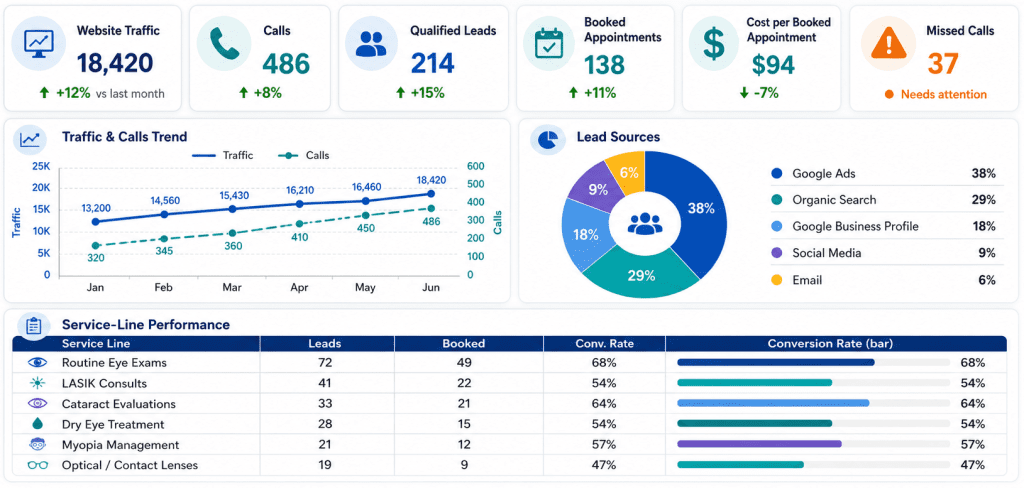
A good eye clinic marketing dashboard should show the numbers that connect marketing spend to patient demand, appointment activity, and growth priorities.
At the top level, the dashboard should include total leads, qualified leads, calls, forms, online bookings, cost per lead, cost per booked appointment, conversion rate by channel, and month-over-month trends. These numbers give leadership a quick view of whether marketing is producing opportunities.
The dashboard should also separate performance by channel. PPC, organic search, local SEO, Google Business Profile, email, social, referral campaigns, and retargeting may all play different roles. Google Business Profile reporting, for example, can help clinics understand how people find the practice on Search and Maps and what actions they take after viewing the profile.
For deeper insight, the dashboard should include service-line performance, location-level performance, landing page conversion rate, missed call trends, call outcomes, and lead quality notes. A multi-location ophthalmology group needs to know whether one office is outperforming another. A LASIK center needs to know whether leads are consultation-ready. An optometry practice needs to understand whether traffic is translating into exams, optical visits, or contact lens revenue.
What Are the Most Common Marketing Analytics Mistakes Eye Clinics Make?
The most common marketing analytics mistakes include tracking too many numbers, trusting incomplete data, ignoring call outcomes, measuring leads instead of appointments, and failing to connect marketing performance with clinic operations.
One major mistake is having no reliable conversion tracking. Without conversion tracking, the clinic may know that marketing generated clicks or traffic but not whether those visitors became leads. Another mistake is counting every lead equally. A spam form, an existing patient question, an out-of-area inquiry, and a high-intent cataract consultation should not carry the same weight.
Ignoring calls is another serious issue. If a large share of patient inquiries happen by phone, then a report that focuses only on forms will understate performance. It may also hide missed calls and poor call outcomes. This is especially important because Google Ads and other marketing platforms can track call-based conversions when properly configured.
Another mistake is failing to segment by location or service line. A clinic may think marketing is working because total leads are up, while a priority service is declining. Or a multi-location group may miss the fact that one location is generating traffic but not converting calls into appointments.
Privacy and compliance can also be overlooked. Healthcare organizations should be careful with tracking technologies, pixels, analytics tools, and advertising platforms because HHS has warned that HIPAA rules may apply when tracking technologies collect or disclose protected health information.
The final mistake is reporting without recommendations. A good analytics report should not leave the clinic thinking, “So what?” It should explain what changed, why it matters, and what action should happen next.
How Can Eye Clinics Build a Simple Analytics Framework?
Eye clinics can build a simple analytics framework by organizing metrics into four layers: visibility, engagement, conversion, and business impact.
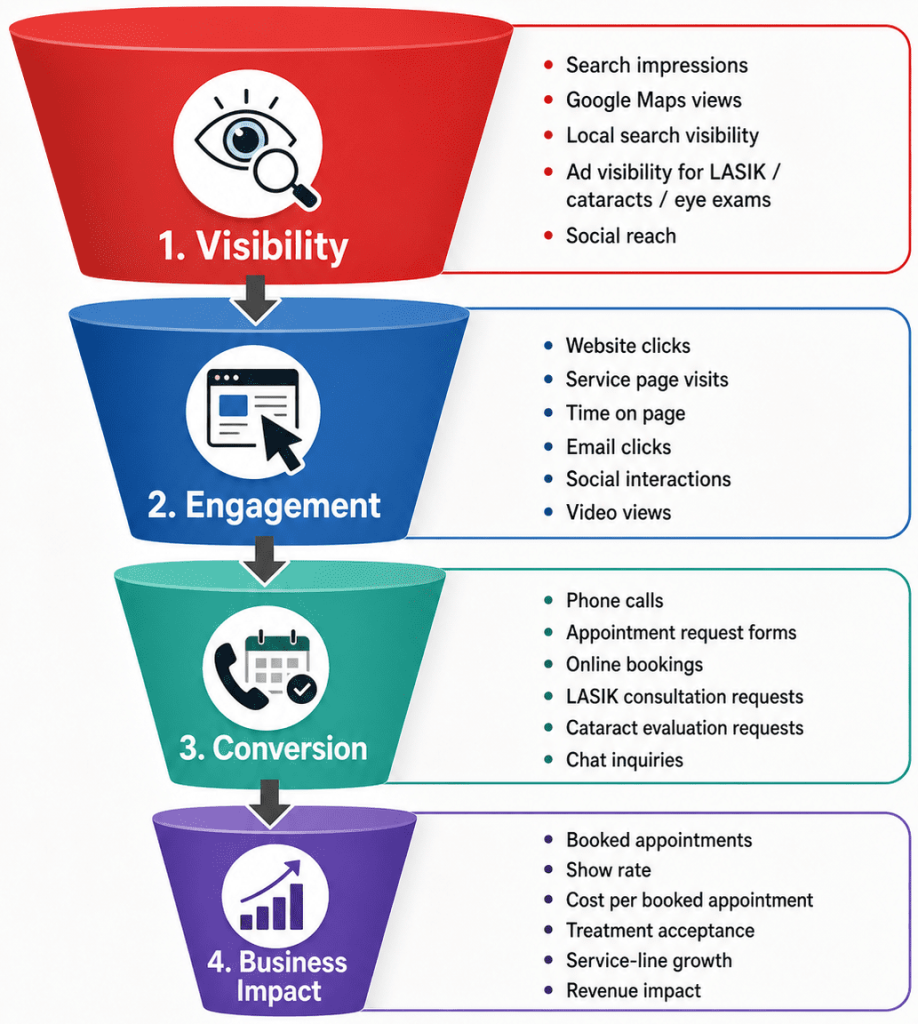
The first layer is visibility. This includes impressions, rankings, map views, local search visibility, social reach, and ad visibility. These numbers show whether people are seeing the clinic, but they do not prove patient demand.
The second layer is engagement. This includes clicks, website sessions, page views, video views, email clicks, social interactions, and time on page. These numbers show that people interacted with the clinic’s marketing, but they still do not prove that a patient is ready to schedule.
The third layer is conversion. This includes calls, forms, online bookings, consultation requests, chat inquiries, and key website actions. Google Analytics 4 uses key events to measure actions that are especially important to business success, making this layer essential for understanding meaningful behavior.
The fourth layer is business impact. This includes booked appointments, show rates, patient acquisition cost, revenue, treatment acceptance, service-line growth, and location-level growth. This is where marketing becomes connected to practice performance.
Vanity metrics usually live in the first two layers. That does not mean they should be ignored. It means they should be connected to the lower layers before the clinic uses them to make major budget or strategy decisions.
FAQ
What is the most important marketing metric for an eye clinic?
The most important metric is usually cost per booked appointment, because it connects marketing spend to an actual patient scheduling outcome. Cost per lead is also useful, but it can be misleading if the clinic does not know whether those leads became appointments.
For some clinics, the most important metric may vary by goal. A LASIK center may prioritize cost per consultation. An ophthalmology group may prioritize cataract evaluations or specialty care appointments. A general optometry practice may focus on new patient exams and optical-related visits.
Are clicks a bad metric for eye clinic marketing?
Clicks are not bad, but they are incomplete. A click shows that someone interacted with your ad, search result, email, or website link. It does not prove that the person was qualified, local, ready to book, or interested in a priority service.
Clicks become useful when paired with conversion and appointment data. For example, a campaign with fewer clicks but more booked appointments is often more valuable than a campaign with high traffic and weak patient intent.
How can an eye clinic know if Google Ads are working?
An eye clinic can know Google Ads are working by tracking qualified calls, forms, online bookings, booked appointments, cost per qualified lead, and cost per booked appointment. Clicks and impressions should be reviewed, but they should not be the final measure of success.
The clinic should also review search terms, location targeting, landing page performance, and call outcomes. Google Ads phone call conversion tracking can help advertisers see which campaigns and keywords are driving valuable calls.
Should eye clinics track phone calls from marketing campaigns?
Yes. Eye clinics should track phone calls because many patients prefer to call when they have questions about symptoms, insurance, surgery, scheduling, or provider availability.
Call tracking helps the clinic understand which campaigns generate phone inquiries and whether those calls are answered, qualified, and converted into appointments. It can also reveal operational problems such as missed calls or weak scheduling follow-up.
What is a good cost per lead for an eye clinic?
A good cost per lead depends on the service, location, competition, and lead quality. A low-cost lead is not necessarily good if it does not become a booked appointment. A higher-cost lead may be worthwhile if it is tied to a valuable service such as LASIK, cataract surgery, or specialty ophthalmology care.
Instead of relying only on generic benchmarks, eye clinics should compare cost per lead with cost per booked appointment, patient value, and service-line goals. Healthcare search advertising benchmarks vary by specialty, which makes internal performance context especially important.
How do vanity metrics affect marketing decisions?
Vanity metrics can cause clinics to overinvest in campaigns that look active but do not produce patient growth. They can also make underperforming campaigns appear successful because the report shows more impressions, clicks, likes, or traffic.
The risk is not the metric itself. The risk is using surface-level numbers to make budget decisions without checking calls, lead quality, appointments, and business impact.
Can marketing analytics help reduce wasted ad spend?
Yes. Marketing analytics can reduce wasted ad spend by showing which campaigns, keywords, locations, landing pages, and service lines produce qualified patient inquiries.
For PPC, analytics can reveal irrelevant search terms, weak conversion rates, poor landing page performance, low-quality leads, and campaigns that generate clicks without appointments. Once those issues are visible, the clinic can cut waste and shift budget toward stronger opportunities.
How often should an eye clinic update its marketing dashboard?
An eye clinic should update its marketing dashboard at least monthly, with weekly checks for PPC spend, tracking issues, calls, missed calls, and urgent campaign problems.
Monthly reporting is usually best for strategic review. Weekly checks help prevent wasted spend and catch operational issues quickly. Quarterly reviews are useful for larger decisions about budget allocation, service-line focus, and growth planning.
Conclusion
Marketing analytics should make growth clearer, not more confusing. For eye clinics, the real value of analytics is not in showing more numbers. It is in revealing which marketing activities help patients discover the practice, contact the team, schedule appointments, and move forward with care.
Vanity metrics such as impressions, clicks, rankings, traffic, and social engagement can provide context, but they should not be mistaken for outcomes. The most useful reports connect visibility and engagement to calls, forms, bookings, patient acquisition cost, service-line growth, and revenue-related decisions.
When eye clinics track the right metrics, they can stop guessing. They can see which campaigns deserve more investment, which landing pages need improvement, which calls are being missed, which services are driving demand, and where marketing dollars are being wasted.
The takeaway is simple: better analytics does not mean more complicated reporting. It means clearer reporting that helps your clinic make smarter growth decisions.
Why Visiclix is Your Ideal Choice for Marketing Analytics for Eye Clinics?
Visiclix helps eye clinics move beyond surface-level reporting and understand what their marketing data actually means. Instead of focusing only on impressions, clicks, or website traffic, Visiclix helps connect campaign activity to meaningful outcomes such as qualified calls, appointment requests, booked visits, and service-line growth.
Visiclix understands that eye care marketing is not one-size-fits-all. A LASIK campaign, cataract campaign, dry eye campaign, and routine exam campaign each need different performance expectations, conversion paths, and reporting priorities. By organizing analytics around patient intent and clinic goals, Visiclix helps practices see which marketing efforts are truly contributing to growth.
With performance-focused healthcare marketing expertise, Visiclix gives eye clinics clearer visibility into wasted spend, lead quality, PPC performance, call tracking, and local search results. That clarity helps clinic owners, practice managers, and marketing teams make decisions with confidence instead of reacting to disconnected numbers.
Turn Eye Clinic Marketing Data Into Growth With Visiclix
Ready to stop chasing vanity metrics and start tracking what actually grows your practice? Visiclix can help your eye clinic measure the right numbers, reduce wasted ad spend, improve patient acquisition, and turn marketing analytics into smarter growth decisions.