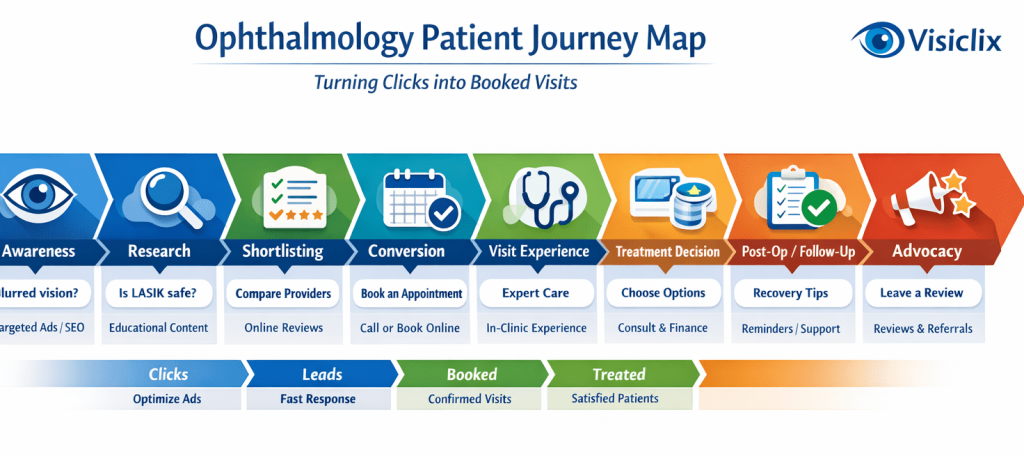
Most ophthalmology practices don’t have a “marketing problem.” They have a journey problem: the ad promise, the landing page, the phone experience, and the in-clinic visit don’t feel like one connected experience.
A patient journey map fixes that. It shows how patients move from “What’s happening to my vision?” to “I trust this clinic—book me.” And once you can see the journey, you can improve it with fewer guesses and less wasted spend in ophthalmology marketing.
What is an ophthalmology marketing patient journey map?
An ophthalmology marketing patient journey map is a simple framework that documents every step a patient takes from first awareness to long-term retention—plus what they’re thinking, what they need to believe, and what friction could stop them.
A strong map includes:
- Stages (awareness → research → booking → visit → follow-up)
- Patient questions at each stage (e.g., “Is cataract surgery safe?”)
- Objections (fear, cost, insurance, outcomes, downtime)
- Touchpoints (ads, SEO pages, reviews, phone calls, reminders)
- Next-step CTAs (call, book online, consult request, directions)
Ophthalmology is uniquely “journey-heavy” because trust and clarity matter as much as convenience—especially when procedures are involved and patients are anxious about outcomes. (AAO patient education resources emphasize the value of clear education and informed consent.)
Why does a patient journey map improve ophthalmology marketing ROI?
A journey map improves ROI because it prevents the most expensive mistake in marketing: sending high-intent patients into a confusing or inconsistent experience.
It helps you:
- Increase conversion without increasing spend (message match + lower friction)
- Stop lead leakage (missed calls, slow follow-up, unclear next steps)
- Align the full team (marketing, front desk, clinical, billing/financing)
- Measure what matters (booked appointments, show rate, treatments—not just clicks)
In practice, it connects the online and offline worlds—critical for clinics—because many “real conversions” happen by phone or in person. Google explicitly supports importing offline conversions so advertisers can connect ad clicks to offline outcomes.
What are the key stages in the ophthalmology patient journey?
Here’s a practical stage model you can apply across service lines:
- Awareness – notices symptoms or dissatisfaction (blur, glare, dry eye, glasses fatigue)
- Research – learns causes and options (what it is, risks, outcomes)
- Shortlisting – compares providers (reviews, credentials, location, insurance, technology)
- Conversion – books (call/form/chat → confirmed appointment)
- Visit experience – checks in, gets evaluated, trusts the team
- Treatment decision – chooses plan (timing, lens options, financing/coverage, next steps)
- Post-op / follow-up – adheres, gets reassurance, avoids complications
- Advocacy – reviews, referrals, returns for annual care or other services
For procedure-heavy services like cataract, patient education strongly shapes decisions—AAO materials outline what patients want to know (expectations, risks, recovery, costs).
How do you map patient questions and objections at each stage?
Start by writing the patient’s one big question at each stage, then list the objections that could stop them.
A simple question-and-objection bank (examples)
- Awareness: “Is this serious—or normal aging?”
- Objections: denial, uncertainty, “I’ll wait.”
- Research: “What are my options and risks?”
- Objections: fear, misinformation, overwhelm.
- Shortlisting: “Who can I trust with my eyes?”
- Objections: low trust, lack of proof, unclear credentials.
- Conversion: “How fast can I get in, and what will it cost?”
- Objections: insurance confusion, no times available, phone frustration.
- Visit: “Will they listen and explain?”
- Objections: rushed experience, confusing process.
- Treatment decision: “Is it worth it for me?”
- Objections: fear of surgery, uncertainty about outcomes, cost/financing.
- Post-op: “Is this normal, and what do I do next?”
- Objections: anxiety, missed instructions.
When you document objections, be careful with health claims and outcomes in your messaging. FTC guidance emphasizes that health-related claims must be truthful, not misleading, and supported by appropriate evidence.
How do you choose the best touchpoints for each stage in ophthalmology marketing?
Match touchpoints to intent—don’t treat every channel like it’s a booking machine.
Stage-to-touchpoint mapping (what works best)
- Awareness → educational SEO content, short-form video, community content
- Goal: help them name the problem and seek evaluation.
- Research → condition pages, procedure pages, FAQs, comparison guides
- Goal: build understanding and reduce fear.
- Shortlisting → Google Business Profile, reviews, physician bios, location pages
- Goal: prove trust + convenience. (GBP policy and guidelines matter for staying compliant.)
- Conversion → high-intent landing pages, click-to-call, online booking, chat
- Goal: remove friction and confirm next steps.
- Visit/Treatment → printed/digital education, financing/coverage explanations, post-visit summary
- Goal: clarity and confidence.
- Post-op/Advocacy → reminders, instructions, check-ins, review/referral asks
- Goal: adherence + retention + reputation.
Also build your map with privacy and compliance in mind. HIPAA rules around “marketing” can require patient authorization depending on the communication and use of PHI, with specific exceptions.
How do you apply a patient journey map to PPC for ophthalmology marketing?
Use the map to split PPC by intent, then route each intent to the right page and follow-up.
First, separate campaigns by intent (not by “all services”)
- Problem/condition intent (research): “why is my vision blurry,” “cataract symptoms”
- Service intent (mid/high): “cataract surgery consultation,” “LASIK cost”
- Local/provider intent (high): “ophthalmologist near me,” “best cataract surgeon [city]”
- Brand intent (protect): your practice name + variations
Next, match each intent to the correct landing page
- Research clicks → education page with soft CTA (schedule an evaluation)
- High-intent clicks → conversion page with strong proof + booking options
Then, build the “handoff” chain (this is where ROI is won)
Ad → landing page → call tracking / form → confirmation + reminders → showed visit
Finally, close the attribution loop
If bookings happen offline, connect ad clicks to booked appointments by using Google’s offline conversion import (or enhanced conversions for leads where applicable).
Also keep targeting compliant: Google’s personalized advertising has restrictions for health-related categories, so remarketing and audience strategies must be planned carefully.
How do you design landing pages that match each journey stage?
Your landing page should answer the stage’s primary question in the first 5 seconds.
Awareness/research landing pages (lower pressure)
Include:
- Clear explanation of symptoms/condition
- “When to see an ophthalmologist” guidance
- Simple next step: schedule an evaluation
High-intent conversion pages (booking-focused)
Include:
- Strong headline with message match to the ad
- Proof: credentials, experience, reviews, affiliations, outcomes phrased carefully
- Convenience: location, hours, insurance info, what to expect
- Friction-killers: click-to-call, online booking, short forms, FAQ accordion
Don’t ignore compliance and trust
- Avoid exaggerated outcome claims; ensure claims are supported (FTC).
- Handle patient communications with HIPAA awareness when PHI is involved.
What KPIs should you track across the ophthalmology patient journey map?
Track KPIs by stage so you can diagnose where the journey breaks.
Marketing metrics (early stages)
- Impressions, CTR
- Engaged sessions (not just sessions)
- Scroll depth / FAQ interaction (research quality)
Conversion metrics (middle)
- Calls, forms, online bookings
- Answer rate (percent of calls answered)
- Speed-to-lead (time to callback)
- Booking rate (lead → scheduled)
Business outcomes (late stages)
- Show rate (scheduled → arrived)
- Treatment acceptance rate (evaluated → proceeded)
- Post-op adherence signals (follow-up attendance)
- Reviews + referral volume
To improve optimization, connect online to offline outcomes using Google’s offline conversion tracking capabilities.
How do you turn the journey map into a weekly operating system for your practice?
A journey map becomes powerful when it’s operational.
A simple weekly cadence
- First: review the funnel as a team (lead → booked → showed → treated)
- Next: pick one bottleneck to fix this week (example: low answer rate)
- Then: implement one change (script, staffing, page tweak, scheduling blocks)
- Finally: measure impact next week and repeat
Assign owners by stage
- Marketing owner: traffic quality + landing pages
- Front desk owner: answer rate + booking workflow
- Clinical owner: education consistency + plan clarity
- Ops owner: reminders, follow-ups, review requests
Keep patient communications compliant
HIPAA marketing rules can require authorization in certain scenarios, with defined exceptions. If your workflow uses PHI in communications, align processes to HIPAA guidance and the regulatory text.
What mistakes should you avoid when building a patient journey map for ophthalmology marketing?
These are the patterns that waste the most budget and time:
- One generic map for every service line
LASIK, cataract, and medical eye care have different fears, timelines, and cost logic. - Optimizing only for leads, not booked visits
If you don’t measure booking + show rate, you’ll scale low-quality volume. - Sending high-intent clicks to education-only pages
High-intent patients need proof, clarity, and a fast path to schedule. - Ignoring review and profile compliance
Stay aligned with Google Business Profile policies/guidelines to avoid visibility risk. - Forgetting health ad policy constraints
Health-related targeting and personalization have restrictions—plan audiences accordingly.
Can you use one ophthalmology patient journey map for LASIK, cataract, and medical eye care?
Yes—but only as a shared backbone with service-line variations.
What stays consistent
- Trust signals (credentials, reputation, clarity)
- Convenience (availability, location, scheduling)
- Education that reduces uncertainty
- Follow-up that builds retention
What changes by service line
- LASIK: elective, price shopping, heavy comparison, strong outcome expectations
- Cataract: age-related concerns, fear and health literacy barriers, lens option complexity (AAO cataract info helps illustrate what patients want to understand).
- Medical eye care (glaucoma/retina/etc.): ongoing care, urgency varies, insurance-driven decisions
How do you create an ophthalmology patient journey map template you can fill in today?
Use this fill-in template for each stage:
Stage → Patient goal → Top question → Top objection → Best channel → Asset needed → CTA → Follow-up → Owner → KPI
Example (Conversion stage):
- Goal: book an appointment
- Question: “Can I get in soon, and what will it cost?”
- Objection: “I’m not sure insurance covers this / I don’t want surprise costs.”
- Channel: PPC + landing page + phone
- Asset: booking page + insurance explainer + pricing ranges where appropriate
- CTA: call/book
- Follow-up: confirmation + reminders
- KPI: booking rate + answer rate + show rate
If you want PPC optimization that reflects reality, set up offline conversion measurement so booked appointments (not just form fills) guide bidding.
FAQ
What is the fastest way to improve conversion rates in ophthalmology marketing?
Fix the “conversion chain” first: answer rate, speed-to-lead, booking workflow, and landing page message match. Then connect booked appointments back to ad platforms using offline conversion tracking so campaigns optimize toward real outcomes.
How many landing pages should an ophthalmology practice have for PPC?
At minimum: one high-intent page per core service line (e.g., cataract consult, LASIK consult, comprehensive eye exam) plus location variants if you serve multiple cities. Add research pages for condition-intent traffic.
Should ophthalmology marketing focus more on SEO or paid ads?
Use both based on the journey: SEO supports awareness/research and reduces long-term acquisition costs, while PPC captures high-intent demand now. A journey map decides where each channel fits.
What should a front desk team do to improve marketing results?
Treat the front desk as a conversion team: answer quickly, use a consistent script, confirm next steps, and reduce scheduling friction. Track answer rate and booking rate every week.
How do you measure booked appointments from ophthalmology marketing?
Use call tracking and CRM/scheduling data to record when a lead becomes a booked appointment, then import those conversions into Google Ads (or use enhanced conversions for leads where applicable).
Conclusion
A patient journey map turns ophthalmology marketing from a list of tactics into a connected system. It helps you align channels to intent, reduce friction at booking, improve in-clinic continuity, and build retention through follow-up and advocacy.
If you want better ROI without endlessly increasing spend, map the journey first—then build your PPC, SEO, and operations around the exact moments patients decide.
Why Visiclix is Your Ideal Choice for Ophthalmology Marketing?
Visiclix is built for practices that want measurable growth, not disconnected “marketing activities.” Instead of guessing which tactic to try next, we start with a patient journey map that connects your ads, landing pages, phone workflow, and follow-up into one conversion system—so your marketing performance reflects how patients actually choose care.
We also focus on what matters most for ophthalmology: trust, clarity, and operational execution. That means improving the parts most agencies ignore—like answer rate, booking friction, message match, and appointment outcomes—while keeping measurement strong enough to optimize campaigns based on booked visits and real revenue (not vanity metrics).
Ready to Improve Your Ophthalmology Marketing Results With Visiclix?
If you’re tired of paying for leads that don’t book (or bookings that don’t show), Visiclix can help you build a patient journey map, tighten your conversion chain, and optimize campaigns around real outcomes.
Next step: Book a journey + PPC funnel review and get a prioritized list of the highest-impact fixes for your practice.