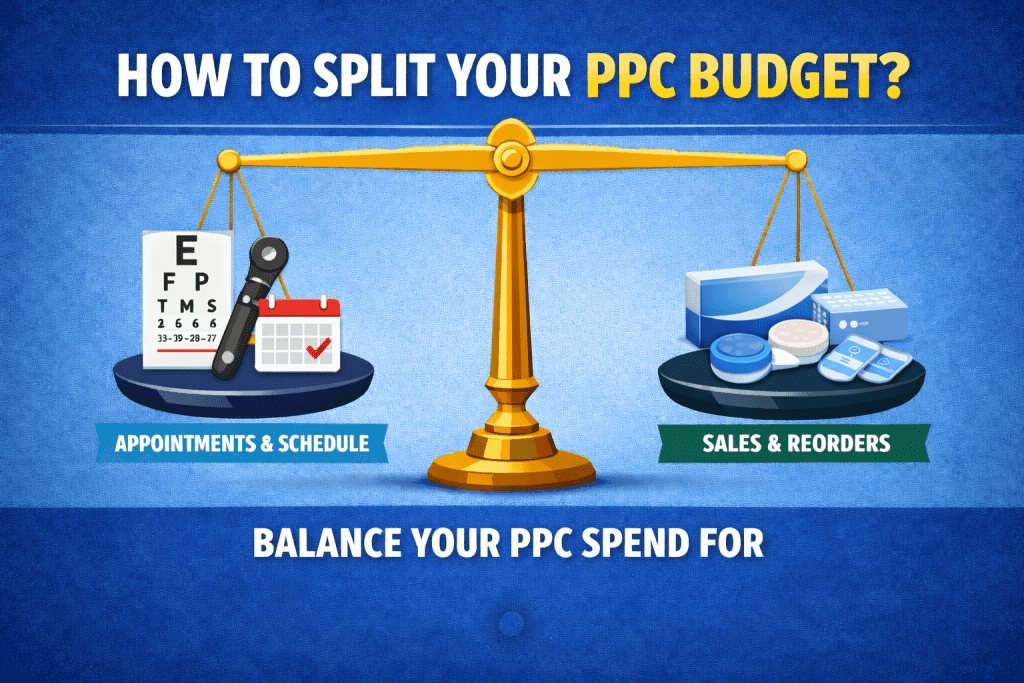
A profitable PPC budget optometry plan isn’t just “spend more on what gets more leads.” Eye exams and contact lenses behave like two different businesses: one is an appointment engine limited by capacity, and the other is a repeat-purchase product line shaped by margins, fulfillment, and price competition. When you budget them the same way—or worse, bundle them into one campaign—you end up chasing the wrong conversions and calling it “Google being expensive.”
This guide lays out a practical way to split spend between exams and contacts using break-even math, clean campaign structure, and tracking that reflects what actually hits your bank account.
What’s the real difference between selling an appointment and selling contact lenses through PPC?
Eye exams are constrained by your schedule. Even if demand is strong, you can only sell as many appointments as your providers and staff can deliver without hurting patient experience. That means “more conversions” isn’t always better—especially if your conversion definition is a booking that later no-shows.
Contact lenses don’t have the same capacity limit, but they do have different friction. People shop by brand and price, compare options quickly, and often reorder based on convenience. That can make contact lens PPC look volatile: a small change in shipping expectations, price clarity, or the steps to reorder can swing conversion rate materially.
The most important takeaway is that these two offers should not compete for the same budget inside the same campaign. They require different landing experiences, different success metrics, and often different bidding strategies.
How do you calculate what you can afford to pay for an eye exam lead versus a contact lens customer?
Budget decisions get easy once you stop debating CPCs and start anchoring to break-even CPA. You’re not trying to “get cheap clicks.” You’re trying to buy outcomes at a cost that leaves you profit.
For eye exams, your true unit isn’t the booking—it’s the kept appointment. If no-show rates aren’t accounted for, your CPA math will always be overly optimistic. Operationally, no-shows are common enough in healthcare contexts that they need to be built into the model rather than treated as an exception.
A simple, usable exam model looks like this:
- Break-even CPA (Exams) = Gross profit per kept exam × Show rate
Then pick a target CPA below break-even to ensure you’re not merely surviving:
- Target CPA = Break-even CPA × 0.6–0.8
Contact lenses work differently. The break-even is driven by contribution margin per order and how many orders you reasonably expect from a customer. If you don’t have strong retention, assume only the first order. If you’ve built a reorder engine (reminders, easy re-purchase, subscription options), your allowable CPA can be higher because you’re buying a customer, not a one-time sale.
- Break-even CPA (Contacts) = Contribution margin per order × expected number of orders in your value window
This is the heart of the exam vs contacts budgeting decision: exams can have high downstream value but are capacity-limited; contacts can scale but are margin- and retention-sensitive.
How should your Google Ads account be structured so the budget split actually works?
If you want clean budgeting, you need clean separation. At minimum, create two distinct Search campaigns: one dedicated to eye exams and one dedicated to contact lenses. This prevents each offer from stealing spend and also lets you measure performance without ambiguity.
Just as importantly, your ad-to-page match must stay tight. Sending exam-intent traffic to a general homepage weakens relevance, hurts conversion rate, and clouds your conclusion about whether the “exam campaign” is profitable. Google’s own guidance emphasizes making landing pages relevant and useful relative to ad intent.
Your conversion setup should reflect reality, not convenience. For exams, calls and booking completions matter—but if you can connect outcomes back to Google Ads (like kept appointments or completed exams), optimization gets dramatically more accurate. Google supports offline conversion imports and lead-related enhancements specifically for this kind of closed-loop measurement.
For contacts, purchase tracking is the clearest signal. If e-commerce is in place, conversion values allow bidding to prioritize revenue rather than just “more orders,” which is especially important if order values vary by brand or pack size.
How do you set an initial budget split—and what tells you to shift it?
Your starting split should come from one question: what’s your current constraint?
If you need new patients, exams usually deserve a larger share early because they build your base and feed downstream opportunities. If you’re already busy, exam spend can become counterproductive—your marginal dollar might be better invested in contact lenses where you can scale without increasing clinic load.
The most reliable approach is to start with a reasonable allocation, run it long enough to gather stable conversion data, and then rebalance using a simple rule:
shift budget toward the campaign that beats target CPA without creating an operational bottleneck.
That last clause matters. A campaign can look great on paper but still be the wrong place to put the next dollar if it creates scheduling chaos, staff burnout, or longer wait times that harm reviews and retention.
What optimizations protect profitability for both offers without turning into busywork?
The highest-leverage routine for both campaigns is the same: query quality control. In optometry PPC, wasted spend often comes from searches that “sound relevant” but aren’t commercial intent, or aren’t aligned with what you actually offer.
Negative keywords are the primary control mechanism, and they’re meant to be applied systematically—not randomly. The Search terms report then becomes your weekly truth serum: it shows exactly what people typed, which queries converted, and which ones are draining budget.
Over time, your optimization rhythm becomes less about constant tinkering and more about maintaining clean demand:
- For exams, you’re protecting spend from low-intent research traffic and mismatched services.
- For contacts, you’re protecting spend from price-only browsers if you can’t win that game, and from irrelevant queries that don’t match your brand/product inventory.
Remarketing can help both, but it’s most powerful when it aligns to decision cycles: exam shoppers often need trust and timing reassurance, while contact lens shoppers often need friction removed to complete purchase or reorder. When remarketing is small but consistently profitable, it deserves its own protected slice rather than being starved by top-of-funnel campaigns.
Conclusion
Splitting budget between eye exams and contact lenses isn’t a creative choice—it’s a financial one. Once you calculate break-even and target CPA, separate the campaigns so the data is clean, and track outcomes that reflect reality (kept appointments and purchases), the “right split” stops being guesswork.
Start with a constraint-based allocation, let the campaigns run long enough to learn, and shift spend toward what beats target CPA without breaking capacity. That’s how optometry PPC becomes predictable.
Why Visiclix is Your Ideal Choice for PPC Budgeting in Optometry?
Visiclix helps optometry practices stop treating PPC as “lead generation” and start running it as a profit-controlled system. That begins with separating eye exam and contact lens campaigns so performance isn’t blended, then building measurement that ties ad spend to real outcomes—calls that become kept appointments, bookings that become revenue, and purchases that repeat.
Visiclix also focuses on the part most practices miss: protecting the budget through intent discipline. With a structured search terms and negative keyword workflow, plus landing page alignment that improves conversion efficiency, Visiclix makes it easier to scale what’s working while cutting what’s quietly wasting spend.
Build a Smarter PPC Budget with Visiclix
If you want a clean exam-vs-contacts budget plan built around break-even CPA, real conversion tracking, and an allocation system you can actually run week to week, contact Visiclix for a PPC budget audit and split-spend roadmap.