
In competitive markets, optometry practices rarely lose because they offer bad care. They lose because patients cannot quickly tell why one practice is the better fit than another. When websites, Google profiles, review language, office visuals, and service pages all sound similar, patients fall back on the easiest comparison points: location, insurance, availability, or price.
That is why optometry brand positioning matters. Strong positioning helps a practice claim a clear, relevant space in the patient’s mind. It tells the right audience who you serve, what makes your care different, and why choosing your practice is worth it. For local visibility, this clarity also supports better alignment across your website, Google Business Profile, reviews, and service messaging, which matters because Google’s local results are influenced by relevance, distance, and prominence.
What is Optometry Brand Positioning and Why Does It Matter in a Crowded Market?
Optometry brand positioning is the strategic decision about how your practice should be perceived by a specific group of patients. It is not just your logo, color palette, or tagline. It is the answer to a more important question: when patients compare providers, what do you want them to remember and value about your practice first?
That makes positioning different from branding and marketing. Branding is how your practice looks, sounds, and feels. Marketing is how you promote your services. Positioning sits underneath both. It defines the core promise that your branding expresses and your marketing amplifies. HubSpot describes a positioning statement as a concise explanation of who a product or service is for, what need it fulfills, and how it is distinct from alternatives. That same logic applies to optometry practices.
In crowded markets, this matters more because patient choice gets harder, not easier. If your practice looks interchangeable with nearby competitors, your message loses force. But when your positioning is clear, your entire patient journey becomes easier to understand: the homepage headline is sharper, service pages are more persuasive, ads are more targeted, and reviews reinforce a consistent story.
Why Do So Many Optometry Practices Sound the Same to Patients?
Most optometry practices default to safe, generic messaging. They say they provide “quality eye care,” “personalized service,” or “advanced technology.” None of those phrases are wrong, but they are also not memorable because many competitors can claim the same things.
This sameness often comes from trying to appeal to everyone at once. A practice may want to attract families, medical eye care patients, dry eye cases, contact lens wearers, premium eyewear buyers, and seniors all under one broad brand message. The result is a weak middle ground. Patients see a long list of services, but no strong reason the practice is especially right for them.
Another common problem is that the visible brand promise and the lived patient experience are not aligned. In healthcare, patient experience shapes trust, satisfaction, and long-term engagement. When a practice positions itself as premium, attentive, or highly personalized, patients expect those claims to show up in scheduling, communication, wait times, staff interactions, and follow-up care. If they do not, the positioning breaks down.
How Do You Analyze the Competitive Market Before Choosing a Brand Position?
You should not choose a brand position in isolation. You choose it in context. That means studying what nearby practices already claim, how they present themselves, and where the market feels saturated or under-served.
Start with a local competitor audit. Review each practice’s homepage headline, service categories, doctor bios, eyewear emphasis, financing or insurance language, review themes, and Google Business Profile categories. Look for patterns. If ten practices all present themselves as convenient family eye care providers, that positioning may be crowded. If very few clearly own pediatric vision, dry eye treatment, premium eyewear styling, or medically oriented eye care, there may be room to differentiate.
Then pay attention to local search signals. Google states that local ranking is mainly influenced by relevance, distance, and prominence. That means your position has to be specific enough to match search intent. A practice that genuinely specializes in dry eye, myopia management, or pediatric exams can support that position with focused service pages, complete business information, review signals, and a well-built profile, making the practice more relevant to those searches.
The key is not simply finding what competitors do poorly. It is finding the place where your practice can be both credible and distinct.
How Do You Identify the Right Patient Audience for Your Positioning?
Good positioning starts with patient selection. Not exclusion in a harsh sense, but strategic clarity. You can serve many people while still building your brand around the patients who best match your strengths, service mix, and growth goals.
For an optometry practice, that audience might be young families who want continuity of care, parents worried about childhood myopia progression, adults seeking stylish premium frames, busy professionals who value efficiency, seniors needing ongoing medical eye care, or dry eye patients looking for more specialized support. Different audiences care about different proof points. A parent evaluating myopia management wants trust, clinical clarity, and long-term monitoring. A premium eyewear buyer may care more about curation, aesthetics, and concierge-level service.
This matters strategically because the clinical opportunity in eye care is not uniform. For example, myopia management has become more prominent as prevalence concerns have increased and professional guidance has emphasized the importance of early intervention and treatment options. Likewise, dry eye is a significant and well-established clinical need with evidence-based guidance supporting diagnosis and long-term management. If your practice has real capabilities in either area, those service lines can support a stronger and more focused position than a generic “full-service eye exam” message alone.
What Makes an Optometry Practice Truly Different From Local Competitors?
Real differentiation is not a slogan. It is a difference patients can understand and experience.
For optometry practices, meaningful differentiation usually falls into one or more of these categories. The first is clinical expertise. A practice may be known for pediatric vision, ocular disease co-management, dry eye care, specialty contact lenses, or myopia management. The second is patient experience. Some practices differentiate through warmth, education, speed, convenience, or a more personalized journey. The third is retail and aesthetic value. A practice with a strong optical boutique, carefully selected frame lines, or high-touch styling support can build a more premium identity. The fourth is technology and process. Advanced diagnostics or streamlined digital workflows can strengthen a position, but only when patients understand why those tools improve their experience or outcomes.
The most important distinction is this: patients do not reward practices merely for having differences. They reward practices for communicating differences that matter to them. “We use advanced technology” is weak. “We use advanced imaging to catch issues early and explain your eye health clearly” is stronger because it links the feature to patient value.
How Do You Turn Your Differentiators Into a Clear Value Proposition?
Once you know your audience and differentiators, turn them into a simple value proposition. A good structure is:
We help [specific patient group] get [desired outcome] through [distinct approach], so they can [meaningful benefit].
That formula works because it forces focus. It makes you define who the brand is for, what problem matters most, how your practice is different, and why that difference has practical value. HubSpot’s guidance on value propositions and positioning statements follows this same principle of clarity and alignment.
Here is the difference in practice:
Weak version:
“We provide high-quality eye care with personalized service.”
Stronger version:
“We help families and growing children protect long-term vision through proactive, education-focused eye care and myopia management.”
Another example:
“We help style-conscious patients find eyewear that fits their vision needs and personal identity through curated frame selections and a premium in-office experience.”
The stronger versions are better because they are easier to remember, easier to support with proof, and easier to reflect across web copy, ads, and reviews.
Should Your Practice Compete on Price, Experience, Expertise, or Convenience?
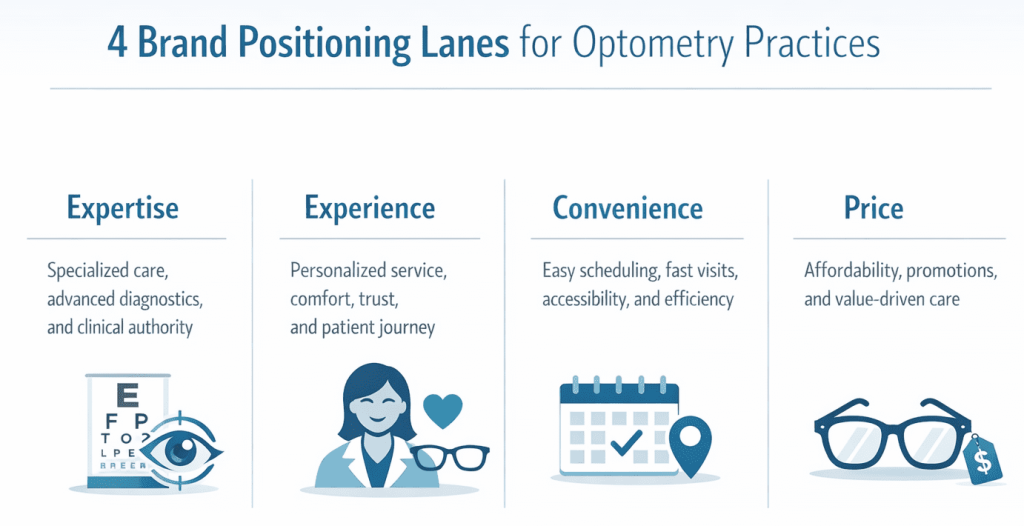
Most independent optometry practices should avoid leading with price unless they are intentionally built around a high-volume, low-friction model. Competing on price is difficult to sustain against larger chains, warehouse retailers, and businesses with more aggressive promotional structures. It can also weaken perception if your real strength is expertise, specialized care, or a premium optical experience.
A better approach is to choose the lane that best fits your capabilities. If your doctors are especially strong in medical or specialty care, lead with expertise. If your optical is a major advantage, lead with style and curated service. If your systems are unusually efficient, lead with convenience. If your team experience is exceptional, lead with warmth, trust, and personalization.
The important thing is consistency. Patients should see the same position reflected everywhere. A practice cannot credibly present itself as luxury-level care, discount-friendly, ultra-convenient, and deeply specialized all at once. That is not positioning. That is message clutter.
How Does Brand Positioning Influence Your Website, Messaging, and Local SEO?
Positioning should reshape your digital presence from the top down. Your homepage headline should say more than “Welcome to our practice.” It should quickly communicate your core value to your ideal patient. Service pages should not be generic checklists. They should reflect the priorities of the audience you most want to attract. Your “About” page should reinforce why your doctors and team are uniquely qualified to deliver the promised experience.
Positioning also improves local SEO because it helps you become more relevant for the searches that matter most. Google advises businesses to keep profile information complete and accurate, and explains that local visibility depends in large part on relevance, distance, and prominence. A practice with a clear specialty focus can support relevance through precise categories, strong descriptions, accurate services, focused content, and reviews that mention those services.
Reviews play a major role here. BrightLocal’s 2025 research found that Google remains the dominant platform consumers use to find local business reviews. That means review generation should not be treated as a generic reputation tactic. It should support your position. If you want to be known for pediatric care, dry eye treatment, or exceptional eyewear styling, your review strategy should encourage patients to describe those specific experiences in natural language.
For PPC and landing pages, positioning matters just as much. Paid campaigns perform better when the offer matches a specific patient need and the landing page reinforces a clear value proposition instead of broad, unfocused brand copy.
What Should Your Visual Brand and In-Office Experience Communicate?
Your visual identity should make your position feel believable before a patient ever meets the doctor. A practice that wants to be seen as modern and technology-led should not present itself with dated photography, vague headlines, and inconsistent office design. A practice that wants premium perception should not create a bargain-bin visual impression. A family-centered practice should not feel cold, overly clinical, or difficult to navigate.
In healthcare, first impressions and patient interactions influence trust and likelihood to recommend. That means brand positioning cannot stop at design files. It has to show up in staff scripting, appointment confirmations, front-desk tone, exam-room education, optical handoff, follow-up communication, and the physical environment itself.
The best visual systems do not just look attractive. They make the brand promise easier to recognize. Photography, signage, fonts, colors, doctor bios, and merchandising should all support the same story your website tells.
How Can Independent Optometry Practices Position Themselves Against Corporate Chains?
Independent practices usually win by being more specific, more human, and more trust-rich than chains. A chain may compete well on convenience, broad insurance visibility, or standardization. An independent practice can compete on relationship continuity, specialized expertise, curated experience, local identity, and deeper education.
This is especially powerful when the positioning is patient-centered rather than owner-centered. Patients care less that you are independent in principle and more about what independence enables. It may allow more tailored recommendations, greater continuity with the same doctor, better frame curation, longer education moments, or a more thoughtful care experience. That is the difference patients understand.
Independent practices should also lean into local prominence-building signals. Google explicitly notes that prominence is part of local ranking, and prominence is influenced by information such as reviews, links, and overall visibility. In practice, that means a well-positioned independent brand can become highly competitive by earning strong branded searches, better review narratives, more local mentions, and a clearer reputation around specific services.
How Do You Test Whether Your Brand Positioning Is Actually Working?
Positioning is working when the right patients become easier to attract, easier to convert, and easier to retain.
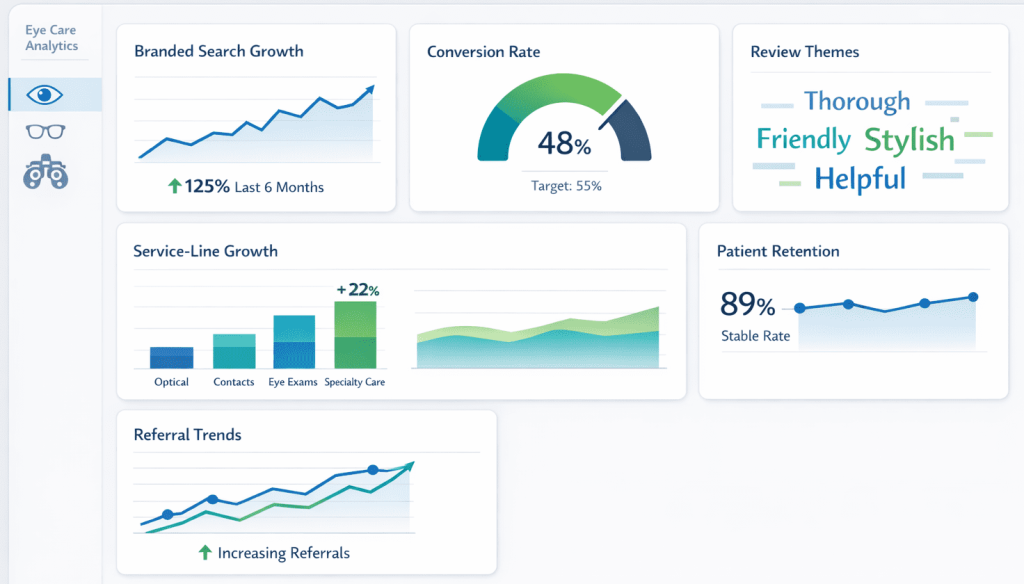
Start by tracking whether inquiry quality improves. Are you getting more calls or form fills for the services you most want to grow? Are more patients mentioning the qualities you want to own, such as thoroughness, stylish eyewear, great care for children, or helpful dry eye support? Review language is especially useful because it reveals how patients naturally describe your practice. Since Google reviews are a major discovery source for local businesses, this feedback affects both perception and visibility.
Then look at business metrics. Watch conversion rates on key landing pages, appointment mix by service line, no-show rate, retention, referral patterns, revenue per patient, and branded search activity in your analytics platforms. If your positioning says you are the area’s go-to destination for specialty contact lenses, but most new patients still arrive for basic routine exams and mention low price, your position is not fully landing.
Finally, test message consistency. Ask front-desk staff, opticians, and doctors to describe the practice in one or two sentences. If every answer is different, the market is probably receiving a blurry picture too.
What Are the Biggest Brand Positioning Mistakes Optometry Practices Should Avoid?
The first mistake is trying to be for everyone. Broad positioning feels safe, but it usually makes a practice less memorable. The second mistake is copying competitors. If the market already sounds generic, imitation only makes you disappear faster.
The third mistake is making claims without proof. A practice cannot credibly position itself as premium, advanced, or specialized unless the patient experience, service pages, team expertise, reviews, and environment all reinforce that promise. The fourth mistake is treating positioning as a one-time slogan exercise. Positioning is strategic infrastructure. It affects website content, Google Business Profile setup, paid campaign angles, staff messaging, and even which photos you choose.
The final mistake is failing to revisit your position as the market changes. New competitors, new service lines, shifting patient demand, and evolving search behavior can all change which position is most advantageous over time.
What is the difference between optometry branding and brand positioning?
Brand positioning is the strategic place your practice wants to occupy in the patient’s mind. Branding is the system of visuals, tone, and messaging used to express that position. Positioning comes first because it gives branding direction.
Can a small independent optometry practice out-position larger chains?
Yes. Independent practices often have an advantage when they focus on strengths chains cannot express as convincingly, such as continuity of care, niche expertise, local trust, and a more personalized patient journey. That advantage grows when those strengths are clearly reflected across reviews, local search presence, and service messaging.
How do I know whether my practice should position around medical eye care or eyewear?
Choose the area where your practice has the strongest combination of capability, proof, market opportunity, and patient demand. If your doctors have meaningful specialty strengths and you want to grow care-based services, medical positioning may fit better. If your optical experience is a standout asset and patients respond strongly to style and product curation, eyewear-led positioning may be smarter.
Does premium positioning work for optometry practices?
Yes, when it is supported by real experience and not just premium language. Premium positioning works best when patients can clearly see and feel the difference through doctor expertise, optical curation, education, convenience, office environment, and service consistency.
How often should an optometry practice revisit its brand position?
A full repositioning is not always necessary, but most practices should review their position annually and more deeply whenever they add major services, enter a more competitive market, redesign their website, or see a mismatch between the patients they want and the patients they are attracting.
Can local SEO improve if our positioning is clearer?
Yes. Clearer positioning can improve relevance because it helps you create more specific service pages, business information, category choices, and review signals around the searches you most want to match. Google explicitly states that relevance is one of the main local ranking factors.
What should appear in an optometry positioning statement?
A strong statement should identify your target patient, the problem or need you address, your distinctive approach, and the meaningful value patients get from choosing you.
Is patient experience part of brand positioning?
Yes. In healthcare, patient experience influences trust, satisfaction, and loyalty. If your stated position does not match the experience patients actually have, the market will believe the experience, not the message.
Conclusion
Winning a competitive market does not require an optometry practice to outshout every nearby competitor. It requires the practice to become the clearest, most credible choice for the right patients. That is what effective optometry brand positioning does. It transforms a practice from “one more option” into a distinct answer to a specific patient need.
When positioning is done well, it sharpens everything downstream. Your website becomes clearer, your local SEO becomes more relevant, your reviews tell a more consistent story, and your marketing stops relying on vague claims. Most importantly, patients understand why your practice is worth choosing.
Why Visiclix is Your Ideal Choice for Optometry Brand Positioning?
Visiclix is uniquely positioned to help optometry practices turn vague branding into a growth-focused market advantage. Instead of treating branding as a cosmetic exercise, Visiclix can align positioning with the channels that actually drive patient acquisition, including websites, local SEO, paid campaigns, landing pages, and review strategy. That matters in competitive markets where the difference between getting considered and getting ignored often comes down to message clarity.
Visiclix also brings the strategic discipline needed to connect brand promise with patient-facing execution. A strong optometry brand is not built by visuals alone. It is built when market analysis, service-line priorities, audience targeting, conversion messaging, and local visibility all support the same position. That is the kind of integrated brand positioning work that helps practices stand out for the right reasons.
Build a Stronger Optometry Brand With Visiclix
If your practice blends into the market, patients will default to convenience or price. Visiclix can help you define a sharper position, clarify what makes your practice different, and turn that positioning into a digital presence that attracts and converts the right patients. The result is a brand that feels more credible, more memorable, and more competitive where it counts.