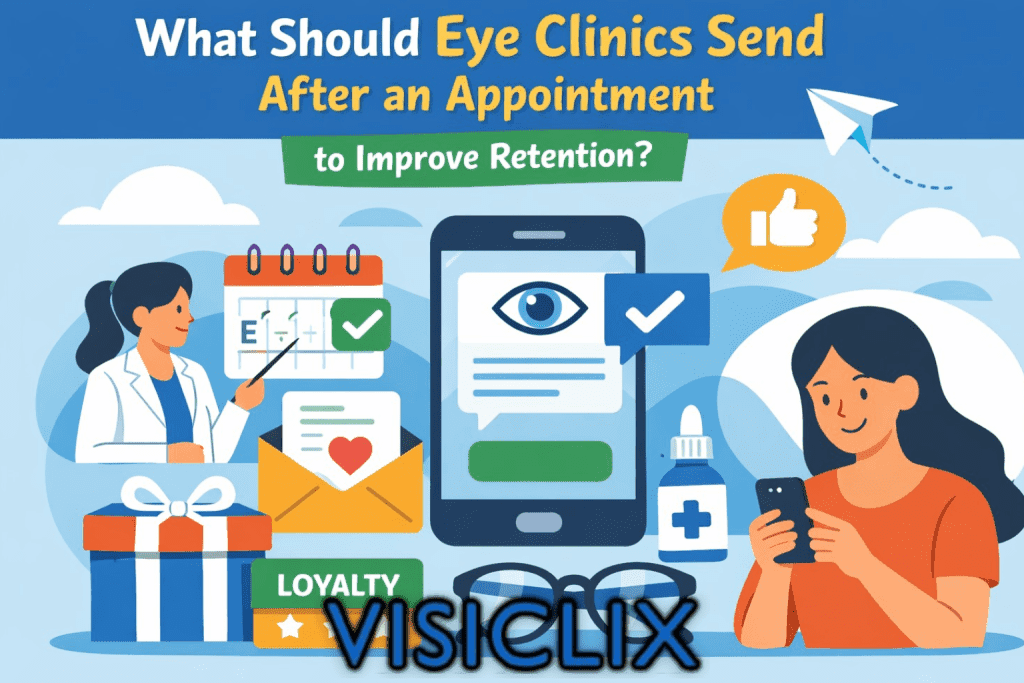
Many eye clinics put a lot of effort into getting a patient booked, checked in, seen, and treated, then go nearly silent once the appointment ends. That is a missed opportunity. The period right after a visit is when patients are most likely to remember your clinic, act on care instructions, leave a review, book a follow-up, or purchase recommended products.
That is why email marketing for optometry practices works best when it is not treated as a generic newsletter channel. It should function as a structured post-appointment system. The right emails help patients know what to do next, help clinics protect recall revenue, and help teams stay connected without relying entirely on phone calls. The American Optometric Association highlights recall systems as a core part of patient communication, including computer-assisted recall and pre-appointments for annual eye health exams. HHS also confirms that healthcare providers may communicate with patients by email under HIPAA, with appropriate consideration for security and patient preferences.
What is post-appointment email marketing for optometry practices?
Post-appointment email marketing for optometry practices is a planned series of messages sent after a patient visit to guide the next action. That next action might be reading care instructions, confirming a follow-up, ordering glasses, reordering contacts, leaving a review, or returning for an annual exam.
This is different from sending occasional promotions or a monthly newsletter. A post-appointment sequence is triggered by what just happened in the clinic. It is tied to the patient journey, not just the marketing calendar. That distinction matters because HIPAA draws real lines around treatment, healthcare operations, and marketing activities, even though those categories can overlap in practice. HHS notes that the Privacy Rule specifically defines these terms and carves out certain treatment and healthcare operations communications from what counts as marketing.
Why does post-appointment email marketing matter for eye clinics?
It matters because appointments create momentum. Right after a visit, the patient is still thinking about their symptoms, prescription, glasses options, contact lens habits, or next exam. If the clinic sends a useful email during that window, the patient gets clarity. If the clinic sends nothing, the patient often defaults to delay.
For optometry practices, that delay shows up in familiar ways. Patients forget to book recommended testing. They postpone annual exams. They do not reorder lenses on time. They mean to leave a review, but never get around to it. A well-built email sequence reduces friction around all of those steps by turning vague intent into a clear next action.
It also improves the patient experience. A follow-up email can reassure a patient after dilation, remind a new contact lens wearer about proper use, or explain what to expect next after a dry eye consultation. That makes the clinic feel organized and attentive rather than transactional.
From a business standpoint, post-appointment emails also support recall and retention. The AOA’s patient communication guidance explicitly includes recall methods such as mail recall, telephone recall, dispensing-related recall, computer-assisted recall, and pre-appointments for the next annual eye health examination. Email fits naturally into that framework.
What should an eye clinic send immediately after an appointment?
The first email should be simple, reassuring, and practical. In most cases, the best immediate message is a thank-you email with a short recap and a clear next step.
That message can include:
- a thank-you for visiting
- confirmation that the appointment was completed
- a plain-language reminder of what happens next
- contact details for questions
- a link to schedule a follow-up, review eyewear options, access the portal, or pay an outstanding balance if appropriate
The goal is not to cram everything into one email. The goal is to reduce uncertainty. A patient who just left your office should not have to guess whether they need to return in two weeks, watch for a call, pick up glasses, or reorder contacts.
For practices thinking about compliance, this is also where discipline matters. HHS says providers may communicate with patients by email and should consider the risks of unencrypted email and patient preferences. That means the immediate follow-up should be helpful without including unnecessary protected health information in a casual marketing-style message.
What educational follow-up emails should eye clinics send after different visit types?
Educational follow-up emails should match the reason for the appointment. This is where many clinics lose relevance. They send the same post-visit message to every patient, even though a routine eye exam patient and a dry eye patient do not need the same guidance.
For a routine eye exam, the best educational follow-up may be minimal. A short message can remind the patient about prescription access, eyewear next steps, or annual recall timing.
For a contact lens fitting, the follow-up can reinforce wear schedules, replacement rules, hygiene basics, and what to do if lenses feel uncomfortable. HHS guidance is useful here because it recognizes that treatment and healthcare communications often overlap with practical product-use messaging. In healthcare, communications that encourage proper use of currently prescribed products or therapies can fall outside the strict definition of marketing in some circumstances.
For a dry eye visit, the follow-up email can explain the recommended routine in plain language: artificial tears, warm compresses, screen habits, environmental triggers, and when symptoms should prompt another visit.
For a pediatric eye exam, the follow-up may be aimed at the parent or guardian and focus on wear compliance, school-related concerns, myopia management next steps, or when the child should be seen again.
For a medical eye care follow-up, the safest approach is usually a more tightly controlled communication process. The email can guide the patient toward secure next steps rather than overexplaining clinical details in a broad marketing system.
The principle is simple: the more closely the email matches the patient’s actual visit, the more useful and effective it becomes.
How does email marketing for optometry practices support recall and rebooking?
Email supports recall and rebooking by keeping the next appointment visible before it is forgotten. That is especially important in optometry because many patients do not feel urgent symptoms when it is time to come back. Annual care is easy to delay when nothing feels wrong.
A strong system usually separates follow-up reminders, annual recall, and reactivation. Follow-up reminders are for patients who already need the next step soon, such as a pressure check, lens follow-up, or medical reevaluation. Annual recall targets patients who are approaching their usual return window. Reactivation is for patients who are already overdue and need a stronger prompt to return.
This structure aligns with the AOA’s emphasis on recall systems, including dispensing-related recall and computer-assisted recall. In other words, recall is not an optional marketing extra for eye clinics. It is part of healthy patient communication and practice operations.
When should eye clinics send a review request after an appointment?
Eye clinics should send review requests while the visit is still fresh, but not so fast that the message feels automated or premature. For a routine eye exam, that may be later the same day or within a few days. For an eyewear pickup or contact lens fitting, it may make more sense to wait until the patient has actually used the product or completed the fitting process.
The review request should be neutral and honest. Ask for feedback based on the real experience. Do not pressure patients to leave only positive reviews, and do not route unhappy patients through a separate hidden path while publicly soliciting only favorable responses.
That is not just a best practice. It is a compliance issue. The FTC says its Consumer Reviews and Testimonials Rule went into effect on October 21, 2024, and the rule addresses deceptive and unfair conduct involving reviews and testimonials. Google Business Profile also says reviews must reflect a genuine experience and prohibits offering incentives in exchange for a review, a changed review, or removal of a negative one.
For most eye clinics, the safest review-request formula is simple: thank the patient, invite honest feedback, and provide a straightforward path to leave a review.
What promotional emails make sense after an eye appointment?
Promotional emails can work well after an eye appointment, but only when they feel like a logical continuation of care rather than a random sales push.
For example, a patient who just completed an exam may reasonably receive an email about:
- frame styling or eyewear selection
- lens upgrades that relate to how they use their glasses
- contact lens reordering
- benefits reminders tied to vision coverage, FSA, or HSA timing
- relevant specialty services such as dry eye treatment or myopia management
The key is relevance. HHS notes that healthcare communications often overlap with encouraging use or purchase of certain health-related products or services, which is exactly why clinics need to think carefully about what is a treatment or healthcare communication, what is the practice describing its own health-related services, and what crosses into marketing. HHS also says communications describing a covered entity’s own health-related products or services may fall outside the Privacy Rule’s definition of marketing in some cases.
Practically, that means an eyewear follow-up tied to an exam can make sense. A blast pushing unrelated offers to every patient does not.
How often should optometry practices email patients after an appointment?
There is no single perfect number, but there should be a deliberate cadence. Most clinics do better with a small, purposeful sequence than with either silence or over-messaging.
A practical rhythm often looks like this:
- same day: thank-you and next steps
- 2 to 5 days later: visit-specific education or FAQ follow-up
- 5 to 10 days later: review request, if appropriate
- 2 to 6 weeks later: relevant product or service follow-up
- months later: annual recall or reactivation, depending on timing
That sequence works because each email has a job. One reduces confusion. One reinforces compliance. One gathers feedback. One supports related revenue. One brings the patient back.
Clinics should also remember that promotional emails are subject to federal commercial email rules. The FTC’s CAN-SPAM guidance says commercial email must follow requirements such as accurate header information, non-deceptive subject lines, clear identification rules where applicable, and a working way for recipients to opt out of future commercial messages.
Is email HIPAA-compliant for patient communication in optometry?
Email can be used for patient communication in optometry, but compliance depends on how the clinic uses it, what information is included, and what safeguards are in place.
HHS states that healthcare providers may communicate with patients by email and should warn patients about the risks of unencrypted email when appropriate. HHS also notes that patients have the right to request communications by alternative means or at alternative locations if the request is reasonable. For example, HHS explicitly says a provider should accommodate a patient’s request to receive appointment reminders by email rather than by postcard if email is a reasonable alternative means for that provider.
The practical takeaway for optometry practices is to separate “can email patients” from “can put anything into any email platform.” Clinics should limit unnecessary PHI in routine campaigns, think carefully about which workflows belong in secure systems, and make sure vendors and internal processes align with HIPAA obligations. HHS also explains that the Privacy Rule establishes national standards to protect medical records and other individually identifiable health information.
This article is not legal advice, but the operational rule is clear: use email thoughtfully, not casually.
What should eye clinics avoid in post-appointment email campaigns?
The first mistake to avoid is generic messaging. If every patient gets the same follow-up, the campaign becomes easy to ignore. Relevance is the whole point of post-appointment email.
The second mistake is including more health information than necessary in a broad marketing workflow. HHS allows email communication with patients, but that does not mean every email platform or every message type is appropriate for detailed clinical information.
The third mistake is blurring honest review collection with review manipulation. The FTC’s rule and Google’s review guidance both make this riskier than it used to be. No incentives for positive reviews. No fake testimonials. No selective suppression of negative feedback.
The fourth mistake is sending promotions before care guidance is clear. If a patient still does not understand their next clinical step, selling to them too early can erode trust.
The fifth mistake is forgetting segmentation. A patient who purchased eyewear, a patient trying contact lenses for the first time, and a patient seen for medical eye concerns should not enter the same follow-up path.
How should optometry practices segment post-appointment emails?
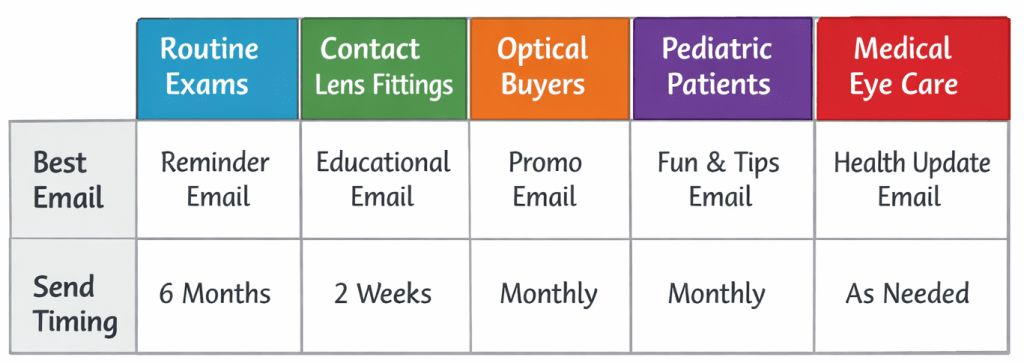
Segmentation is what makes post-appointment email worth doing. Without it, the practice is just sending mail. With it, the practice is guiding patients based on what they actually need.
The most useful segments for eye clinics usually include:
- new patients versus returning patients
- routine exams versus medical eye visits
- glasses patients versus contact lens patients
- pediatric families versus adult patients
- exam-only patients versus optical buyers
- specialty-care patients, such as dry eye or myopia management patients
These segments change both the content and the timing of the email. A new patient may need more orientation and reassurance. A returning patient may need a faster route to rebooking. A contact lens patient may need replenishment and wear reminders. A pediatric family may need parent-centered instructions.
HHS guidance is helpful here because it recognizes that communications about a provider’s own health-related services and certain wellness or preventive communications may be treated differently from broader third-party-style marketing. That supports the case for highly relevant, practice-specific follow-up instead of generic promotions.
What does an effective post-appointment email sequence for an eye clinic look like?
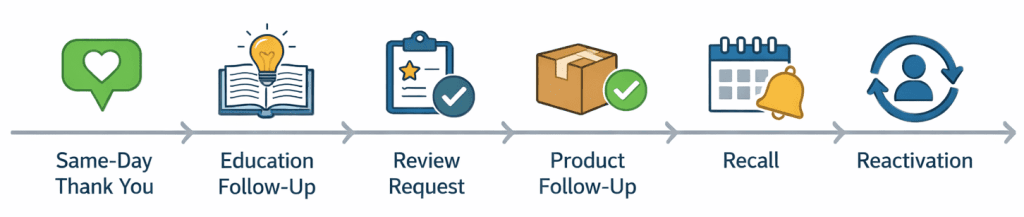
A strong post-appointment sequence does not need to be long. It needs to be intentional.
Email 1: Thank-you and next steps
Sent the same day. Confirms the visit, reassures the patient, and tells them what happens next.
Email 2: Visit-specific education
Sent within a few days. Reinforces care instructions, product use guidance, or common follow-up questions.
Email 3: Review request
Sent when the patient has enough context to assess the experience. Neutral language, honest feedback, easy path.
Email 4: Relevant product or service follow-up
Sent only if it logically connects to the visit, such as eyewear, contact lens replenishment, or a related in-house service.
Email 5: Recall reminder
Sent months later, before the patient falls out of habit.
Email 6: Reactivation email
Sent if the patient is overdue. This one should focus on returning for care, not just on a discount or promotion.
That framework works because it follows the patient journey. It treats email as a care-support and retention system first, and a revenue channel second.
How can optometry practices measure whether post-appointment email campaigns are working?
The best way to measure success is to connect email behavior to clinic outcomes.
Start with core email metrics like opens and clicks, but do not stop there. For an eye clinic, the more meaningful questions are:
- did the patient book the next visit?
- did the patient return on recall?
- did the patient leave a review?
- did the patient complete the eyewear or contact lens purchase?
- did unsubscribe rates rise after certain messages?
Those metrics show whether the sequence is helping patients act. A campaign with good open rates but poor rebooking may be interesting. A campaign that increases recall response is valuable.
The strongest programs also compare results by segment. If recall emails work for routine exams but underperform for contact lens patients, the issue may not be email as a channel. It may be messaging, timing, or offer relevance.
FAQ
What is the best first email to send after an eye exam?
The best first email is usually a thank-you message with simple next steps. It should reduce confusion, not introduce a heavy sales pitch.
How soon should an optometry practice ask for a review?
Usually within a few days works well for routine visits, but timing should reflect the visit type. If the value of the appointment is only clear after product use or follow-up, wait until the patient has had that experience.
Can an eye clinic send follow-up emails under HIPAA?
Yes, providers may communicate with patients by email, but clinics still need to manage security, patient preferences, and the amount of PHI included in each message.
Should review requests and recall reminders be separate emails?
Usually yes. They serve different goals and occur at different points in the relationship. Combining them can weaken both messages.
What types of promotions work best after an optometry appointment?
Promotions tied to the visit work best, such as eyewear follow-up, lens options, contact lens replenishment, or relevant specialty services.
How many emails should an eye clinic send after one visit?
Enough to guide the next steps, but not so many that the patient feels chased. For many clinics, three to five purposeful emails across the short and long term is a practical starting point.
What is the difference between recall emails and reactivation emails?
Recall emails are sent before the patient becomes overdue. Reactivation emails target patients who have already lapsed and need a stronger reason to return.
Conclusion
The best email marketing for optometry practices is not about sending more messages. It is about sending the right message after the appointment, at the moment when the patient is most likely to act on it.
For eye clinics, that means building a post-appointment sequence that is useful, segmented, timely, and compliance-aware. A thank-you email creates clarity. Educational follow-up improves adherence. Review requests strengthen reputation. Recall emails protect retention. Relevant product follow-up supports revenue without undermining trust.
When a clinic treats post-appointment email as part of the patient journey rather than as a generic promotion channel, the result is better communication and a stronger practice.
Why Visiclix is Your Ideal Choice for Email Marketing for Optometry Practices?
Visiclix is an ideal choice for eye clinics because the real challenge is not simply sending emails. It is building a post-appointment system that fits how optometry practices actually operate. That means connecting follow-up messaging to visit type, patient segment, recall timing, reputation goals, and revenue opportunities without turning every touchpoint into a sales blast.
Visiclix helps practices move beyond one-size-fits-all campaigns by structuring smarter sequences for thank-you emails, care follow-ups, review requests, recall reminders, and reactivation. That kind of system supports both patient experience and business performance. For eye clinics that want more than generic marketing advice, Visiclix offers a more practical path: relevant automation, clearer patient journeys, and email strategy designed around how optometry really works.
Ready to Build a Better Post-Appointment Email System with Visiclix?
If your clinic is still relying on scattered reminders, occasional newsletters, or manual follow-up, this is the right time to build a smarter system. Visiclix can help you create a post-appointment email strategy that improves patient communication, supports recall, increases reviews, and drives more value from every completed visit.
Talk to Visiclix about building an email workflow that turns appointments into stronger long-term patient relationships.