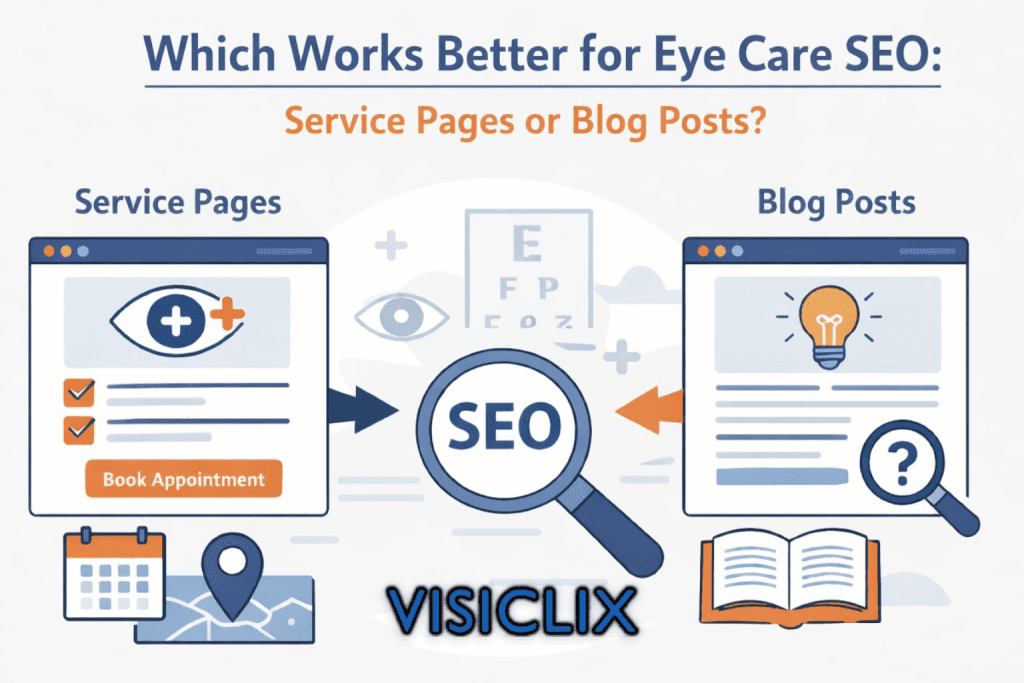
Eye care practices should put appointment-driven, revenue-focused topics on service pages and question-driven, educational topics on blog posts. That split matters because Google’s guidance rewards helpful, people-first content, while local search visibility depends on giving users the most relevant page for the intent behind their search. A patient searching “dry eye treatment near me” usually needs a service page; someone searching “what causes dry eye” usually needs an educational post.
For a practice trying to grow organic traffic and booked appointments, the goal is not choosing between pages and posts. The goal is building a content system where service pages convert, blog posts educate, and internal links connect the two so readers can move naturally from research to action. Google explicitly says internal links help it discover pages and understand relevance, and it recommends a logical site structure that points users toward important pages.
What is an eye care content strategy, and why does it matter for SEO?
An eye care content strategy is the plan that decides which topics your practice will cover, which format each topic belongs in, who each page is for, and how that content supports visibility and patient acquisition. In SEO terms, it helps search engines understand your site structure and helps patients find the right page at the right stage of their journey. Google’s SEO Starter Guide emphasizes content that is helpful, reliable, unique, and kept up to date.
For eye care brands, that strategy matters even more because patients do not all search the same way. Some searches are local and urgent, such as “eye exam near me” or “emergency eye doctor.” Others are educational, such as “how often should adults get an eye exam” or “dry eye vs allergies.” Google’s local ranking guidance also notes that local results are influenced by relevance, distance, and prominence, which means your content has to match what the searcher is actually looking for.
A strong content strategy also supports trust. The National Eye Institute says a dilated eye exam is the only way to detect some eye diseases early, and the American Optometric Association says periodic comprehensive exams are an important part of preventive health care because many eye and vision problems have no obvious signs or symptoms. That creates a natural content opportunity: publish educational content that explains why care matters, then connect that content to conversion-focused service pages where patients can book.
What is the difference between a service page and a blog post in eye care SEO?
A service page is designed to rank for commercial or transactional searches and convert visitors into patients. A blog post is designed to rank for informational searches and help users understand a symptom, condition, treatment, or next step. Search intent is the reason behind a query, and matching that intent is central to SEO.
On an eye care website, a service page usually covers a defined offer such as comprehensive eye exams, pediatric eye care, contact lens fittings, dry eye treatment, or emergency eye care. It should explain what the service is, who it is for, what to expect, and how to schedule. It should also include location relevance, trust signals, and a clear CTA because the visitor is often closer to booking. Google’s guidance on people-first content and page usefulness supports this kind of focused page when it clearly solves the user’s problem.
A blog post serves a different role. It answers questions, captures long-tail traffic, and builds authority around topics that patients search before they are ready to choose a provider. Examples include “What are the signs of dry eye?”, “How often should children get vision exams?”, or “When is blurry vision an emergency?” Those topics help your site show up earlier in the decision process and can feed qualified readers into your service pages through well-placed internal links.
Why should eye care practices use both service pages and blog posts instead of choosing one?
Eye care practices should use both because service pages capture demand and blog posts create demand. If you only build service pages, you may miss the large audience still researching symptoms, timing, risks, and options. If you only publish blog posts, you may attract traffic that never finds a clear path to book an appointment.
Using both formats also helps you cover the full patient journey. A patient might first search “why are my eyes burning,” then “dry eye symptoms,” then “dry eye treatment,” and finally “dry eye specialist near me.” That is not one query with one perfect page type. It is a sequence of intent shifts, and your content architecture should reflect that. Ahrefs notes that search intent can evolve and that aligning content to the real goal behind the query is essential.
There is also a local SEO advantage. Google Business Profile guidance says businesses can improve local ranking by keeping their profiles complete and relevant, but local visibility is stronger when the website also reinforces those services and locations with clear pages that match what users search. Blog content then broadens topical coverage and supports the more commercial pages.
Which topics belong on eye care service pages?
Topics belong on service pages when the searcher is likely deciding where to go, what to book, or which provider can help. These pages should target your highest-value services and clearly align to booking intent.
Typical eye care service page topics include:
- Comprehensive eye exams
- Contact lens exams and fittings
- Pediatric eye exams
- Dry eye treatment
- Emergency eye care
- Myopia management
- Diabetic eye exams
- LASIK co-management
- Cataract co-management
- Eyewear and specialty lenses
- Insurance and financing
- Location pages for each clinic or service area
Those topics make sense as service pages because they map directly to patient action. The AOA says comprehensive eye and vision examinations are part of preventive care, and NEI says dilated exams are important for detecting disease early. That makes “eye exam” a core service page topic, not just a blog topic. Similarly, the American Academy of Ophthalmology describes dry eye as a condition with symptoms, causes, and treatments, making it a strong candidate for both a service page and related educational support content.
A strong service page should not read like a generic SEO page. It should explain who the service is for, what symptoms or concerns it addresses, how the appointment works, what technologies or expertise the practice offers, and what the patient should do next. It should also use clear titles and headings, because Google says informative, relevant titles and headings support site quality and navigation.
Which topics belong in eye care blog posts?
Topics belong in blog posts when the searcher is trying to learn, compare, understand symptoms, or decide whether care is needed. These posts are especially useful for long-tail queries and early-stage patient education.
Strong blog topics for eye care include:
- How often should you get an eye exam?
- What happens during a comprehensive eye exam?
- What are the symptoms of dry eye?
- Dry eye vs allergies: what is the difference?
- Signs your child may need a vision exam
- What causes blurry vision?
- Are blue-light glasses necessary?
- What is myopia management?
- When should you seek emergency eye care?
- How to care for contact lenses safely
These topics are a good fit because they answer questions rather than asking the user to commit immediately. For example, NEI says many eye diseases have no symptoms, which supports educational content around preventive exams. The AOA provides exam frequency guidance for different age and risk groups, which can power detailed blog content answering “how often” questions. AAO materials on dry eye also support educational posts about symptoms, causes, and when to see a specialist.
The best eye care blog posts do more than chase traffic. They should answer the question directly, explain the clinical context in plain language, and then point the reader to the relevant service page. That is how blog content contributes to revenue without pretending to be a service page.
How does search intent decide whether a topic should be a page or a post?
Search intent should be your main rule for deciding format. If the query suggests a user wants a provider, a location, a price, an appointment, or a treatment option, it usually belongs on a service page. If the query suggests the user wants an explanation, checklist, symptom guide, or comparison, it usually belongs in a blog post.
In practice, terms like near me, clinic, exam, specialist, treatment, appointment, insurance, cost usually signal service-page intent. Terms like what is, how, why, symptoms, causes, can, when usually signal blog intent. This is not a hard law, but it is a reliable planning framework.
Some eye care topics need both. “Dry eye treatment” may deserve a service page targeting treatment intent, while blog posts can support adjacent questions such as “what causes dry eye,” “dry eye vs allergies,” and “when should dry eye be treated?” That layered structure gives Google more context and gives patients a clearer route from information to action.
How can eye care practices avoid cannibalization between service pages and blog posts?
Eye care practices can avoid cannibalization by assigning one primary intent to one primary URL. Google’s canonicalization guidance explains that canonicalization is about selecting the representative URL for substantially similar content. If your site publishes multiple pages chasing the same keyword and intent, Google may struggle to understand which one should rank.
The most common mistake is creating a blog post that is too similar to a core service page. For example, if your practice already has a strong “Comprehensive Eye Exams” page, then a blog post titled “Complete Eye Exams in [City]” may compete with it rather than support it. A better approach is to publish a blog post such as “How Often Should Adults Get an Eye Exam?” and link back to the service page for readers ready to schedule.
To reduce overlap, give each URL a distinct role:
- Service page: commercial intent, appointment CTA, service details
- Blog post: question-based intent, explanation, education
- Location page: local relevance, practice details, directions, local trust signals
- FAQ section: concise clarifications that support either page type without replacing it
You should also use canonical tags correctly where needed, keep titles and headings distinct, and review Search Console if two URLs are earning impressions for the same query. Google’s Performance report lets you compare clicks, impressions, CTR, and average position by page and query.
How should service pages and blog posts link together in an eye care SEO plan?
Service pages and blog posts should link together in a hub-and-supporting-content model. Your service page is the primary destination for appointment intent, while blog posts expand the topical footprint around related patient questions. Google says internal links help it find pages and assess relevance, and it recommends linking to important pages from other relevant pages.
For example, your dry eye cluster could look like this:
- Core service page: Dry Eye Treatment
- Supporting blog posts: What Causes Dry Eye?; Dry Eye vs Allergies; When Should You See a Doctor for Dry Eye?; Home Remedies That May Help Between Visits
Each blog post should link naturally to the dry eye service page, and the service page can link back to a few useful educational resources for patients who need more context. HubSpot’s topic-cluster guidance also supports building pillar pages and related cluster content connected by internal links.
This structure is especially useful in eye care because many services sit at the intersection of medical need and patient education. A myopia management page can convert high-intent parents, while related blog posts can answer questions about progression, screening, and treatment options before the family is ready to contact the practice.
What does a simple 90-day content strategy for an eye care practice look like?
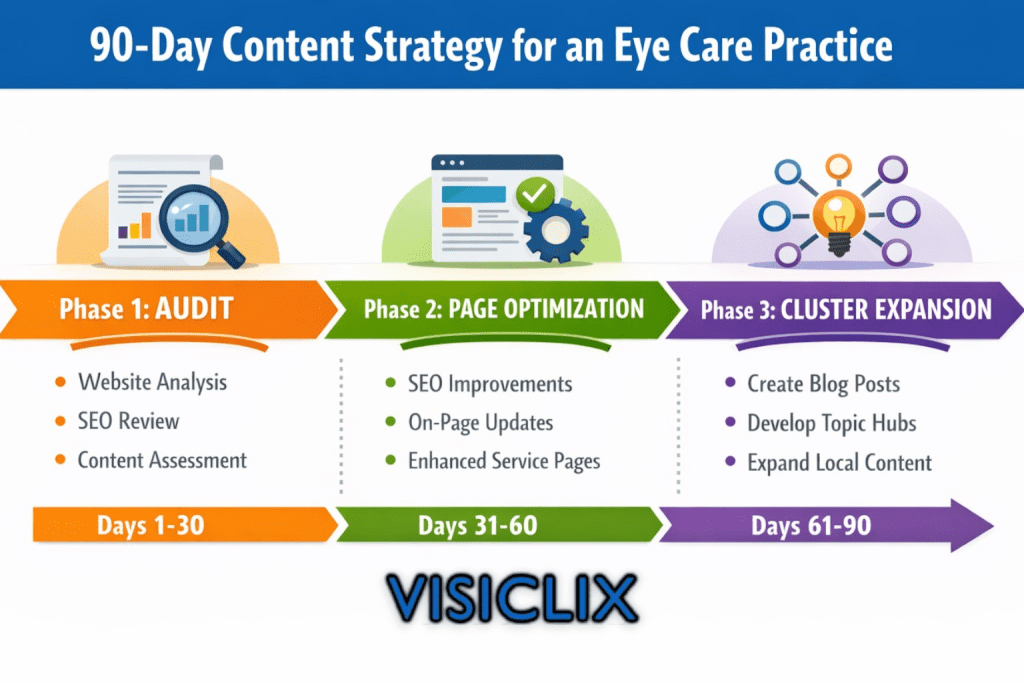
A useful 90-day plan starts with structure, then fills gaps, then measures performance. That sequence works because Google rewards clarity, relevance, and site quality more than random publishing volume.
Days 1–30: audit your current site. Identify your highest-value services, existing blog content, weak or missing location pages, and any overlapping URLs. Make sure your Business Profile is verified and complete, because Google says verified businesses with accurate information are better positioned to appear on Maps and Search.
Days 31–60: improve core service pages first. Start with pages like comprehensive eye exams, pediatric eye exams, dry eye treatment, contact lens exams, and emergency eye care. Tighten titles, headings, CTAs, FAQs, and local relevance. Then publish supporting blog posts around the services with the strongest commercial value.
Days 61–90: expand the cluster. Add internal links, refresh older posts, and create new articles based on patient questions and Search Console data. Review which pages are earning impressions but low clicks, and which blog posts are already assisting conversions. Search Console’s Performance report is built for this kind of analysis, with clicks, impressions, CTR, and average position.
A realistic publishing cadence for many practices is to improve several core pages first, then add two to four strong blog posts per month tied to priority services. The goal is not volume for its own sake. The goal is building a site that is easier for both patients and search engines to understand.
What should eye care practices measure to know whether their content strategy is working?
Eye care practices should measure performance by page type, not just total traffic. Search Console provides clicks, impressions, CTR, and average position, which makes it useful for seeing whether service pages and blog posts are improving visibility for the right queries.
For service pages, focus on:
- Organic clicks to key services
- Rankings for local and treatment-intent queries
- Appointment form submissions
- Calls from organic traffic
- Direction requests or local actions tied to your Business Profile
For blog posts, focus on:
- Impressions and clicks for informational queries
- Engagement and assisted conversions
- Click-through rate to related service pages
- Growth in topic coverage across target conditions and patient questions
Google Analytics can track important actions as conversions or key events, and Google Ads documentation notes that these conversions can be used to evaluate performance across channels. That matters for PPC-focused teams because content often influences branded search, remarketing audiences, and conversion paths even when the blog post is not the last-click page.
A simple reporting view for Visiclix clients would separate:
- service-page rankings and conversions,
- blog-post traffic and assists,
- local visibility indicators,
- internal-link-assisted movement from posts to pages.
That structure tells you whether the content system is actually generating patient demand and capturing it.
Is a blog or a service page better for local eye care SEO?
For local appointment intent, service pages are usually better. For top-of-funnel discovery and authority building, blog posts are usually better. The strongest local SEO strategy uses both, with service pages acting as the destination and blog posts acting as the support network.
That matters because local search is not just about proximity. Google says local ranking depends on relevance, distance, and prominence. Relevance improves when your site has a page that clearly matches the service a patient wants in the location they searched. Prominence improves as your practice becomes more visible and trusted across search signals. Blog content supports that by expanding your topical authority and giving more entry points into the site.
So the right answer is not “blog posts or service pages.” It is service pages first for conversion, blog posts second for expansion, and strong internal linking to connect the two.
FAQ
Can an eye care blog post rank better than a service page?
Yes, if the query is informational. A blog post about symptoms, timing, or treatment basics may outrank a service page because it better matches what the user wants. But for booking-intent queries, a service page is usually the better fit.
How many service pages should an optometry website have?
There is no fixed number, but every meaningful service and each important location should have its own clear page when the intent is distinct. Google recommends a logical site structure with relevant links to important pages, which supports creating separate pages where they serve different user needs.
Should each eye care location have its own page?
Usually yes, when each location serves a distinct market or offers different details patients need. Separate pages help match local queries and make location-specific information easier to find.
How often should an eye care practice publish blog content?
Consistency matters more than arbitrary volume. Publish as often as you can maintain quality, freshness, and strategic alignment to services. Google’s guidance favors helpful, reliable, people-first content over content made mainly to manipulate rankings.
What is the best first blog topic for a local optometrist?
A strong first topic is usually tied to a core service and a common patient question, such as “How Often Should You Get an Eye Exam?” or “What Are the Symptoms of Dry Eye?” Those topics have clear patient value and naturally link to your eye exam or dry eye treatment pages.
Can blog posts help more patients book appointments?
Yes, when they target the right questions and link to the right service pages. Internal linking helps users and search engines discover relevant content, and educational posts often assist conversions even when they are not the final landing page.
Conclusion
The smartest eye care SEO strategy is not built around publishing more content for the sake of it. It is built around assigning the right job to the right page type. Service pages should own commercial intent, local relevance, and conversion. Blog posts should own education, long-tail discovery, and trust building. When both are connected through intentional internal links and clear site structure, the website becomes easier for Google to understand and easier for patients to use.
For the keyword content strategy eye care, that means planning content by patient intent instead of by gut instinct. Start with your most valuable services, build the pages that deserve to rank for booking-driven searches, and then publish blog posts that answer the questions patients ask before they are ready to contact you. That is how content supports both SEO growth and patient acquisition.
Why Visiclix is Your Ideal Choice for Eye Care Content Strategy?
Visiclix is well positioned to help eye care brands turn content from a publishing exercise into a patient-acquisition system. Instead of treating SEO pages and blog posts as separate tactics, Visiclix can build a unified strategy where service pages target commercial searches, blog content targets educational demand, and internal linking moves visitors from curiosity to conversion. That approach is especially valuable in eye care, where the same patient may research symptoms, compare treatment options, and look for a local provider across multiple searches before booking.
Just as important, Visiclix can align organic content with the metrics that matter to growth-focused practices. Google’s reporting tools make it possible to measure clicks, impressions, rankings, and conversions by page type, which means an eye care content strategy can be managed as a real performance channel rather than a vague branding initiative. With the right structure, Visiclix can help practices prioritize the pages that drive appointments, support them with useful educational content, and prove which topics are contributing to pipeline and revenue.
Ready to Build an Eye Care Content Strategy That Converts with Visiclix?
If your practice has service pages that are not ranking, blog posts that are not driving action, or a site structure that makes SEO harder than it should be, Visiclix can help you fix the foundation and build a smarter content system. The opportunity is not just to publish more. It is to create the right service pages, the right blog posts, and the right path between them so more searchers become patients.