
A strong quarterly review does not try to measure everything. It focuses on the marketing KPIs eye care practices can actually use to make better budget, channel, and growth decisions in the next 90 days. In practical terms, that means tracking how marketing turns traffic into inquiries, inquiries into booked appointments, and booked appointments into profitable patient relationships.
For eye care practices, that quarterly lens matters because marketing performance is rarely captured by one number alone. A campaign may generate low-cost leads but weak appointment quality. Another may produce fewer conversions but stronger revenue from premium eyewear, dry eye services, specialty exams, or higher-value care. The point of a quarterly marketing review is to identify which channels are producing the best business outcomes, not just the biggest activity spikes.
What are marketing KPIs in eye care?
Marketing KPIs are the small set of performance indicators that show whether your marketing is helping the practice reach its growth goals. In GA4, the most meaningful actions for a business can be defined as key events, and those actions can also be used as conversions for cross-channel measurement and ad optimization. For an eye care practice, those important actions often include appointment requests, online booking completions, click-to-call actions, contact lens consultation forms, or requests for specialty services.
That distinction matters because not every metric is a KPI. Pageviews, impressions, and social reach can be useful supporting metrics, but they only become meaningful when they connect to appointment demand, patient acquisition, or revenue impact. A quarterly review should separate “interesting numbers” from “decision-making numbers.”
In eye care, the best KPI mix usually includes four categories: acquisition, website conversion, paid media efficiency, and retention. Together, these show whether marketing is attracting the right audience, moving them toward action, doing so at an efficient cost, and supporting repeat patient value over time.
Why should eye care practices review marketing KPIs quarterly instead of only monthly?
A monthly report is useful for pacing, but a quarterly review is better for judgment. Three months gives you enough data to see whether a trend is real, whether campaign changes improved performance, and whether one channel is consistently outperforming another. It also gives you more context for attribution, since GA4 attribution reporting is built to help assign credit across a user’s path to key events rather than just the last click.
That longer view is especially important in eye care, where scheduling patterns and service demand can fluctuate. A practice might see one month driven by insurance reminders, another by back-to-school exams, and another by a specialty push such as dry eye or myopia control. Quarterly review smooths out that noise and helps leadership ask the right question: which marketing investments are building sustainable growth?
Quarterly reviews also create better operational alignment. When you review KPIs every 90 days, you can compare marketing performance with front-desk follow-up, provider availability, schedule utilization, and service-line demand. That makes the review more useful than a simple ad report because it connects promotion to patient flow and revenue quality.
Which patient acquisition KPIs matter most for a quarterly review?
The first group of KPIs should answer one simple question: is marketing generating the right patient opportunities? For most eye care practices, the most useful acquisition KPIs are qualified leads, booked appointments, appointment conversion rate, new-patient count, cost per lead, and cost per booked appointment. These are stronger than raw traffic or raw inquiries because they reflect actual progress toward patient acquisition.
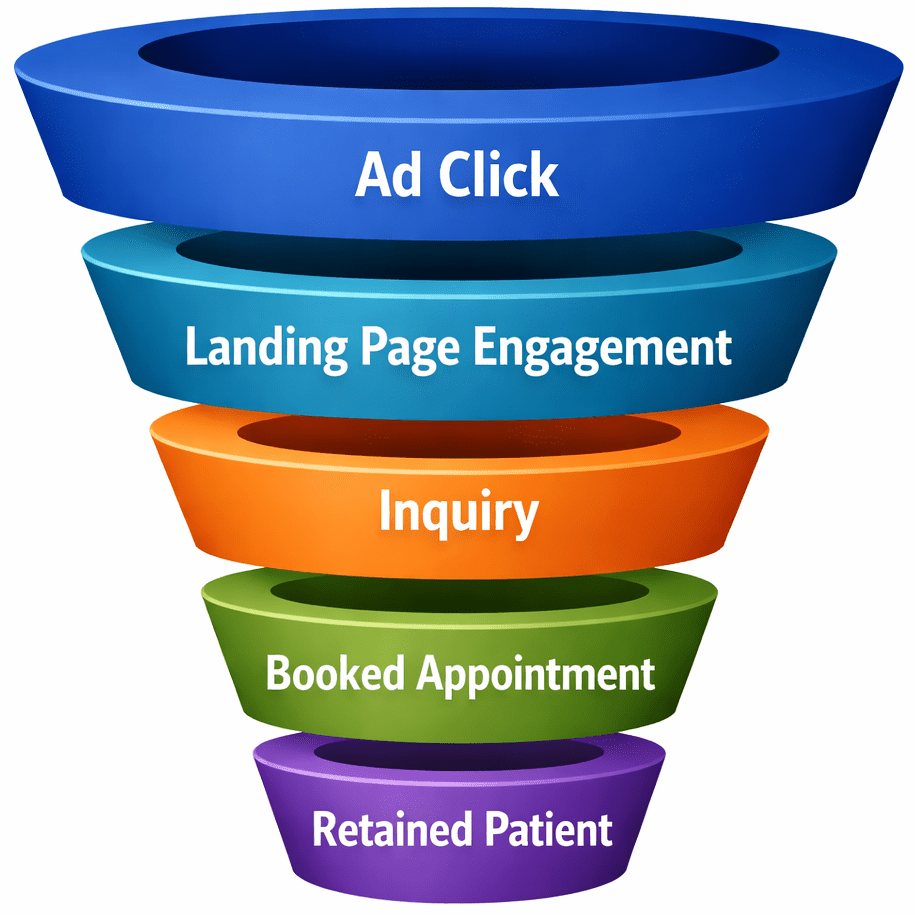
A practical quarterly review usually starts with qualified leads. Not every form fill or phone call should count equally. A dry eye consultation request, pediatric exam booking, or LASIK co-management inquiry may carry far more value than a generic question. Once you define what qualifies as a meaningful lead, you can compare channels more fairly.
The next KPI is booked appointments. This is often the clearest bridge between marketing activity and business value. If campaigns are generating calls and forms but booked appointments are flat, the problem may be response time, call handling, online scheduling friction, or lead quality rather than ad volume.
Finally, tie acquisition to efficiency. Cost per lead tells you how expensive demand generation is, while cost per booked appointment tells you whether that demand is translating into real scheduling outcomes. For quarter-over-quarter decisions, the second number usually matters more.
How should eye care practices measure website and landing page performance?
Your website review should focus on whether pages are helping visitors take action. GA4 defines engagement rate as the percentage of sessions that qualify as engaged sessions, and an engaged session is one that lasts longer than 10 seconds, has a key event, or includes at least two page or screen views. That makes engagement rate a more modern quality signal than the old habit of relying on bounce rate alone.
For eye care marketing, the most useful site KPIs are landing page conversion rate, online booking completion rate, click-to-call rate, form completion rate, and engagement rate on high-intent pages. High-intent pages often include comprehensive eye exams, contact lenses, pediatric eye care, dry eye treatment, eyewear, insurance, financing, and location pages.
Quarterly review should compare these pages side by side. A page that gets strong traffic but poor form completion may need a better offer, stronger trust signals, a more visible booking path, or clearer service messaging. A page with strong engagement but weak booked appointments may be attracting interest without enough urgency or clarity.
This is also where practices can spot content gaps. If one service line has healthy ad traffic but weak landing page conversion, the issue may not be media buying at all. The fix may be page structure, call-to-action placement, mobile usability, or the difference between educational content and conversion content.
What paid advertising KPIs should eye care practices review every quarter?
Paid media review should answer two questions: are your ads producing conversions, and are those conversions worth the spend? Google Ads continues to frame automated bidding around conversion and conversion-value outcomes. Target CPA is designed to help advertisers get as many conversions as possible at an average target cost per conversion, while Target ROAS uses predicted conversion value to maximize return relative to ad spend.
Because of that, the core paid KPIs for a quarterly eye care review should include click-through rate, cost per click, conversion rate, cost per conversion, cost per booked appointment, conversion value, and return on ad spend. These metrics tell you whether ads are attracting interest, whether traffic is turning into action, and whether the practice is paying a reasonable amount for meaningful outcomes.
Impression share also deserves attention for priority service lines. Google defines impression share as the number of impressions your ad received divided by the total number of impressions it was eligible to receive. That makes it useful for understanding whether your practice is missing visibility because of budget, bid competitiveness, or limited reach.
In eye care, it is smart to review paid KPIs by service category rather than only by account total. Routine exams, medical eye care, pediatric services, dry eye, premium eyewear, and specialty consultations can all have different economics. Quarterly decisions get sharper when those service lines are measured separately.
Which retention and reactivation KPIs belong in a quarterly marketing review?
Quarterly marketing review should not stop at new-patient acquisition. Eye care is a relationship business, and some of the most profitable marketing outcomes come from retention, recall, and reactivation. A practice that only measures new leads can easily miss the value of bringing existing patients back for exams, eyewear updates, contact lens orders, or specialty follow-up care.
The most useful retention KPIs often include recall response rate, reactivation rate for lapsed patients, repeat purchase rate, review generation rate, email click performance, and patient lifetime value trend. These metrics show whether marketing is supporting ongoing patient engagement rather than one-time conversions.
This is where channel performance becomes more nuanced. A paid search campaign may win the initial visit, while email, SMS, or remarketing may be what drives the second appointment or eyewear purchase. Quarterly review is the right place to assess that broader contribution instead of judging every channel only by first-touch acquisition.
For many practices, retention metrics also reveal hidden growth opportunities. If acquisition costs are rising but reactivation remains underused, the highest-return move may be better recall campaigns and more intentional nurture sequences rather than simply increasing ad spend.
How can eye care practices separate vanity metrics from useful KPIs?
A useful KPI changes a decision. A vanity metric mostly changes how a report looks. That is the simplest test.
For example, social impressions can be encouraging, but they are not enough on their own. A better quarterly review asks whether social content increased branded search, referral traffic, website engagement on key pages, or appointment requests. The same rule applies to website traffic. Traffic only becomes strategically valuable when it produces key events, conversions, or qualified patient demand.
The easiest way to separate the two is to build your report backward from business outcomes. Start with booked appointments, new-patient acquisition, cost efficiency, and revenue contribution. Then work up to the supporting metrics that explain those outcomes. That prevents teams from overvaluing reach while underexamining conversion quality.
In practice, that means follower growth is secondary to booked appointments from social, impressions are secondary to impression share plus conversion efficiency, and pageviews are secondary to landing page conversion rate. The KPI is the number that helps you choose what to do next quarter.
How should an eye care practice structure a quarterly marketing KPI dashboard?
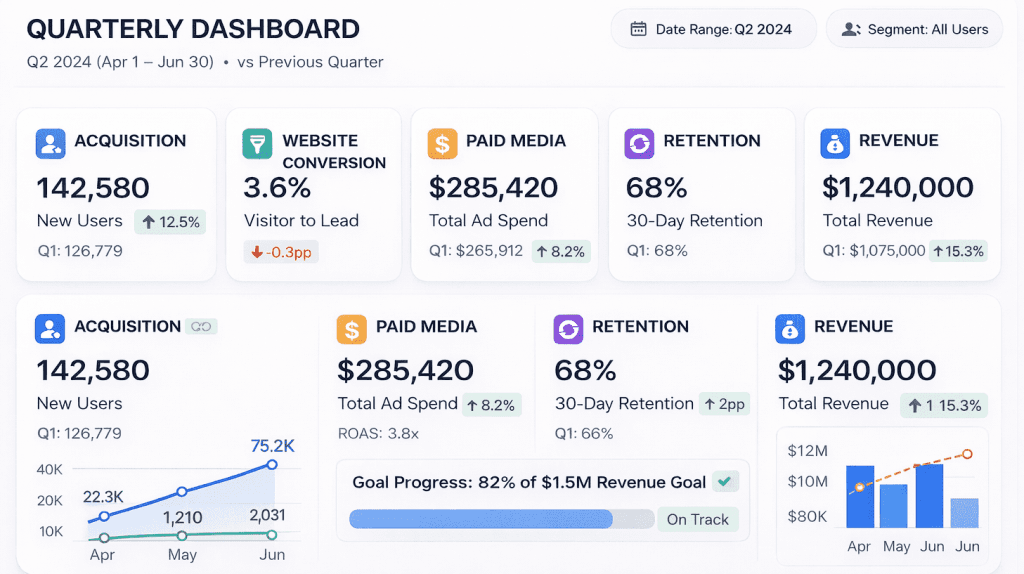
A strong dashboard should be simple enough for leadership to read quickly and specific enough for the marketing team to act on. The cleanest structure is usually: executive summary, acquisition KPIs, website conversion KPIs, paid media KPIs, retention KPIs, and action items for the next quarter.
GA4 and Google Ads support this approach because key events, conversions, attribution settings, and conversion values are designed to help advertisers measure important actions consistently across channels and optimize around them.
An eye care dashboard works best when it is segmented. Break out performance by channel, by location if the practice is multi-site, and by service line when those services have different economics. That makes it easier to see whether one campaign is producing low-cost but low-value volume while another is generating fewer leads but stronger booked revenue.
Each dashboard should also end with interpretation. Numbers alone do not drive growth. Every quarterly report should finish with a short list of findings, likely causes, and next-quarter actions.
What should eye care practices do when quarterly KPIs miss the target?
When performance misses the goal, the best response is diagnosis, not panic. Most KPI problems fall into one of four categories: traffic quality, conversion friction, follow-up breakdown, or weak offer positioning.
If click-through rate is healthy but landing page conversion rate is poor, the traffic may be interested but unconvinced. The page may need clearer proof, stronger calls to action, or better alignment between keyword intent and page messaging. If cost per lead looks acceptable but booked appointments remain weak, the issue may be response speed, scheduling process, or lead qualification rather than campaign setup.
Attribution reports can also help here. GA4’s attribution tools are meant to show how different touchpoints contribute before key events occur, which helps explain why channels may appear weaker or stronger under different reporting lenses.
The key is to avoid changing everything at once. A quarterly review should produce focused decisions: improve one landing page, tighten one audience, revise one offer, fix one follow-up workflow, or reallocate spend from one underperforming service line to a stronger one.
Which benchmarks should eye care marketers compare quarter over quarter?
The most useful benchmark is usually your own history. Compare the current quarter with the previous quarter, then compare it again with the same quarter last year. That gives a clearer picture than relying too heavily on generic industry averages, especially in a category where geography, payer mix, specialty services, and brand maturity vary so much.
The next level is internal segmentation. Compare channels against each other, service lines against each other, and locations against each other when relevant. This often reveals the real opportunity. One location may need stronger local visibility, while another may need better landing pages or front-desk conversion discipline.
Where available, include value-based comparisons too. A campaign that generates fewer total leads may still be better if its booked appointments lead to higher-value care or stronger repeat revenue. Quarterly review should reward profitable growth, not just volume.
Are all marketing KPIs equally important for every eye care practice?
No. KPI priority should reflect the business model.
A general optometry practice may prioritize new-patient bookings, exam utilization, recall response, eyewear conversion, and review growth. A specialty-focused practice may care more about consultation quality, show rate, cost per specialty lead, and revenue per acquired patient. A multi-location group may emphasize location-level consistency, impression share, channel efficiency, and dashboard standardization across markets.
That is why the best quarterly review does not start with a template and stop there. It starts with business goals, then chooses the KPI mix that best reflects those goals. The framework can stay consistent, but the weighting should match the practice.
What is the most important marketing KPI for an eye care practice?
The most important KPI is usually the one closest to profitable patient growth. For many practices, that is booked appointments or cost per booked appointment, because those numbers connect marketing activity to actual scheduling outcomes. A traffic increase is encouraging, but a booking increase is operationally meaningful.
How many KPIs should an eye care practice review each quarter?
Most practices should focus on a compact scorecard rather than a giant spreadsheet. Around 8 to 15 primary KPIs is usually enough for leadership, supported by secondary diagnostic metrics when needed. The goal is clarity, not volume.
What is a good cost per booked appointment for eye care marketing?
There is no universal benchmark that fits every practice. A good target depends on service line, market competition, average patient value, and whether the campaign is promoting routine care or a higher-value specialty service. The right test is whether acquisition cost leaves enough margin for profitable growth.
Should optometry and ophthalmology practices track the same KPIs?
They should use a similar framework, but not identical weighting. Both need acquisition, conversion, and retention metrics. The difference is that service mix, referral patterns, patient value, and conversion paths can vary significantly between general optometry and more medically oriented or specialty ophthalmology services.
Can Google Analytics and Google Ads track eye care marketing KPIs accurately?
They can track a large share of digital marketing performance when setup is correct. GA4 supports key events, engagement measurement, attribution, and conversions, while Google Ads supports conversion tracking, conversion values, Target CPA, and Target ROAS for optimization. Accuracy still depends on proper implementation, clear event definitions, and clean reporting logic.
How often should marketing dashboards for eye care be updated?
Dashboards should be reviewed regularly, often weekly or monthly for pacing, but interpreted more deeply on a quarterly basis. That cadence gives teams enough visibility to catch issues early while still making strategic decisions from a meaningful sample of data.
Conclusion
The best marketing KPIs eye care practices review each quarter are the ones that reveal whether marketing is producing real business results. That means looking beyond vanity metrics and focusing on qualified leads, booked appointments, conversion efficiency, channel performance, retention, and revenue contribution.
A quarterly review works because it provides enough context to make smarter decisions. It shows which campaigns deserve more budget, which pages need stronger conversion paths, which service lines are outperforming, and where follow-up or retention workflows may be suppressing growth. When the review is built around clear KPIs and clear actions, marketing becomes easier to manage and easier to improve.
Why Visiclix is Your Ideal Choice for Marketing KPI Tracking in Eye Care?
Visiclix is well positioned to help eye care practices turn disconnected marketing data into a quarterly growth system. Instead of stopping at clicks, impressions, or surface-level reporting, Visiclix can help practices evaluate the full path from campaign engagement to booked appointments and long-term patient value. That matters because eye care marketing is not just about generating demand. It is about generating the right demand, measuring it accurately, and improving results quarter after quarter.
Just as important, Visiclix understands the difference between a general marketing report and an eye care performance review. Practices need measurement that reflects how people actually choose providers, schedule appointments, respond to recalls, and engage with service-specific offers. With the right dashboard structure and KPI focus, Visiclix can help practices see what is working, what is underperforming, and what should happen next.
Ready to Review Your Eye Care Marketing KPIs with Visiclix?
If your practice is investing in SEO, paid ads, social media, email, or retention campaigns, a quarterly KPI review can show you where growth is really coming from and where money is quietly being wasted. Visiclix can help you build a clearer reporting framework, identify the metrics that matter most, and turn your next quarterly review into a better plan for patient growth.