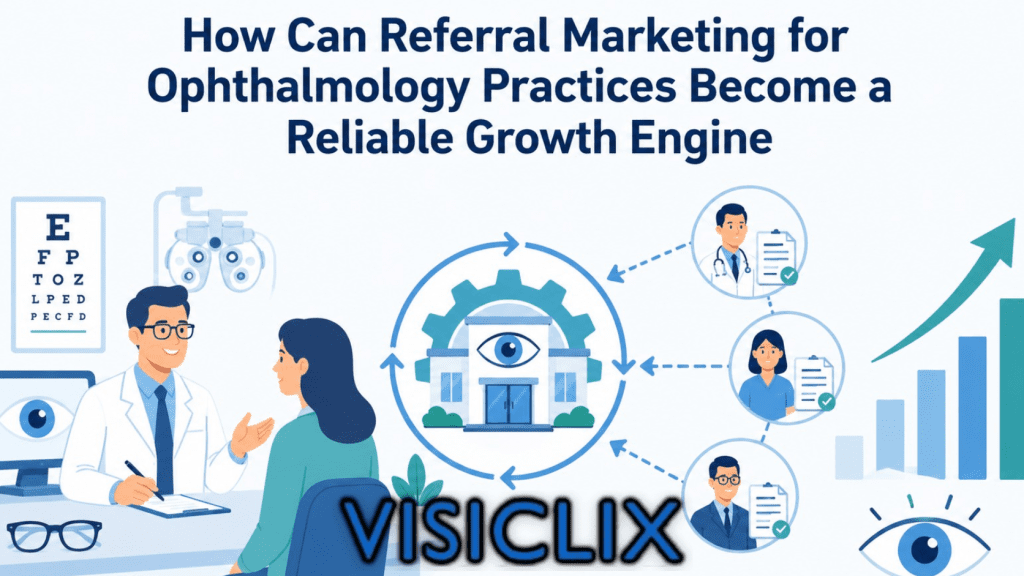
Ophthalmology practices often receive referrals because patients need specialized care, surgical evaluation, or ongoing management for complex eye conditions. But relying on referrals without a system can make growth unpredictable. One month may bring a steady flow of cataract consults, diabetic eye exams, or glaucoma evaluations; the next month may slow down because partner communication, patient access, or local visibility was not maintained.
Referral marketing for ophthalmology practices is most effective when it is treated as a measurable growth engine. That means your practice does not simply “network” with local providers. It builds a structured process for identifying referral partners, earning clinical trust, making referrals easy, tracking performance, and reinforcing credibility through digital marketing.
A strong referral engine connects physician relationships, optometry co-management, patient experience, local SEO, PPC, reputation management, and reporting. The goal is not just more names on a spreadsheet. The goal is a repeatable system that helps the right patients reach the right ophthalmologist at the right time.
What Is Referral Marketing for Ophthalmology Practices?
Referral marketing for ophthalmology practices is the structured process of building relationships with local physicians, optometrists, health partners, and existing patients to generate qualified patient referrals. It turns word-of-mouth and professional trust into a repeatable acquisition channel.
A passive referral model depends on chance. A doctor may send a patient because they know your name, a patient may mention your practice to a family member, or an optometrist may refer occasionally after a positive experience. An active referral engine is different. It defines who should refer, why they should refer, how they should refer, what happens after the referral, and how the practice measures the result.
Common referral sources include primary care physicians, optometrists, endocrinologists, pediatricians, neurologists, urgent care centers, senior living communities, diabetes educators, and existing patients. Each group has a different reason to refer. A primary care provider may identify vision concerns during a routine exam. An endocrinologist may refer patients for diabetic eye disease screening. An optometrist may refer for cataract surgery, glaucoma evaluation, retina concerns, or co-managed care.
Ophthalmology referrals are often trust-based because patients may be anxious about their vision, surgery, or a possible diagnosis. The referring provider is not just passing along a name. They are lending credibility. That is why referral marketing must be built around clinical confidence, clear communication, scheduling ease, and a patient experience that reflects well on the referring partner.
Why Do Ophthalmology Practices Need a Referral Engine Instead of Random Referrals?
Ophthalmology practices need a referral engine because random referrals are inconsistent, difficult to measure, and vulnerable to relationship gaps. A referral engine creates a repeatable way to build patient flow from trusted local sources.
Eye care is highly relationship-driven. Many patients do not wake up knowing whether they need an ophthalmologist, optometrist, retina specialist, glaucoma specialist, or emergency evaluation. They often depend on another provider to guide the next step. The American Academy of Ophthalmology states that prompt, appropriate referral to an ophthalmologist is supported when signs or symptoms of possible eye disease or injury are observed, and many eye diseases may begin subtly with minimal symptoms.
That clinical reality creates a marketing opportunity, but only for practices that make referrals easy and reliable. If a referring provider has to search for the right fax number, wonder whether the patient was scheduled, or wait too long for consultation notes, the relationship weakens. If the patient has a poor phone experience or cannot get an appointment, the referral source may choose another practice next time.
A referral engine is especially valuable for high-value service lines such as cataract surgery, glaucoma care, retina care, LASIK, dry eye treatment, and diabetic eye exams. The CDC’s Vision and Eye Health Surveillance System tracks diabetic retinopathy as a major eye health concern, and the CDC’s diabetes reporting continues to highlight the large national burden of diabetes and related complications.
Referral marketing should not replace SEO, PPC, patient reviews, or retention campaigns. It should connect with them. A referred patient may still search your practice online, read reviews, compare providers, check your website, and call your office before booking. Your referral strategy and digital presence should reinforce the same message: this practice is trusted, accessible, and clinically capable.
Who Should Ophthalmology Practices Build Referral Relationships With?
Ophthalmology practices should prioritize referral relationships with providers and organizations whose patients commonly need eye care, surgical evaluation, or disease management. The strongest partners are not always the biggest offices. They are the ones whose patient needs align with your services and whose teams trust your process.
Primary Care Physicians
Primary care physicians are often the first point of contact for patients with blurry vision, eye discomfort, chronic disease risks, medication concerns, or preventive care needs. They may not be eye specialists, but they regularly encounter patients who need ophthalmic evaluation.
For example, a patient with diabetes, hypertension, sudden vision changes, eye pain, or medication-related symptoms may first mention the issue during a primary care visit. If your practice has made referral criteria simple and your scheduling process dependable, the primary care office is more likely to send that patient to you instead of giving a generic recommendation.
Primary care referral relationships work best when your practice provides concise materials. A one-page guide explaining when to refer for cataracts, glaucoma symptoms, diabetic eye exams, flashes and floaters, red eye, or sudden vision loss can be more useful than a long brochure.
Optometrists
Optometrists can be some of the most valuable referral partners for ophthalmology practices. Many patients already have an established relationship with an optometrist for routine vision care, contact lenses, glasses, or eye health monitoring. When a condition requires medical or surgical ophthalmology care, the optometrist’s recommendation carries strong influence.
Co-management opportunities often exist for cataract surgery, glaucoma, retina concerns, refractive surgery, dry eye, and complex disease management. The key is to make the optometrist feel respected, informed, and included. If your practice communicates clearly and returns the patient for ongoing care when appropriate, the relationship becomes collaborative rather than competitive.
A strong optometry referral strategy should define which cases are ideal for referral, how the patient will be scheduled, how updates will be sent, and how co-management responsibilities will be handled.
Endocrinologists and Diabetes Care Teams
Endocrinologists, diabetes educators, and diabetes care teams are important partners because diabetes can affect eye health and requires ongoing monitoring. Diabetic retinopathy remains a major public health concern, and the CDC’s VEHSS provides modeled prevalence estimates for diabetic retinopathy in the United States.
These referral relationships are often built around education and access. Diabetes care teams need confidence that their patients can schedule exams, understand why eye care matters, and receive follow-up when findings require treatment. Ophthalmology practices can support this by offering patient-friendly materials explaining diabetic eye exams, retinal imaging, symptoms that require urgent attention, and the importance of routine monitoring.
The practice should also make it easy for diabetes care teams to refer patients in batches or through a clear workflow. A simple digital referral form, dedicated referral email, or coordinator contact can reduce friction.
Pediatricians and Family Medicine Providers
Pediatricians and family medicine providers may identify eye alignment issues, failed vision screenings, infections, injuries, developmental concerns, or unusual visual behavior in children. While not every ophthalmology practice provides pediatric services, those that do should make referral guidance easy to understand.
These providers need clarity on which symptoms require urgent attention and which can be scheduled routinely. They also need parent-friendly education because families may be nervous when a child is referred to an ophthalmologist.
If your practice treats pediatric eye concerns, referral materials should avoid overly technical language. They should explain common reasons for referral, what parents can expect, and how quickly different concerns should be evaluated.
Urgent Care Centers and Emergency-Oriented Providers
Urgent care centers, emergency departments, occupational health clinics, and walk-in medical providers frequently see patients with red eye, trauma, sudden vision changes, flashes and floaters, foreign body sensation, eye pain, or infection concerns. The American Academy of Ophthalmology notes that common reasons for ophthalmology consultation include vision changes, eye pain, red eye, and flashes and floaters.
These partners need a fast and practical referral pathway. They are not looking for a marketing pitch. They need to know who to call, what information to send, what symptoms require immediate evaluation, and whether your practice can accommodate urgent cases.
For urgent referral partners, your practice should create a separate workflow from routine marketing outreach. This may include a priority line, same-day triage process, urgent referral checklist, and clear after-hours guidance when appropriate.
Senior Living Communities and Care Coordinators
Senior living communities, assisted living facilities, care coordinators, and home health organizations can be meaningful referral partners for practices focused on cataracts, glaucoma, macular degeneration, diabetic eye care, and low-vision concerns.
These relationships are often influenced by logistics. Older patients may face transportation barriers, caregiver coordination issues, medication complexity, or difficulty understanding appointment instructions. A practice that supports caregivers, provides clear scheduling details, and communicates in plain language can become a preferred local resource.
Educational talks can work well in this setting. Topics such as cataract symptoms, glaucoma awareness, diabetic eye health, and when vision changes should not be ignored can build trust without feeling overly promotional.
How Do You Identify the Best Referral Partners in Your Local Market?
The best referral partners are found by combining your current patient data, geographic research, service-line priorities, and relationship potential. A good referral strategy starts with evidence, not assumptions.
Begin by auditing where your current referrals already come from. Review intake forms, EHR notes, call tracking records, referral forms, CRM fields, and appointment data. Look for providers, clinics, optometry offices, or community organizations that already appear repeatedly. These warm relationships are usually easier to strengthen than cold prospects.
Next, segment referral partners by service-line fit. A cataract-focused practice may prioritize optometrists, primary care physicians, and senior care communities. A retina-focused practice may prioritize optometrists, endocrinologists, primary care providers, and diabetes educators. A LASIK center may focus more heavily on optometrists, patient referrals, local employers, and digital search visibility.
Location also matters. A provider five minutes away from your office may be more likely to refer than one across town, especially if patients face transportation challenges. But proximity is not enough. Insurance fit, communication style, patient demographics, and ease of access all influence referral quality.
Prioritize partners using criteria such as current referral volume, patient quality, specialty alignment, distance, insurance compatibility, scheduling urgency, and relationship accessibility. A provider who sends fewer patients but sends highly qualified surgical candidates may be more valuable than a source that sends many poorly matched inquiries.
Digital data can also reveal referral opportunities. PPC search terms, local SEO performance, call data, and service-page traffic may show strong patient demand in areas where physician referrals are weak. For example, if many people search for cataract surgery consultations in your area but few referrals come from nearby optometrists, that gap deserves attention.
How Can Ophthalmology Practices Earn Trust From Local Physicians and Health Partners?
Ophthalmology practices earn trust from local physicians and health partners through clinical credibility, fast access, clear communication, and reliable patient outcomes. Trust is not built by one introductory visit. It is built through repeated proof that your practice handles referred patients well.
Start with clinical clarity. Referral partners should understand what your ophthalmologists treat, which cases you prioritize, which insurance plans you accept, and how quickly patients can be seen. A referring office should not have to guess whether to send cataracts, glaucoma concerns, diabetic retinopathy screening, flashes and floaters, dry eye, or urgent red eye cases.
Create concise referral packets for each major service line. These packets can include provider bios, credentials, technology highlights, referral criteria, required clinical information, scheduling instructions, and patient education sheets. The goal is not to overwhelm the partner. The goal is to make referral decisions easier.
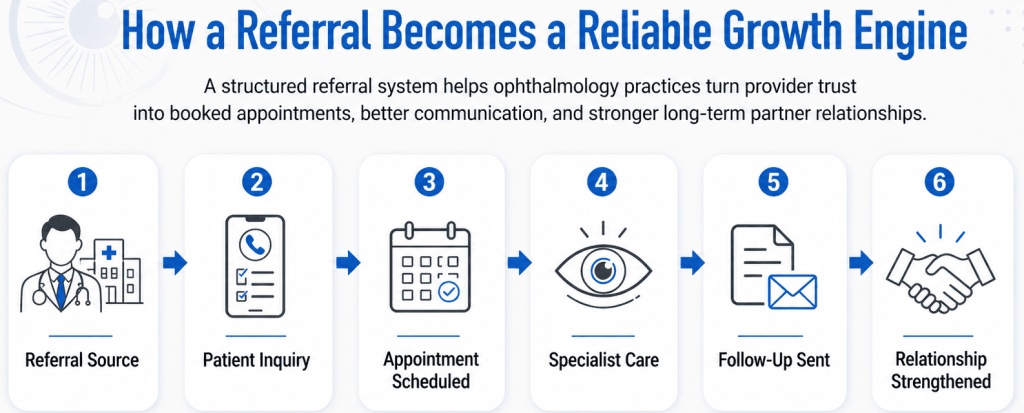
Communication after the referral is just as important as outreach before the referral. Referring providers want to know whether the patient was seen, what the diagnosis was, what treatment plan was recommended, and whether follow-up is needed. When consultation notes are timely and useful, the referring provider feels confident sending future patients.
Practices should also protect the referral partner’s relationship with the patient. Optometrists and primary care providers may hesitate to refer if they believe the patient will be absorbed permanently into another system without communication. Clear co-management expectations and respectful follow-up reduce that concern.
Privacy and compliance matter as well. HHS explains that HIPAA marketing rules can apply when protected health information is disclosed in exchange for remuneration to encourage use of a product or service, and healthcare organizations should be careful about how patient information is used in marketing communications. Referral development should be built with privacy-conscious communication, documented workflows, and appropriate legal guidance when needed.
How Should Practices Make the Referral Process Easier for Physicians and Patients?
Practices should make the referral process easier by reducing every point of friction for the referring office and the patient. The easier it is to refer, schedule, confirm, and follow up, the more likely partners are to use your practice consistently.
A dedicated referral phone line or referral coordinator can make a major difference. Busy medical offices do not want to sit in a general phone queue. If your practice receives many professional referrals, create a pathway that helps referring teams reach the right person quickly.
An online referral form is also useful, especially for practices that want clean data capture. The form should be simple and secure, requesting only the information needed to process the referral. Depending on partner preferences, your practice may still need to offer fax because many medical offices continue to use fax-based workflows.
A referral landing page can centralize the process. It can include referral instructions, accepted insurance information, urgent referral guidance, downloadable forms, service-line criteria, provider bios, and contact information. This page should be designed for providers and office staff, not just patients.
Patients also need clarity. After being referred, they should know who will contact them, how soon they can expect a call, what records they need, whether they need a driver, what insurance details are required, and what to expect at the visit. If referred patients feel confused, the referral source may receive the complaint.
For urgent conditions, create a separate triage workflow. Not every eye complaint has the same urgency, and referring partners need guidance. AAO referral statements emphasize prompt, appropriate referral when possible eye disease or injury signs and symptoms are present. A practical referral engine should help partners distinguish routine referrals from cases that require faster attention.
What Marketing Materials Help Strengthen Ophthalmology Referral Partnerships?
The best referral marketing materials make your practice easy to understand, easy to trust, and easy to refer to. They should answer the partner’s core questions quickly: What do you treat? When should we refer? How do we refer? What happens next?
One-page referral guides are often the most useful. They can be created for cataracts, glaucoma, retina, diabetic eye care, LASIK, dry eye, pediatric eye concerns, or urgent symptoms. Each guide should include common referral indicators, basic patient instructions, scheduling details, and the best contact method.
Provider bio cards can also help. Referring doctors and office staff are more comfortable sending patients when they understand the specialist’s credentials, clinical focus, and communication style. Include professional photography, board certification details when applicable, specialties, languages spoken, and a short explanation of the patients each provider is best suited to help.
Patient education handouts are useful because they help the partner explain why the referral matters. For example, an endocrinology office may appreciate a plain-language handout on diabetic eye exams. A senior care community may use a cataract symptoms checklist. An optometry office may share a cataract surgery preparation overview.
Digital materials matter too. Referral forms, service-line landing pages, educational videos, and email templates help partner offices access information quickly. For larger practices, a password-free referral resource hub can reduce repetitive questions and improve consistency.
| Material | Who Uses It | Why It Improves Referrals |
| One-page referral guide | Physicians and office staff | Clarifies when and how to refer |
| Service-line sheet | Partner providers | Explains conditions and procedures |
| Patient handout | Patients and caregivers | Reduces confusion before scheduling |
| Referral landing page | Partner offices | Centralizes forms and instructions |
| Provider bio card | Doctors and care coordinators | Builds confidence in the specialist |
A Table Comparing Referral Materials.
How Can PPC and SEO Support Referral Marketing for Ophthalmology Practices?
PPC and SEO support referral marketing by reinforcing credibility when referred patients or referring providers search for your practice online. A referral may start offline, but the decision often continues online.
A patient who receives your name from an optometrist may still search your ophthalmologist, read reviews, check your Google Business Profile, visit your website, and compare your office to other local options. Google’s Business Profile platform is designed to help businesses appear on Search and Maps and provide key information to people looking for them. For ophthalmology practices, complete profiles, accurate hours, service details, photos, and review management can influence whether a referred patient follows through.
Search behavior also matters. A Google/Compete healthcare study found that patients used digital resources during hospital research, including hospital sites, health insurance company sites, health information sites, and consumer-generated reviews. Although the study is older and hospital-focused, it supports a durable point: referred patients often validate healthcare decisions online before taking action.
SEO strengthens referral marketing by making your service lines easy to find. If a primary care provider tells a patient to look into cataract surgery, glaucoma evaluation, or diabetic eye care, your website should have clear pages that answer those questions. These pages should explain symptoms, evaluation steps, treatment options, insurance considerations, and what happens during the visit.
PPC can support referral marketing in several ways. Paid search can capture patients who were told they need an ophthalmologist but were not given a specific practice. It can also support high-value service lines, new location launches, competitive markets, or seasonal demand. Landing pages can be built around specific services and designed to convert referred or search-driven patients.
Healthcare advertising requires care. Google Ads states that healthcare and medicine ads and destinations are expected to follow appropriate laws and industry standards. Ophthalmology practices should avoid exaggerated claims, respect privacy rules, review platform policies, and make sure ad copy and landing pages are accurate.
Reputation management is another important bridge between referrals and digital marketing. Patients may trust a physician’s recommendation, but reviews can reinforce or weaken that trust. BrightLocal’s Local Consumer Review Survey tracks how consumers use reviews to evaluate local businesses, which makes review quality and recency an important local marketing consideration.
How Do You Track Referral Marketing Performance?
Ophthalmology practices should track referral marketing performance by source, patient quality, booked appointments, completed visits, procedure conversion, revenue, and retention. Without tracking, referral marketing becomes relationship activity without business intelligence.
Start with source capture. Every new patient intake process should ask how the patient heard about the practice. Staff should be trained to distinguish between “doctor referral,” “optometrist referral,” “Google search,” “insurance directory,” “friend or family,” and “returning patient.” If possible, collect the specific provider, practice, or organization name.
EHR fields, CRM tags, call tracking, referral forms, and intake notes can all contribute to reporting. The exact tools matter less than consistency. A practice that captures referral source data 90% of the time with a simple process is in a better position than one with advanced software used inconsistently.
Key metrics should include number of referrals by source, appointment booking rate, appointment show rate, completed visit rate, surgical or procedure conversion rate, revenue by referral source, average time to appointment, referral growth over time, and incomplete or lost referrals.
Not all referral sources are equal. One optometry partner may send fewer patients but produce a high percentage of cataract surgery consults. Another partner may send many patients who do not match your services or insurance mix. Tracking helps the practice invest in the right relationships.
Monthly reporting should be simple enough for leadership to use. A referral dashboard can show top referral partners, service-line trends, referral conversion, revenue impact, and follow-up activity. This allows the practice to decide where to schedule outreach, which partners need better materials, and which referral workflows need improvement.
What Mistakes Stop Ophthalmology Referral Programs From Growing?
Most ophthalmology referral programs fail because they are informal, inconsistent, hard to use, or poorly tracked. The problem is rarely a lack of potential partners. The problem is usually a weak system.
One common mistake is waiting for referrals instead of actively developing relationships. A practice may assume local providers already know what it offers, but that is often untrue. New doctors enter the market, office staff changes, service lines expand, and competitors build stronger relationships.
Another mistake is making the referral process too difficult. If the phone system is confusing, forms are outdated, insurance information is unclear, or no one confirms receipt, partner offices lose confidence. Referral partners are busy. They will naturally favor practices that make their work easier.
Slow scheduling can also damage referral growth. Some patients can wait for routine care, but others need prompt evaluation. If partners believe their patients cannot access your practice in a reasonable timeframe, they may stop referring even if they respect your physicians.
Poor communication back to referring providers is a major issue. If a partner sends a patient and never receives an update, the referral feels incomplete. Timely consultation notes, care summaries, and co-management communication protect the relationship.
Practices also make the mistake of treating every referral partner the same. A high-volume optometry practice deserves a different engagement strategy than a small clinic that refers occasionally. Segmenting partners allows the practice to invest time where it has the most impact.
Finally, some practices overlook the front desk. Referral marketing is not only the job of physicians or administrators. The first phone call can either strengthen or weaken the referral relationship. Staff should know how to identify referred patients, capture the source, prioritize partner communication, and explain next steps clearly.
How Can an Ophthalmology Practice Build a Referral Engine Step by Step?
An ophthalmology practice can build a referral engine by auditing current sources, prioritizing service lines, creating partner workflows, simplifying referrals, tracking performance, and using digital marketing to reinforce trust.
Start with a referral audit. Pull data from intake forms, EHR records, call logs, website forms, and staff knowledge. Identify who already refers, which services they refer for, and where the practice is missing opportunities.
Next, define priority service lines. A practice cannot build every referral pathway at once. Cataracts, glaucoma, retina, LASIK, dry eye, diabetic eye care, pediatric ophthalmology, and urgent eye conditions may each require different partners and materials. Choose the services most aligned with growth goals, capacity, and profitability.
Build a local partner list. Include optometrists, primary care physicians, endocrinologists, pediatricians, neurologists, urgent care centers, senior living organizations, diabetes educators, and community health partners. Segment the list by specialty, distance, relationship status, current referral volume, and opportunity level.
Create referral-friendly materials. Each priority service line should have a simple guide explaining when to refer, how to refer, what patients should expect, and how follow-up works. Make these materials available in both print and digital formats.
Build a dedicated referral page or form. The page should give partner offices one reliable place to find contact information, forms, insurance guidance, urgent referral instructions, and provider details. Keep it easy to navigate and avoid burying referral instructions deep inside the website.
Train staff on referral intake. Team members should know how to recognize professional referrals, capture the exact source, route urgent cases, explain scheduling timelines, and communicate respectfully with partner offices. A strong referral strategy can fail if the intake team is not prepared.
Begin outreach with warm relationships. Existing referrers, former colleagues, local optometrists, and physicians who have already sent patients are the best starting point. Thank them, ask what would make the referral process easier, and share updated materials.
Offer educational value. Lunch-and-learns, short webinars, printed clinical guides, and patient education resources help referral partners without making the relationship feel purely transactional. Education is especially useful for service lines where patients need help understanding why specialty care matters.
Follow up after referred patient encounters. This is where many practices fall short. A concise, timely note can do more for future referrals than another promotional visit. It shows the partner that their patient was handled professionally.
Review performance every month. Look at referral volume, conversion rate, revenue, partner trends, and missed opportunities. Use that information to decide which relationships to nurture, which materials to improve, and which workflows to fix.
When Should Practices Invest in Professional Help for Referral Marketing?
Practices should invest in professional help when they want measurable referral growth but lack the time, systems, content, analytics, or digital marketing structure to manage it consistently. Referral marketing is simple in concept but complex in execution.
Professional support is especially useful for multi-location practices, practices launching a new service line, or practices competing in crowded markets. A cataract surgeon entering a new area, a LASIK center trying to increase consult volume, or a retina practice expanding physician relationships may need more than occasional outreach.
It also makes sense when a practice receives referrals but cannot measure them. If leadership cannot answer which referral partners drive booked appointments, completed visits, procedures, revenue, or long-term patient value, the practice is missing strategic insight.
Professional help can connect referral marketing with SEO, PPC, content, landing pages, reputation management, CRM setup, tracking, and reporting. This matters because modern referrals rarely live in one channel. A partner recommendation, Google search, review profile, landing page, and phone call may all influence the same patient journey.
The best time to get help is before growth becomes chaotic. If referral volume increases but intake workflows, tracking, and communication are weak, the practice may lose opportunities. A structured system helps scale referrals without creating confusion for staff, partners, or patients.
FAQ
What is the best referral source for an ophthalmology practice?
The best referral source depends on the practice’s service lines. Optometrists, primary care physicians, endocrinologists, diabetes care teams, senior care organizations, and existing patients can all be valuable sources.
For cataract and co-managed surgical care, optometrists are often especially important. For diabetic eye care, endocrinologists and primary care providers may be strong partners. For urgent concerns, urgent care centers and emergency-oriented providers may be valuable.
How do ophthalmology practices get more physician referrals?
Ophthalmology practices get more physician referrals by making the referral process easy, communicating clearly, proving clinical reliability, and maintaining consistent outreach. A provider is more likely to refer when they trust that the patient will be scheduled, treated well, and communicated back to them.
The process should include simple referral instructions, direct scheduling pathways, useful clinical materials, timely consultation notes, and regular relationship-building with partner offices.
Should ophthalmology practices market to optometrists?
Yes. Ophthalmology practices should market to optometrists when there are appropriate co-management or specialty-care opportunities. Optometrists often have strong patient relationships and can identify when a patient needs surgical, medical, or specialist ophthalmology care.
The key is to approach optometry relationships as partnerships, not competition. Clear co-management expectations, respectful communication, and patient handoff processes help build trust.
How do you track referrals in an ophthalmology practice?
Track referrals through intake forms, EHR fields, referral forms, call tracking, CRM tags, website form fields, and monthly reporting dashboards. Staff should capture not only that the patient was referred, but also the specific provider, practice, or organization that referred them.
Useful metrics include referral source, booked appointments, show rate, completed visits, procedure conversion, revenue, time to appointment, and referral growth by partner.
Can PPC help with referral marketing?
Yes. PPC can help referral marketing by improving visibility when patients search after receiving a recommendation. It can also capture patients who were told they need an ophthalmologist but were not given a specific provider.
PPC works best when ads lead to accurate, service-specific landing pages and follow healthcare advertising policies. Google Ads expects healthcare and medicine advertisers to follow applicable laws and industry standards.
Is referral marketing compliant for healthcare practices?
Referral marketing can be compliant, but practices must follow healthcare advertising rules, privacy requirements, anti-kickback considerations, and platform policies. Because healthcare marketing can involve sensitive patient information, practices should be careful about how they use patient data and referral relationships.
HHS provides guidance on HIPAA marketing rules, including situations where protected health information is disclosed in exchange for remuneration for communications encouraging use of a product or service. Practices should involve qualified legal or compliance guidance when creating formal referral, advertising, or partner programs.
Conclusion
Referral marketing works best when ophthalmology practices treat it as a system, not a side activity. Strong relationships still matter, but relationships alone are not enough. Practices need clear referral criteria, easy scheduling pathways, partner-friendly materials, trained staff, timely communication, and reliable tracking.
A strong referral engine helps local physicians, optometrists, health partners, and patients understand when to choose your practice and what to expect. It also gives leadership better visibility into which relationships are actually driving growth.
For ophthalmology practices, the opportunity is clear: build trust offline, reinforce it online, and measure the full path from referral source to patient outcome. When referral marketing, SEO, PPC, reputation management, and patient experience work together, referrals become more predictable, more valuable, and easier to scale.
Why Visiclix is Your Ideal Choice for Referral Marketing for Ophthalmology Practices?
Visiclix helps ophthalmology practices turn referral relationships into measurable growth systems. Instead of relying on scattered outreach, passive word-of-mouth, or disconnected campaigns, Visiclix can help align your referral strategy with local SEO, PPC, landing pages, reputation signals, and conversion tracking. That gives your practice a clearer path from physician trust to booked appointments and long-term patient growth.
For ophthalmology practices, the real opportunity is not just getting more attention. It is earning the right attention from patients and partners who already have a reason to trust you. Visiclix understands how to connect search visibility, paid traffic, patient education, and referral-focused messaging into one growth strategy that supports sustainable practice development.
Visiclix can also help identify where your referral engine is leaking opportunities. That may include weak service-line pages, inconsistent referral tracking, poor landing page conversion, unclear local visibility, or campaigns that are not tied to revenue. With the right strategy, your practice can make better decisions about where to invest, which partners to prioritize, and how to convert more referred patients.
Build a Stronger Referral Engine With Visiclix
Ready to make referrals more predictable, measurable, and profitable? Partner with Visiclix to build a referral marketing strategy that supports physician relationships, strengthens your local visibility, and turns patient demand into booked appointments.
Schedule a strategy conversation with Visiclix and discover how your ophthalmology practice can create a stronger referral engine.