
When choosing an eye clinic, patients should look for qualified eye care providers, relevant services, clear explanations of exams and treatments, modern diagnostic capabilities, transparent cost and insurance information, convenient scheduling, strong reviews, and a patient experience that feels trustworthy from the first interaction. The right clinic is not always the nearest option or the one with the lowest advertised price. It is the clinic that clearly shows it can understand the patient’s concern, provide the right level of care, and guide them toward the next step with confidence.
This is why the patient journey for eye care marketing matters. Patients rarely choose an eye clinic after seeing one ad or visiting one page. They search symptoms, compare providers, read reviews, check insurance details, look at doctor credentials, and decide whether booking feels easy and safe. Eye clinics that answer these questions early are more likely to convert searchers into scheduled patients.
What Type of Eye Care Provider Does the Patient Need?
One of the first things patients need to understand is whether they should see an optician, optometrist, or ophthalmologist. Many people use the phrase “eye doctor” broadly, but each provider plays a different role.
| Provider | Helps With | Best For |
|---|---|---|
| Optician | Glasses, lenses, fitting | Eyewear needs |
| Optometrist | Eye exams, prescriptions, common eye issues | Routine care |
| Ophthalmologist | Medical eye care, disease treatment, surgery | Advanced care or surgery |
An optician helps with glasses, lenses, and eyewear fitting. An optometrist performs eye exams, prescribes glasses or contact lenses, and manages many common eye conditions. An ophthalmologist is a medical doctor who diagnoses and treats eye diseases and performs eye surgery. Cleveland Clinic explains that ophthalmologists can perform surgery, while optometrists commonly provide exams, prescriptions, and non-surgical eye care.
For clinics, this distinction should be easy to find on the website. A patient searching for a routine vision exam may need a different provider than someone experiencing eye pain, cataract symptoms, glaucoma concerns, or sudden vision changes. Strong eye care marketing helps patients understand where they fit before they call.
How Can Patients Tell If a Clinic Treats Their Specific Concern?
Patients usually begin their search with a problem, not a provider title. They may look for help with blurry vision, dry eyes, red eyes, eye strain, floaters, cataracts, diabetic eye screening, LASIK, contact lens discomfort, or children’s eye exams. If a clinic’s website only says “comprehensive eye care,” patients may still wonder whether the clinic can help them.
A strong eye clinic website should connect symptoms and conditions to clear service pages. For example, a dry eye page should explain symptoms, possible causes, diagnosis, and treatment options. A cataract page should explain what cataracts are, when surgery may be discussed, and what happens during a consultation. A diabetic eye exam page should explain why regular monitoring matters and what the exam includes.
This type of content helps patients move from uncertainty to action. It also improves PPC and SEO performance because the page matches what patients are actually searching for.
Why Do Credentials, Experience, and Specialties Matter?
Patients want reassurance before trusting a clinic with their eyesight. Credentials, experience, and specialties help answer the question behind every booking decision: “Can this clinic safely help me?”
Doctor bios should include more than names and degrees. They should explain each provider’s role, specialty areas, clinical experience, surgical focus if relevant, languages spoken, and patient care approach. A cataract patient wants to know whether the doctor regularly evaluates cataracts. A glaucoma patient wants to know whether the clinic manages glaucoma. A parent wants to know whether the clinic provides care for children.
Vague claims like “expert eye care” are less persuasive than specific proof. Clinics should show what makes their providers qualified and connect that expertise to real patient needs. In the buyer journey, credentials are not just background information. They are trust-building conversion assets.
How Does the Clinic’s Online Presence Shape the First Impression?
A patient’s first impression often happens online before any phone call. The clinic’s website, Google Business Profile, reviews, ads, landing pages, photos, and booking process all influence whether the clinic feels credible.
An effective patient journey for eye care marketing starts before the patient speaks to the clinic. Patients should quickly see what the clinic treats, who the doctors are, where the clinic is located, how to book, whether insurance is accepted, and what makes the clinic trustworthy.
A confusing website can make even a skilled clinic feel less reliable. Important information should not be hidden. Phone numbers should be easy to tap on mobile. Online booking should be simple. Service pages should answer real patient questions. Location, hours, parking, and appointment instructions should be clear.
Patients are comparing options. If one clinic makes the process easier to understand, that clinic often earns more confidence.
What Trust Signals Help Patients Choose One Clinic Over Another?
Patients look for proof before they book. Trust signals include patient reviews, detailed doctor profiles, clinic photos, professional affiliations, educational content, clear service descriptions, transparent policies, and helpful FAQs.
Reviews are especially important because they show how other patients experienced the clinic. Patients often look for comments about staff kindness, wait times, communication, doctor thoroughness, scheduling, and whether the provider explained things clearly. A strong review profile helps reduce uncertainty.
Educational content is another trust signal. A clinic that explains symptoms, exams, treatments, risks, recovery, and follow-up shows that it respects the patient’s need to understand. Real clinic photos also help. Authentic images of the office, equipment, doctors, and team can make the experience feel more familiar before the visit.
Patients are not only asking, “Can this clinic treat me?” They are asking, “Can I trust this clinic with my vision?”
How Should Clinics Explain Exams, Technology, and Treatment Options?
Eye clinics should explain exams, technology, and treatments in patient-friendly language. Most patients do not need a technical description of every device. They need to know what will happen, why it matters, whether it may be uncomfortable, and how the results help the doctor make decisions.
A helpful exam page might explain vision testing, eye pressure checks, dilation, retinal imaging, and doctor evaluation. The National Eye Institute notes that dilated eye exams help doctors check for common eye problems and detect disease early, often before symptoms become obvious.
Technology should be tied to patient benefit. Instead of simply saying “advanced diagnostic equipment,” explain how the technology may support earlier detection, clearer diagnosis, or better treatment planning. Treatment pages should also explain who may be a candidate, what to expect, possible risks, recovery, and follow-up care.
Why Do Cost, Insurance, and Convenience Affect Booking Decisions?
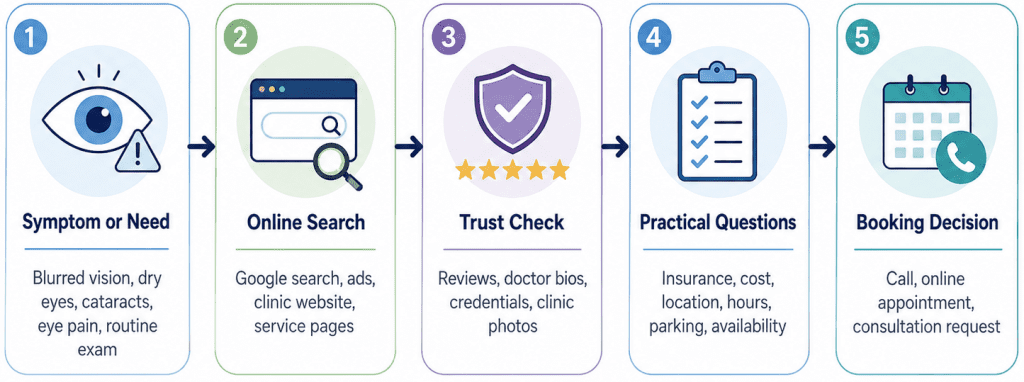
Even motivated patients may delay care if cost or insurance information is unclear. Eye clinics should make financial details easy to find, including accepted insurance, consultation fee guidance, payment options, financing availability, and what may affect final pricing.
This does not mean every service needs a fixed public price. Some costs depend on diagnosis, testing, or treatment plan. However, patients should not feel completely in the dark. Cost clarity builds trust and reduces hesitation.
Convenience also matters. Patients may choose a clinic because it offers online booking, fast appointment availability, clear hours, accessible parking, helpful reminders, or multilingual support. For PPC campaigns, this is critical. Paid clicks are wasted when landing pages do not make booking easy.
The best patient journey for eye care marketing combines education, trust, cost clarity, and a frictionless path to an appointment.
FAQ
How do I know if an eye clinic is trustworthy?
A trustworthy eye clinic clearly shows who its providers are, what services it offers, what patients can expect, and how to book. Strong reviews, detailed doctor bios, real clinic photos, and clear explanations of exams and treatments all help build confidence.
Should I choose an optometrist or ophthalmologist?
Choose an optometrist for routine exams, prescriptions, and many common eye concerns. Choose an ophthalmologist if you may need medical eye care, disease management, or surgery. Some clinics offer both, making it easier to guide patients to the right provider.
What should a good eye clinic website include?
A good eye clinic website should include services, doctor profiles, location details, phone number, online booking, insurance information, FAQs, reviews, and clear explanations of common exams or treatments.
Why does the patient journey matter in eye care marketing?
The patient journey matters because patients compare clinics before booking. They need answers, reassurance, and a simple next step. Clinics that provide this are more likely to turn online searches into appointments.
Conclusion
Patients choose an eye clinic based on trust, clarity, expertise, convenience, and confidence. They want to know whether the clinic treats their concern, whether the provider is qualified, what the visit involves, how much it may cost, and whether booking will be simple.
For eye clinics, the opportunity is clear: answer patient questions before the first call. A strong website, helpful content, clear service pages, visible credentials, transparent financial guidance, and easy booking all support better decisions. The clinics that win are not always the loudest. They are the ones that make the choice feel safest and clearest.
Why Visiclix is Your Ideal Choice for Patient Journey for Eye Care Marketing?
Visiclix helps eye clinics turn patient questions into a clear, conversion-focused marketing journey. Instead of relying on generic service pages or disconnected PPC campaigns, Visiclix builds strategies around what patients need to see before they choose one clinic over another: trust, expertise, convenience, cost clarity, and treatment relevance.
With a patient-first approach to SEO, PPC, landing pages, and content planning, Visiclix helps eye care providers attract qualified visitors and guide them toward booking with confidence. The focus is not just more clicks. The goal is to create a stronger path from search intent to scheduled appointment.
Grow Your Eye Clinic with Visiclix
Ready to turn patient searches into booked appointments? Visiclix can help your clinic build a smarter eye care marketing strategy that supports every stage of the patient journey.