
Patient hesitation turns into booked appointments when your marketing reduces uncertainty, proves trust, removes scheduling friction, and gives patients one clear next step. In patient booking hesitation marketing, the goal is not to pressure people into acting faster; it is to make the decision feel safer, clearer, and easier from the first ad click to the final confirmation.
For eye care practices, hesitation often happens after interest has already been created. A patient may need an eye exam, dry eye treatment, LASIK consultation, cataract evaluation, or updated eyewear, but still pause before booking because the next step feels unclear or risky. That pause is where appointments are won or lost. Strong marketing does not simply attract clicks; it helps patients feel confident enough to schedule.
What Causes Patient Booking Hesitation in a Healthcare Marketing Funnel?
Patient booking hesitation is usually caused by uncertainty, weak trust, poor timing, or unnecessary effort. Patients do not always abandon a booking because they are uninterested. Many stop because they cannot quickly answer practical questions: “Do they take my concern seriously?” “Is this provider credible?” “Will this cost more than I expect?” “Can I schedule without calling during work?”
This matters because healthcare booking is not the same as ordinary e-commerce. Patients are making a personal decision that may involve health anxiety, cost concerns, insurance questions, provider trust, and time away from work or family. Even small gaps in the experience can create resistance. A vague service page, outdated practice photos, hidden appointment options, or a form that feels too long can interrupt momentum.
Online booking research also shows that patient behavior depends heavily on how the practice makes booking available and understandable. A 2024 JMIR mixed-methods study found that more patients were aware online booking was available than had actually used it, and that practice-level factors influenced awareness and use. That means the practice experience itself can either support or suppress patient action.
Why Do Patients Delay Booking Even After Clicking an Ad?
Patients delay booking after clicking an ad because the landing page often fails to resolve the doubts behind the search. A click signals interest, not commitment. If the page does not immediately confirm relevance, credibility, location, appointment options, and next steps, the patient may leave to “think about it” and never return.
This is especially expensive in PPC. When a practice pays for high-intent traffic, the post-click experience must work as hard as the ad. Visiclix’s PPC Google Search Ads service focuses on reaching high-intent searchers and directing them to optimized landing pages that match patient intent and increase appointment bookings.
The critical mistake is assuming the ad already did the persuasion. It did not. The ad earned attention. The landing page must earn confidence. For example, a patient searching for “dry eye specialist near me” may need a page that clearly explains symptoms treated, provider expertise, appointment expectations, insurance guidance, and how quickly they can be seen. Without those details, booking feels like a risk.
What Trust Signals Help Hesitant Patients Feel Safe Enough to Schedule?
The strongest trust signals are specific, current, and easy to verify. Patients want proof that the practice is competent, organized, and experienced with their concern. Generic claims like “trusted eye care” are weak unless supported by reviews, provider credentials, real patient education, clear service explanations, and consistent business information.
For eye care practices, trust signals should include provider bios, Google reviews, authentic patient testimonials, accurate local listings, real office photos, and plain-language explanations of what happens during the visit. These details reduce uncertainty because they help patients picture the experience before they commit. They also reduce the perceived risk of choosing the wrong provider.
Reputation is part of the conversion path, not a separate branding activity. Visiclix’s reputation management and local citation services include review monitoring, review collection, listing accuracy, and reputation repair support for eye care businesses. That matters because patients often validate a practice through reviews before they book.
How Should Landing Pages Reduce Booking Friction Before the CTA?
Landing pages should reduce booking friction by answering the patient’s next question before asking for the appointment. A strong page does not force patients to hunt for information. It organizes the decision clearly: what the service is, who it helps, why the practice is credible, what the visit involves, and how to book.
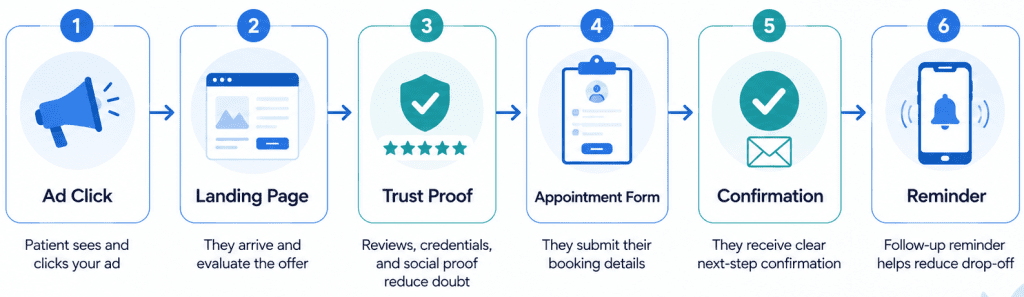
The CTA should be obvious and repeated naturally. Use “Schedule an Appointment,” “Request a Consultation,” or “Call Now” instead of vague buttons like “Submit.” Keep forms short, especially on mobile. Ask only for what is needed to start the conversation. Add tap-to-call buttons, visible hours, location details, insurance notes, and a short “what happens after you request an appointment” section near the form.
This is where design becomes psychology. A slow, crowded, or confusing website tells patients the practice may be difficult to work with. Visiclix’s website design for eye care practices emphasizes responsive design, fast loading, tap-to-call features, easy navigation, and usability improvements that support more appointment bookings and patient inquiries.
How Can Follow-Up Move Undecided Patients Toward an Appointment?
Follow-up moves undecided patients forward by restoring momentum after the first inquiry. A patient who submits a form, calls after hours, or starts booking but does not finish should not disappear into a dead zone. They need quick confirmation, useful answers, and a clear next step.
Good follow-up is not aggressive. It is service-oriented. Send a confirmation message, explain when the practice will respond, provide a phone number, and answer common questions based on the service requested. For appointments already scheduled, SMS and email reminders can help reduce missed visits. A 2025 Frontiers study in ophthalmology settings found online appointment scheduling improved flexibility and resource use in a practice setting, while SMS reminders were associated with reduced no-shows in the hospital setting.
Healthcare follow-up must also be handled carefully. Google treats health-related content as a sensitive interest category in personalized advertising, and HHS explains that some healthcare marketing communications involving protected health information may require authorization unless an exception applies. Practices should use compliant systems, avoid unnecessary health details in reminders, and confirm that marketing workflows protect patient information.
What Should Eye Care Practices Measure to Find Booking Hesitation?
Eye care practices should measure where interested patients stop moving forward. If clicks are increasing but appointments are not, the problem may not be traffic. It may be the decision path after the click.
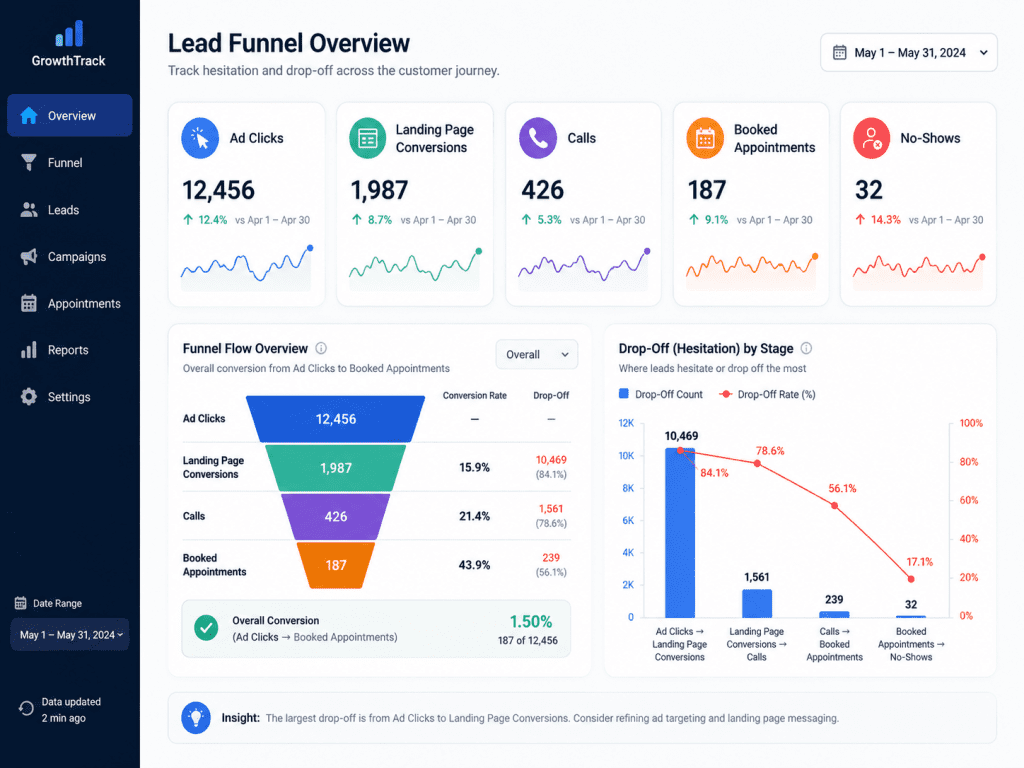
Track landing page conversion rate, form completion rate, click-to-call rate, missed-call rate, inquiry-to-booking rate, cost per booked appointment, booking lag time, reminder response rate, and no-show rate. These metrics reveal whether hesitation is caused by poor ad targeting, weak page content, lack of trust, slow response, or booking friction.
This is why isolated tactics rarely solve the problem. A better approach connects ads, content, website design, reputation, analytics, and follow-up into one patient journey. Visiclix positions itself as an eye care marketing partner that helps optometry and ophthalmology practices attract more patients and increase appointments through strategic digital marketing. Its digital marketing services for eye care include SEO, PPC, web design, reputation management, display advertising, social media, and video advertising.
FAQ
What is patient booking hesitation?
Patient booking hesitation is the delay or resistance a patient feels before scheduling an appointment, even when they are interested. It often comes from uncertainty, lack of trust, unclear pricing or insurance expectations, poor website usability, or confusing next steps.
Why do patients abandon appointment forms?
Patients abandon appointment forms when the process feels too long, unclear, slow, or inconvenient. They may also stop if they do not know what happens after submitting the form or if the page has not built enough trust before asking for personal information.
How can PPC ads reduce patient hesitation?
PPC ads reduce hesitation when they match patient intent and lead to a page that answers the patient’s real concern. The ad should promise a clear solution, while the landing page should prove credibility, explain the service, and make booking easy.
What trust signals matter most before a patient books?
The most important trust signals include strong Google reviews, accurate local listings, provider credentials, real office photos, patient testimonials, and clear explanations of the appointment experience. These signals help patients feel that the practice is credible and safe to contact.
Should eye care practices use text reminders?
Yes, text reminders can help patients remember and follow through with appointments when used appropriately. Practices should keep messages simple, avoid unnecessary health details, and make sure their communication tools are configured for healthcare privacy requirements.
How do reviews affect patient booking decisions?
Reviews help patients reduce perceived risk. A strong review profile shows that other patients have trusted the practice, completed appointments, and had positive experiences. For hesitant patients, that outside validation can be the final reassurance needed to schedule.
Conclusion
Patient hesitation is not always a traffic problem. Often, it is a decision problem. Patients may already be interested, but they need more clarity, proof, convenience, and reassurance before they are ready to book.
The most effective patient booking strategy reduces doubt at every step. Strong ads attract the right people. Helpful landing pages answer their questions. Reviews and provider credibility build trust. Simple forms and quick follow-up make action easier. When these pieces work together, eye care practices can turn more existing interest into booked appointments without simply spending more on ads.
Why Visiclix is Your Ideal Choice for Patient Booking Hesitation Marketing?
Visiclix is built specifically for optometrists, ophthalmologists, and eye care practices that want marketing to produce measurable patient growth. Instead of treating traffic, web design, PPC, SEO, and reputation as separate projects, Visiclix helps practices connect each part of the digital journey. That matters because patient hesitation often happens between channels, not inside one channel alone. A strong campaign needs the ad, landing page, reviews, and booking path to work together.
Visiclix also brings industry-specific focus to a problem that generic agencies often oversimplify. Eye care patients have unique concerns around symptoms, trust, appointment timing, insurance, provider expertise, and treatment expectations. With services across marketing packages for eye care practices, PPC, website design, reputation management, and full-service digital strategy, Visiclix helps practices create a clearer path from patient interest to confirmed appointment.
Turn More Patient Interest Into Appointments With Visiclix
If your practice is getting traffic but not enough booked appointments, the problem may be hesitation hidden inside your marketing funnel. Visiclix can help you identify the gaps, strengthen patient confidence, and improve the conversion path from first click to scheduled visit.