
To align patient experience and eyecare marketing goals, your practice needs to treat every patient touchpoint as part of the marketing funnel: search, website visits, phone calls, scheduling, office flow, provider communication, follow-up, reviews, and retention. A strong patient experience marketing strategy connects what your ads and content promise with what patients actually experience before, during, and after care.
For optometry and ophthalmology practices, this alignment matters because patients do not judge the practice only by clinical outcomes. They also remember whether they could find clear information online, schedule easily, reach a helpful front desk, understand their options, and feel respected during the visit. AHRQ defines patient experience around the aspects of care patients value, including timely appointments, access to information, and good communication with providers.
What does patient experience mean in eyecare marketing?
Patient experience in eyecare marketing means the full impression a patient forms from the first online search to the final follow-up after an appointment. It includes digital access, appointment convenience, staff communication, waiting-room expectations, doctor-patient interaction, billing clarity, and review response.
This is why patient experience cannot sit only with operations while marketing focuses only on clicks and leads. Competitor research consistently shows that healthcare marketing performs better when it reflects patient priorities, not just service promotion. WebMD Ignite, for example, frames patient-centered marketing around individualized needs, preferences, and useful education instead of purely branded messaging.
For eyecare practices, this means your SEO strategy should answer real patient questions, your PPC campaigns should send people to useful landing pages, and your front desk should be ready to fulfill the expectations created by those campaigns.
How does patient experience influence patient acquisition?
Patient experience influences acquisition because modern patients compare providers before they ever call. They look at reviews, convenience, location, website quality, insurance information, appointment access, and whether the practice feels trustworthy.
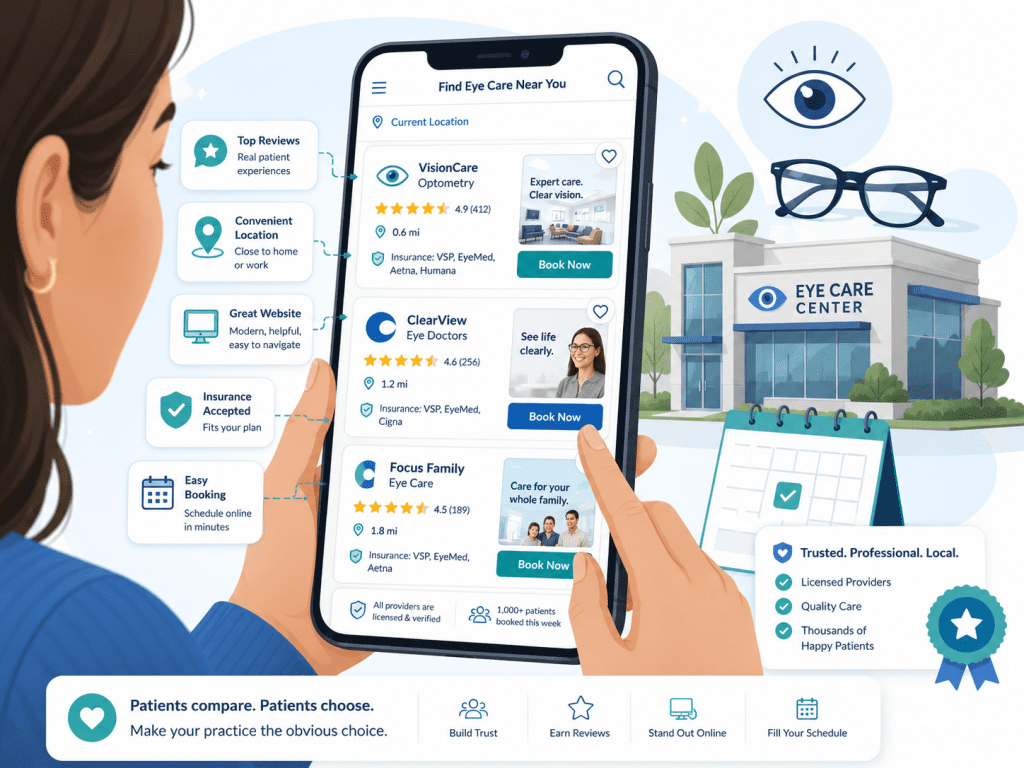
A patient may click an ad for “eye exam near me,” but the conversion depends on what happens next. If the landing page is confusing, the phone line is hard to reach, or appointment information is unclear, the marketing spend loses value. Full Media’s healthcare marketing guidance highlights that patients use digital platforms to evaluate reputation, provider quality, technology, referrals, and trust signals before making decisions.
In eyecare, acquisition goals should therefore include experience-based metrics such as call answer rate, online booking completion, form response time, review sentiment, and appointment show rate. These metrics show whether marketing is creating real patient momentum or only generating surface-level traffic.
How can eyecare practices connect marketing promises with the actual patient journey?
Eyecare practices can connect marketing promises with the patient journey by mapping each campaign message to a real operational experience. If your ads promote same-week appointments, your scheduling process must support that. If your website emphasizes advanced technology, staff should be prepared to explain that technology in patient-friendly terms.
Start by reviewing the top entry points into your practice: Google Business Profile, organic search pages, paid search landing pages, referral pages, social media, and direct calls. Google Business Profile performance data can show how patients discover your profile and what actions they take, including website clicks, calls, directions, and bookings.
Then match each entry point with patient expectations. A cataract consultation page should reduce uncertainty. A pediatric optometry page should reassure parents. A dry eye landing page should explain symptoms, treatment options, and next steps without making exaggerated medical claims. This is where a focused digital marketing services strategy helps bring acquisition and patient care goals into one system.
Why should reviews and reputation be part of the strategy?
Reviews and reputation should be part of the strategy because patients often experience your brand through other patients’ stories before they experience your care directly. A five-star review about a kind technician, clear explanation, or easy appointment process can support conversion as strongly as a well-written ad.
This is especially important in ophthalmology and optometry because non-clinical factors often shape patient satisfaction. Glaucoma Today reported that, in one review-content study, only half of patient comments about ophthalmologists were directed at the physician, while 75% of negative comments involved nonphysician factors such as staff, location, parking, and the overall office experience.
A strong reputation management plan should encourage ethical review generation, monitor feedback, respond professionally, and share recurring themes with the practice team. Reviews should not be treated only as marketing assets. They are patient-experience data that can reveal friction in scheduling, communication, wait times, billing, or follow-up.
How should PPC, SEO, and social media support patient experience goals?
PPC, SEO, and social media should support patient experience goals by helping patients make confident decisions, not just by driving clicks. In healthcare, marketing that educates, clarifies, and reduces anxiety is more valuable than messaging that only pushes appointment volume.
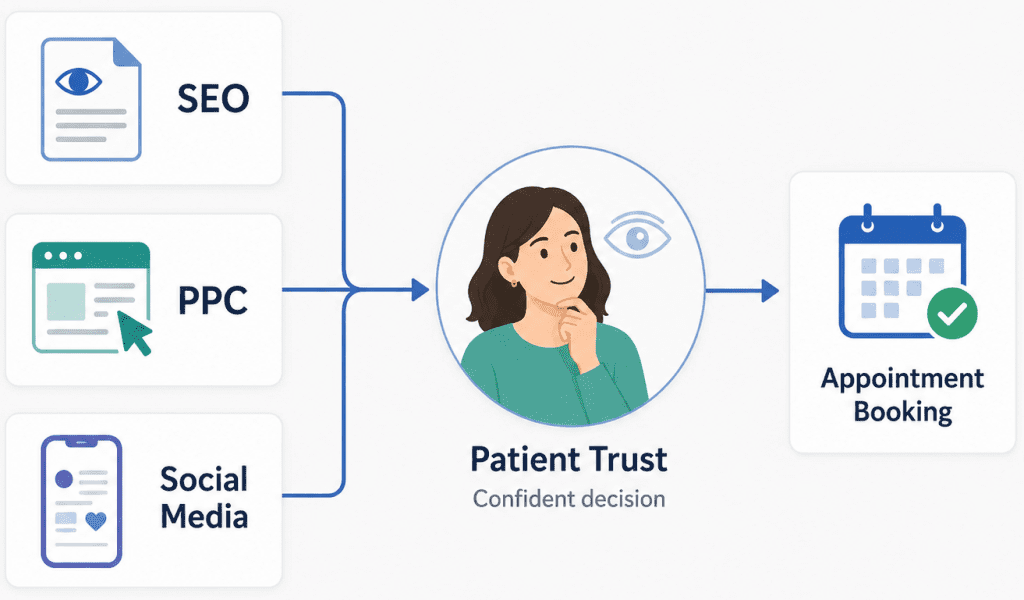
SEO should organize content around patient questions: “When should I schedule an eye exam?”, “What causes blurry vision?”, “How do cataract evaluations work?”, or “What should I expect during a contact lens fitting?” PPC should focus on high-intent services while matching ad copy to landing-page content and appointment availability. Social media should humanize the practice through patient education, team culture, service explainers, and trust-building updates.
Visiclix’s social media marketing services are especially relevant here because social platforms can reinforce the caring side of an eyecare brand. Meanwhile, targeted display advertising can help keep the practice visible to relevant local audiences when used responsibly and in alignment with healthcare advertising policies.
Are there compliance risks when aligning healthcare marketing with patient experience?
Yes. Healthcare marketing must be careful with privacy, claims, targeting, and patient information. A campaign can be patient-centered without implying sensitive knowledge about an individual’s health condition or using personal health data inappropriately.
Google’s healthcare and medicines policy states that healthcare-related ads must follow applicable laws and industry standards, and some healthcare content may be restricted by location, certification, or category. Google’s personalized advertising policy also treats health as a sensitive interest category and restricts certain advertiser-curated audiences for health-related content.
For eyecare practices, the safest strategy is to focus on service relevance, geographic reach, educational value, and clear next steps. Avoid fear-based claims, overpromising results, or using language that makes patients feel personally targeted based on a condition.
What KPIs show that patient experience and marketing are aligned?
The best KPIs combine marketing performance with patient-experience outcomes. Click-through rate, cost per lead, organic rankings, and website traffic are useful, but they do not tell the full story.
Track conversion rate by service line, call quality, missed-call volume, form response time, appointment booking rate, appointment show rate, review rating trends, review themes, returning-patient volume, and referral sources. A 2024 Asia Pacific Journal of Health Management study found that marketing mix and patient experience influenced loyalty through satisfaction, reinforcing the need to measure satisfaction as part of growth strategy.
When these KPIs are reviewed together, your practice can see where growth is being blocked. A campaign may attract the right patients, but poor follow-up may reduce bookings. A website may rank well, but unclear appointment messaging may reduce conversions. Alignment means identifying those gaps and fixing them quickly.
FAQ
What is a patient experience marketing strategy?
A patient experience marketing strategy is a plan that connects marketing, communication, access, reputation, and follow-up around the patient journey. It ensures that what patients see online matches what they experience in the practice.
Why does patient experience matter for eyecare practices?
Patient experience matters because patients often judge eyecare practices by convenience, communication, trust, reviews, and staff interactions in addition to clinical care. These factors can influence whether they book, return, or refer others.
Can better patient experience improve PPC performance?
Yes. Better patient experience can improve PPC performance by increasing landing-page trust, call conversions, appointment bookings, and follow-through after the click. PPC works best when the practice can deliver on the promise made in the ad.
How often should an eyecare practice review patient-experience data?
Eyecare practices should review key experience data at least monthly. This includes reviews, missed calls, booking rates, form response time, and campaign performance.
Conclusion
Aligning patient experience and eyecare marketing goals means making growth feel seamless, trustworthy, and patient-centered. Your ads, website, reviews, phone experience, office flow, and follow-up should all support the same promise: clear, accessible, compassionate eye care.
The most effective strategy does not separate marketing from operations. It uses marketing data to improve the patient journey and patient feedback to improve marketing. When both sides work together, eyecare practices can attract more qualified patients, strengthen loyalty, and build a reputation that supports long-term growth.
Why Visiclix is Your Ideal Choice for Patient Experience Marketing Strategy?
Visiclix specializes in helping optometrists and ophthalmologists attract more patients through digital strategies built specifically for eyecare. The team understands that successful marketing is not only about visibility; it is about connecting patients with the right information, the right message, and the right next step at the right time.
With services spanning SEO, PPC, reputation management, social media, display advertising, and web-focused growth strategy, Visiclix helps practices connect marketing performance with patient trust. Their eyecare-specific approach makes it easier to build campaigns that support appointment growth while respecting the patient journey and the credibility of the practice.
Grow Patient Trust and Appointments with Visiclix
Ready to turn patient experience into a stronger growth engine for your practice? Contact Visiclix to discuss a customized eyecare marketing strategy designed to attract patients, improve visibility, and support measurable practice growth.