
Payment information can improve patient marketing by removing uncertainty before a patient books an appointment. For eye clinics, patients often want to know whether their insurance is accepted, what their out-of-pocket costs may be, whether financing is available, and how easy it will be to pay. When that information is clear on ads, landing pages, appointment forms, and follow-up messages, it reduces hesitation and makes the path to booking feel safer and more convenient.
That is why insurance and payment marketing for eye clinics should not be treated as a billing-only issue. It is part of the patient acquisition experience. A clinic that clearly explains accepted plans, payment options, financing availability, self-pay guidance, and billing support can build trust before the first visit. Research-backed patient payment content also shows that clear billing, digital payment options, flexible financing, and personalized support can strengthen patient loyalty and satisfaction.
What payment information matters most to eye care patients?
The most useful payment information is the information that helps patients understand whether they can afford care, use their benefits, and avoid billing surprises. For an eye clinic, this usually includes accepted insurance plans, vision benefits, medical insurance guidance, co-pay expectations, self-pay options, financing availability, HSA/FSA eligibility, online payment access, and who to contact with billing questions.
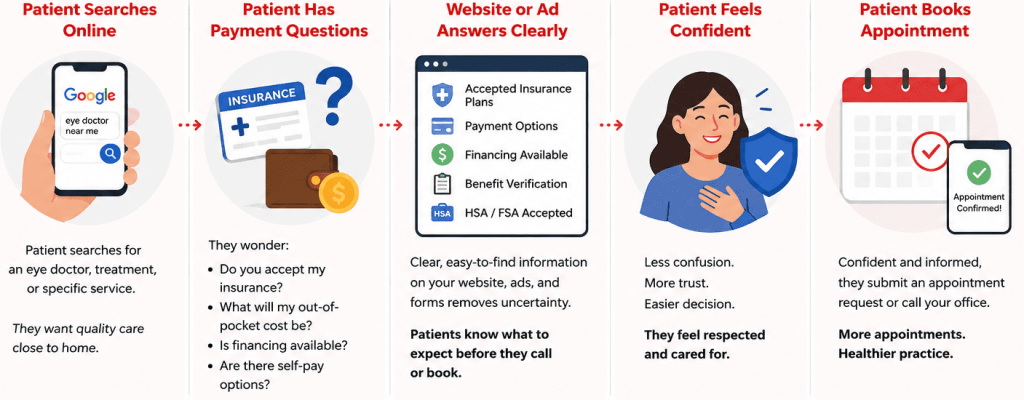
Patients are not always comparing clinics only by doctor quality or location. They are also evaluating convenience, affordability, and confidence. A patient searching for an eye exam, cataract consultation, dry eye treatment, LASIK evaluation, or specialty ophthalmology service may leave a website if the payment experience feels unclear. Even a strong PPC campaign can lose conversions when the landing page fails to answer basic insurance and cost questions.
This is where a strong eye care website and campaign strategy matter. A clinic’s service pages should explain payment expectations in plain language, while its appointment forms should make insurance questions easy to answer. Visiclix’s digital marketing services for eye care are especially relevant here because payment clarity works best when it is connected to website design, SEO, PPC, reputation, and conversion strategy.
How can insurance and payment details improve PPC performance?
Insurance and payment details can improve PPC performance by increasing relevance, reducing wasted clicks, and helping high-intent patients feel ready to schedule. Someone clicking a paid ad for “eye doctor near me that accepts insurance” or “cataract consultation cost” is already showing financial intent. If the ad and landing page answer that concern quickly, the clinic has a better chance of turning the click into a booked appointment.
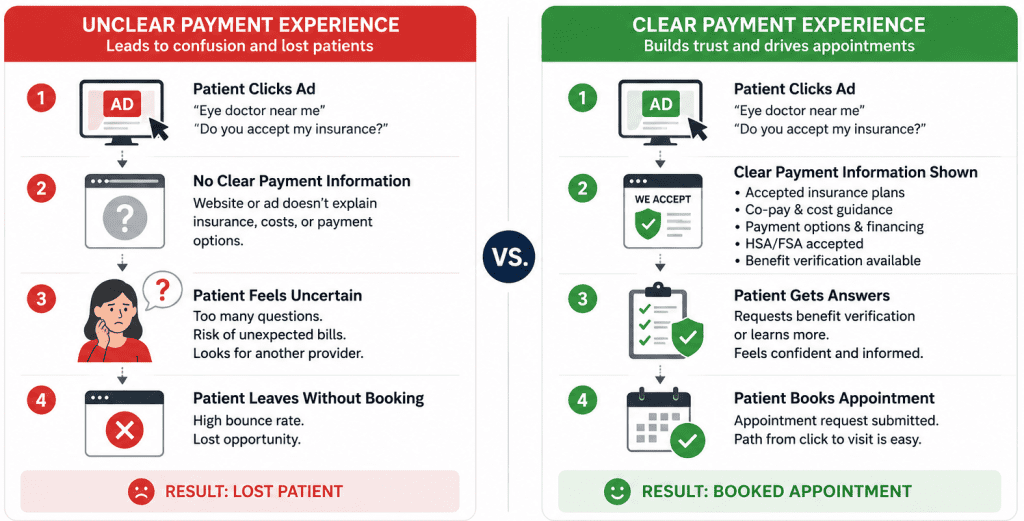
For example, a PPC landing page can include a short section such as “We accept many major vision and medical insurance plans,” followed by a form field that lets patients request benefit verification. For self-pay or elective services, the page can mention available payment options or financing discussions without overpromising exact costs. This helps match the patient’s search intent while protecting the clinic from making unsupported pricing claims.
Visiclix’s PPC Google Ads for optometrists and ophthalmologists focuses on high-intent searches, optimized landing pages, conversion tracking, and campaign refinement. Those same PPC fundamentals become stronger when payment information is treated as a conversion asset. A click is not valuable by itself; it becomes valuable when the page answers the patient’s biggest concern and guides them toward scheduling.
Why does payment transparency build patient trust?
Payment transparency builds trust because it shows patients that the clinic respects their time, budget, and decision-making process. Healthcare payment confusion is a real friction point. Cedar’s Healthcare Financial Experience Study surveyed 1,200 consumers and found that patients want to pay their healthcare bills, but many find bills unaffordable and the process too complex.
For eye clinics, transparency does not always mean publishing exact prices for every scenario. Eye care billing can vary based on insurance coverage, medical necessity, diagnostic testing, procedure type, and provider recommendations. Instead, transparency means explaining what patients can expect, which questions they should ask, what information they should bring, and how the clinic helps them understand next steps.
This also supports reputation. Patients are more likely to feel respected when the financial side of care is easy to understand. When billing is confusing, a patient may still receive excellent clinical care but leave with a negative impression. A strong reputation management strategy for eye care should therefore consider the full patient experience, including the payment and billing process.
How should eye clinics use payment information on their website?
Eye clinics should use payment information on their website by placing it where patients naturally need reassurance. This includes the homepage, appointment page, service pages, FAQ section, and PPC landing pages. The goal is not to overwhelm patients with billing policy details. The goal is to answer common questions before they become barriers.
A good payment-focused website section may include accepted insurance categories, a note about verifying benefits before the visit, available payment methods, financing or payment plan guidance, and a reminder that final costs depend on coverage and services provided. The language should be simple, direct, and patient-friendly.
This also supports organic search. Patients often search for insurance-related and cost-related questions before choosing a provider. Clinics that publish clear, helpful content around those questions can improve relevance for local and service-based searches. Visiclix’s SEO for optometrists emphasizes visibility, content value, user experience, and long-term search performance, which fits naturally with payment and insurance education.
How can digital payment options improve the patient experience?
Digital payment options improve the patient experience by making payment faster, more convenient, and easier to complete outside normal office hours. Competitor research across healthcare payment articles consistently highlights online payments, digital statements, payment portals, automated reminders, and flexible payment options as important parts of modern patient expectations. HFMA notes that mobile-first online payment platforms, communication preferences, and digital billing access can improve the patient payment experience.
For eye clinics, this convenience can support both collections and marketing. A clinic that offers online payments, text or email reminders, and clear billing support can promote a more modern patient experience. That message can appear in follow-up emails, patient onboarding content, and post-visit communications.
Digital payments also create useful marketing insights when handled appropriately. Clinics can identify common friction points, such as patients asking the same insurance questions, abandoning appointment forms, or calling repeatedly about billing confusion. Those insights can guide better website copy, PPC landing pages, and patient education content.
Are there compliance concerns when using payment information in marketing?
Yes, there are compliance concerns. Eye clinics must be careful when using patient-specific insurance, billing, or payment data for marketing. HIPAA generally requires written authorization before protected health information is used or disclosed for marketing purposes, with limited exceptions. HHS explains that the Privacy Rule gives individuals control over whether and how their protected health information is used for marketing.
The safest approach is to use general payment information in public marketing, not individual patient data. For example, it is appropriate to publish general guidance about accepted insurance, payment methods, financing availability, or what to bring to an appointment. It is much riskier to use a patient’s diagnosis, insurance status, unpaid balance, or treatment history to target marketing unless the clinic has proper authorization and legal guidance.
Eye clinics should also be aware of good faith estimate requirements for uninsured or self-pay individuals. Federal rules require providers and facilities to issue good faith estimates of expected charges in certain scheduled or requested care situations, and the information must be clear and understandable.
When should payment messaging appear in the patient journey?
Payment messaging should appear early enough to reduce hesitation, but not so aggressively that it feels transactional. The best moments are before booking, during appointment confirmation, before the visit, after insurance verification, and after care is provided.
Before booking, payment messaging should reassure patients that the clinic accepts insurance questions and can help verify benefits. During confirmation, the clinic can remind patients to bring insurance cards, IDs, referral documents, or HSA/FSA cards if applicable. After the visit, billing messages should be clear, timely, and easy to act on.
This is also where marketing and operations need to work together. A PPC ad may bring in the lead, but the front desk, billing team, website, and automated follow-up process all influence whether that lead becomes a satisfied patient. For clinics that want a stronger growth system, Visiclix’s contact page offers a way to start a conversation about improving visibility, appointment growth, and patient-focused marketing.
FAQ
What is insurance and payment marketing for eye clinics?
Insurance and payment marketing for eye clinics is the practice of using clear payment, insurance, financing, and billing information to improve patient trust and appointment conversions. It helps patients understand their options before they schedule care.
Should eye clinics list accepted insurance plans online?
Yes, eye clinics should usually list accepted insurance plans or provide a clear way for patients to request verification. Because coverage can vary by plan and service, the page should also encourage patients to confirm benefits with the clinic and their insurer.
Can payment information improve Google Ads conversions?
Yes. Payment information can improve Google Ads conversions by answering high-intent financial questions on the landing page. Patients who know what to expect are more likely to complete a form, call the office, or request an appointment.
Should eye clinics publish exact prices?
Sometimes, but only when the clinic can do so accurately and compliantly. Many eye care costs depend on insurance, diagnosis, testing, and treatment details, so ranges, explanations, and estimate guidance may be more appropriate than fixed prices.
Conclusion
Payment information improves patient marketing because it answers one of the most important questions patients have before choosing an eye clinic: “Can I understand and manage the cost of this care?” When insurance details, payment options, financing guidance, and billing support are easy to find, patients feel more confident taking the next step.
For eye clinics, this is not just a revenue cycle improvement. It is a marketing advantage. Clear payment communication can support PPC performance, SEO visibility, patient trust, reputation, and long-term loyalty.
Why Visiclix is Your Ideal Choice for Insurance and Payment Marketing for Eye Clinics?
Visiclix understands that eye care marketing is different from general healthcare marketing. Optometry and ophthalmology practices need strategies that reflect patient search behavior, local competition, insurance concerns, and appointment intent. By combining SEO, PPC, website strategy, and reputation support, Visiclix helps clinics create a clearer path from online search to scheduled visit.
Visiclix also brings a patient-focused approach to campaign performance. Instead of treating clicks, rankings, and impressions as isolated metrics, Visiclix helps eye care practices connect marketing activity to real growth opportunities. That includes improving landing pages, strengthening service content, and making the online experience easier for patients who are comparing providers.
Grow Your Eye Care Practice with Visiclix
Ready to turn patient questions into booked appointments? Partner with Visiclix to build a clearer, more conversion-focused digital marketing strategy for your eye clinic. Start with a personalized consultation and discover how better messaging, stronger PPC campaigns, and patient-friendly content can help your practice grow.