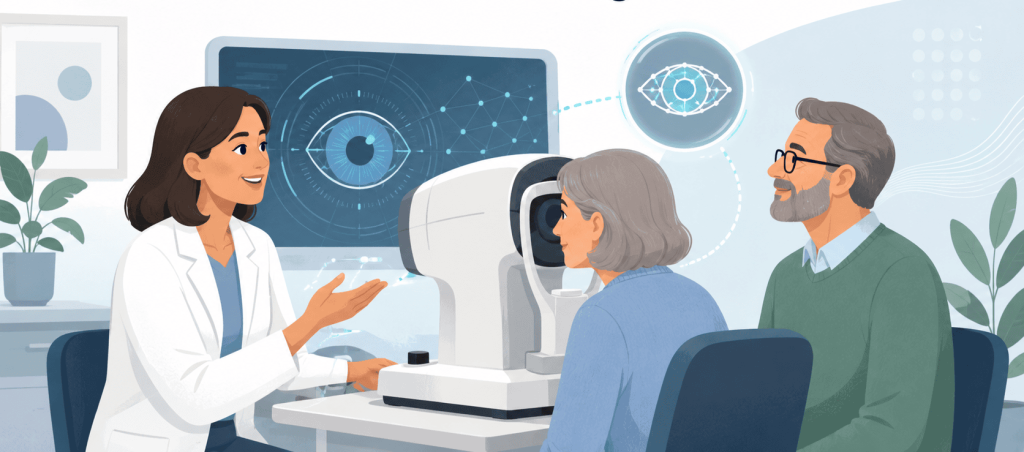
Marketing an AI-assisted eye exam works best when patients understand what the technology does, why it is being used, and where their eye doctor remains involved. Effective AI eye exam marketing should focus less on the novelty of artificial intelligence and more on the patient experience: clearer information, appropriate screening support, clinician involvement, and an easy path to the next step.
That means avoiding vague promises such as “revolutionary AI eye care.” Instead, tell patients which part of the exam uses AI, what information the system evaluates, who reviews the findings, and what happens afterward. Clear expectations make advanced technology feel useful rather than intimidating.
What Should Patients Understand About an AI-Assisted Eye Exam Before They Book?
Patients first need to know that “AI-assisted eye exam” can describe different workflows. In some settings, AI may help analyze retinal images or support clinical decision-making. In others, an authorized autonomous system may produce a screening result without a clinician interpreting that particular image. The FDA, for example, has authorized autonomous systems for diabetic retinopathy screening.
So, be specific. If AI analyzes one component of an otherwise clinician-led exam, say that. If the technology provides an autonomous screening result for an authorized use, explain what the result means and when the patient may need referral or additional evaluation.
Patients should leave your marketing with three simple answers: What does the technology do? What does the eye care professional do? What should I expect during my appointment?
That clarity is more valuable than making the technology sound futuristic.
Which Patient Concerns Should Your Marketing Answer First?
Start with the questions that can create hesitation.
“Is my optometrist still involved?” Explain the clinician’s actual role. If the doctor reviews results, combines them with other exam findings, discusses recommendations, or determines further care, make that clear.
“Is AI diagnosing me?” Avoid a universal yes or no. Ophthalmic AI includes both assistive and autonomous applications, and the American Academy of Ophthalmology recognizes that these technologies need to be evaluated according to their intended clinical use.
“Why are you using AI?” Give patients a practical reason. Describe the specific function or benefit supported by the technology rather than claiming that AI automatically makes an exam “better.”
“What happens to my information?” Privacy answers must reflect the practice’s real systems and vendors. HHS states that a third-party AI vendor handling protected health information on behalf of a covered provider can qualify as a business associate, which brings contractual and safeguarding obligations.
One more concern matters: “Will my appointment feel different?” A brief explanation of what the patient will see, do, and experience can remove uncertainty before they arrive.
How Should AI Eye Exam Marketing Explain Benefits Without Overpromising?
Start with the patient benefit, then explain the technology behind it.
There is a major difference between saying, “Our revolutionary AI catches eye disease with unmatched accuracy” and saying, “Our practice uses AI-assisted retinal analysis as part of this screening process. Your care team will explain your results and whether additional evaluation is recommended.”
The second version gives the patient useful information without turning a technical tool into a guarantee.
That distinction also matters from an advertising perspective. The Federal Trade Commission says health-related advertising claims require appropriate substantiation. Claims about accuracy, disease detection, superior results, or guaranteed outcomes therefore should not appear simply because they sound persuasive. They need evidence that supports the specific claim being made.
Use clinician oversight as a trust signal when it accurately reflects the workflow. Recent research on patient-facing AI in eye care found promise for AI-supported education and communication but also identified the continuing need for supervision, safety monitoring, readability controls, and patient-centered validation.
Specific beats spectacular.
How Should the Message Change Across Ads, Landing Pages, Social Media, and Video?
Patients encounter your message in different contexts, so each channel has a different job.
Google Ads
Search ads should communicate one understandable benefit and give patients a logical next step. A headline might introduce AI-assisted retinal screening, while the supporting copy emphasizes the exam experience or clinician involvement.
Do not try to explain the entire technology in a few lines. The ad earns the click. The landing page earns understanding and confidence.
Healthcare advertisers should also review current platform targeting rules. Google classifies health as a sensitive interest category and restricts certain personalized advertising methods involving sensitive health information.
A specialized Google Ads strategy for eye care practices can help connect high-intent searches with landing pages built around the same patient message.
Landing Pages
This is where the full explanation belongs. Tell visitors what AI assists with, what the clinician does, what happens during the visit, and what the results may lead to. Add concise FAQs and one prominent appointment action.
Strong eye care website design also helps keep that information easy to navigate on mobile devices instead of burying the explanation inside dense technical copy.
Social Media
Social posts can make unfamiliar technology feel familiar. Try short clinician videos, “what to expect” posts, equipment demonstrations, or simple myth-versus-fact content.
A coordinated social media marketing strategy for eye care can reinforce the same explanation patients encounter on your website.
Video
Video is especially useful when the process is easier to show than describe. Let patients see the equipment, the exam setting, and the clinician who remains part of their care.
For paid campaigns, video advertising for eye care practices can turn that educational content into broader patient awareness.
What Should Your Staff Say When Patients Ask About the AI?
The message should not change when a patient goes from the website to the front desk.
Give staff a short, approved explanation of the technology. For example: “We use AI to assist with analysis of this part of your screening. Your eye care team will explain the findings and let you know whether anything else is recommended.”
Then define the boundary. Front-desk staff should know when a question becomes clinical and needs to be handed to an optometrist or another qualified member of the care team.
Track the questions patients repeatedly ask, too. If three people in a week ask whether AI replaces the doctor, that is not just a staff-training issue. It may indicate that your website or advertising is creating uncertainty.
Those questions can become new FAQs, service-page improvements, social content, and SEO content for your eye care practice.
How Can You Tell Whether Your AI Messaging Is Building Trust and Bookings?
Measure what happens after people see the message.
For AI eye exam marketing, useful indicators include landing-page conversion rate, appointment requests, completed bookings, cost per booked appointment, calls containing AI-related questions, and FAQ engagement. Front-desk feedback matters as well. If patients repeatedly arrive with the wrong expectations, the campaign may be generating clicks without generating understanding.
Test the messaging itself. One version might lead with the technology, while another leads with the patient benefit and introduces AI afterward. Compare conversion quality, not just click-through rate.
The goal is not to prove that people find AI exciting. It is to determine whether the message helps the right patients understand the service and confidently schedule care.
FAQ
Is an AI-assisted eye exam the same as an eye exam performed entirely by AI?
Not necessarily. “AI-assisted” can refer to many workflows. AI may analyze a particular image or measurement while the optometrist manages the broader examination, or an authorized autonomous system may perform a defined screening function. Marketing should describe the specific technology being used rather than treating all AI eye care as identical.
Can AI replace an optometrist during an eye exam?
That depends on the task, but AI should not be presented as a blanket replacement for comprehensive professional eye care. Certain systems have authorization for autonomous screening in defined situations, while many other tools support clinicians rather than replace them. Patients need to know which model applies to the service being promoted.
Should an optometry practice use the word “AI” in its advertising?
Yes, when it helps patients accurately understand the service. The term should explain something meaningful, not function as a buzzword. Pair “AI” with a plain-language description of what the technology actually does.
What should an AI-assisted eye exam landing page include?
Include the patient benefit, the AI system’s role, clinician involvement, what happens during the appointment, appropriate privacy information, frequently asked questions, and a clear appointment CTA.
What is the biggest mistake practices make when promoting AI-assisted exams?
Overstating the technology. Copy that sounds autonomous, infallible, or clinically superior without appropriate evidence can create confusion and potentially raise advertising concerns. Specific, substantiated explanations are safer and more credible.
Keep the Technology Clear and the Patient at the Center
Patients do not need a lesson in machine learning before booking an eye exam. They need to understand what the technology means for their appointment.
Review your ads, service pages, videos, social posts, and front-desk explanations from that perspective. Wherever the language makes AI sound more complicated, independent, or miraculous than the real experience, simplify it. Better understanding can create a much stronger path from initial curiosity to a confident appointment request.
Why Visiclix Is Your Ideal Choice for AI Eye Exam Marketing?
Visiclix specializes in digital marketing for optometry and ophthalmology practices, with services spanning SEO, Google Ads, website design, social media, and video advertising. That eye-care focus matters when a campaign needs to balance new technology with patient-friendly communication. Instead of treating an AI-assisted service as a generic technology product, the strategy can remain centered on how eye-care patients actually search, evaluate, and choose a practice.
Visiclix can also connect the pieces of the campaign so patients receive a consistent explanation from search result to landing page to appointment request. Clear messaging can be paired with conversion-focused pages, targeted advertising, educational content, and measurable campaign performance. The result is a marketing strategy designed to create interest without sacrificing understanding.
Make Your AI-Assisted Eye Exam Campaign Clearer With Visiclix
AI can help differentiate an eye care practice, but only when patients understand why it matters. Contact Visiclix to discuss a patient-focused digital marketing strategy that connects clearer messaging with search visibility, advertising, website performance, and appointment growth.