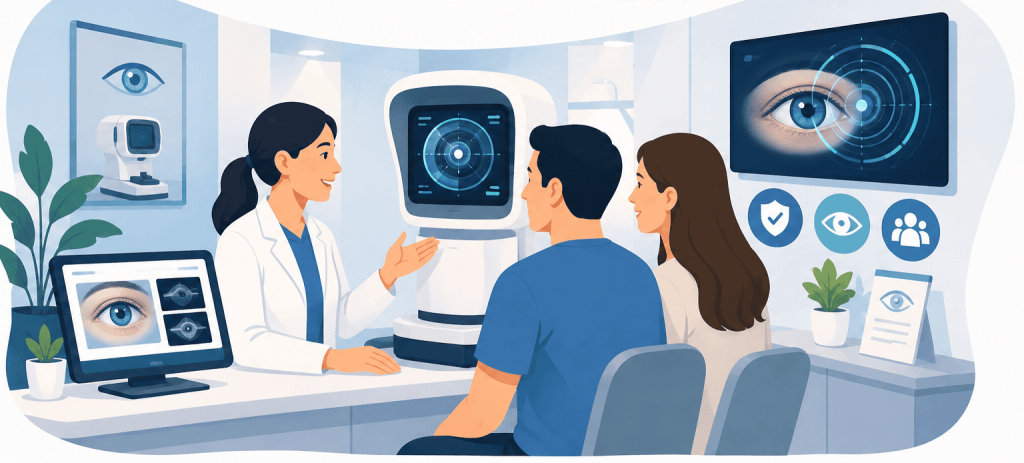
Eye care practices can market new technology successfully by focusing less on the equipment itself and more on what it means for patients. That means explaining the technology in clear language, creating useful website content, reaching people through search and paid advertising, preparing staff to answer questions, and tracking whether interest turns into appointments.
Effective eye care technology marketing should make unfamiliar technology feel understandable and relevant. Patients may not recognize a device name or know why a new diagnostic tool matters. They are more likely to care about whether it can make an exam more informative, improve convenience, support more personalized care, or help their doctor evaluate an eye condition. The marketing should make that connection without exaggerating what the technology can do.
What Should a Practice Clarify Before Promoting New Eye Care Technology?
Before promoting new technology, a practice should understand exactly who it is for, what patient need it addresses, and what should happen when someone responds to the campaign.
Start with the patient rather than the equipment. Which services will use the technology? Which patients are most likely to benefit? What questions will they have? Just as importantly, make sure the practice is operationally ready. Staff should understand how to explain the service, schedule interested patients, and route questions appropriately.
This is especially important when introducing a new specialty service. A clear specialty eye care marketing strategy can help separate the service’s message and patient journey without making the broader practice brand feel fragmented.
Health-related claims also deserve care. The Federal Trade Commission says health claims should have appropriate substantiation, so practices should avoid turning a legitimate technological capability into an unsupported promise about outcomes.
How Can Practices Turn Complex Technology Into Patient-Friendly Benefits?
Practices can make technology easier to understand by translating features into meaningful patient benefits.
Think in three steps: feature, benefit, patient meaning. Instead of simply saying that the practice has high-resolution imaging, explain what the imaging allows the doctor to see or monitor. Instead of leading with artificial intelligence terminology, explain how the technology may assist the doctor when reviewing information. For remote-care tools, focus on appropriate convenience and access rather than the software behind them.
The wording matters. Avoid making the device sound like it replaces the doctor’s judgment or guarantees an outcome. Emerging technologies in optometry can support areas such as imaging, remote care, documentation, monitoring, and practice efficiency, but professional oversight and responsible implementation remain important.
Which Digital Channels Work Best for Promoting New Eye Care Technology?
The strongest strategy uses several digital channels together, with the practice website serving as the main place where patients can learn more and decide what to do next.
Website and Landing Pages
Give important technologies or related services a clear destination page. Explain who the service may help, what the technology does, what patients can expect, and how to request an appointment.
The page should also match the promise made in the advertisement. Google recommends close alignment between ads, keywords, landing-page content, and calls to action. Visiclix’s guide to eye care landing page copywriting provides additional ways to make these pages clearer and more conversion-focused.
SEO and Educational Content
Patients may search for a symptom, condition, exam, or treatment without knowing that a particular technology exists. Educational content can meet them earlier in that journey.
Google encourages helpful, reliable, people-first content rather than pages created mainly to manipulate search rankings. A thoughtful SEO strategy for eye care practices can connect technology-related services with the questions patients are actually asking.
PPC Search Campaigns
Paid search is useful when the technology supports a service that already has clear search demand. A practice can reach patients searching for relevant exams, treatments, conditions, or consultations rather than waiting for them to discover the equipment name.
Learn more about Google PPC advertising for optometrists and ophthalmologists and how paid search can support high-intent patient acquisition.
Social Media and Video
Social and video content can introduce technology before patients actively search for it. A short provider video, equipment demonstration, or patient FAQ can make an unfamiliar service feel far less intimidating.
Practices can support that education with social media marketing and video-focused digital campaigns that keep the message visual, simple, and approachable.
How Should PPC Campaigns Promote New Eye Care Technology?
PPC campaigns should usually begin with the patient’s need, not the name printed on the machine.
For eye care technology marketing, this means organizing keywords and ads around the conditions, services, questions, or outcomes patients are already searching for. Device and manufacturer terms can still be useful when there is meaningful search demand, but they should not be the entire strategy.
Keep each ad closely connected to its landing page. If an ad promotes a particular exam or consultation, the click should lead to a page explaining that exact service and providing an obvious next step. Google specifically recommends matching landing pages to ad text and keyword themes.
Remarketing can also support longer decision journeys, but healthcare advertisers need to pay close attention to platform rules. Google’s personalized advertising policies restrict targeting based on sensitive health conditions. For broader context, see Visiclix’s guide to retargeting ads for eye care.
How Can Practices Build Trust Around Technology Patients Do Not Understand Yet?
Practices can build trust by educating first and selling second.
Let doctors and clinical staff explain what the technology does in language patients already understand. Add FAQs to service pages. Show what an appointment may involve. Use authentic photos or videos when appropriate, and be transparent about who may or may not be a good candidate.
Patient stories can be helpful too, but they should never be used to imply results the practice cannot support. The FTC notes that testimonials alone are not enough to substantiate objective health or safety claims.
Privacy matters as well. For covered entities, HIPAA places limits on using or disclosing protected health information for marketing and generally requires authorization in situations defined as marketing under the Privacy Rule.
The experience after the click should reinforce the same sense of care. Visiclix explores this further in its guide to aligning patient experience and eyecare marketing goals.
How Should an Eye Care Practice Measure Technology Marketing ROI?
Practices should measure whether marketing produces meaningful patient actions, not just visibility.
Start with qualified phone calls, appointment requests, completed forms, landing-page conversion rates, scheduled consultations, and kept appointments. Where appropriate, connect those results with acquisition cost and revenue from the promoted service.
Google Ads allows advertisers to define valuable conversion actions such as website actions and phone calls, then evaluate performance at the campaign, ad group, ad, and keyword levels.
That distinction matters. A campaign may produce plenty of clicks while generating few appropriate appointments. If so, the issue may be the targeting, message, landing page, booking experience, or even the way the service is being explained.
Search or Ad → Service Page → Qualified Inquiry → Appointment → Patient Revenue
What Questions Do Eye Care Practices Have About Marketing New Technology?
Should an eye care practice advertise the technology’s brand name?
Yes, when patients actually recognize or search for the brand. Otherwise, lead with the condition, service, or patient need and use the technology name as supporting information.
How soon should a practice start marketing newly installed technology?
Start once the practice can confidently deliver the experience being promoted. Staff training, scheduling, website content, tracking, and patient FAQs should ideally be ready before significant advertising spend begins.
Can a smaller eye care practice market advanced technology effectively?
Yes. A smaller practice does not need to compete everywhere at once. Focused geographic targeting, useful service pages, local search visibility, and carefully selected paid-search campaigns can concentrate resources on the patients most likely to need the service.
Should marketing focus on the device or what it does for patients?
Focus primarily on patient relevance. Technical specifications can add credibility, but they rarely answer the patient’s first question: “Why should this matter to me?”
How often should technology marketing campaigns be reviewed?
Review them regularly enough to identify wasted search terms, weak landing pages, low-quality inquiries, missed calls, booking problems, or changing patient questions. Optimization should continue after launch rather than treating the first campaign as finished.
What Should Your Practice Do After Launching the Campaign?
Keep listening.
The questions patients ask by phone, through forms, during appointments, and on social media can reveal what your marketing still needs to explain. Search terms and conversion data can also show whether you are reaching the right audience or attracting people who expected something different.
New technology may strengthen a practice’s services, but the equipment cannot explain its own value. Clear communication can. Keep refining the message until patients understand not simply that your practice has new technology, but why it may be relevant to their care.
Why Visiclix Is Your Ideal Choice for Eye Care Technology Marketing?
Visiclix focuses specifically on marketing for optometrists, ophthalmologists, and eye care organizations. That specialization helps the team understand that promoting an eye care service requires more than generating traffic. Patients need clear information, trustworthy messaging, and a simple path from initial interest to contacting the practice.
Visiclix brings together digital marketing services for eye care including SEO, paid search, website strategy, social media, display advertising, and video. Campaigns can be built around the service the technology supports, the patients the practice wants to reach, and the actions that matter after a click. A more connected approach. One designed to help a technology investment contribute to measurable practice growth.
Turn Your Technology Investment Into Patient Growth With Visiclix
Your new technology deserves more than an announcement on your website. Visiclix can help turn it into a focused, patient-friendly marketing strategy built around visibility, trust, qualified inquiries, and appointments.
Connect with Visiclix to discuss how your practice can introduce new technology to the patients who may benefit from it.