Specialty services can be some of the strongest growth drivers in an eye care practice, but they can also create brand confusion when they are promoted without a clear strategy. Patients may see ads for dry eye, myopia management, specialty contact lenses, cataract care, LASIK, diabetic eye exams, or vision therapy and wonder whether the practice still provides routine eye care, family eye exams, or general medical eye care.
That is where specialty eye care marketing needs to be handled differently from general practice promotion. The goal is not simply to advertise more services. The goal is to organize your specialties under a clear, trusted practice brand so patients understand both your advanced capabilities and your broader care promise.
Eye care practices are uniquely complex because many operate across routine exams, medical eye care, optical retail, contact lenses, surgical co-management, and condition-specific care. For example, diabetic eye care requires clinical trust and urgency because diabetes increases the risk of retinopathy, glaucoma, and cataracts, and the CDC emphasizes yearly dilated eye exams for people with diabetes. Myopia management requires a different educational approach because parents may be trying to understand why their child’s nearsightedness is progressing and what can be done to slow it.
Effective specialty marketing brings these needs into focus without making the practice feel scattered. It helps patients find the right service, understand the value of specialty care, and take the next step while still reinforcing the practice’s core identity.
What Is Specialty Eye Care Marketing?
Specialty eye care marketing is the strategy of promoting advanced, condition-specific, or service-specific eye care offerings to patients who are actively searching for help with a particular problem. These services may include dry eye treatment, myopia management, specialty contact lenses, scleral lenses, keratoconus care, diabetic eye exams, glaucoma care, cataract consultations, LASIK evaluations, pediatric eye care, retina services, low vision care, or vision therapy.
This is different from general eye care marketing. General marketing usually promotes the practice as a whole: annual eye exams, glasses, contact lenses, family care, convenience, insurance acceptance, and provider trust. Specialty marketing focuses on a more specific patient need, symptom, diagnosis, or treatment path.
A dry eye patient may search for burning, gritty, watery, or irritated eyes. The National Eye Institute defines dry eye as a condition that happens when the eyes do not make enough tears to stay wet, and its symptoms and treatments differ from a routine vision complaint. A parent researching myopia control may be less interested in “eye exams near me” and more interested in whether their child’s prescription can be managed over time. A keratoconus patient may be looking for a provider who fits scleral lenses, not a general optical shop.
The most important point is that specialty marketing should not replace the core brand. It should act as a focused extension of the practice’s larger promise. If your brand stands for comprehensive, modern, patient-centered eye care, each specialty campaign should show how that promise applies to a specific condition or patient group.
Why Can Marketing Specialty Eye Care Services Dilute Your Brand?
Marketing specialty eye care services can dilute your brand when patients can no longer quickly understand what your practice does, who it serves, or why they should trust it. Brand dilution usually happens when service-line campaigns are launched one at a time without a shared positioning system.
This often shows up as disconnected landing pages, inconsistent visual design, different tones across ads and web pages, separate microsites that feel unrelated to the main practice, or homepage messaging that promotes too many services at once. A patient who sees one ad for dry eye, another for LASIK, another for pediatric care, and another for designer eyewear may not understand the relationship between those services unless the practice brand provides a clear umbrella.
The risk is especially high in eye care because different service lines carry different expectations. A routine exam patient may want convenience, insurance clarity, and a friendly experience. A medical eye care patient may want clinical expertise, technology, and reassurance. A specialty contact lens patient may want proof that the provider handles complex fittings. A cataract or LASIK patient may want confidence, safety, and a clear explanation of candidacy.
Brand architecture helps solve this problem. Harvard Business School Online describes brand architecture as a way to organize brand relationships, customer touchpoints, differentiators, and communication so growth does not weaken the core mission. For an eye care practice, that means your main brand should remain the trusted center, while specialties function as organized service lines beneath it.
The goal is not to market fewer services. The goal is to make every specialty easier to understand.
How Do You Choose Which Specialty Services to Market First?
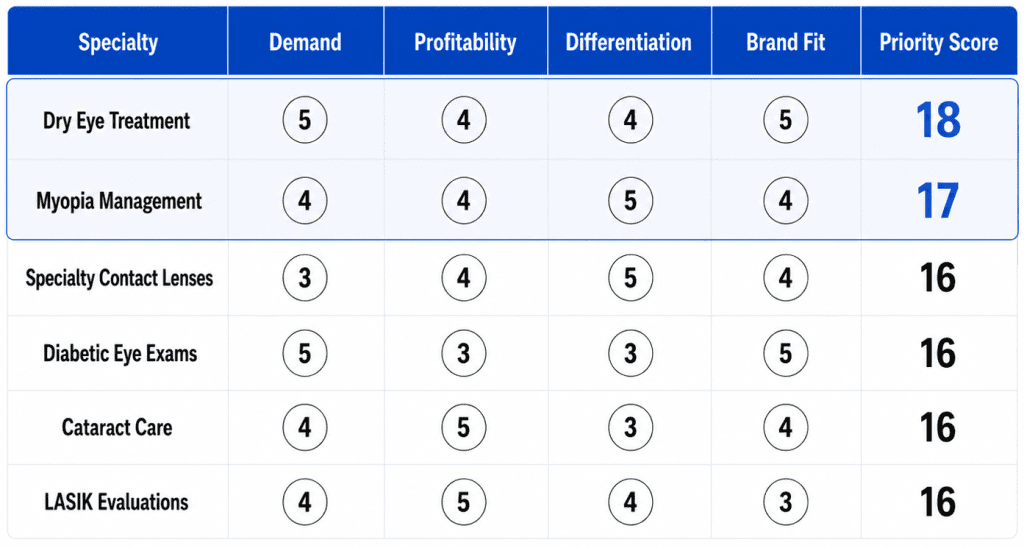
You should choose which specialty services to market first by evaluating demand, profitability, clinical capacity, local competition, provider expertise, and brand fit. Not every specialty should receive equal marketing investment at the same time.
A practical prioritization process starts with patient demand. Look at what patients are already asking about, which symptoms appear frequently in phone calls, which services providers mention during exams, and which search terms show local activity. For example, dry eye, myopia management, diabetic eye exams, and specialty contacts often align with highly specific patient concerns. Dry eye patients may be searching because symptoms interfere with daily comfort, while diabetic eye exam patients may need annual monitoring because diabetic retinopathy can cause vision loss and may not show early symptoms.
Next, evaluate operational readiness. A service may have strong market demand, but if the practice does not have trained staff, clear scheduling workflows, appropriate technology, provider availability, or a defined consultation process, marketing can create frustration instead of growth. Specialty campaigns should only be scaled when the practice can deliver a consistent patient experience.
Then consider differentiation. If several nearby practices advertise the same service, your messaging needs to explain why your approach is different. That difference may come from diagnostic technology, provider training, treatment options, continuity of care, pediatric experience, optical integration, or a more personalized consultation process.
A simple scoring framework can help:
| Specialty Growth Factor | What to Evaluate |
| Patient demand | Search volume, patient questions, referral patterns, local awareness |
| Revenue potential | Consultation value, treatment value, lifetime patient value |
| Clinical readiness | Provider availability, equipment, protocols, staff training |
| Competitive position | Nearby competitors, messaging gaps, service differentiation |
| Brand fit | Whether the specialty supports your long-term practice identity |
A practice with strong dry eye technology and staff training may prioritize dry eye before launching a broader medical eye care campaign. A family-focused practice may prioritize myopia management because the audience already overlaps with pediatric care. A medically oriented practice may start with diabetic eye exams, glaucoma monitoring, or cataract evaluations because those services reinforce its clinical position.
How Should Your Core Brand and Specialty Messages Work Together?
Your core brand should define the practice’s overall promise, while specialty messages should explain specific ways that promise is delivered. The brand should answer, “Why should patients trust us?” Specialty campaigns should answer, “How can we help with this specific problem?”
A clear structure might look like this:
| Brand Layer | Role |
| Core brand | The practice identity, promise, tone, reputation, and patient experience |
| Service categories | Routine eye care, medical eye care, surgical care, specialty vision services, optical |
| Specialty campaigns | Dry eye, myopia management, scleral lenses, diabetic eye exams, cataracts, LASIK, vision therapy |
This structure prevents every specialty from competing for attention as if it were a separate business. Instead, each service becomes part of a coherent care ecosystem.
For example, a strong core brand message might be: “Comprehensive eye care with advanced solutions for complex vision needs.” That message leaves room for routine exams, dry eye, specialty contacts, pediatric care, and medical eye care without forcing the practice into one narrow category.
Specialty messages should then become more specific. A dry eye campaign might focus on lasting relief, diagnostics, and treatment options. A myopia campaign might focus on helping parents understand progression and management. A diabetic eye care page might focus on annual exams, early detection, and coordination with broader diabetes care.
The key is consistency. The tone, visual identity, trust signals, provider presentation, appointment process, and calls to action should feel connected across every specialty. If a patient lands on a specialty page after clicking an ad, they should immediately recognize that the page belongs to the same practice they saw on Google, Maps, the homepage, or a referral card.
How Do You Build Specialty Service Pages That Attract High-Intent Patients?
You build specialty service pages that attract high-intent patients by focusing each page on one specific patient need, then connecting symptoms, education, treatment options, provider expertise, and the next step. A dedicated specialty page should not read like a generic service list.
A strong specialty page usually includes:
| Page Element | Purpose |
| Clear page title | Confirms the service or condition immediately |
| Patient problem | Reflects symptoms, concerns, or motivations |
| Plain-language explanation | Helps patients understand the condition or service |
| Treatment approach | Explains what the practice offers and what to expect |
| Trust signals | Shows provider expertise, technology, experience, and reviews |
| FAQ | Answers common objections and appointment questions |
| CTA | Guides the patient to book, call, request a consultation, or schedule screening |
This structure works because specialty patients often arrive with more specific intent than general eye care patients. Someone searching for scleral lenses, dry eye treatment, myopia control, or cataract consultation is usually trying to solve a defined problem. Sending that person to a homepage forces them to search again inside your site.
Google’s SEO Starter Guide emphasizes creating sites that help users find and explore content easily, while Google’s guidance on sitelinks recommends concise, relevant internal anchor text that helps users navigate to the right page. For specialty eye care, this means your service pages should be easy to find from the homepage, service category pages, provider bios, blog posts, and Google Business Profile where appropriate.
Each specialty page should also link back to the larger practice ecosystem. A dry eye page might link to medical eye care, contact lens exams, and relevant blog content. A myopia page might link to pediatric eye care and parent FAQs. A diabetic eye exam page might link to comprehensive eye exams and medical eye care. These links help patients understand that the specialty is part of a complete practice, not a disconnected offering.
How Should PPC Campaigns Be Structured for Specialty Eye Care Marketing?
PPC campaigns for specialty eye care marketing should be structured by specialty, intent level, and conversion action rather than grouped into one general eye care campaign. Each specialty deserves its own keyword themes, ad copy, landing page, budget logic, and conversion tracking.
For example:
| Campaign | Keyword Intent | Landing Page |
| Dry eye | Symptoms, treatment, evaluation | Dry eye treatment page |
| Myopia management | Child nearsightedness, myopia control | Myopia management page |
| Specialty contacts | Scleral lenses, keratoconus contacts | Specialty contact lens page |
| Diabetic eye exams | Diabetic eye exam, diabetes vision test | Diabetic eye care page |
| Cataract care | Cataract consultation, blurry vision cataracts | Cataract evaluation page |
| LASIK | LASIK consultation, LASIK candidacy | LASIK evaluation page |
This structure improves message match. A parent researching myopia control should not see the same ad as an adult looking for dry eye relief. A diabetic patient should not land on a general optical page after searching for an annual diabetic eye exam.
Google Ads identifies ad relevance, expected click-through rate, and landing page experience as key Quality Score diagnostic components, and landing page experience is based on how relevant and useful the page is to the person searching. Google also notes that lead journeys can involve multiple online touchpoints before a person fills out a lead form, which makes consistency across ads, landing pages, reviews, and follow-up especially important.
Conversion tracking should go beyond form fills. Specialty campaigns often generate phone calls, online booking clicks, map direction clicks, chat inquiries, and consultation requests. Google Ads supports website conversion measurement and phone call conversion tracking, which can help practices understand which campaigns are producing valuable actions.
The most important PPC metric is not raw click volume. It is qualified appointment growth. A campaign with fewer clicks and more appropriate patients is usually more valuable than a campaign that produces cheap traffic but few booked visits.
How Can Content Marketing Educate Specialty Patients Without Overwhelming General Patients?
Content marketing can educate specialty patients without overwhelming general patients by organizing content around patient questions, symptoms, and service categories. The blog should not become a random collection of clinical topics. It should support the specialty service pages that matter most.
A useful content model is the topic cluster. The specialty service page acts as the conversion page, while supporting blog posts answer related questions.
For example, a dry eye cluster could include:
| Core Page | Supporting Blog Topics |
| Dry eye treatment | What causes dry eye? Why are my eyes watery but dry? When should I see an eye doctor for dry eye? What are dry eye treatment options? |
A myopia management cluster could include:
| Core Page | Supporting Blog Topics |
| Myopia management | Why is my child’s prescription getting worse? Can myopia progression be slowed? What are myopia control options? When should children be checked for nearsightedness? |
A specialty contact lens cluster could include:
| Core Page | Supporting Blog Topics |
| Specialty contact lenses | What are scleral lenses? Can contacts help keratoconus? Why are regular contacts uncomfortable? What happens during a specialty lens fitting? |
Google’s people-first content guidance recommends creating helpful, reliable content for users rather than content created primarily to manipulate rankings. This is especially important in health-related content because patients need clarity, reassurance, and accurate expectations before they take action.
The best specialty content starts with a direct answer, then expands. A patient should not have to read 800 words before understanding whether their symptoms may be related to dry eye or whether their child may be a candidate for myopia management. The content should explain the issue plainly, identify when professional care is appropriate, and guide the reader to the relevant specialty service page.
Content should also avoid clinical overload. Specialty patients are often anxious, confused, or comparing options. They need enough information to feel informed, not so much terminology that they delay scheduling.
How Do Reviews, Referrals, and Provider Authority Support Specialty Growth?
Reviews, referrals, and provider authority support specialty growth by giving patients evidence that the practice can handle their specific concern. Specialty care often involves higher anxiety, greater cost, longer treatment timelines, or more complex decision-making than routine care.
Reviews help patients understand the experience from another patient’s perspective. However, review generation must be handled carefully. Google states that reviews should reflect genuine experiences and that offering incentives in exchange for reviews is considered fake and misleading content. Practices should ask for honest feedback in a compliant, neutral way and avoid coaching patients to make specific claims.
Referrals are also important. Depending on the specialty, referral sources may include primary care physicians, pediatricians, occupational therapists, schools, diabetes educators, local optometrists, ophthalmologists, or surgical partners. A myopia management program may benefit from parent education and pediatric referral relationships. A diabetic eye care program may benefit from communication with primary care and endocrinology networks. A specialty contact lens program may benefit from referrals from providers who do not fit complex lenses.
Provider authority strengthens the message. Specialty pages and campaigns should highlight relevant training, certifications, technology, clinical focus, continuing education, speaking experience, publications, or years of experience when accurate and appropriate. Patients considering advanced care want to know who will treat them and why that provider is qualified.
Compliance matters throughout this process. HHS explains that the HIPAA Privacy Rule addresses how protected health information may be used or disclosed for marketing and generally requires authorization for marketing uses with limited exceptions. Google Ads also maintains healthcare and medicines advertising policies that healthcare advertisers must follow. Specialty eye care marketing should be persuasive, but it should not overpromise outcomes, misuse patient information, or make unsupported claims.
How Can You Promote Multiple Specialties Without Making Your Website Feel Confusing?
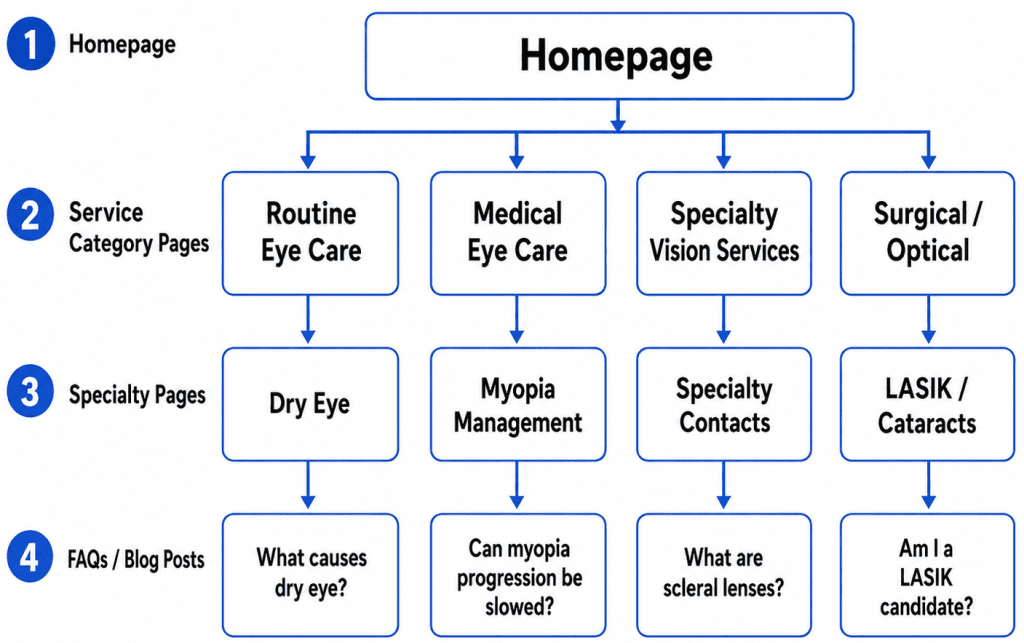
You can promote multiple specialties without making your website confusing by using clear navigation, logical service grouping, consistent naming, and selective homepage promotion. The homepage should communicate the practice brand first, then guide patients into the right service path.
A clean service structure might look like this:
| Main Category | Example Specialty Pages |
| Routine Eye Care | Comprehensive eye exams, contact lens exams, family eye care |
| Medical Eye Care | Dry eye, glaucoma, diabetic eye exams, eye infections |
| Specialty Vision Services | Myopia management, vision therapy, low vision, specialty contacts |
| Surgical Eye Care | Cataract consultations, LASIK evaluations, co-management |
| Optical | Eyeglasses, designer frames, contact lenses, lens technology |
This hierarchy helps patients self-select. A general patient can still find routine care. A specialty patient can move quickly into the relevant service. A referring provider can see the scope of care without digging through unrelated pages.
Google Business Profile can also support this structure. Google allows businesses to manage services on their profile and group different services under appropriate categories when that option is available. For an eye care practice, this can reinforce services such as eye exams, contact lenses, dry eye care, pediatric eye care, or other offerings supported by the practice.
The homepage should not try to promote every specialty equally. A stronger approach is to feature the practice’s core message, then highlight two to four priority specialties based on strategy. Additional specialties can live in service pages, navigation, PPC landing pages, blog clusters, and internal links.
What Metrics Show Whether Specialty Eye Care Marketing Is Working?
The best metrics for specialty eye care marketing are qualified inquiries, booked appointments, service-line revenue, and patient quality—not traffic alone. A campaign can generate many clicks and still fail if those clicks do not become appropriate patients.
Useful metrics include:
| Metric | Why It Matters |
| Organic rankings by specialty | Shows whether service pages and content are gaining visibility |
| PPC conversion rate by specialty | Reveals which campaigns are converting traffic into action |
| Cost per qualified lead | Helps compare campaign efficiency across services |
| Call quality | Shows whether inquiries match the intended specialty |
| Booked appointment rate | Measures front-desk and scheduling effectiveness |
| Service-line revenue | Connects marketing to actual business growth |
| No-show rate | Helps identify poor lead quality or weak follow-up |
| Review growth and sentiment | Shows whether patient experience supports marketing |
| Landing page engagement | Helps diagnose message clarity and conversion friction |
Conversion tracking is essential because many specialty patients call rather than fill out a form. Google Ads offers phone call conversion tracking for calls from ads and websites, helping advertisers understand how ads lead to phone inquiries.
Front-desk tracking is just as important as platform tracking. Staff should know which campaigns are active, what each specialty consultation involves, which questions patients are likely to ask, and how to route specialty inquiries. Without this operational connection, marketing may appear underperforming when the real issue is intake, scheduling, or follow-up.
Practices should review performance by specialty rather than only at the account level. Dry eye, myopia management, LASIK, cataracts, specialty contacts, and diabetic eye exams may have different conversion rates, timelines, lead values, and patient readiness levels. Each campaign should be judged against its own business goal.
What Are the Most Common Specialty Eye Care Marketing Mistakes?
The most common specialty eye care marketing mistakes happen when practices treat specialty growth as a campaign problem instead of a positioning, website, tracking, and patient experience problem.
One major mistake is marketing every specialty at once. This spreads budget too thin and creates scattered messaging. It is better to prioritize a few high-fit services, build strong pages and campaigns, and expand once the practice has a repeatable system.
Another mistake is sending all specialty ads to the homepage. A homepage usually cannot answer the specific questions behind a high-intent search. Someone searching for dry eye treatment, scleral lenses, or diabetic eye exams needs a focused page that confirms relevance immediately.
A third mistake is using too much clinical jargon. Patients may not search for “meibomian gland dysfunction,” “axial elongation,” or “irregular corneal astigmatism” first. They may search based on symptoms, concerns, or plain-language terms. Clinical accuracy matters, but the first layer of messaging should meet patients where they are.
Practices also often overlook staff training. If a myopia campaign is running, the front desk should understand that parents may ask about treatment options, age ranges, insurance, follow-up visits, and consultation expectations. If a dry eye campaign is running, staff should know how the evaluation is scheduled and what symptoms qualify.
Other common mistakes include disconnected landing pages, weak calls to action, unsupported claims, poor review practices, lack of call tracking, thin blog content, outdated Google Business Profile services, and inconsistent brand visuals. Each one makes specialty marketing less trustworthy and harder to measure.
When Should an Eye Care Practice Work With a Specialty Marketing Partner?
An eye care practice should work with a specialty marketing partner when specialty growth requires more strategy, tracking, content depth, PPC discipline, or brand structure than the internal team can realistically manage. Specialty marketing is not just about launching ads. It requires alignment between positioning, website architecture, content, paid search, local presence, conversion tracking, and patient intake.
A partner may be useful when specialty services are clinically strong but underbooked. This often means the practice has the expertise but lacks the messaging, visibility, or conversion system needed to turn patient demand into appointments.
A partner may also be useful when PPC campaigns generate clicks but few qualified patients. In that case, the issue may be keyword intent, ad copy, landing page relevance, conversion tracking, call handling, or service positioning. Google Ads can measure conversions and optimize toward business goals, but the campaign still needs the right structure and data inputs.
Practices with multiple specialties often need outside support because complexity compounds quickly. A single-service campaign is manageable. A full specialty growth strategy across dry eye, myopia, specialty contacts, cataracts, LASIK, and medical eye care requires a hierarchy that protects the core brand while giving each service enough depth to compete.
The right partner should understand both healthcare trust and performance marketing. For specialty eye care, that means balancing patient education, clinical credibility, local SEO, PPC efficiency, landing page quality, review strategy, compliance awareness, and measurable ROI.
FAQ
What is the best way to market specialty eye care services?
The best way to market specialty eye care services is to build dedicated service pages, create patient-focused educational content, run tightly segmented PPC campaigns, collect compliant reviews, and connect each specialty back to the practice’s core brand. This approach helps patients find the exact service they need without making the practice feel fragmented.
Does every specialty eye care service need its own landing page?
Every priority specialty should have its own dedicated page. A dry eye patient, myopia parent, diabetic patient, LASIK candidate, and specialty contact lens patient all have different questions and motivations. Dedicated pages allow your messaging, SEO, PPC, FAQs, and calls to action to match the patient’s intent.
How can PPC help promote specialty eye care services?
PPC can help specialty eye care services by capturing high-intent searches from patients who are actively looking for treatment, consultations, or evaluations. The strongest PPC campaigns are separated by service line and send users to relevant landing pages rather than a general homepage.
Can specialty marketing confuse existing patients?
Specialty marketing can confuse existing patients if the messaging makes the practice appear focused on only one service or if specialty pages feel disconnected from the main brand. A clear service hierarchy prevents this by showing that specialty care is part of a broader eye care experience.
How often should specialty eye care content be updated?
Specialty eye care content should be reviewed at least annually, and sooner when treatment options, technology, provider availability, insurance information, or clinical guidance changes. PPC landing pages should be reviewed more frequently because conversion data can reveal issues with messaging, calls to action, or lead quality.
What specialty eye care services are best for SEO?
The best specialty eye care services for SEO are usually services patients actively search for by symptom, condition, or treatment name. Examples may include dry eye treatment, myopia management, scleral lenses, keratoconus care, diabetic eye exams, cataract consultations, LASIK evaluations, glaucoma care, and pediatric eye care.
How do you measure ROI from specialty eye care marketing?
You measure ROI by tracking qualified leads, booked appointments, cost per qualified lead, service-line revenue, patient lifetime value, and campaign-specific conversion sources. For PPC, phone call tracking, form tracking, online booking tracking, and staff intake notes are essential because many healthcare conversions happen offline.
Conclusion
Specialty services can become major growth drivers for eye care practices, but only when they are marketed with structure. Without a clear system, specialty campaigns can compete with one another, confuse patients, and weaken the practice’s core identity.
The strongest approach keeps the core brand at the center. Your practice brand should communicate trust, expertise, and patient experience. Your specialty campaigns should then show how that trust applies to specific needs such as dry eye, myopia management, diabetic eye exams, specialty contacts, cataracts, LASIK, or other advanced services.
Successful specialty eye care marketing depends on clear prioritization, dedicated service pages, precise PPC structure, helpful content, compliant reviews, provider authority, organized navigation, and disciplined tracking. When these elements work together, specialty growth does not dilute the brand. It strengthens it.
Why Visiclix is Your Ideal Choice for Specialty Eye Care Marketing?
Visiclix helps eye care practices turn specialty services into focused, measurable growth opportunities without weakening the trust they have already built with patients. Instead of treating every service as a disconnected campaign, Visiclix builds marketing systems that connect your core brand, specialty positioning, patient education, and conversion strategy.
For practices investing in PPC, SEO, and service-line growth, Visiclix brings the strategic structure needed to attract the right patients—not just more traffic. From specialty landing pages and campaign messaging to performance tracking and conversion-focused content, Visiclix helps your practice promote advanced care in a way that feels clear, credible, and aligned with your long-term brand.
Grow Specialty Services With Visiclix
Ready to promote your specialty eye care services without confusing your market or diluting your brand? Visiclix can help you build a smarter specialty marketing strategy that attracts high-intent patients, improves campaign ROI, and keeps your practice positioned as the trusted choice for comprehensive eye care.