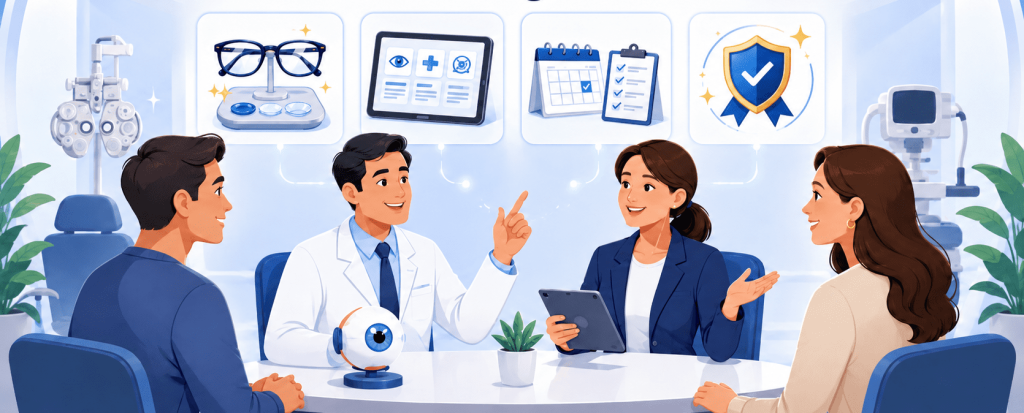
Many eye clinics have the same marketing problem: they offer far more than routine eye exams, but their website, ads, and appointment paths still treat every patient like a general exam patient. That works for broad visibility, but it can bury high-value services such as dry eye treatment, myopia management, scleral lenses, medical eye care, diabetic eye exams, LASIK co-management, cataract evaluations, and specialty contact lenses.
That is where service line marketing for eye clinics becomes valuable. Instead of promoting the clinic as one large list of services, service line marketing creates clearer paths for different types of patients. A parent searching for myopia control, an adult struggling with dry eye symptoms, and a patient looking for an annual eye exam should not all land on the same vague page with the same call to action.
The goal is not to split your brand into disconnected campaigns. The goal is to keep one trusted clinic brand while giving each patient a more relevant message, page, and next step.
What is service line marketing for eye clinics?
Service line marketing for eye clinics is the strategy of promoting specific high-value eye care services with their own messaging, landing pages, campaigns, and conversion paths while keeping the overall clinic brand consistent. In healthcare, a service line is often treated as a defined area of care or business with its own strategic, operational, and financial goals. For eye clinics, that means a dry eye program, myopia management program, scleral lens service, or medical eye care offering can be marketed more intentionally than a general “eye care services” page.
A general eye exam campaign usually speaks to convenience, insurance, location, appointment availability, and preventive care. A specialty-service campaign needs a different approach. It often has to explain symptoms, clarify who the service is for, reduce uncertainty, and show why the patient should choose your clinic for that specific need.
This matters because patients rarely think in terms of your internal service menu. A patient may not search “meibomian gland dysfunction treatment.” They may search “why do my eyes burn at the computer?” A parent may not search “pediatric myopia management clinic.” They may search “how to slow my child’s nearsightedness.” Service line marketing connects those real questions to the right clinical service.
For an eye clinic, this approach can improve both marketing performance and patient experience. The clinic can attract better-fit leads, the front desk can route inquiries more accurately, and doctors can spend less time correcting mismatched expectations during the visit.
Why do high-value eye care services get lost inside general eye exam marketing?
High-value eye care services get lost when every message points patients toward the same broad “book an eye exam” action. That call to action is useful for routine demand, but it is often too general for patients who are dealing with a specific symptom, condition, or treatment goal.
For example, dry eye is not just a routine vision complaint. The National Eye Institute explains that dry eye can involve symptoms such as burning, scratchiness, blurry vision, redness, and sensitivity to light. A patient experiencing those symptoms may need education before they understand why a dedicated dry eye evaluation is different from simply updating a glasses prescription.
The same issue applies to myopia management. Parents may understand that their child’s prescription is getting stronger, but they may not know that certain treatments are designed to slow myopia progression. The American Academy of Ophthalmology lists options such as low-dose atropine, orthokeratology, and special contact lenses as approaches used for myopia control in children.
When these services are hidden under a generic “eye exams” page, patients may not recognize that your clinic offers the solution they need. Even worse, paid search traffic may convert into the wrong appointment type. Someone looking for advanced dry eye care may book a standard exam, arrive with the wrong expectations, and leave feeling like the clinic did not understand their problem.
Which eye clinic services should have their own marketing path?
Any eye care service with strong patient demand, higher revenue potential, different clinical positioning, or a more complex decision process should have its own marketing path. The clearest candidates are services that patients search for separately or need extra explanation before booking.
Dry eye treatment is a strong example because patients often search by symptoms before they understand the diagnosis. A landing page can explain what dry eye is, what symptoms suggest a more advanced evaluation, and what patients can expect during a dry eye visit. This makes the service easier to understand than placing it in a long list of general clinic offerings.
Myopia management also deserves its own path because the decision-maker is often a parent, not the child receiving care. Parents need to understand what myopia is, why progression matters, what treatment options exist, and why early evaluation may be helpful. The messaging should answer practical questions without overstating outcomes or creating fear.
Specialty contact lenses and scleral lenses are also good candidates. These patients may have keratoconus, severe dry eye, post-surgical corneas, high prescriptions, or a history of failed contact lens wear. They are not looking for a basic contact lens fitting; they are looking for expertise.
Medical eye care services can also benefit from clearer marketing. Diabetic eye exams, glaucoma monitoring, cataract evaluations, and ocular disease care all involve patient education and trust. Diabetic eye care is especially important because diabetic retinopathy affected an estimated 9.6 million people in the United States in 2021, according to a JAMA Ophthalmology study using CDC vision surveillance data.
Not every service needs a full campaign at once. A practical starting point is to choose one to three service lines based on profitability, appointment capacity, clinical strength, local search demand, and how often the service is currently being under-booked or misrouted.
How should an eye clinic separate general exam messaging from service-line campaigns?
An eye clinic should separate messaging by patient intent, not by brand. The clinic can keep one unified identity while creating different paths for routine eye exam patients and specialty-service patients.
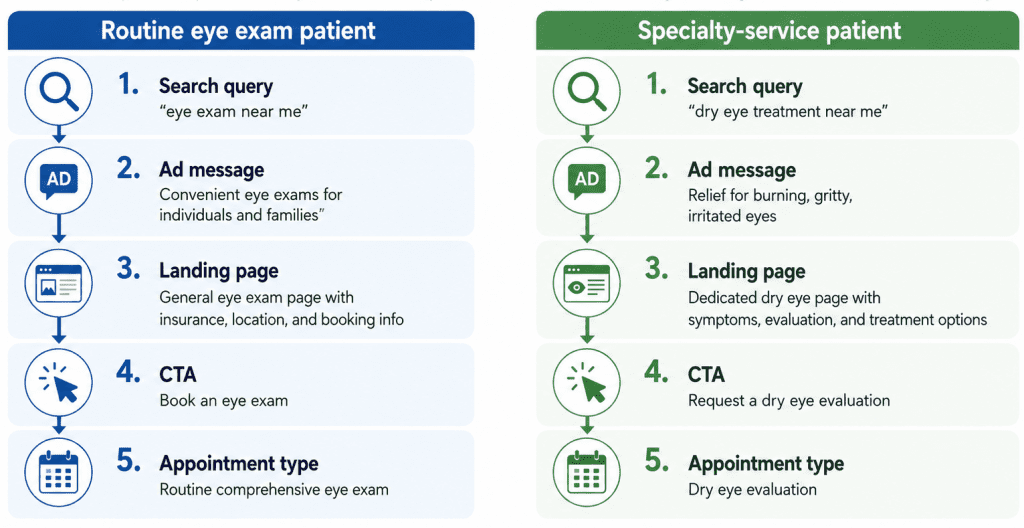
A general exam patient usually wants answers to simple questions: Are you nearby? Do you take my insurance? Can I book soon? Do you see children or families? Can I get glasses or contacts? The page and ads for this audience should be simple, direct, and convenience-focused.
A service-line patient usually has a more specific concern. A dry eye patient wants to know why their symptoms keep coming back. A parent wants to know whether anything can be done about their child’s worsening nearsightedness. A scleral lens patient wants to know whether your clinic handles complex contact lens cases. These pages need more education, more reassurance, and more proof of expertise.
Google Ads also supports this kind of structure. Google recommends organizing ad groups around common themes, such as the products or services being advertised, and notes that tightly organized ad groups can help ads stay relevant to keywords. For eye clinics, this means a general eye exam campaign should not be mixed with dry eye, myopia management, scleral lens, or LASIK co-management keywords in one broad structure.
How do you build patient segments without making people feel over-targeted?
Build patient segments around intent, symptoms, service needs, and geography instead of making personal assumptions about a patient’s health. The best healthcare marketing feels helpful, not invasive.
For example, “Dry eye treatment options for burning, irritated eyes” is clearer and safer than language that implies the advertiser knows the user has a specific diagnosis. “Schedule a myopia consultation for your child” is more appropriate than fear-based messaging that pressures parents with worst-case outcomes.
This distinction matters in PPC because healthcare advertising has stricter policy considerations. Google’s healthcare and medicines policy limits certain health-related advertising categories, and its personalized advertising policy treats health as a sensitive interest category in many contexts. Eye clinics should make sure ads, targeting, landing pages, and remarketing strategies are built around compliant, patient-centered communication.
Segmentation should begin with search intent. A person searching “eye exam near me” is not showing the same intent as someone searching “dry eye specialist near me” or “scleral lenses for keratoconus.” These searches deserve different ads, different landing pages, and different appointment options.
Good segmentation also protects the patient experience. A general exam patient should not feel pressured into a specialty service before they understand its relevance. A specialty-service patient should not be forced to dig through a generic page to find the care they need.
How should service-line landing pages be structured for clarity and conversion?
A service-line landing page should answer the patient’s main question quickly, explain the service in plain language, build trust, and make the next step obvious. The page should not feel like a copied section from the main services page.
The top of the page should immediately identify who the service is for. A dry eye page might open with a message for patients dealing with burning, gritty, watery, or tired eyes. A myopia page might speak directly to parents whose child’s prescription keeps increasing. A scleral lens page might address patients who have been told they are hard to fit for contacts.
The next section should explain what the service is and what happens during the appointment. This is especially important for services that patients do not fully understand. A patient may know they are uncomfortable, frustrated, or worried, but they may not know what an evaluation involves or what treatment options exist.
Trust signals should be specific. Instead of saying “advanced technology,” explain what the technology helps evaluate. Instead of saying “experienced doctors,” explain the clinic’s experience with the service line. Reviews, provider credentials, insurance information, FAQs, and simple appointment instructions can all reduce friction.
Google’s landing page guidance reinforces the importance of matching the landing page to the ad and keywords. If a user clicks an ad for a specific service, the landing page should deliver that specific information rather than sending them to a generic homepage.
How can PPC promote high-value services without hurting general exam volume?
PPC can promote high-value services without hurting general exam volume by separating campaigns, budgets, keywords, landing pages, and conversion goals. The mistake many clinics make is trying to run one campaign for every eye care need.
A better structure is to create separate campaigns or tightly themed ad groups for major service lines. A general exam campaign might focus on “eye exam near me,” “optometrist near me,” “contact lens exam,” and “family eye doctor.” A dry eye campaign might focus on “dry eye treatment,” “dry eye doctor,” or “burning eyes treatment.” A myopia campaign might focus on parent-driven searches around slowing nearsightedness progression.
Negative keywords are also important. Google defines negative keyword lists as a way to prevent ads from showing in less relevant contexts, although behavior can vary by campaign type. For an eye clinic, this can help reduce overlap between general exam searches and specialty-service searches.
Tracking should also be service-specific. A form submission is useful, but it is not enough. Clinics should know whether that lead became a dry eye evaluation, a routine exam, a myopia consultation, a contact lens fitting, or an unrelated call. Google Ads conversion measurement is designed to show what users do after clicking an ad, which can help advertisers understand campaign performance and optimize toward valuable actions.
This is where many high-value campaigns become more profitable. The clinic stops judging PPC only by cost per lead and starts judging it by cost per qualified appointment, show rate, service-line revenue, and patient lifetime value.
Why does patient education matter more for specialty eye care marketing?
Patient education matters more for specialty eye care because patients often search symptoms before they know the name of the service they need. Education helps them connect their problem to the right appointment type.
A dry eye patient may search for “eyes burning after screen time,” “watery eyes but dry feeling,” or “gritty eyes in the morning.” The clinic’s content should explain when symptoms may be related to dry eye and why an eye care professional can evaluate the cause. The National Eye Institute notes that dry eye can happen when eyes do not make enough tears or when tears do not work correctly to keep the eyes wet.
A parent researching myopia may search “why does my child’s vision keep getting worse?” or “can nearsightedness be slowed?” Educational content can explain that myopia control is different from simply updating glasses every year. It can also introduce treatment categories in a balanced way, while encouraging an individualized consultation.
This kind of content supports both SEO and PPC. Blog posts can answer early-stage questions, while landing pages can convert higher-intent traffic. Together, they create a stronger path from concern to understanding to appointment request.
Patient education also reduces pressure on staff. When the website explains the basics clearly, phone calls become more qualified. The patient already understands why the service exists and what type of appointment they are requesting.
How should eye clinics connect service-line marketing with the in-office patient experience?
Eye clinics should connect service-line marketing with the in-office experience by making sure staff, technicians, doctors, and follow-up systems understand the promise made in the campaign. A service-line campaign is not just an ad strategy; it is an operational pathway.
If an ad promotes a dry eye evaluation, the front desk should know how to identify and schedule that appointment. If a landing page promotes myopia management, staff should know whether the first step is a consultation, comprehensive exam, or specific testing visit. If a campaign promotes scleral lenses, the team should understand that these patients may have more complex histories than standard contact lens patients.
The patient intake process should also support the service line. Forms can ask about symptoms, prior treatments, contact lens history, screen use, diabetes status, or child vision concerns depending on the service. This gives the doctor better context and reinforces that the clinic is prepared for the patient’s specific need.
In-office marketing should be used carefully. Posters, brochures, and checkout prompts can help existing patients discover relevant services, but the clinic should avoid overwhelming every general exam patient with every specialty offering. The best approach is targeted education based on symptoms, exam findings, lifestyle, or doctor recommendation.
Follow-up is part of the journey too. A patient who asks about dry eye but does not book immediately may need a helpful email explaining symptoms and evaluation options. A parent interested in myopia control may need a short guide before deciding. Clear follow-up can increase conversions without making the first interaction feel pushy.
What metrics show whether service-line marketing is working?
The right metrics show whether the campaign is attracting qualified demand, creating the right appointment types, and supporting profitable growth. Clicks and impressions are not enough.
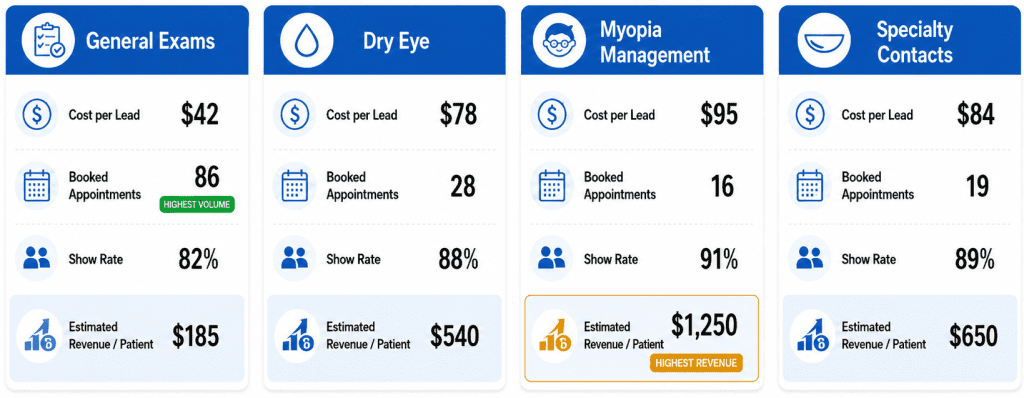
At the campaign level, track conversion rate, cost per lead, cost per booked appointment, and search term quality. Google’s search terms report can show which actual searches triggered ads, helping advertisers refine keywords and improve relevance.
At the clinic level, track appointment show rate, service-line close rate, revenue per patient, treatment acceptance, referral source, and new versus returning patient mix. For example, a dry eye campaign may produce fewer leads than a general exam campaign but generate higher clinical value if those patients book evaluations and continue treatment.
General exam stability is also an important metric. Service-line growth should not create confusion that reduces routine exam volume. If general exam bookings decline after launching specialty campaigns, the clinic may need clearer navigation, better budget separation, or more distinct CTAs.
What mistakes should eye clinics avoid when promoting high-value services?
Eye clinics should avoid mixing every service into one campaign, sending paid traffic to generic pages, using vague messaging, and measuring leads without checking appointment quality. These mistakes make campaigns look busy while producing weak results.
The first mistake is using the homepage as the landing page for every ad. A homepage has too many jobs. It has to introduce the clinic, explain services, support existing patients, show location details, and route visitors to different parts of the site. It is rarely the best destination for a high-intent specialty search.
The second mistake is using clinic-centered language instead of patient-centered language. “Advanced ocular surface disease management” may be clinically accurate, but “help for burning, gritty, irritated eyes” is easier for patients to understand. The best service-line pages can explain the clinical service without forcing patients to decode medical terminology.
The third mistake is making unsupported or overly aggressive claims. Healthcare marketing should build trust through clarity, education, and evidence. This is especially important in paid ads, where platform policies and patient expectations both require careful language.
The fourth mistake is ignoring the handoff from marketing to operations. If the front desk cannot identify the service-line lead, if the schedule does not have the right appointment type, or if the doctor is unaware of the campaign promise, the patient experience can break down quickly.
FAQ
What is an example of service line marketing for an eye clinic?
An example is a dry eye campaign with its own search ads, landing page, symptom-focused messaging, appointment type, tracking, and follow-up sequence. Instead of sending dry eye patients to the homepage, the clinic sends them to a page that explains symptoms, evaluation steps, treatment options, and how to request a dry eye appointment.
Is service line marketing only for large ophthalmology practices?
No. Independent optometry practices can use service line marketing too. In fact, smaller clinics may benefit from it because it helps them focus budget on the services that best match their strengths, capacity, and revenue goals.
How many service lines should an eye clinic market at once?
Most clinics should start with one to three service lines. A focused rollout is easier to track, easier for staff to support, and easier to optimize. Good starting points are services with strong patient demand, clear differentiation, and available appointment capacity.
Can service line marketing help general eye exam growth too?
Yes. Service line marketing can help general exam growth by reducing confusion. When specialty campaigns have their own pathways, general exam pages can stay simple, convenient, and focused on routine care.
Should each eye care service have its own landing page?
High-value or high-intent services should usually have their own landing page. A separate page helps match the patient’s search intent, explain the service clearly, and create a more relevant conversion path.
How does PPC fit into service line marketing for eye clinics?
PPC helps capture high-intent demand for specific services. Separate campaigns for general exams, dry eye, myopia management, specialty contacts, or medical eye care can send patients to more relevant pages and make ROI easier to measure.
What is the difference between a service page and a service-line campaign?
A service page explains what the clinic offers. A service-line campaign includes the page, ads, keywords, budget, tracking, staff workflow, appointment type, and follow-up process needed to turn interest into booked care.
Conclusion
High-value eye care services need more than a place on the services menu. They need clear messaging, dedicated landing pages, thoughtful PPC structure, patient education, accurate tracking, and a staff workflow that supports the promise made online.
The strongest strategy is not to market every service harder. It is to make every patient path clearer. General eye exam patients should find a simple route to routine care, while specialty-service patients should find information that speaks directly to their symptoms, goals, and concerns.
For eye clinics, service line marketing creates a more organized way to grow. It helps clinics protect routine exam volume while building demand for dry eye care, myopia management, specialty contact lenses, medical eye care, and other high-value services.
Why Visiclix is Your Ideal Choice for Service Line Marketing for Eye Clinics?
Visiclix helps eye clinics turn high-value services into clear, measurable growth opportunities. Instead of relying on generic campaigns that send every patient to the same page, Visiclix builds marketing paths around real patient intent. That means general exam patients get a simple booking journey, while specialty-service patients get the education and confidence they need to take the next step.
Visiclix understands that eye care marketing must balance growth, clarity, and trust. From PPC campaign structure to landing page strategy and conversion tracking, Visiclix helps clinics separate service lines without fragmenting the brand. The result is a cleaner patient journey, stronger lead quality, and better visibility into which services are actually driving revenue.
Grow High-Value Eye Care Services With Visiclix
Your clinic should not have to choose between promoting specialty services and keeping general exam patients on the right path. With Visiclix, you can build service-line campaigns that are clear, strategic, and designed around measurable patient acquisition.
Schedule a service-line marketing review with Visiclix to identify which high-value services are ready for stronger promotion and where your current patient journey may be causing confusion.