
Patient segmentation in eye care marketing is about understanding that not every patient is looking for the same thing. A parent searching for pediatric eye care has different concerns than a senior considering cataract surgery, a young adult interested in LASIK, or a returning patient who simply needs an annual eye exam. By dividing patients into clear groups based on their needs, age, treatment interests, appointment history, and decision-making behavior, optometrists and ophthalmologists can create marketing that feels more personal and relevant.
Instead of sending the same message to everyone, eye care practices can tailor their PPC ads, landing pages, emails, and follow-up campaigns to match what each patient actually cares about. For example, families may respond better to messaging around convenience and children’s eye health, while dry eye patients may be looking for relief, education, and treatment options. Patients interested in premium eyewear may be drawn to style and quality, while cataract or LASIK patients may need trust-building content that explains the process clearly.
When patient segmentation is done well, marketing becomes less generic and more helpful. Patients feel understood, campaigns attract better-quality leads, and practices have a clearer path to booking more appointments with the right people. In the long run, segmentation helps eye care practices connect with patients in a more meaningful way while also supporting business growth.
What Is Patient Segmentation in Eye Care Marketing?
Patient segmentation in eye care marketing means dividing your patient audience into meaningful groups based on their needs, motivations, conditions, decision triggers, and likely services. Instead of marketing “eye exams” to everyone in the same way, a clinic builds different messages for parents, older adults, elective candidates, contact lens wearers, diabetic patients, dry eye patients, and other high-value groups.
Good segmentation goes beyond basic demographics. Age can be useful, but it is not enough by itself. A 42-year-old parent searching for “child eye exam near me” has a different intent than a 42-year-old searching for “LASIK consultation.” A 68-year-old looking for dry eye treatment may need a different message than a 68-year-old comparing cataract surgery options.
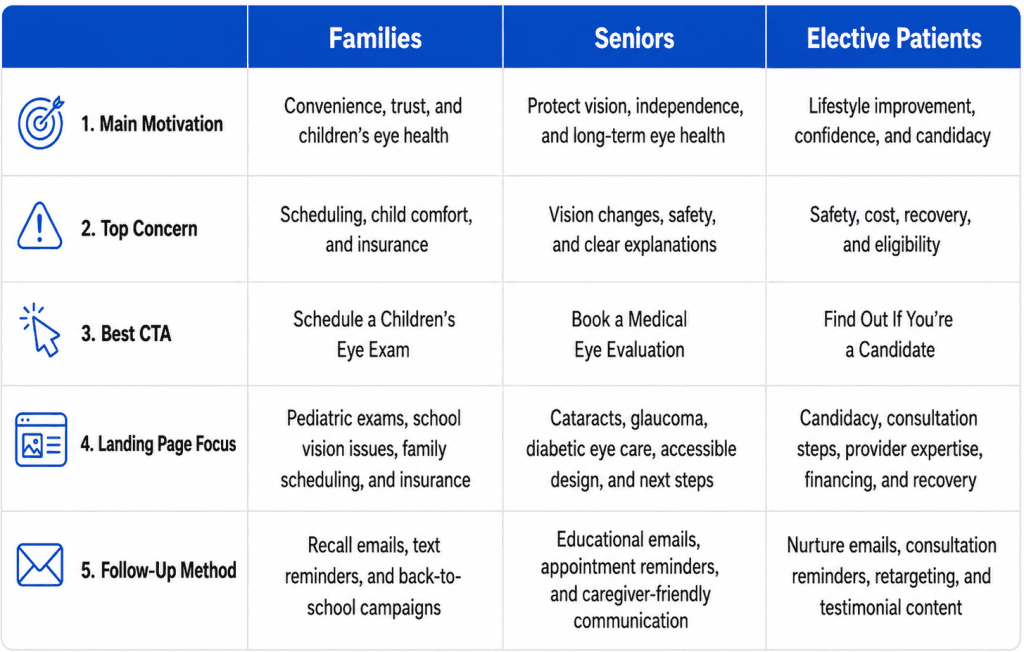
Useful segmentation focuses on what the patient is trying to solve. For example, families may care about school performance, pediatric experience, insurance, and convenient scheduling. Seniors may care about protecting independence, understanding symptoms, and managing ongoing medical eye conditions. Elective patients may care about candidacy, cost, recovery, safety, and outcomes.
In digital marketing terms, segmentation helps clinics connect the full path from search intent to appointment. Google Analytics defines an audience as a group of users who share behavioral, demographic, or descriptive characteristics, and those audiences can be used with advertising tools such as Google Ads. For eye clinics, that means segmentation can shape campaign structure, landing pages, follow-up workflows, and reporting.
Why Does Patient Segmentation Matter for Eye Clinics Running PPC Campaigns?
Patient segmentation matters for PPC because paid search performance depends on relevance. A segmented campaign can match the patient’s search intent with the right ad, the right landing page, and the right call to action.
Google Ads explains that keywords are used to match ads with what people are searching for, while keyword match types control how closely a keyword needs to match a user’s search query. That makes intent mapping essential. A campaign for “pediatric eye exam” should not use the same ad copy, landing page, or CTA as a campaign for “cataract evaluation” or “LASIK near me.”
Segmentation also improves the quality of the post-click experience. Google recommends that ads accurately describe what a business offers and that landing pages be relevant, useful, and easy to navigate. If a parent clicks an ad about children’s eye exams and lands on a generic homepage, the clinic creates friction. If that parent lands on a page explaining pediatric exams, school vision concerns, accepted insurance, and family scheduling, the experience feels more trustworthy.
The benefit is not only more clicks. Segmentation can improve lead quality. A generic campaign may generate form fills from people who are not a good fit, are confused about the service, or are not ready to book. A segmented campaign helps pre-qualify intent before the patient contacts the clinic.
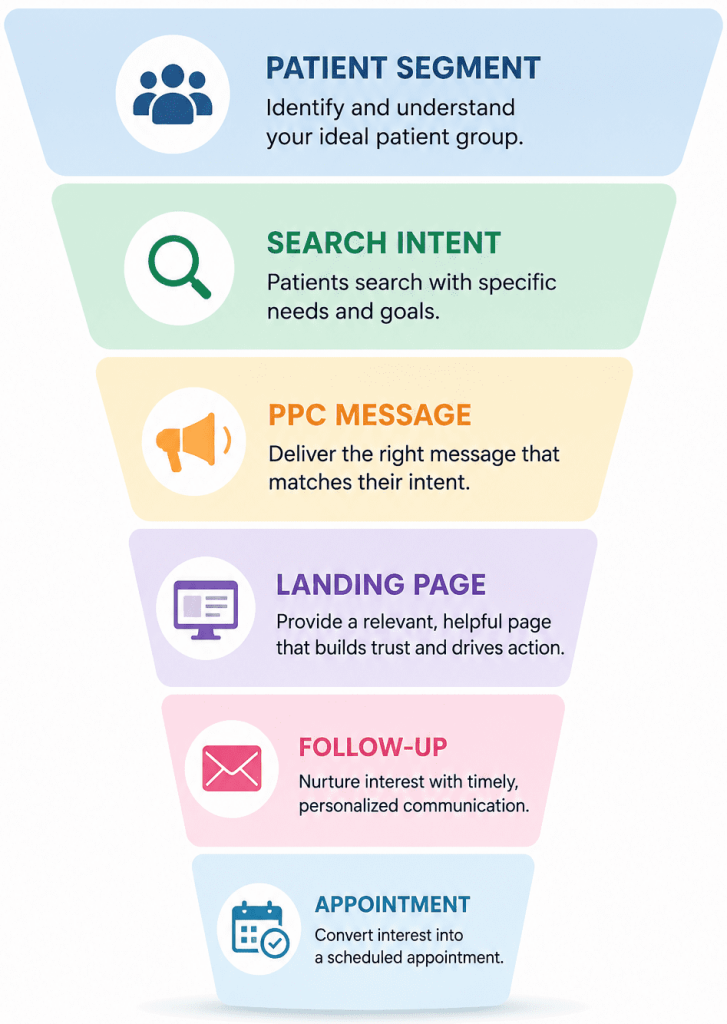
For eye care PPC, segmentation should influence five major campaign elements: keyword groups, ad copy, landing page content, CTA language, and follow-up. When all five match the patient’s situation, the campaign has a stronger chance of converting clicks into booked appointments.
How Should Eye Clinics Segment Messaging for Families?
Eye clinics should segment family messaging around trust, convenience, prevention, affordability, and the ability to care for children and parents in one place. Parents are not only choosing an eye doctor. They are deciding whether a clinic feels safe, practical, and worth fitting into a busy family schedule.
Family-focused messaging should directly answer parent concerns. Is the clinic experienced with children? What ages does it see? Are appointments easy to schedule? Does the clinic accept common vision plans or insurance? Can siblings or parents be scheduled around the same time? These details matter because parents often make care decisions under time pressure.
The clinical importance of children’s vision care also gives marketers a strong educational angle. The CDC notes that vision problems can affect school performance, and it emphasizes early detection and treatment to help protect a child’s vision. The National Eye Institute also identifies myopia as a condition that makes far-away objects appear blurry, which is especially relevant for school-age children who may struggle to see boards, screens, or classroom materials.
For PPC campaigns, family segments can be organized around high-intent searches such as “children’s eye exam,” “pediatric optometrist,” “back to school eye exam,” “myopia control,” and “family eye doctor.” Each campaign should lead to a page that reassures parents quickly. The page should explain the exam process, common signs of vision problems, available eyewear options, appointment timing, and what parents should bring.
Family messaging should avoid sounding overly clinical at the top of the page. Parents usually respond better to practical reassurance: “Clear answers for your child’s vision,” “Family-friendly eye exams that fit your schedule,” or “Help your child see clearly at school and at home.” The deeper content can explain comprehensive exams, myopia concerns, and treatment options.
Follow-up should also be family-specific. Text reminders, annual recall emails, sibling appointment prompts, and seasonal back-to-school campaigns can all work well. The key is to make the next step easy. Parents are more likely to respond when the message clearly connects eye care to school, comfort, safety, or convenience.
How Should Eye Clinics Segment Messaging for Seniors?
Eye clinics should segment senior messaging around clarity, safety, independence, prevention, and ongoing care. Seniors may be looking for routine eye exams, but many are also concerned about cataracts, glaucoma, diabetic eye disease, macular degeneration, dry eye, or changes that affect daily life.
This audience should never be treated as digitally unreachable. AARP’s 2026 technology trends report found that adults age 50 and older have rapidly integrated digital services into daily routines, with smartphone ownership rising from 55% in 2016 to 90% in 2025. That means digital ads, email, patient portals, and text reminders can still be effective, as long as they are clear, accessible, and respectful.
Senior eye care messaging should emphasize what patients can protect, not just what they might lose. A stronger message is “Protect your vision and independence with a comprehensive eye evaluation,” rather than “You may be at risk for vision loss.” The first version is empowering; the second can feel alarming.
There is strong clinical support for prevention-focused messaging. The CDC explains that some eye diseases have no symptoms in their early stages and that comprehensive dilated eye exams can find diseases early, when treatment to prevent vision loss is most effective. The National Eye Institute reports that more than half of Americans age 80 and older either have cataracts or have had cataract surgery. CDC guidance also notes that people with diabetes are at higher risk of vision loss and eye diseases, including retinopathy, glaucoma, and cataracts.
Senior-focused PPC campaigns can be structured around cataract evaluations, diabetic eye exams, glaucoma monitoring, dry eye treatment, or medical eye exams. Each landing page should use plain language, larger readable text, a simple appointment CTA, and clear explanations of symptoms, conditions, and next steps.
Accessibility matters. Senior landing pages should avoid dense blocks of text, small buttons, vague CTAs, or complicated forms. They should also acknowledge caregivers when appropriate. Some older patients book appointments independently, while others involve adult children, spouses, or caregivers in the decision.
Strong senior CTAs include “Schedule a Medical Eye Evaluation,” “Book a Cataract Consultation,” “Request a Diabetic Eye Exam,” or “Get Clear Answers About Your Vision Changes.” These CTAs work because they are specific, practical, and tied to the patient’s concern.
How Should Eye Clinics Segment Messaging for Elective Patients?
Eye clinics should segment elective patients around lifestyle goals, confidence, candidacy, safety, financing, and provider expertise. Elective patients are often interested, but they may not be ready to book immediately. They need education before conversion.
Elective eye care can include LASIK, refractive surgery, premium cataract lenses, cosmetic eyelid procedures, specialty contact lenses, or other cash-pay and consultation-driven services. These patients usually compare providers more actively than routine exam patients. They may read reviews, check credentials, compare financing, watch videos, and return to the website multiple times before booking.
For LASIK and similar procedures, candidacy is one of the strongest messaging angles. The American Academy of Ophthalmology recommends that patients considering LASIK discuss risks and benefits with an ophthalmologist and ask whether vision correction surgery is the best option compared with glasses or contact lenses. Harvard’s Department of Ophthalmology notes that good LASIK candidates are generally 21 or older, have good eye and general health, and have had stable prescriptions for at least one year.
That makes “Find out if you’re a candidate” stronger than “Get LASIK today.” The first message reduces pressure and invites a consultation. The second may feel too aggressive for a patient who still has questions.
Elective PPC campaigns should use segmented landing pages that answer the patient’s real objections. What does the consultation include? How is candidacy determined? What are the risks? What does recovery look like? Is financing available? What technology or experience does the provider offer? What happens if the patient is not a candidate?
Elective follow-up should be more nurturing than urgent. A patient who downloads a LASIK guide or visits a financing page may need educational emails, consultation reminders, testimonial content where compliant, and retargeting ads that address common questions. The goal is to build confidence until the patient is ready to schedule.
How Can Eye Clinics Match Patient Segments to the Right Marketing Channels?
Eye clinics should choose marketing channels based on how each patient segment searches, decides, and prefers to communicate. The same channel can work differently depending on the patient’s intent.
Search ads are strongest when the patient already knows what they need. A parent searching for “pediatric eye exam near me,” a senior searching for “cataract symptoms,” or an elective patient searching for “LASIK consultation” is showing active intent. These searches should lead to focused landing pages rather than a general homepage.
Social ads are often better for awareness, education, and seasonal reminders. Families may respond to back-to-school campaigns. Seniors may respond to educational posts about cataracts, diabetic eye exams, or glaucoma risk. Elective patients may respond to videos explaining candidacy, recovery, or financing. Pew Research Center’s 2025 social media research found that YouTube and Facebook remain among the most widely used platforms among U.S. adults, with platform use varying by age and demographic group.
Email works well for recall, reactivation, education, and nurturing. Families can receive annual exam reminders. Seniors can receive condition-specific education. Elective patients can receive consultation preparation content. SMS works best for simple, immediate actions such as confirmations, reminders, and short scheduling prompts.
Phone experience is also part of segmentation. A great ad can fail if the front desk answers every call with the same script. A parent may ask about child exam timing. A senior may ask about Medicare or medical coverage. An elective patient may ask about cost, candidacy, or consultation length. Staff should know which campaign generated the call and what the caller likely needs.
The channel should never carry the entire strategy. A clinic can run search ads, social ads, email, and text messages and still underperform if the message is generic. Segmentation makes the channel more effective because it gives each campaign a sharper purpose.
How Should Eye Clinics Personalize PPC Ads and Landing Pages for Each Segment?
Eye clinics should personalize PPC ads and landing pages by aligning search intent, ad copy, landing page content, proof points, and CTA language. The patient should feel continuity from the search query to the appointment request.
For families, the ad might say: “Children’s Eye Exams for Clearer School Days.” The landing page should then explain pediatric exams, school vision concerns, signs a child may need an exam, and family scheduling options. The CTA might be “Schedule a Children’s Eye Exam.”
For seniors, the ad might say: “Concerned About Cataract Symptoms?” The landing page should explain cloudy vision, glare, night driving difficulty, evaluation steps, and what to expect at the visit. The CTA might be “Book a Cataract Evaluation.”
For elective patients, the ad might say: “Find Out If LASIK Is Right for You.” The landing page should explain candidacy, consultation steps, provider credentials, risks, recovery, and financing. The CTA might be “Request a LASIK Consultation.”
Google’s own guidance supports this kind of message match. Responsive search ads are designed to combine assets in ways that help deliver relevant ads that adapt to changing consumer behavior. Google also says website conversion measurement helps advertisers understand what users do after interacting with ads, which is necessary for campaign optimization.
The biggest mistake is sending every ad to the homepage. Homepages are built for general navigation. PPC landing pages should be built for specific intent. A patient who clicked for diabetic eye exams should not have to search through optical promotions, contact lens pages, and general exam content to find the next step.
Personalized landing pages should include segment-specific proof. Families may need pediatric experience, parent reviews, insurance clarity, and friendly care language. Seniors may need medical expertise, plain-language condition education, accessibility, and continuity of care. Elective patients may need credentials, consultation details, technology, financing, and outcome expectations.
What Patient Data Should Eye Clinics Use for Segmentation?
Eye clinics should use ethical, privacy-conscious first-party data such as appointment history, service interest, condition category, communication preference, campaign source, and website behavior. The best segmentation data is practical, consent-aware, and directly tied to care or marketing relevance.
Useful first-party data may include whether a patient booked a pediatric exam, diabetic eye exam, cataract evaluation, contact lens fitting, LASIK consultation, dry eye visit, or optical purchase. Clinics can also segment by recall status, last appointment date, preferred communication method, and service-line interest.
Behavioral data can also help. A website visitor who views a LASIK financing page may belong in an elective consultation nurture path. A patient who clicks an email about back-to-school exams may belong in a family recall campaign. A patient who submits a form for cataract symptoms should receive senior or medical eye care follow-up, not a generic optical promotion.
Clinics should be careful with health information and marketing compliance. HHS explains that HIPAA’s Privacy Rule defines marketing, creates exceptions for certain treatment and healthcare operations activities, and generally requires individual authorization for uses or disclosures of protected health information for marketing purposes unless an exception applies.
In practice, clinics should work with compliant platforms, honor communication preferences, limit unnecessary sensitive information in messages, and avoid invasive targeting. A reminder saying “It’s time to schedule your annual eye exam” is different from an overly detailed message that exposes a patient’s condition.
Segmentation should help patients receive more relevant communication, not make them feel watched. The best approach is to use enough data to be helpful while keeping messages professional, respectful, and privacy-conscious.
How Can Eye Clinics Build Patient Personas Without Overcomplicating the Process?
Eye clinics can build practical patient personas by documenting each segment’s main concern, likely service need, search intent, objection, trust signals, preferred channel, and best CTA. The goal is not to create fictional characters for a slide deck. The goal is to make campaigns easier to write, launch, and measure.
A simple family persona might be “Busy Parent Managing Child Vision Care.” This person cares about school performance, convenience, insurance, child-friendly staff, and clear explanations. Their objections may include time, cost, uncertainty about whether an exam is needed, and concern about how their child will handle the visit.
A senior persona might be “Older Adult Protecting Long-Term Vision.” This person cares about independence, safety, symptom clarity, trusted medical care, and ongoing monitoring. Their objections may include confusion about symptoms, uncertainty about insurance, fear of surgery, or difficulty navigating appointment systems.
An elective persona might be “Research-Driven LASIK Candidate.” This person cares about lifestyle improvement, safety, candidacy, cost, recovery, and provider reputation. Their objections may include fear of complications, uncertainty about eligibility, financing questions, and not knowing which provider to trust.
HubSpot describes buyer personas as more than demographics; they include behaviors, motivations, goals, and pain points that influence decisions. Eye clinics should apply that same principle to patient personas, but with extra care because healthcare decisions are personal and sometimes sensitive.
Personas should guide campaign structure. If a persona does not change the ad, landing page, CTA, or follow-up, it is probably too vague. A useful persona makes it obvious what message to write and what next step to offer.
What Mistakes Should Eye Clinics Avoid When Segmenting Patient Messaging?
Eye clinics should avoid relying only on age, stereotyping patients, using generic ads, ignoring landing page relevance, and measuring only form fills instead of booked appointments and revenue quality.
One common mistake is assuming all seniors dislike digital communication. Current technology adoption among older adults makes that assumption risky. AARP reports significant digital adoption among adults age 50 and older, including high smartphone ownership. Seniors may still prefer clear language, larger text, and simple navigation, but that is not the same as being offline.
Another mistake is treating all parents as price-only shoppers. Cost matters, but parents also care about trust, convenience, child comfort, school readiness, and whether the clinic explains care clearly. If every family campaign leads with discounts, the clinic may attract low-intent shoppers while missing parents who value quality and reassurance.
A third mistake is treating elective patients as ready to buy immediately. Elective patients often need education before booking. A hard-sell ad may produce curiosity clicks but fail to convert if the landing page does not answer candidacy, safety, cost, and recovery questions.
Clinics should also avoid using the same CTA for every segment. “Book Now” may be fine for routine exams, but “Request a Consultation,” “Schedule a Medical Eye Evaluation,” or “Find Out If You’re a Candidate” may match intent better for medical or elective campaigns.
Finally, segmentation should include the front desk. If PPC ads promise a child-friendly experience, cataract guidance, or LASIK consultation support, the phone team should be prepared to continue that message. Marketing creates the expectation; the clinic experience confirms or breaks it.
How Can Eye Clinics Measure Whether Segmented Messaging Is Working?
Eye clinics should measure segmented messaging by tracking both marketing performance and appointment outcomes. Clicks and leads matter, but the real question is whether campaigns produce the right booked patients.
PPC metrics include click-through rate, cost per click, conversion rate, cost per lead, and landing page conversion rate. These show whether the campaign is generating engagement. Google Ads conversion measurement can track valuable website actions after ad interactions, which helps advertisers understand performance and optimize campaigns.
Clinic-level metrics are just as important. Track booked appointments, show rates, consultation rates, procedure conversion rates, cost per booked patient, and revenue by service line. A campaign with a low cost per lead may still be weak if those leads do not book or show up.
Each segment should have its own success indicators. Family campaigns may be judged by pediatric exam bookings, family exam clusters, and annual recall response. Senior campaigns may be judged by medical eye evaluations, cataract consultations, diabetic exam bookings, or glaucoma follow-up adherence. Elective campaigns may be judged by consultation bookings, consultation attendance, candidacy rate, and procedure conversion.
Call tracking and form tracking are especially important for eye clinics because many patients still prefer to call. A clinic should know which keyword, ad, and landing page generated the call. Without that visibility, it is difficult to know whether segmented messaging is actually improving patient acquisition.
The best reporting connects segment, campaign, appointment type, and outcome. That allows a clinic to shift budget toward the audiences and messages that produce real patient value, not just the campaigns that generate the cheapest leads.
FAQ
What is patient segmentation for eye care marketing?
Patient segmentation for eye care marketing means grouping patients by needs, intent, service interest, and decision factors so an eye clinic can create more relevant ads, landing pages, emails, texts, and follow-up messages.
For example, a family looking for pediatric eye care may need reassurance about child-friendly exams and scheduling. A senior may need education about cataracts, glaucoma, or diabetic eye exams. An elective patient may need information about candidacy, safety, financing, and consultation steps.
Why should eye clinics segment families, seniors, and elective patients separately?
Eye clinics should segment these groups separately because they usually have different motivations, concerns, and conversion paths. Families often prioritize convenience and trust. Seniors often prioritize clarity, prevention, and continuity of care. Elective patients often prioritize outcomes, provider expertise, safety, cost, and confidence.
When clinics use the same message for all three groups, they make campaigns less relevant. Segmentation helps each patient see information that matches their situation.
What is the best marketing message for families looking for eye care?
The best message for families focuses on convenience, prevention, trust, and child-friendly care. Strong examples include “Clear vision support for every stage of childhood,” “Make eye care easier for your family,” or “Schedule a children’s eye exam before school concerns grow.”
The message should be practical and reassuring. Parents want to know that the clinic can care for their child, explain findings clearly, and make scheduling manageable.
What is the best marketing message for senior eye care patients?
The best message for senior eye care patients focuses on protecting vision, independence, and confidence. Strong examples include “Protect your vision with a comprehensive medical eye evaluation” or “Get clear answers about cataracts, glaucoma, and age-related vision changes.”
This audience often benefits from plain language, accessible design, and a clear explanation of what happens next. The message should be educational without creating unnecessary fear.
What is the best marketing message for elective eye care patients?
The best message for elective eye care patients focuses on candidacy, confidence, lifestyle improvement, and informed decision-making. A strong example is “Find out if LASIK is right for you” because it feels lower-pressure than “Book LASIK now.”
Elective patients need enough information to trust the provider before booking. Landing pages should explain consultation steps, risks, recovery, financing, and provider qualifications.
Can small eye clinics use patient segmentation without a large marketing team?
Yes. Small eye clinics can start by segmenting campaigns by service line and patient intent. The simplest starting point is to create separate messaging for family eye exams, senior medical eye care, and elective consultations.
A clinic does not need a complex system to begin. Even separate landing pages, tailored ad copy, and segment-specific follow-up messages can improve relevance and lead quality.
How often should eye clinics update their patient segments?
Eye clinics should review patient segments at least quarterly. They should also update segments whenever they add a service, change campaign goals, see a shift in patient demand, or notice that PPC performance is declining.
Seasonal updates are also useful. Family messaging may change before back-to-school season, senior medical campaigns may align with annual benefits reminders, and elective campaigns may shift around financing promotions or consultation availability.
Conclusion
Eye care marketing works better when clinics stop sending every patient the same message. Families, seniors, and elective patients all need eye care, but they do not share the same motivations, concerns, objections, or decision timelines.
Families need convenience, trust, and reassurance. Seniors need clarity, accessibility, preventive education, and confidence in ongoing care. Elective patients need candidacy guidance, proof of expertise, financing clarity, and a low-pressure consultation path.
For PPC campaigns, segmentation is especially valuable because it connects search intent to ad copy, landing page content, CTA language, and follow-up. When those pieces align, clinics are better positioned to improve conversion quality, reduce wasted spend, and turn more high-intent searches into booked appointments.
The key takeaway is simple: segmentation is not about making marketing more complicated. It is about making every message more relevant to the patient who sees it.
Why Visiclix is Your Ideal Choice for Patient Segmentation in Eye Care Marketing?
Visiclix helps eye clinics move beyond generic advertising by building PPC strategies around real patient intent. Instead of treating every click the same, Visiclix helps clinics identify the audiences that matter most, including families, seniors, and elective patients, then align campaigns with the messages most likely to convert.
A strong segmentation strategy requires more than clever ad copy. It requires keyword planning, landing page alignment, conversion tracking, follow-up strategy, and ongoing optimization. Visiclix brings these pieces together so clinics can understand which campaigns are driving not only leads, but booked appointments and higher-value patient opportunities.
For clinics competing in crowded local markets, relevance is a major advantage. Visiclix helps eye care practices create campaigns that speak clearly to each patient group’s needs, whether the goal is more pediatric exams, more cataract evaluations, more diabetic eye care appointments, or more elective consultations.
By focusing on segmentation, message match, and measurable performance, Visiclix gives eye clinics a smarter way to grow. The result is marketing that feels more helpful to patients and more accountable to the clinic’s business goals.
Turn Segmented Eye Care Campaigns Into More Booked Appointments With Visiclix
Visiclix can help your eye clinic identify where generic messaging is wasting PPC spend and where segmented campaigns can create stronger patient acquisition opportunities.
If your current campaigns send every patient to the same page, use the same CTA for every service, or measure leads without tracking booked appointments, Visiclix can help you build a clearer strategy. Start with a segmentation-focused PPC audit and uncover how your clinic can reach families, seniors, and elective patients with messages that convert.