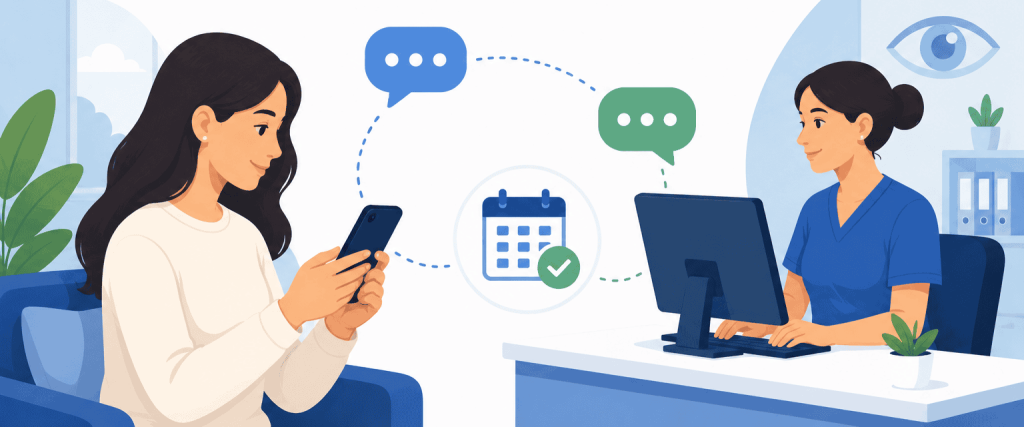
Texting can make appointment booking easier by giving patients a quick way to ask questions, confirm availability, request changes, and understand what happens next without waiting on hold or playing phone tag.
For eye care patients, those small conversations can matter. Someone may want to know whether they need a routine exam or a contact lens appointment, whether insurance is accepted, how long testing may take, or whether dilation could affect their drive home. The National Eye Institute notes that dilation can leave vision blurry and increase light sensitivity for several hours, making appointment preparation an important part of the patient experience.
That is where two way texting for optometry becomes useful. Rather than treating text messages only as reminders, clinics can use responsive communication to remove uncertainty while a patient is deciding whether, when, and how to book.
This fits into the broader patient journey for eye care marketing, where every interaction between initial search and appointment can affect confidence.
What Causes Patients to Hesitate Before Booking an Eye Appointment?
Patients do not always abandon an appointment because they lack interest. Sometimes they simply do not have enough information to act confidently.
An eye clinic visitor may wonder which provider handles their concern, whether a particular exam includes dilation, whether the clinic accepts their insurance, how much time to allow, or what they need to bring. The National Eye Institute also distinguishes between optometrists and ophthalmologists depending on a patient’s care needs, which illustrates why even choosing the right type of appointment may require clarification.
A good website should resolve as many of these questions as possible before the patient reaches the booking stage. Clear service pages, doctor information, office details, insurance guidance, and visible calls to action all reduce friction. Visiclix’s guidance on eye care landing page copywriting similarly emphasizes answering patient concerns and making the next action obvious.
But websites cannot anticipate every question. That is where an accessible communication channel can help close the gap.
How Does Two Way Texting for Optometry Reduce Booking Friction?
Two way texting for optometry reduces booking friction by allowing a patient and clinic to exchange information without requiring both people to be available for a live phone conversation.
A patient might text, “Do I need a separate appointment for contacts?” or “Can I move my exam from Tuesday to Friday?” A staff member can answer when workflow allows, and the patient can respond when convenient.
That is different from sending a one-direction reminder that only tells the patient when to arrive.
Recent research reinforces this distinction. A 2026 study in JAMA Network Open analyzed responses from patients who replied to automated healthcare text messages. Researchers found replies involving appointment management, requests for help, communication preferences, data corrections, and other needs beyond the automated system’s recognized commands. The study concluded that these responses showed opportunities for more responsive, bidirectional communication.
For an eye clinic, the practical lesson is simple: if patients are given a text channel, some will naturally try to use it as a conversation.
Why Can Responsive Messaging Increase Patient Confidence Before the Visit?
Responsive messaging can increase confidence because it confirms that the clinic is reachable and that the patient’s next step is understood.
A short reply can reassure someone that the office received their request. Written messages can also give patients appointment details they can revisit later, such as arrival time, location information, preparation instructions, or a link to paperwork.
That clarity matters in eye care. If dilation may be part of the visit, for example, the National Eye Institute advises patients that vision may be blurry afterward and that light sensitivity can last for several hours. A clinic that communicates relevant preparation information clearly helps patients arrive with more realistic expectations.
Responsive does not mean informal or unstructured, though. Clinics still need consistent answers, clear staff responsibilities, and boundaries around which conversations belong in text versus a phone call or another communication system.
Visiclix explores a similar principle in its guide to aligning patient experience with eye care marketing goals. The promise made online should match the experience patients receive when they try to schedule or ask for help.
How Can Text Messaging Help PPC and Website Leads Become Booked Patients?
A paid click is not the same thing as a booked appointment.
Someone can click an eye clinic’s Google Ad with strong intent and still hesitate after reaching the landing page. Perhaps they need to confirm insurance. Maybe they are unsure which service to select. Or they are searching from work and cannot make a phone call.
A messaging option can provide another path forward. Instead of asking the visitor to make a larger commitment immediately, the clinic can give them a way to resolve one practical question.
This makes message consistency especially important. A Google Ad, landing page, booking experience, and staff response should all support the same expectation. Visiclix’s PPC Google Ads services for eye care practices focus on connecting high-intent search traffic with relevant landing experiences and measurable patient actions.
Measurement should continue past the initial lead. Google Ads supports importing lead outcomes back into advertising measurement, including enhanced conversions for leads, which can help businesses connect online interactions with later offline outcomes.
For clinics, that means looking beyond clicks and raw inquiries. Track which campaigns produce meaningful appointment requests and, where systems allow, which leads actually progress further through the booking process.
How Should Eye Clinics Build a Useful Two-Way Messaging Workflow?
A useful texting workflow starts with operational clarity, not software.
First, decide who monitors incoming replies. A text channel that appears responsive but goes unchecked can create more frustration than having no texting option at all.
Next, define which questions staff can handle through messaging. Scheduling changes, location details, appointment preparation, office hours, and links to forms may fit naturally. More complex or sensitive conversations may need to move to another channel.
Templates can help with frequent questions, but they should not make every response sound robotic. Keep messages concise and give staff room to address what the patient actually asked.
Privacy and security also require deliberate planning. HHS explains that messaging technologies can be used for patient communication, while stressing the importance of appropriate privacy and security protections for protected health information. HHS also recommends helping patients understand how they will be contacted and what security considerations may apply to remote communication tools.
In other words, ordinary texting should not automatically be treated as secure simply because it is convenient. Clinics should evaluate vendors, workflows, consent requirements, HIPAA responsibilities where applicable, and the sensitivity of the information being exchanged.
The communication strategy should also work alongside the clinic’s broader SEO strategy for eye doctors. Strong educational content can answer common questions before patients need to ask them, while messaging handles the individual uncertainties that remain.
FAQ
Can patients book an optometry appointment through text?
Yes, if the clinic’s scheduling workflow supports it. Some practices may allow patients to request or confirm appointments directly through messaging, while others may use text to answer questions and then direct patients to an online scheduler or staff-assisted booking process.
What is the difference between two-way texting and appointment reminders?
Appointment reminders mainly send information to the patient. Two-way messaging allows the patient to reply and receive a meaningful response.
That distinction matters because patients often use healthcare texts to ask for help, manage appointments, or clarify information rather than simply reading the original message.
Should texting replace phone calls at an eye clinic?
No. Texting is better viewed as another communication option.
Short scheduling questions may work well through two way texting for optometry, while complicated concerns, urgent symptoms, detailed clinical discussions, or sensitive information may require a phone call or another appropriate channel.
What information can an eye clinic send through text?
Common operational messages may include appointment times, scheduling instructions, office details, preparation reminders, and links to forms. What is appropriate depends on the clinic’s technology, privacy safeguards, consent practices, applicable regulations, and the sensitivity of the information.
How Can Eye Clinics Turn Better Communication Into More Booked Appointments?
Better communication works when it removes unnecessary uncertainty between patient interest and the appointment.
Text messaging can support that goal, but it should not operate alone. The website still needs to explain services clearly. PPC ads should set accurate expectations. Landing pages should make the next step obvious. Staff should know how to handle responses when prospective patients reach out.
Think of the booking journey as one connected experience. Every unanswered question creates another chance for hesitation. Every clear, helpful answer gives the patient a better reason to continue.
For clinics reviewing that larger journey, Visiclix’s digital marketing services for eye care practices provide a useful framework for connecting search visibility, paid advertising, website experience, and conversion strategy.
Why Visiclix Is Your Ideal Choice for Digital Patient Communication?
Visiclix specializes in digital marketing for optometrists, ophthalmologists, and eye care practices, which means patient communication can be considered within the realities of eye care rather than as an isolated marketing tactic. The team works across SEO, paid search, websites, content, and conversion strategy to help practices create clearer paths from patient search to appointment. That specialized focus can be especially valuable when different services require different levels of education, urgency, and reassurance. You can learn more about the team and its approach on the About Visiclix page.
The goal is not simply to generate more traffic or more messages. It is to help eye clinics attract appropriate prospects, reduce avoidable friction, and better understand which digital interactions contribute to meaningful patient acquisition. A connected marketing and communication strategy can make the experience clearer for patients while giving the practice better visibility into performance.
Make Booking Easier With Visiclix
If prospective patients are clicking your ads or visiting your website but still getting stuck before scheduling, the communication path deserves a closer look.
Start a conversation with Visiclix to identify where booking friction, unclear messaging, or disconnected marketing may be limiting patient conversion.