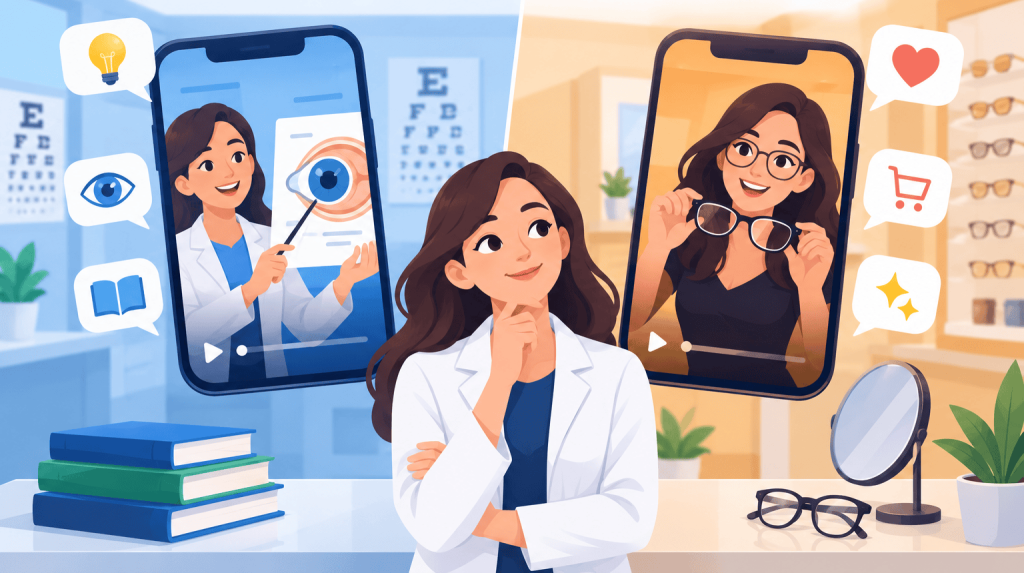
For most eye clinics, eye clinic educational reels should form the foundation of an organic social media strategy, while promotional Reels should support specific services and conversion goals. Educational content gives prospective patients a reason to watch, save, share, and learn from a practice before they are asked to schedule an appointment. Promotional content becomes more useful when that audience already understands its problem and is closer to choosing a provider.
So, it is not really education versus promotion. The stronger approach is education first, followed by well-timed promotion. That balance can help an eye clinic build credibility without turning its Instagram feed into a stream of advertisements.
Why Do Eye Clinic Educational Reels Build Patient Trust?
Eye clinic educational reels can build trust because they address the questions and uncertainties patients may have before contacting a practice. Instead of immediately promoting an eye exam or procedure, a clinic can explain topics such as dry eye symptoms, contact lens care, cataract evaluations, children’s vision, diabetic eye exams, or what happens during a routine appointment.
That approach also gives optometrists and ophthalmologists a practical way to demonstrate expertise. One Reel might answer, “What happens during a dry eye evaluation?” Another could explain a common eye-health misconception in plain language. Useful first. Promotional second.
There is also some ophthalmology-specific evidence that short-form educational video can work as a learning format. A 2025 BMC Medical Education study had 64 medical students create public-awareness Reels about cataracts and myopia. Among survey respondents, 59.6% agreed that Reel-making increased their interest in the subject. The study evaluated medical education rather than clinic marketing, so it should not be interpreted as evidence that educational Reels directly increase appointments, but it does support the format’s potential for communicating ophthalmology topics in an engaging way.
For practices that want this content to support a broader patient-engagement plan, a structured social media marketing strategy for eye care practices can connect individual Reels with consistent branding, audience engagement, and practice visibility.
When Are Promotional Reels More Useful for Eye Clinics?
Promotional Reels are most useful when viewers have already developed some interest in the clinic, service, or eye-care problem. At that point, the content can move from explaining a need to showing why someone should consider taking the next step.
Good promotional topics might include a new service, appointment availability, a specialty treatment, the technology used during evaluations, an introduction to a doctor, or a look at the patient experience. Even then, the Reel should give viewers something useful instead of relying on a generic “book now” message.
For example, an educational Reel might ask, “Why do my eyes feel dry at the end of the day?” A related promotional Reel could explain what patients can expect during the clinic’s dry eye evaluation and then provide a scheduling option.
Clinics can also extend stronger-performing concepts into video advertising. Meta recommends testing Reels advertising creative and using A/B testing to evaluate performance rather than assuming one version will work best. Visiclix also provides video marketing and digital marketing services for eye care practices that can connect educational and promotional video with a wider acquisition strategy.
How Do Educational and Promotional Reels Compare for Reach, Trust, and Appointments?
Educational and promotional Reels serve different stages of the patient journey. Educational content generally creates awareness and familiarity. Promotional content is more focused on converting existing interest into an inquiry or appointment.
| Factor | Educational Reels | Promotional Reels |
|---|---|---|
| Main purpose | Explain and educate | Encourage action |
| Best audience stage | Awareness and consideration | Consideration and decision |
| Common topics | Symptoms, FAQs, myths, procedures | Services, appointments, clinic benefits |
| Typical CTA | Save, share, learn more | Call, book, request an appointment |
| Trust-building role | Strong | Depends on usefulness and tone |
| Conversion role | Builds readiness | Captures stronger intent |
| Main risk | Becoming too technical | Becoming too sales-focused |
That difference is why views alone cannot determine which type is “better.” An educational Reel might reach a large audience and introduce new people to the practice without producing immediate bookings. A promotional Reel may generate less engagement but produce several qualified appointment inquiries.
The measurement has to match the objective. Social video can create demand and familiarity, while a high-intent channel such as Google Ads management for optometrists and ophthalmologists can help a practice reach people who are actively searching for eye-care services.
How Can Eye Clinics Balance Educational and Promotional Reels Without Overpromoting?
Eye clinics can find the right balance by starting with real patient questions and allowing promotion to follow naturally. There is no universal posting ratio that works for every practice. Service mix, audience, location, brand maturity, and patient demand all affect what should be published.
A simple content sequence could look like this:
- Explain why dry eye symptoms can occur.
- Address a common dry eye misconception.
- Show what patients can expect during an evaluation.
- Publish a clinic-specific Reel explaining the next step for someone seeking care.
This creates context before asking the viewer to act. It also keeps the social feed patient-centered rather than campaign-centered. Visiclix’s guidance on how to align patient experience with eyecare marketing goals follows the same principle: digital marketing should help patients make informed, confident decisions instead of focusing only on generating clicks.
Healthcare practices should also consider privacy and advertising requirements before posting. For HIPAA-covered organizations, HHS states that protected health information generally requires valid authorization when it is used or disclosed for marketing, subject to specific exceptions. Testimonials should also be truthful and not misleading, according to the FTC’s Endorsement Guides.
How Should Eye Clinics Measure Whether Their Reels Are Actually Working?
The right metrics depend on what each Reel was designed to accomplish. Eye clinic educational reels can be evaluated through watch time, completion rate, saves, shares, comments, profile visits, and website activity. These signals help show whether viewers found the information useful enough to continue engaging with the practice.
Promotional Reels should be evaluated closer to the business outcome. Website clicks, calls, form submissions, appointment requests, booked appointments, and attended visits can provide a clearer picture than likes alone.
Over time, the practice can compare topics as well as formats. If dry eye education repeatedly produces meaningful engagement and related website visits, for example, that topic may deserve additional content. If a promotional Reel generates appointment inquiries, the clinic can study the message, format, service, and CTA to understand why.
FAQ
Should eye clinics post more educational or promotional Reels?
Educational content should generally take the larger role in an organic content strategy because it gives people a reason to follow and learn from the clinic. Promotional Reels can then be used strategically around services, campaigns, or audiences that show stronger intent. The exact balance should be based on actual performance rather than a fixed formula.
What are good educational Reel topics for optometrists?
Good topics include common symptoms, routine eye exams, contact lenses, dry eye, myopia, cataracts, diabetic eye care, children’s vision, eyewear questions, treatment expectations, and common patient FAQs. Clinics can often find their best ideas by writing down questions patients repeatedly ask during appointments.
Can educational Reels help eye clinics attract patients?
They can contribute to patient acquisition by building awareness, familiarity, and confidence before a person is ready to schedule. However, an educational Reel should not automatically be credited with generating a new patient simply because it received high engagement. Track the journey from social content to the website, inquiries, appointments, and attended visits whenever possible.
Should every eye clinic Reel include a call to action?
No. The CTA should fit the purpose of the content. An educational Reel might ask someone to save the information or read more, while a service-focused Reel may appropriately invite the viewer to schedule an appointment.
How Can Better Reels Lead to Better Patient Conversations?
A strong mix of eye clinic educational reels and carefully timed promotional content gives social media more than one job. Education helps the clinic become a useful source of information. Promotion gives interested viewers a clear way to move forward.
Review your practice’s most recent Reels and ask a simple question: are they mostly helping patients understand something, or mostly asking patients to buy or book something? If the feed leans heavily toward promotion, answering more real patient questions may be the stronger place to start.
Why Is Visiclix Your Ideal Choice for Eye Clinic Social Media Marketing?
Visiclix specializes in digital marketing for optometrists, ophthalmologists, and eye-care practices. That industry focus allows social content to be considered alongside SEO, paid search, video, reputation management, and the wider patient journey. The result is a strategy built around how an eye-care practice actually attracts and communicates with prospective patients.
Visiclix also approaches marketing with measurable growth in mind. Reels do not need to exist as isolated social posts when they can support broader awareness, website traffic, service discovery, and patient acquisition efforts. By connecting creative content with performance data, practices can make better decisions about what to publish, promote, revise, or stop.
Ready to Build a Smarter Reel Strategy With Visiclix?
Your eye clinic does not need more social content simply for the sake of staying active. It needs useful content with a clear purpose.
Schedule a free consultation with Visiclix to review your current digital presence and explore a strategy that connects patient education, visibility, and practice growth.