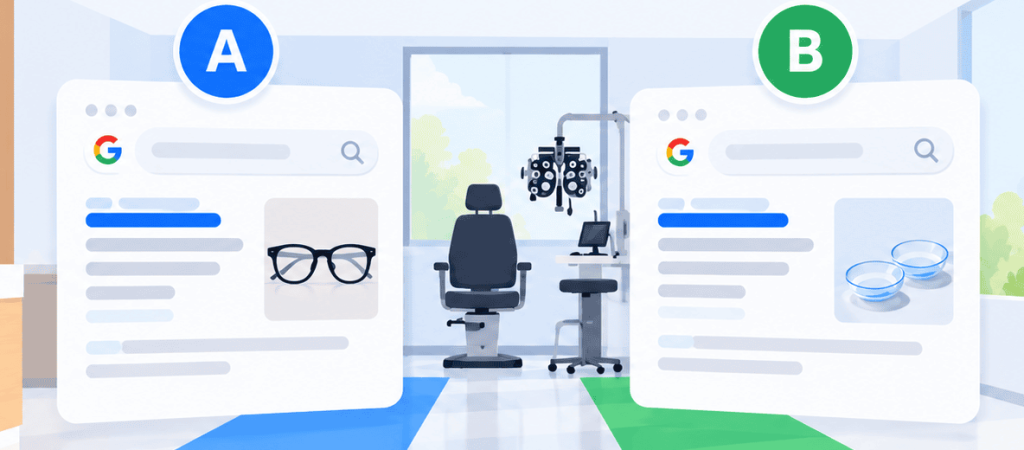
An AI Max experiment lets optometry practices test whether Google’s AI-powered Search features improve advertising results before applying them across an entire campaign.
Google Ads divides traffic and budget between two groups: a control using the original Search campaign settings and a trial with AI Max enabled. This allows practices to compare performance without creating a duplicate campaign.
The goal is to determine whether AI Max produces more relevant patient inquiries and appointment opportunities at an acceptable cost.
If you’re unfamiliar with the technology, Visiclix’s guide to AI Max for optometrists explains its main features.
Here’s how to set up and evaluate an experiment.
Choose a Search Campaign That Can Produce a Meaningful Test
Start with an established Search campaign that has reliable conversion tracking, relatively stable performance, and a clear advertising objective.
For example, an optometry practice might test a campaign promoting comprehensive eye exams. A campaign combining routine exams, optical product sales, and unrelated services may make the results harder to interpret.
Visiclix’s eye exam PPC blueprint provides additional context on organizing campaigns around appointment-focused searches.
Check Campaign Eligibility Before Starting
Google recommends using dedicated AI Max A/B experiments for campaigns generating at least 50 conversions per month.
For campaigns with 20 to 49 monthly conversions, Google suggests considering a before-and-after comparison. This typically involves comparing equal 30-day periods before and after enabling AI Max, although seasonal changes and other factors can weaken the comparison.
These are recommended data thresholds, not universal eligibility requirements.
Before proceeding, confirm that your campaign:
- Runs on Google Search without Display Network targeting.
- Uses an individual campaign budget rather than a shared budget.
- Does not use portfolio bidding or bidding exploration.
- Has no other active experiment.
- Does not already have text customization enabled.
Also check whether AI Max is already active. Google began automatically upgrading certain Search campaigns using legacy broad match settings or automatically created assets in September 2026.
If your campaign has already been upgraded, review its current configuration before attempting to establish a control group.
Set an Appointment-Focused Success Metric Before Launching
An AI Max experiment should measure outcomes that matter to the practice, not simply additional website traffic.
Google Ads can track calls, form submissions, and other conversion actions, but these signals do not always represent confirmed appointments.
Consider three levels of performance:
- Initial inquiries: Calls, contact forms, or appointment requests.
- Qualified inquiries: Prospective patients seeking services the practice actually provides.
- Confirmed appointments: Inquiries that result in scheduled visits.
For example, an increase in phone calls may look promising. But if most calls concern unavailable services or insurance plans the clinic does not accept, the additional conversions may have little business value.
Choose a primary Google Ads conversion metric before testing. Then establish a separate, privacy-conscious process for evaluating appointment quality.
For U.S. eye care practices, Visiclix’s HIPAA-conscious conversion tracking guide explains how to measure marketing performance without unnecessarily exposing sensitive patient information.
Configure the AI Max Experiment in Google Ads
Google’s dedicated AI Max experiment workflow allows advertisers to compare AI Max against their existing Search settings within the same campaign.
Unlike older custom experiments that involve copied campaigns, this approach uses a control group and treatment group within the original campaign.
Step 1: Open Google Ads Experiments
Sign in to Google Ads.
Under Campaigns, open Experiments. Select the plus button, then choose Campaign features and settings.
Step 2: Select AI Max for Search Campaigns
Choose AI Max for Search campaigns, then select Continue.
Click Select campaigns, check the eligible Search campaign you want to test, and select Done.
For a first experiment, using one clearly defined campaign makes the results easier to evaluate.
Step 3: Configure the Experiment
On the experiment creation page, review the control and treatment groups.
A standard 50/50 allocation divides traffic and budget evenly:
- Control: Continues operating without AI Max.
- Treatment: Runs with AI Max enabled.
Give the experiment a descriptive name, such as “Routine Eye Exams | AI Max Test,” and configure its dates.
Allow enough time to collect meaningful conversion data. A campaign receiving relatively few appointment inquiries may need a longer test than a high-volume campaign.
Step 4: Review AI Max Features and Controls
Google enables search term matching, text customization, and final URL expansion by default in the treatment group.
When testing a single campaign, the setup provides controls for text customization, final URL expansion, and brand settings.
Review these options carefully. Brand inclusions or exclusions added during setup apply to both the control and treatment groups.
Step 5: Review Automatic Application
Google provides an option to apply experiment changes automatically when results are favorable.
This setting may be enabled by default. Disable it if you want to review appointment quality and other performance factors before accepting the results.
Select Create once the configuration is correct.
Google’s AI Max experiment instructions provide the current setup details and available controls.
Apply Optometry-Specific Safeguards
AI Max can identify additional relevant searches and adapt advertising messages. That flexibility makes campaign safeguards important for healthcare practices.
Review Search Terms, Locations, and Brand Controls
An optometry clinic advertising routine eye exams should verify that additional search traffic reflects services it provides.
For example, searches about optometry careers, professional training, or unrelated optical products may be irrelevant. Searches for specialized eye treatments also need review if the practice does not offer those services.
Use search term reporting to identify unsuitable traffic rather than excluding broad categories indiscriminately.
Visiclix’s optometry negative keywords guide explains how to make those decisions without unnecessarily blocking legitimate patient searches.
Also review geographic settings and relevant brand controls to keep the campaign aligned with the practice’s advertising goals.
Check AI-Generated Ads and Landing Pages
Text customization can create advertising messages based on available campaign and website content.
Final URL expansion can direct users to relevant pages elsewhere on the practice’s website.
Review both features to avoid misleading service descriptions, unsupported treatment claims, inaccurate appointment availability, or unsuitable destinations.
If specific pages must not receive advertising traffic, consider URL exclusions or disabling final URL expansion.
Effective eye care landing page copywriting also helps ensure visitors receive accurate information and a clear path to requesting an appointment.
Protect Patient Information and Advertising Accuracy
For U.S. practices covered by HIPAA, conversion tracking must not result in impermissible disclosures of protected health information, especially through appointment forms or patient portals.
Google also restricts certain personalized advertising practices involving sensitive health information.
The American Optometric Association emphasizes truthful advertising and substantiated claims. Practices must also follow applicable state optometry board requirements regarding professional credentials, services, and advertising.
Review these obligations before enabling automated messaging or changing tracking configurations.
Monitor the Test Without Distorting the Results
Once the experiment starts, monitor performance while keeping the campaign environment reasonably consistent.
Avoid unnecessary changes to bidding targets, landing pages, targeting, and negative keywords during the evaluation period. Such changes can make it harder to determine whether AI Max caused a performance difference.
Use Google’s reporting tools to review:
- Search terms generating impressions and conversions.
- AI-generated headlines and other assets.
- Landing pages selected for advertisements.
- Conversion trends, costs, and budget limitations.
Google’s AI Max reporting includes search term and ad combination views that help explain which messages and destinations were shown.
Address serious policy or patient-safety issues promptly, and document any changes that could affect the experiment.
A test needs sufficient time for learning and conversions to accumulate. Avoid declaring a winner based on a few days of higher traffic or lower click costs.
Interpret the Results Before Expanding AI Max
After the test, open the Experiments section and select the experiment summary.
Compare the control and treatment groups against the success metrics established before launch.
Prioritize conversion volume, cost per acquisition, and the quality of appointment inquiries.
For example, AI Max might generate additional contact forms while producing no improvement in confirmed appointments. That result deserves investigation before expanding automation.
Visiclix’s guide to cost per booked eye exam explains how confirmed appointments provide a stronger measure of advertising efficiency than inquiries alone.
Decide Whether to Apply, Extend, or Reject the Test
Google recommends accounting for the initial learning period and waiting an additional 7 to 14 days for delayed conversions before preparing the final report.
Consider three possible outcomes:
Apply AI Max: The results provide sufficiently reliable evidence of improved useful conversions or cost efficiency, with acceptable appointment quality and compliant advertising.
Continue evaluating: The experiment shows a promising trend but lacks enough data for a reliable decision. Additional testing may be appropriate.
Keep the original settings: The treatment fails to improve meaningful outcomes or introduces unacceptable relevance, cost, or compliance concerns.
Do not treat an inconclusive result as evidence that AI Max either works or fails.
The decision should reflect both the Google Ads experiment findings and the practice’s actual patient acquisition objectives.
Frequently Asked Questions About AI Max Experiments
Can an optometry practice test AI Max for only certain services?
Yes. A practice can select an eligible Search campaign focused on a particular service, such as routine eye exams or contact lens appointments. The experiment does not need to include every campaign in the advertising account.
What if Google Ads has already enabled AI Max?
Review the campaign’s current AI Max configuration before testing. Google began migrating certain legacy Search features in September 2026, while automatic Dynamic Search Ads upgrades are scheduled to begin in February 2027. An already-enabled campaign may require a different testing plan to establish a meaningful comparison.
Can AI Max run alongside Performance Max campaigns?
Yes. AI Max enhances Search campaigns, while Performance Max operates as a separate campaign type across multiple Google advertising channels. Running both does not automatically invalidate an AI Max experiment, but overlapping advertising activity should be considered when interpreting broader account performance.
What if Google Ads conversions increase but confirmed appointments do not?
Investigate lead quality, conversion definitions, and the front desk’s appointment records. The experiment may be generating more inquiries without improving patient acquisition. Avoid expanding AI Max solely because the platform reports additional conversions.
Make AI Max Decisions Based on Patient Acquisition Results
An AI Max experiment gives optometry practices a structured way to evaluate automation before expanding its use.
The most useful test combines an eligible Search campaign, reliable conversion measurement, appropriate advertising controls, and a careful review of results.
For practices seeking support with campaign preparation, experimentation, and performance evaluation, Visiclix offers Google Ads management for optometry and ophthalmology practices.
The objective is to make informed advertising decisions that support relevant patient inquiries and sustainable appointment growth.