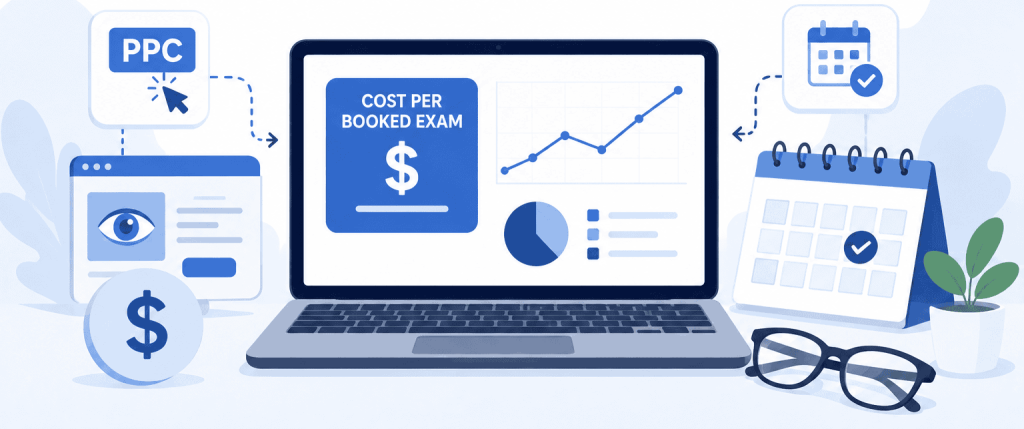
The most useful way to measure cost per booked eye exam is to divide the PPC cost attributable to your campaign by the number of confirmed eye exam appointments that campaign actually generated. If your practice spends $2,000 on PPC and verifies 40 booked appointments from those ads, the result is $50 per booked exam.
Simple math. The difficult part is making sure the 40 appointments are real bookings, not just ad clicks, phone calls, form submissions, or people who opened an online scheduler. Google Ads can measure multiple conversion actions, including website activity and phone calls, but your practice still needs a reliable process for connecting those interactions to confirmed appointments.
What Counts as a Booked Eye Exam in PPC Reporting?
A booked eye exam should be a confirmed appointment that can reasonably be attributed to PPC. It should not simply mean that someone clicked an ad or contacted the office.
For online scheduling, a completed booking confirmation is usually the clearest signal. For phone calls, the front desk may need to verify whether the caller actually scheduled. Form submissions require similar follow-through because a patient who requests an appointment may never complete the scheduling process.
That distinction matters. Google Ads lets advertisers create separate conversion actions for website activity, calls, and other outcomes. A practice can therefore measure several stages of the patient journey rather than treating every interaction as the same result.
Visiclix’s Google Ads for “Eye Exam Near Me” PPC Blueprint explains how calls, forms, and booking confirmations can fit into a broader optometry PPC tracking strategy.
What Costs Should You Include in the Calculation?
At minimum, include the advertising spend required to generate the appointments being measured. For deeper business analysis, you can also maintain a second, fully loaded acquisition figure that includes relevant PPC management costs.
Keep the two calculations separate.
A media-only number tells you how efficiently your advertising budget is creating appointments. A fully loaded acquisition number gives you a broader picture of what the overall PPC program costs the practice.
Do not confuse either metric with the operational cost of providing the exam. Clinical staffing, rent, equipment, and other practice expenses belong to a different financial calculation.
For practices evaluating the broader investment required to run paid search, Visiclix outlines its approach on its PPC Google Ads services page and digital marketing packages page.
How Do You Calculate the Metric Correctly?
The calculation should use the same time period and attribution rules for both spending and verified appointments.
PPC cost per booked eye exam = attributable PPC cost ÷ PPC-attributed booked eye exams
For example:
PPC spend: $3,000
Verified booked exams: 60
$3,000 ÷ 60 = $50 per booked exam
Now compare that with cost per lead.
Suppose the same $3,000 produced 100 phone calls, forms, and other leads. The reported cost per lead would be $30. But if only 60 of those leads actually booked, $30 is not the true appointment acquisition figure. The more meaningful result is $50 per booked exam.
That gap is exactly why practices should avoid making budget decisions from lead volume alone.
How Can You Track Which Bookings Actually Came From PPC?
Accurate attribution requires connecting the original advertising interaction to what ultimately happened inside the practice.
How should online bookings be tracked?
Track the successful completion of the scheduling process whenever the booking system allows it. Google Ads supports website conversion measurement through the Google tag and conversion events, including actions that occur after someone arrives from an advertisement.
A booking confirmation is generally more useful than simply tracking a click on the “Schedule” button.
How should phone bookings be tracked?
Use call measurement to identify calls generated by advertising, then determine which callers actually scheduled.
Google Ads call reporting can track information such as call duration, start time, and whether a call connected. Advertisers can also define qualifying calls as conversion actions based on factors such as minimum duration. However, a long phone call is still not proof that an exam was booked.
How should form leads be tracked?
A form submission should initially be recorded as a lead. If the patient later schedules, the booking outcome should be connected back to that lead where your systems allow it.
Google’s enhanced conversions for leads can help businesses send later offline outcomes back to Google Ads using first-party data and ad-click information. In 2026, Google recommends using its updated Data Manager workflows for these lead and offline conversion processes.
Why should practice records be checked?
Because advertising platforms measure digital events. Your scheduling or practice-management records show whether an appointment actually exists.
Compare the two regularly.
A clear mobile booking experience also makes measurement easier by reducing unnecessary steps between ad click and appointment. Visiclix’s website design and hosting services focus on responsive, conversion-oriented experiences for eye care practices.
Why Can Cost Per Lead Give Eye Care Practices the Wrong Picture?
Cost per lead measures the initial response to advertising. It does not tell you how efficiently those responses become scheduled patients.
Imagine two campaigns that each spend $2,000 and generate 40 leads.
Campaign A converts 20 of those leads into booked appointments. Campaign B converts 32.
Both campaigns show a $50 cost per lead, but their appointment economics are very different. Campaign A costs $100 per booked appointment, while Campaign B costs $62.50.
Why the difference? Search quality may vary. One campaign may receive more irrelevant inquiries. Calls may go unanswered. Patients may encounter booking friction, limited appointment availability, insurance questions, or a landing page that does not match what the advertisement promised.
Cheap leads can still become expensive patients.
What Other Metrics Should You Compare With Booked-Exam Acquisition Cost?
Booked appointment cost should be viewed alongside several downstream metrics because one number cannot explain the entire patient-acquisition process.
Lead-to-booking rate
This measures the percentage of PPC leads that ultimately schedule. A falling booking rate can reveal problems in lead quality, staff follow-up, or the scheduling experience.
Appointment show rate
A booked exam has marketing value, but an attended exam has greater business value. Track cancellations and no-shows separately so changes in patient attendance do not remain hidden.
Cost per completed exam
When attendance data is reliable, this metric goes one step beyond bookings and shows what you spend to produce an actual visit.
Patient value
A practice may also compare acquisition cost with the value generated by different patient types and services. The purpose is not to optimize every campaign toward the cheapest possible appointment. It is to understand whether the patients being acquired make economic sense for the practice.
For a wider view of how PPC fits alongside other patient-acquisition channels, see Visiclix’s digital marketing services for eye care practices.
How Often Should an Eye Care Practice Review This Metric?
Monitor tracking regularly, then make performance decisions using enough data to distinguish genuine trends from short-term fluctuations.
A weekly review is useful for catching broken conversion tracking, unusual spending, missed-call patterns, or campaigns suddenly producing poor-quality inquiries. Monthly analysis is generally more useful for comparing acquisition efficiency and making budget decisions.
Practices with lower PPC volume may need longer periods before drawing strong conclusions.
When enough data exists, compare results by campaign, location, appointment type, and other meaningful categories. Most importantly, keep your definitions consistent. If one month counts every phone call as a booking and the next counts confirmed appointments only, the comparison is worthless.
How Can You Lower the Cost Without Sacrificing Booking Quality?
Improve the number by reducing wasted advertising spend and increasing the percentage of qualified prospects who successfully schedule.
Start with traffic quality. Remove irrelevant search terms, tighten geographic targeting, and make sure advertisements match the services patients can actually book. Then examine what happens after the click.
Can mobile users find the scheduling button immediately? Does someone answer the phone? Is insurance information easy to locate? Are available appointments reasonable? Does the landing page clearly match the patient’s original search?
Better conversion does not always require more traffic. Sometimes the biggest opportunity is fixing what happens to the traffic you already paid for.
For detailed campaign tactics covering search terms, negatives, location targeting, ads, landing pages, and ongoing optimization, use the Visiclix optometry PPC campaign blueprint.
FAQ
What is a good cost per booked eye exam?
There is no universal benchmark that every eye care practice should target. An acceptable acquisition cost depends on local advertising competition, patient value, appointment type, show rate, service mix, and the economics of the individual practice.
Is booked-exam acquisition cost the same as cost per lead?
No. Cost per lead measures inquiries or defined lead actions. Booked-exam acquisition cost measures how much advertising spend was required to produce confirmed appointments.
Should canceled or no-show appointments count as booked exams?
They can remain in the booked-appointment metric because they were genuinely scheduled, but cancellations and no-shows should also be tracked separately. Cost per completed exam can then show what the practice spent to generate appointments that actually resulted in visits.
Can Google Ads automatically tell me how many eye exams were booked?
Google Ads can track configured website actions, calls, and imported offline conversion outcomes. However, accurate appointment reporting still depends on how well the practice connects advertising data with actual scheduling records.
What Should Your Practice Do With This Number Each Month?
Use it to make better decisions, not just to fill another dashboard.
Verify the appointments. Compare acquisition performance across campaigns. Watch for changes in booking rate, completed visits, and patient value. When the number rises, investigate whether the problem began with traffic quality, advertising costs, the landing experience, phone handling, or scheduling.
When it falls, identify why before simply increasing the budget.
Better measurement makes it easier to put PPC dollars behind campaigns that are producing real patient opportunities instead of rewarding campaigns for generating activity that never reaches the schedule.
Why Visiclix Is Your Ideal Choice for PPC Measurement?
Visiclix specializes in digital marketing for optometrists, ophthalmologists, and eye care practices. That industry focus helps connect advertising performance with the outcome practices actually care about: bringing appropriate patients closer to an appointment. Its services include Google Ads, web design, SEO, and broader digital marketing strategies designed around eye care growth. Learn more about the team on the About Visiclix page.
Measurement also works better when campaigns, landing pages, tracking, and patient conversion are treated as parts of the same system. Visiclix can help practices evaluate paid-search performance beyond clicks and surface-level leads, then identify opportunities to improve targeting, conversion paths, and appointment acquisition. Clearer numbers. Better decisions. More confidence in where the marketing budget goes.
See What Your PPC Is Really Producing With Visiclix
If your reporting ends at clicks, calls, or form submissions, you may still be missing the metric that matters most.
Contact Visiclix for a free marketing consultation to review how your campaigns connect advertising spend with real patient appointments and identify where stronger tracking or conversion strategy could improve performance.