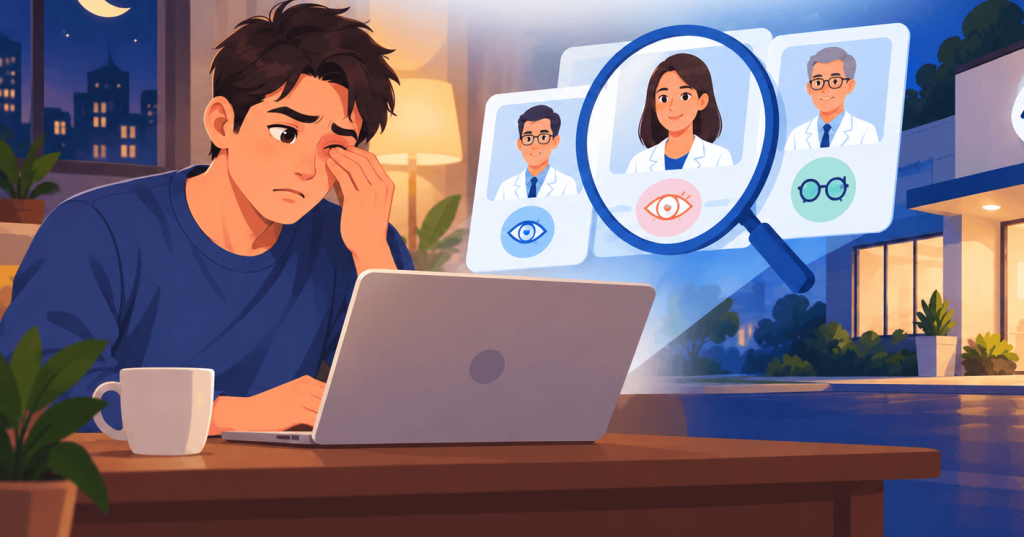
A patient searching for eye care at 9 p.m. has a different problem from someone looking for an appointment during normal office hours.
They may be dealing with sudden eye pain, new floaters, an injury, a red eye that is getting worse, or another symptom they do not know how to interpret. At the same time, the clinic they find in search may already be closed.
That is where after hours eye care SEO becomes more than a question of rankings. The clinic’s website and local search presence should quickly tell the patient whether the practice is available, what happens if they call or submit a message, when normal service resumes, and where they should turn if the problem should not wait.
The goal is not to make a clinic look available around the clock. It is to make the next appropriate action clear even when the clinic cannot see the patient immediately.
After-Hours Searches Have a Different Job Than Same-Day Urgent Searches
Not every time-sensitive eye care query represents the same intent.
A search for “urgent eye doctor near me” at 2 p.m. may come from someone trying to find an appointment that afternoon. A search for “eye doctor open now” at 11 p.m. raises a different question: what can this person actually do at this hour?
That distinction should shape the content a clinic publishes.
Visiclix’s guide to same-day urgent eye care SEO focuses on helping patients determine whether a clinic can provide care today. An after-hours experience has another job. It must still be useful when the answer is, “Our office is currently closed.”
Eye clinics should therefore think beyond one broad “emergency eye care” keyword. Searches can reflect different needs, including:
- finding a clinic that is currently open
- understanding whether a symptom may be urgent
- determining whether a problem can wait until morning
- locating emergency care when the clinic is unavailable
- scheduling the next available appointment
Giving those needs clear destinations is part of good search-intent planning. Visiclix’s optometry search intent mapping framework recommends identifying missing, mismatched, and overlapping intent rather than publishing pages around keywords alone.
Make the Clinic’s Current Availability Impossible to Misunderstand
For an after-hours visitor, operating status is not minor footer information. It may be the first fact they need.
The website should make regular hours, weekend schedules, phone numbers, locations, and relevant holiday changes easy to find on a mobile screen. If the office is closed, the visitor should not have to interpret vague language to determine that.
Google Business Profile information should tell the same story. Businesses can edit their main hours and use special hours for holidays, special events, and other temporary schedule changes. Clinics should make sure those hours reflect the times patients can actually access the practice.
The website should also explain what “contact us” actually means after closing.
For example:
- Is voicemail checked only when the office reopens?
- Does an answering service respond after hours?
- Is an on-call clinician genuinely available?
- Can patients schedule online while the office is closed?
- Are website forms monitored overnight or only during business hours?
There is no universal answer. The important part is publishing the clinic’s real process.
A button that says “Call Now” can still be useful when an office is closed, but nearby copy should not suggest that a clinician will answer immediately unless that is true. Likewise, a contact form should not look like an emergency-response channel if submissions will sit unread until the next business day.
This is also a website-design issue. Critical availability information needs to remain obvious on smaller screens, which makes mobile-friendly website design for eye-care practices part of the after-hours experience.
Publish Clear Guidance for Problems That Should Not Wait Until Morning
After-hours content should not attempt to diagnose a patient’s condition. It can, however, help people recognize situations in which delaying professional evaluation may be inappropriate.
Examples may include intense eye pain, major changes in vision, a serious eye injury, an object stuck in the eye, chemical exposure, or sudden flashes, floaters, or curtain-like changes in vision.
A clinic’s content can translate that principle into a clear after-hours pathway.
Instead of simply publishing a long list of eye emergencies, tell visitors what to do when the practice itself cannot provide immediate care. That might mean directing certain patients to an emergency department, another appropriate emergency resource, or the clinic’s established after-hours process.
The exact instructions should reflect the clinic’s clinical policies and should be reviewed by an appropriately qualified eye-care professional.
That distinction matters. An SEO writer should not independently decide which symptoms are safe to delay.
Eye clinics can also support this experience with carefully planned educational content. Visiclix’s guide to symptom-based SEO for optometrists explains how people often search for the symptom they notice before they know the name of a condition or service.
Give After-Hours Visitors a Useful Next Step Instead of a Dead End
Telling someone “we are closed” is accurate, but it is not enough.
The next step should depend on what the clinic can actually offer. A visitor may be able to:
- schedule the next available routine appointment
- view the next opening time
- call an established after-hours number
- follow the clinic’s emergency instructions
- get directions to the practice for a later visit
- review relevant symptom or urgent-care information
The order of information matters too.
A worried mobile visitor should not have to scroll through several paragraphs about the practice before finding out what to do. For an after-hours page or urgent-care section, a useful hierarchy is often:
- current availability
- urgent safety guidance
- the appropriate next action
- contact or scheduling options
- additional supporting information
This is where search experience and conversion design meet. The purpose of the CTA is not simply to generate a lead. It is to direct the visitor toward an action that makes sense at that moment.
Keep Website Hours and Google Information Consistent
After-hours eye care SEO can break down before someone ever visits the clinic’s website.
A patient may see an “Open” or “Closed” indication directly in Google Search or Maps. If those hours disagree with the website, the patient has to decide which source to trust.
Practices should periodically compare operating information across their website, Google Business Profile, location pages, scheduling systems, and other important listings.
Holiday schedules deserve particular attention. Clinics should update special hours for temporary schedule changes rather than allowing outdated information to remain visible.
Structured data can support the same effort. Visiclix’s local schema markup guide for eye clinics explains how schema can help reduce ambiguity around business information. Schema supports understanding, but it does not create after-hours availability or guarantee rankings.
Clinics should also resist the temptation to manufacture an “open late” advantage. If the practice is not open 24 hours, the website and Business Profile should not imply that it is.
Accuracy is more valuable than appearing available when the practice is not.
Build One After-Hours Search Journey Instead of Several Competing Pages
An eye clinic usually does not need multiple pages targeting slightly different versions of “emergency eye doctor,” “urgent eye doctor,” and “after-hours eye clinic.”
Each useful page should have its own job.
An urgent eye care service page can target appointment-oriented searches. Symptom articles can answer specific questions. Location pages can serve geographic intent. Provider pages can explain who delivers the care. An after-hours article or clearly defined section can address what happens when normal availability ends.
Visiclix’s guide to service pages versus blog posts for eye-care SEO recommends separating appointment-driven topics from question-driven educational topics, then connecting them with relevant internal links.
A keyword map for eye-care services can help assign those themes to specific URLs before another page is published. That reduces the chance that several pieces of content compete for essentially the same patient need.
Audit the After-Hours Experience From the Patient’s Point of View
The simplest way to find problems is to experience the search journey when the clinic is actually closed.
Search for the practice on a phone after normal hours and ask:
- Does Google correctly show whether the clinic is open or closed?
- Are weekend and holiday hours accurate?
- Is the phone number obvious?
- Is it clear whether anybody answers after hours?
- Does the site explain what people with potentially serious symptoms should do?
- Can a routine patient schedule the next available visit?
- Do the contact page, urgent-care page, location page, and Google profile agree?
- Does any wording suggest 24-hour availability that the practice does not provide?
- Has the clinical guidance been reviewed recently?
The point of the audit is not to add more words to the website. It is to remove uncertainty from a high-stress search.
FAQ
What is after hours eye care SEO?
After hours eye care SEO is the process of making a clinic’s search presence and website useful to people looking for time-sensitive eye care outside normal operating hours. It includes accurate hours, appropriate content, clear emergency guidance, local search information, and realistic next-step options.
Should an eye clinic create a separate after-hours eye care page?
Not automatically. A separate page makes sense when it satisfies a distinct search intent and contains enough useful information to justify its existence. If the information largely repeats an urgent-care service page, improving the existing page or publishing a focused supporting article may be better.
Should an eye clinic say it offers emergency eye care if it is not open 24/7?
A clinic should clearly distinguish the type of care it provides from when that care is available. Offering urgent or emergency eye care during business hours does not automatically mean the practice provides 24-hour access. Website and Business Profile wording should make that distinction clear.
How should eye clinics handle holiday closures for SEO?
Update the website and any relevant scheduling information, then update Google Business Profile with the correct temporary or special hours. The important point is that every patient-facing source should reflect the same schedule.
Can schema markup help with after-hours searches?
Schema can help search engines understand business information such as operating hours and locations. It cannot compensate for inaccurate hours, weak content, or a confusing patient journey, and it does not guarantee higher rankings.
What should an eye clinic website tell someone with a possible eye emergency after closing?
It should make the clinic’s current availability clear, explain which contact channels are actually monitored, provide clinician-reviewed guidance for situations that may require immediate care, and give an appropriate next step when the practice is unavailable.
After-hours search visibility is ultimately an accuracy and patient-experience problem as much as an SEO problem. A clinic does not need to appear open around the clock to be useful to someone searching late at night. It needs to make the safest and most appropriate next step easy to understand.
For eye-care practices whose service pages, symptom content, operating information, and local search presence do not yet work together, Visiclix’s SEO services for eye doctors can help turn those individual pieces into a clearer search journey.