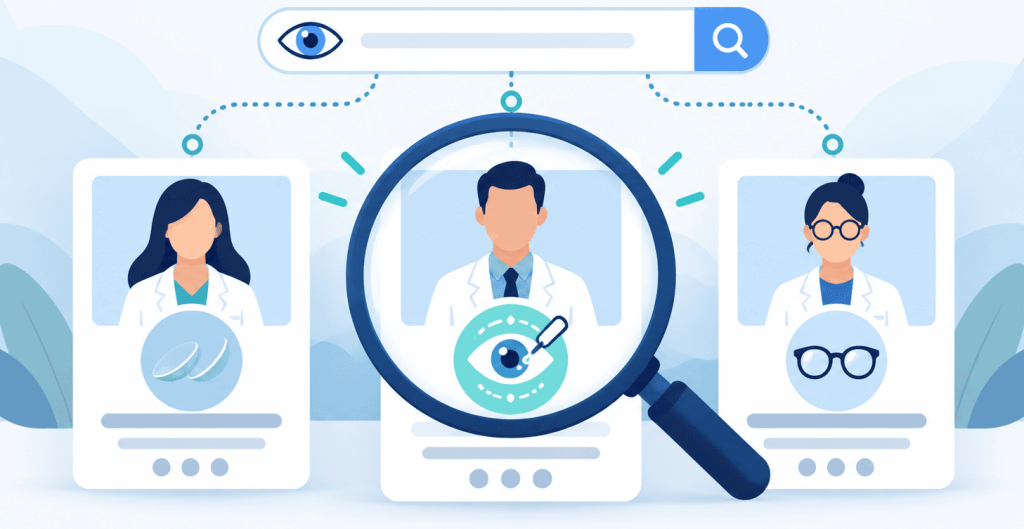
Search engines can identify which eye doctor offers a specific service when an eye care website clearly connects the provider, service, credentials, location, and supporting pages. That connection is built through visible page content, descriptive internal links, organized site architecture, accurate location information, and structured data that reinforces what users can already see.
That is the core purpose of optometrist service page SEO. A service page should do more than mention a treatment. It should help search engines and prospective patients understand what the practice offers, which provider delivers that care, where the service is available, and what someone should do next.
This distinction matters because “eye doctor” is a broad term. The National Eye Institute notes that the right type of eye doctor depends on the patient’s care needs, while Cleveland Clinic and WebMD distinguish optometrists, ophthalmologists, and other eye care professionals according to their roles and scopes of care. A website should make those distinctions just as clearly.
What Makes Optometrist Service Page SEO Clear to Search Engines?
A strong service page gives one service a recognizable home and supplies enough context to understand what that service means within the practice.
For example, a dry eye treatment page should not simply say that the clinic treats dry eye. It can explain who the treatment is intended for, what evaluations may be involved, which qualified providers offer the service, where appointments are available, and how a patient can schedule care.
Think of the relationship this way:
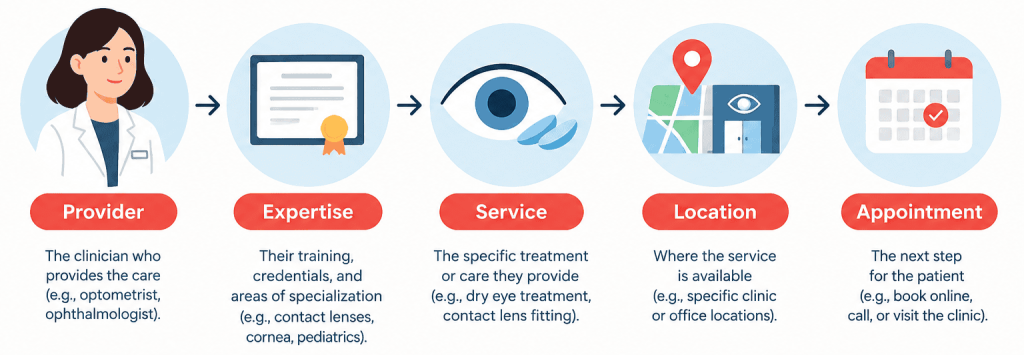
That is much clearer than placing “dry eye treatment” in a long list of services on a generic page.
Page titles and headings should also accurately describe the service rather than attempting to cover several unrelated treatments at once. Provider information should be accurate and useful, particularly when a service depends on specialized training or experience.
Practices that need a broader foundation can also review Visiclix’s SEO services for eye doctors to see how service architecture fits into an overall search strategy.
How Should Provider Pages and Service Pages Connect?
Provider pages and service pages should support each other while answering different questions.
A provider page explains who the clinician is. It can cover education, credentials, areas of interest, professional experience, and the locations where that person practices. A service page explains what the practice offers, who may benefit from it, and how the service is delivered.
These pages can then connect naturally.
Suppose Dr. Smith provides specialty contact lens fittings. Dr. Smith’s profile can mention that experience and direct readers to the specialty contact lens page. In return, the service page can identify Dr. Smith as one of the providers available for that care.
The relationship becomes easier for patients to follow and gives search engines more context about how the pages relate.
Avoid turning every provider profile into a duplicate service page. The bio should focus on the clinician, while the service page remains the primary destination for the treatment or service itself. Visiclix explains this distinction further in its guide to creating doctor bio pages that earn trust and rank.
How Can Keyword Mapping Keep Eye Care Services From Competing With Each Other?
Keyword mapping gives each important search intent a primary destination.
An eye exam query may belong to the comprehensive eye exam page. Dry eye treatment terms may belong to a dedicated dry eye service page. A doctor’s name belongs primarily to that doctor’s profile. Questions such as “why are my eyes dry at night?” may be better suited to educational content that eventually points readers toward the relevant service.
Without this separation, several pages may attempt to satisfy essentially the same search intent.
That can create an unclear site structure. Instead of deliberately assigning one primary URL to an important service, a practice may have a service page, doctor biography, location page, and three blog posts all using nearly identical titles and targeting the same appointment-ready query.
Keyword mapping helps establish hierarchy. Supporting pages can still discuss the topic, but they should contribute additional context and direct users toward the primary service page rather than trying to replace it.
For a more detailed framework, see Visiclix’s SEO keyword map for eye care services.
How Do Internal Links Confirm Which Provider Offers Which Service?
Internal links help search engines discover pages and understand how those pages relate.
Google specifically states that it uses links as a signal when determining page relevance and discovering pages to crawl. It also recommends descriptive, concise anchor text because useful anchor text gives users and Google information about the destination page.
For an eye care practice, that makes descriptive links especially useful.
A provider biography might link through the words “dry eye treatment” rather than a generic phrase such as “click here.” A location page might direct patients to “myopia management at our Northside office.” A service page might link to the profile of the clinician who provides that treatment.
Accuracy still comes first. Do not connect a doctor with a service they do not actually provide simply to create another keyword-rich link.
Educational content can contribute to the same structure. A blog post may answer an early-stage question and then guide readers toward the relevant service when they are ready for care. Visiclix discusses that division of responsibility in its guide to service pages versus blog posts for eye care SEO.
How Can Structured Data Reinforce Provider-Service Relationships?
Structured data can provide machine-readable clues that reinforce optometrist service page SEO, but it works best when it reflects information that is already clear to users.
Google describes structured data as a standardized way to provide explicit information about a page and classify its content. Its guidelines also state that markup should represent the actual visible content and should not describe information hidden from users.
For an eye care website, appropriate Schema.org concepts may include a local or medical business, provider information, location details, and relevant medical specialties. Schema.org also includes Optometric as a medical specialty and offers properties for describing available medical services in applicable provider types.
Structured data should support the page rather than repair weak content. If the visible page never identifies a provider as offering dry eye care, adding that relationship only in code creates an avoidable inconsistency.
Google also makes clear that correctly implemented structured data does not guarantee that a rich result will appear.
Practices working on this technical layer can reference Visiclix’s optometry local schema markup guide.
How Should Multi-Location Eye Practices Show Who Offers What Where?
Multi-location practices should clearly indicate which providers and services are available at each office.
Do not assume that because the organization offers a service somewhere, search engines or patients will understand that it is available everywhere.
Suppose a practice operates three offices, but advanced dry eye treatment is available only at one location. The relevant service page should state that availability. The location page should also identify the service, and provider pages should accurately list where those clinicians practice.
Google’s LocalBusiness structured data documentation similarly recommends defining individual business locations and providing specific information such as addresses and URLs for those locations.
Consistency matters beyond the website too. Practice names, locations, services, phone information, and other major business details should not contradict what patients encounter elsewhere online.
Clear location mapping becomes especially important as a practice grows. More offices create more possible provider-service-location combinations, so the site architecture needs to remain intentional.
FAQ
Should every optometrist service have its own page?
Not necessarily. Important services with distinct patient needs and meaningful search intent often benefit from dedicated pages. Minor variations that would result in thin or nearly identical pages may be better combined into a broader, useful resource.
Should every service page list the doctors who provide that service?
When provider information is relevant and accurate, yes. Showing who delivers the service can help patients make a more informed decision and makes the relationship between provider and treatment clearer.
Can one optometrist be connected to multiple service pages?
Yes. A provider may legitimately offer several services. Each connection should reflect the clinician’s actual role, experience, and scope of practice.
Does Service schema automatically help an optometrist rank?
No. Structured data can help search engines interpret information, but Google does not guarantee rich results or improved rankings simply because markup is present. The underlying page still needs useful, accurate, accessible content.
How can an eye clinic tell if Google understands its service pages?
Google Search Console is a useful starting point. Its Performance report can be analyzed by queries and pages, allowing a practice to see which searches surface specific URLs, how often those URLs appear, and whether users click them. If dry eye queries consistently surface the intended dry eye service page instead of unrelated pages, that is one useful indicator that the site’s mapping is becoming clearer.
What Should an Eye Care Practice Do Next?
Search engines should not have to guess what an eye care practice offers.
Start with one high-value service and trace the relationship from beginning to end. Which page owns the service? Which providers actually deliver it? At which locations? Do the provider and location pages reinforce that relationship? Can relevant educational content guide patients toward it? Is there an obvious path to scheduling?
Then repeat the process for the next priority service.
A well-organized eye care website becomes easier for search engines to interpret because its content reflects the way the practice actually operates. Just as important, prospective patients can more quickly answer the question that brought them to the site: “Can this doctor help me with what I need?”
Why Is Visiclix Your Ideal Choice for Optometrist Service Page SEO?
Visiclix focuses on search strategies built specifically around eye care practices. That specialization matters when provider profiles, service pages, locations, local visibility, technical SEO, and educational content all need to work together. Instead of treating an optometry website like a generic local business site, Visiclix can structure those signals around the way patients actually search for eye care.
The goal is not simply to increase the number of pages on a website. It is to make important services easier to understand, easier to discover, and easier to connect with the right provider and location. A clearer site structure can support stronger organic visibility while giving appointment-ready patients a more direct path from search to care.
Make Your Eye Care Services Easier to Find With Visiclix
If patients have to dig through your website to determine who offers a service, search engines may face the same ambiguity. Visiclix can help organize your providers, services, locations, and supporting content into a clearer search-focused structure designed to turn visibility into meaningful patient action.