
An optometry practice should use Optometric schema to identify each physical clinic, supported by page-specific structured data such as Organization, WebSite, Person, Service, BreadcrumbList, and Article. Each location should be treated as a separate entity with its own address, phone number, opening hours, map, and permanent page URL.
A sound optometry local schema markup strategy does more than install a block of code. It connects the information patients see with the information search engines process. Combined with accurate location pages, business listings, and professional SEO for eye doctors, this creates a clearer and more consistent representation of the practice online.
Google recommends defining each physical business location individually and using the most specific applicable LocalBusiness subtype. Structured data can make a page eligible for enhanced search features, but it does not guarantee a particular result, rich feature, or ranking.
Why Does Structured Data Strengthen Local Search Trust for Eye Clinics?
Structured data strengthens local search trust by giving search engines an organized description of the clinic’s identity. Instead of relying entirely on page copy, crawlers can identify the practice name, address, telephone number, hours, website, map location, services, and relationship to a larger organization.
That information should reinforce what already appears on the website, Google Business Profile, and third-party listings. It should never be used to introduce hidden services, outdated hours, or misleading claims. Google requires structured data to accurately represent the visible page and advises publishers to use the most specific applicable schema types and properties.
Consistency matters here. A clinic showing different phone numbers or opening hours across its website, schema, and listings creates unnecessary ambiguity. Visiclix’s reputation management and local citation services address this broader consistency by helping eye-care practices maintain accurate business information across online platforms.
Which Schema Types Belong on an Optometry Website?
The right schema depends on what each page is primarily about. Not every type belongs on every page, and adding more markup does not automatically make the implementation stronger.
When Should a Clinic Use Optometric or MedicalBusiness?
Use Optometric when the page represents a physical optometry practice or clinic. Schema.org places Optometric beneath MedicalBusiness and LocalBusiness, making it more specific than the broader MedicalBusiness type. Google’s general guidance is to select the most specific applicable local-business subtype.
The term has a second role. Schema.org also recognizes Optometric as a value under MedicalSpecialty, where it describes the practice of testing visual acuity and prescribing corrective lenses. It may therefore be used as a specialty value on compatible medical-provider or medical-organization entities. The context determines the meaning.
Which Supporting Types Should Be Added?
Use Organization and WebSite to describe the overall brand and website. Individual optometrists can normally be represented with Person, while Service can describe clearly documented offerings such as comprehensive eye exams, contact-lens fittings, dry-eye evaluations, or myopia management.
Be careful with Physician. Schema.org defines it as an individual physician or physician’s office considered as a medical organization. It should not be added automatically to every optometrist profile simply because the person is a healthcare provider.
Use Article or BlogPosting for educational content, BreadcrumbList for navigational hierarchy, and Product with Offer only on genuine eyewear or ecommerce pages. Page intent first. Schema second.
Which Practice Details Should an Eye Clinic Include in Its JSON-LD?
An eye clinic should include stable, verifiable details that distinguish the location and explain how patients can find or contact it. Core properties commonly include:
- @id, name, url, and telephone
- image and logo
- address with PostalAddress
- geo with latitude and longitude
- openingHoursSpecification
- hasMap
- sameAs
- parentOrganization for a branch or multi-location brand
A stable @id gives the entity a consistent identifier that other schema nodes can reference. For a multi-location group, parentOrganization can connect the clinic to the larger practice without combining the contact information of separate branches. Schema.org defines that property as the relationship between an organization and the larger organization it belongs to.
A simplified location example might look like this:
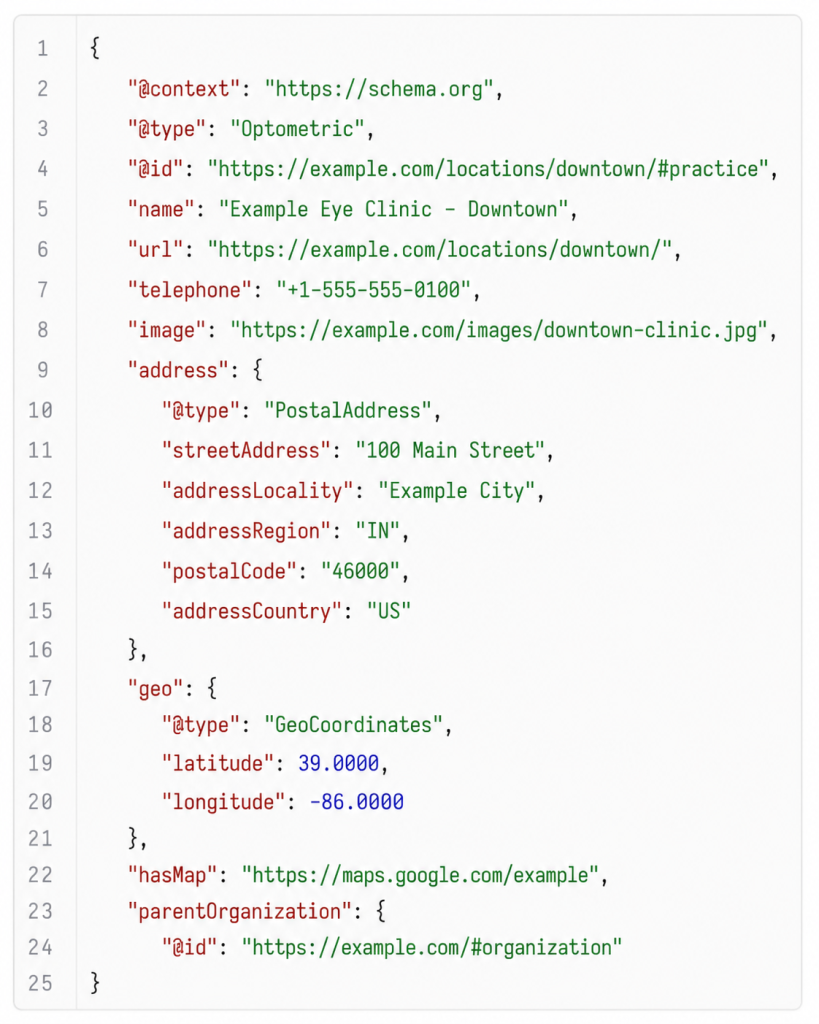
The final code must use the clinic’s real information and match the visible page.
How Should Optometry Local Schema Markup Be Mapped Across the Website?
Optometry local schema markup should follow page intent rather than repeating one clinic object across the entire site.
| Website page | Recommended schema |
| Homepage | Organization and WebSite |
| Individual clinic page | Optometric, PostalAddress, and GeoCoordinates |
| Provider biography | Person and appropriate credentials or affiliations |
| Eye-care service page | Service connected to the clinic or provider |
| Educational article | Article or BlogPosting and BreadcrumbList |
| Eyewear product page | Product and Offer, when genuinely applicable |
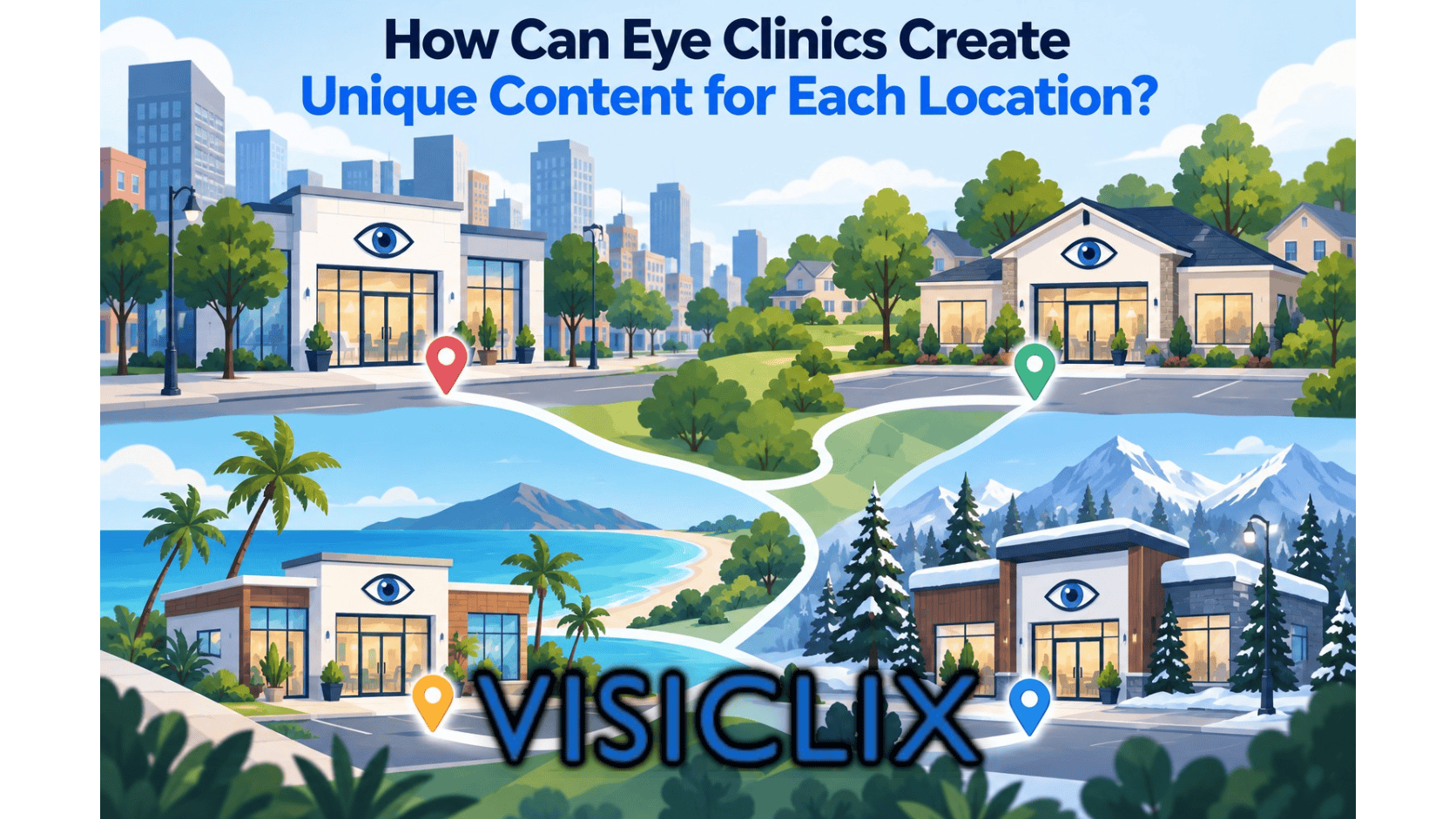
For a multi-location practice, each clinic needs a unique URL, @id, address, phone number, hours, map, and location-specific content. One location, one entity. Reusing the same business markup on every branch page can cause the schema to conflict with what patients actually see.
Google explicitly recommends defining every local business location separately. It also advises placing structured data on the page it describes.
Visual content suggestion: Create a simple architecture diagram connecting the homepage organization to separate location entities, providers, and service pages.
How Can an Optometry Practice Implement and Validate Schema Safely?
A safe implementation begins with an inventory of the real entities and facts on each page. From there, the practice or developer can select the most specific types, generate JSON-LD, connect related nodes with stable identifiers, and check whether a theme or plugin is already creating duplicate markup.
Before deployment, test the code with the Schema Markup Validator to identify vocabulary and relationship problems. Then use Google’s Rich Results Test to see which Google-supported enhancements the page may qualify for. The Rich Results Test checks either code or a publicly accessible URL, but not every valid Schema.org type necessarily appears as a supported rich-result category.
After publishing, inspect the live page in Google Search Console. The URL Inspection tool provides information about indexing, crawlability, rendered content, and structured-data enhancements detected on the page. Recheck the implementation whenever the clinic changes its hours, providers, address, services, website templates, or SEO plugins.
Technical implementation also depends on a stable website foundation. Professional website design, hosting, and maintenance can help prevent schema from breaking during redesigns, plugin updates, and content changes.
Which Schema Mistakes Can Undermine Search Trust?
The most damaging schema mistakes are usually accuracy problems—not missing optional properties. Common examples include conflicting contact details, closed locations that remain active in the code, outdated provider information, and services marked up on pages where they are never mentioned.
Other risks include:
- Copying one location’s JSON-LD onto every branch page
- Creating multiple competing clinic entities through different plugins
- Using broad or inaccurate medical types
- Marking up hidden or irrelevant information
- Assuming an error-free test guarantees a rich result
- Adding review markup solely to obtain stars for the clinic’s own testimonials
Google does not show local-business review stars for self-serving reviews on a business’s own website. A clinic can still publish legitimate patient feedback, but adding AggregateRating does not make those reviews eligible for review-star treatment.
What Else Should Practices Know About Optometry Schema?
Does schema markup directly improve local rankings?
Schema should not be treated as a standalone ranking shortcut. Its practical value is reducing ambiguity, classifying page content, and making eligible information easier for search systems to process. Google still decides which features to display based on numerous factors.
Should every optometry location have separate schema?
Yes. Every physical clinic should have its own entity, URL, address, telephone number, hours, map, and identifier. The locations can then be connected to the same parent organization.
Is Optometric a business type or a medical specialty?
It can function in both contexts. As a business type, it identifies an optometry clinic beneath MedicalBusiness. As a specialty value, it describes optometric care on compatible medical entities.
Can an eye clinic add schema for its patient reviews?
A clinic may represent genuine content accurately, but it should not expect self-published reviews about its own business to produce local-business review stars. Never create, inflate, or hide reviews for structured-data purposes.
How often should a practice audit its schema?
Audit it whenever business information or website technology changes. A broader annual or semiannual review can also catch duplicate plugins, obsolete providers, broken URLs, and inconsistent location data.
Why Is Visiclix Your Ideal Choice for Optometry Local Schema Markup?
Visiclix specializes in digital marketing for optometrists, ophthalmologists, and eye-care practices. Its team combines technical SEO, website development, local visibility, reputation management, and paid advertising rather than treating structured data as an isolated code project. That industry focus helps connect technical implementation with the way real eye-care practices organize locations, providers, and services. Learn more about Visiclix and its eye-care marketing experience.
For practices that need optometry local schema markup, the goal is not simply to pass a validation test. The clinic’s code, website content, business listings, and patient journey must tell the same story. Visiclix offers customizable digital marketing packages for eye-care practices that bring SEO, Google Business Profile management, reviews, website support, and performance tracking together.
Ready to Strengthen Your Search Signals With Visiclix?
Accurate structured data starts with an accurate understanding of the practice itself—its locations, people, services, and online relationships. Get those details right, connect them clearly, and maintain them as the business evolves.
Contact Visiclix to discuss a technical SEO and structured-data review built specifically for your eye-care practice. Clearer signals. Stronger foundations. A website that is easier for both patients and search engines to understand.