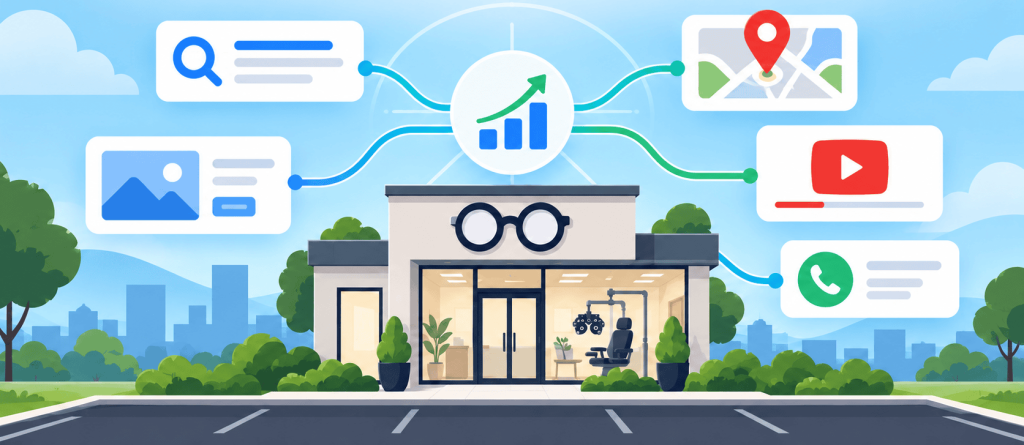
Not everyone looking for an eye exam searches the same way. Some people type “eye doctor near me,” while others search for “where to get my vision checked” or “optometrist accepting new patients.”
These searches may reflect similar needs, but traditional Google Ads campaigns don’t always capture every relevant variation.
That’s where AI Max for optometrists comes in.
Google Ads AI Max introduces AI-powered features that help Search campaigns identify additional relevant searches, customize advertising messages, and direct visitors to suitable website pages.
For optometry practices, this technology could create more opportunities to reach people actively looking for eye care services. Understanding how it works can help practice owners decide whether it belongs in their advertising strategy.
How Does AI Max Work Within Google Search Campaigns?
AI Max enhances existing Google Search campaigns rather than functioning as a separate campaign type. It uses automation to expand search matching, adjust ad messaging, and select relevant landing pages.
Three main features make this possible.
Search Term Matching Finds More Relevant Searches
Traditional Search campaigns rely on keywords selected by advertisers. AI Max expands on this approach using broad match and keywordless technology to identify additional relevant searches.
For example, a practice targeting “eye exam near me” might also become eligible for searches such as “where can I get my eyesight checked.”
Google considers existing keywords, advertisements, and landing page content when identifying these opportunities.
This can help optometrists reach prospective patients who describe their needs differently from the keywords already included in a campaign.
However, broader search matching requires monitoring. Practices should review search terms regularly to ensure their advertising budget isn’t being spent on unrelated services or unsuitable inquiries.
Text Customization Adjusts Ad Messaging
AI Max can generate additional advertising headlines and descriptions using information from a practice’s website and existing campaign content.
Suppose an optometry practice offers routine eye exams and contact lens fittings.
Someone searching for contact lens services may see messaging tailored to that interest, while another person looking for a general eye examination may encounter different wording.
This flexibility can make advertisements more relevant to individual searches.
Still, automated messaging needs oversight. Optometrists should review generated content to ensure advertisements accurately describe their services and avoid unsupported claims.
Final URL Expansion Selects Relevant Landing Pages
Final URL expansion allows Google to select a relevant page from an advertiser’s website instead of always directing visitors to one predetermined destination.
For example, someone searching for contact lens fittings might reach a dedicated service page rather than the practice homepage.
This can make it easier for prospective patients to find the information they’re looking for.
The feature works best when a website has clear, accurate service pages. Advertisers can also apply URL exclusions to prevent unsuitable pages from being used as advertising destinations.
How Can AI Max Help Optometrists Reach More Potential Patients?
AI Max can potentially improve how eye care practices connect with prospective patients. Its benefits come from matching searches with relevant advertising and useful website content.
Discover Relevant Searches Your Keywords May Miss
Patients don’t always use clinical terminology when searching for eye care.
Someone experiencing difficulty seeing distant objects might search for “eye test for blurry distance vision” rather than “comprehensive eye examination.”
Similarly, someone interested in trying contact lenses may search for “contacts for first-time wearers” instead of “contact lens fitting.”
AI Max may identify these variations when they’re relevant to a practice’s campaign.
For optometrists, this creates opportunities to reach people who may not use the exact keywords an advertiser originally selected.
Connect Patients With Relevant Service Information
Getting someone’s attention through an advertisement is only the first step.
Once visitors reach a website, they need information that addresses their concerns.
A parent searching for children’s eye exams, for example, may benefit from landing directly on a pediatric eye care page if the practice offers that service.
AI Max can help connect searches with suitable pages, reducing the need for visitors to navigate through unrelated information.
Clear service descriptions and accessible contact details can further improve that experience.
Create More Opportunities for Appointment Requests
More relevant searches and landing pages may lead to additional appointment opportunities.
However, increased website traffic doesn’t automatically produce more patients.
Visitors still need a convenient way to contact the practice or request an appointment.
A thoughtful online booking strategy can help practices make that next step more straightforward.
AI Max may help attract interested visitors, while the website experience determines how easily they can take action.
AI Max vs. Traditional Search Ads and Performance Max
Although these advertising approaches use Google Ads, they operate differently.
| Advertising approach | How it works |
| Traditional Search Ads | Reach potential customers using selected keywords, targeting settings, and ad assets. |
| Search Ads with AI Max | Enhance Search campaigns with AI-powered matching, messaging, and landing page selection. |
| Performance Max | Uses a separate goal-based campaign type to advertise across multiple Google channels. |
Traditional Search campaigns offer advertisers direct control over selected keywords and campaign settings.
AI Max adds automation to Search campaigns, helping identify additional opportunities without requiring advertisers to manually specify every relevant search variation.
Performance Max takes a broader approach by allowing advertising across channels such as Search, YouTube, Display, and Maps.
For optometrists, choosing the right approach depends on campaign goals, available budget, conversion data, and management requirements.
A practice focused on generating local eye exam appointments may have different advertising needs from one promoting optical products across several channels.
What Should Optometrists Check Before Enabling AI Max?
AI Max can automate certain advertising decisions, but successful implementation still requires preparation.
Before enabling these features, practices should review their website, advertising content, and campaign settings.
Make Sure Your Landing Pages Match Your Services
Final URL expansion relies on having relevant pages available.
If a practice offers comprehensive eye examinations, contact lens fittings, and specialty vision services, its website should clearly explain those services.
Patients should be able to find important details, including practice locations, appointment options, and contact information.
Poorly organized pages can make it difficult for visitors to understand what a practice offers.
Investing in clear website design can improve the experience for people arriving through Google Ads.
Practices should also exclude pages that don’t support their campaign objectives, such as billing portals, patient logins, or administrative forms.
Review Ad Copy and Patient Information Safeguards
Healthcare advertising requires attention to accuracy and privacy.
Automatically generated advertisements should describe services truthfully and avoid promising results that cannot be guaranteed.
Optometrists should periodically review AI-generated headlines and descriptions to ensure they’re appropriate for their practice.
Patient information also requires careful handling.
For U.S. practices subject to HIPAA, advertising tracking and website integrations must be evaluated to avoid inappropriate disclosures of protected health information.
Understanding patient data privacy is especially important when using automated advertising tools alongside website analytics and conversion tracking.
AI Max doesn’t remove a practice’s responsibility to maintain accurate advertising and appropriate privacy safeguards.
Check Your Targeting and Campaign Goals
Most optometry practices serve patients within a defined geographic area.
Before expanding search matching, advertisers should confirm that campaign targeting aligns with their actual service locations.
It’s also important to review negative keywords, landing page exclusions, campaign budgets, bidding strategies, and conversion goals.
For example, an optometrist promoting comprehensive eye exams may not benefit from advertising traffic searching primarily for free online vision tests.
These checks help keep automation focused on searches that are relevant to the practice.
How Can Eye Care Practices Test Whether AI Max Is Working?
Enabling AI Max doesn’t guarantee improved advertising performance.
Practices need a reliable way to determine whether the additional automation produces meaningful results.
Start With a Controlled Experiment
Google Ads provides AI Max experiments for eligible Search campaigns.
These experiments allow advertisers to compare existing campaign performance with a version using AI Max features.
For optometrists, testing can help determine whether expanded search matching and automated messaging generate useful results.
During the experiment, practices should monitor search terms, landing page activity, advertisement content, and conversions.
Avoid making unrelated campaign changes during the test, since those adjustments could make it harder to understand what influenced performance.
Measure Patient Acquisition, Not Just Ad Clicks
An increase in website traffic may look encouraging, but clicks alone don’t indicate whether an advertising campaign is attracting suitable prospective patients.
An optometry practice could receive additional visitors without generating more appointment inquiries.
More useful performance indicators include qualified inquiries, relevant booking actions, conversion rates, and cost per qualified lead.
Practices should also evaluate how those actions are measured.
Appropriate conversion tracking can help advertisers assess results while considering healthcare privacy requirements.
Where permitted, practices can compare aggregate marketing performance with internally recorded appointment outcomes without sharing patient-level health information with advertising platforms.
The goal is to determine whether AI Max contributes to valuable patient acquisition opportunities rather than simply increasing advertising activity.
Frequently Asked Questions About AI Max for Optometrists
Do Optometrists Need to Create New Google Ads Campaigns to Use AI Max?
No. AI Max can be enabled within eligible existing Search campaigns. Practices should review their current campaign settings and bidding strategies before making changes.
Can Small Optometry Practices Use AI Max?
Yes. AI Max isn’t limited to large practices.
However, smaller optometry clinics should consider their advertising budgets, local search demand, conversion data, and available management resources before testing it.
Can Optometrists Turn Off AI Max Features?
Yes. Google provides controls over supported AI Max capabilities, including search term matching and asset optimization.
Some settings depend on others. For example, final URL expansion requires text customization to be enabled.
What Happens to Existing Dynamic Search Ads?
Google has announced changes that transition Dynamic Search Ads functionality toward AI Max.
Automatic upgrades involving Dynamic Search Ads are scheduled to begin in February 2027. Earlier changes involving automatically created assets and campaign-level broad match settings began in September 2026.
Practices using these features should review their campaign configurations and prepare for applicable updates.
Make Smarter Google Ads Decisions for Your Eye Care Practice
AI Max creates opportunities for optometrists to reach additional relevant searches, deliver more tailored advertising, and connect prospective patients with useful website content.
However, its effectiveness still depends on accurate service information, appropriate targeting, reliable measurement, and regular campaign management.
For practices exploring AI Max, the priority should be understanding how these capabilities support their patient acquisition goals.
Visiclix offers Google Ads management for optometrists and eye care practices, helping businesses develop advertising strategies aligned with their services and marketing objectives.
Explore how Visiclix can help your practice make more informed Google Ads decisions and build a strategy focused on attracting relevant prospective patients.