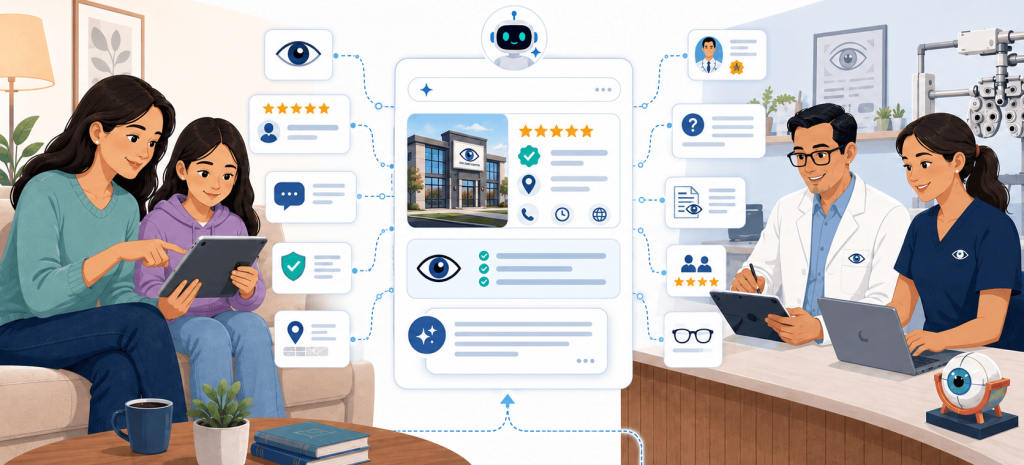
Eye clinics can improve their visibility in AI-driven patient research by publishing information that search systems can easily discover, understand, verify, and reference. Effective AI search optimization for eye clinics combines useful patient education, visible clinical expertise, accurate local details, accessible website technology, and clear conversion paths.
This matters because patients are no longer relying only on a list of traditional search results. They may ask Google’s AI features, ChatGPT Search, Microsoft Copilot, or another assistant to explain symptoms, compare treatments, identify nearby providers, and prepare for an appointment. The clinics that provide clear and credible answers have more opportunities to become part of that research process.
What Does AI Search Optimization for Eye Clinics Actually Involve?
It involves making a clinic’s website useful to patients and understandable to the systems generating search answers.
Traditional SEO generally focuses on rankings, impressions, website visits, and conversions. AI search visibility adds another layer: whether a clinic’s content is mentioned, summarized, or cited when an AI system answers a patient’s question.
The fundamentals have not disappeared. Google states that its generative search experiences remain connected to its core ranking and quality systems. Pages still need to be crawlable, indexable, relevant, and genuinely useful. There is no special AI schema or separate machine-readable file that guarantees inclusion.
For eye clinics, that means strengthening the same foundations addressed through professional search engine optimization for eye-care practices, then expanding the strategy to include direct answers, medical-review signals, consistent clinic information, and AI referral measurement.
Which Patient Questions Should an Eye Clinic Answer First?
Eye clinics should begin with questions that indicate a real symptom, treatment decision, local need, or intention to schedule care.
Start with the language patients actually use—not only formal medical terminology. Someone experiencing visual changes may search for “why do I keep seeing flashes of light?” before searching for information about vitreous detachment. A prospective cataract patient may ask what happens during an evaluation, how long the appointment takes, or whether they will need someone to drive them home.
High-value questions generally fall into four groups:
- Symptoms and conditions: What causes persistent dry eyes? When are new floaters concerning?
- Treatments and comparisons: What happens during a cataract consultation? How are dry-eye treatments selected?
- Local and logistical needs: Does the clinic accept my insurance? Is urgent eye care available?
- Cost and preparation: What affects the cost of an eye exam? What should I bring to my appointment?
Each question should lead to the right kind of page. A detailed condition question may belong in an educational article. Insurance, hours, directions, and practitioner details belong on service or location pages. The American Academy of Ophthalmology similarly recommends using relevant terms and questions prospective patients use when researching eye care.
For searches that suggest a patient is ready to act, organic content can also work alongside PPC Google Ads for optometrists and ophthalmologists. The educational page builds confidence; the campaign captures immediate demand.
How Should Eye-Care Content Be Written So AI Systems Can Trust and Cite It?
Eye-care content should answer questions quickly, explain them responsibly, and make its expertise visible.
Begin each section with a direct response. Then provide the necessary context: what the issue means, why it matters, what patients may expect, and when professional evaluation may be appropriate. Descriptive headings, concise definitions, readable paragraphs, and clearly labeled steps make information easier for both people and search systems to interpret.
Clinical credibility is especially important. Where appropriate, pages should identify the writer or medical reviewer, explain their qualifications, and show when the information was published or reviewed. Medical statements should be supported by primary research, established medical organizations, or government health sources. General educational content should also avoid presenting itself as an individual diagnosis.
Original experience adds another layer of value. Rather than repeating a generic explanation of glaucoma, a clinic can describe what happens during its glaucoma evaluation, which tests may be discussed, how long the visit typically takes, and what patients should prepare beforehand.
Google recommends helpful, reliable, people-first content and encourages publishers to clarify who created the content, how it was produced, and why it exists. It also warns that generating large numbers of pages without adding meaningful value may violate its scaled-content policies.
The website itself must support that content. Clear navigation, readable layouts, fast-loading pages, and strong appointment pathways are part of effective website design and hosting for eye-care professionals. Great information is less valuable when patients cannot comfortably read or act on it.
Which Local and Technical Signals Help AI Verify an Eye Clinic?
Consistent local information and accessible website technology help search systems determine who the clinic is, where it operates, and what services it provides.
A clinic’s name, address, phone number, operating hours, practitioner information, and website URL should be accurate across its website and major listings. Its Google Business Profile should be claimed, verified, and updated when details change. Google specifically allows businesses to maintain information such as their hours, website, phone number, and location through Business Profile.
Reviews also influence how prospective patients assess a practice. Clinics should encourage authentic feedback, respond professionally, and address recurring concerns rather than treating reputation as a simple star-rating exercise. A structured online reputation and review management process can help practices maintain consistency without resorting to inappropriate incentives or scripted responses.
Multi-location groups need a useful page for each location. Each page should contain its actual address, contact information, hours, providers, available services, directions, accessibility details, and appointment options. Thin pages that merely replace one city name with another offer little help to patients.
Behind the scenes, important pages should be indexable, connected through internal links, listed in an XML sitemap, and available in readable HTML. Canonical tags should point to the correct URLs, while robots.txt rules, firewalls, and security systems should not accidentally prevent legitimate crawlers from accessing public information.
Organization and LocalBusiness structured data may help Google understand administrative and location details, but the markup must match what patients can see on the page. It does not guarantee a rich result or AI citation.
Clinics that want public pages to appear in ChatGPT Search should also review access for OAI-SearchBot. OpenAI explains that publishers allowing this crawler can become eligible for inclusion and can track ChatGPT referral traffic in analytics.
How Can Clinics Measure AI Visibility and Connect It to Appointments?
Clinics should measure AI visibility through citations, referral visits, landing-page engagement, and patient actions—not rankings alone.
Begin with a representative set of patient questions. Check which domains are cited, which clinic pages appear, and whether the answers describe the practice accurately. Repeat the review periodically rather than treating one test as definitive, since AI-generated answers can vary.
Website analytics can reveal whether visitors arrive from AI platforms and what they do next. OpenAI adds utm_source=chatgpt.com to ChatGPT referral URLs, which helps site owners identify related visits. Clinics can then measure appointment forms, phone calls, consultation requests, and engagement on the pages receiving those referrals.
Bing Webmaster Tools introduced AI Performance reporting in 2026, including citation totals, cited URLs, visibility trends, grounding queries, intents, topics, and citation-share comparisons across supported Microsoft AI experiences.
These insights should sit alongside the clinic’s wider digital marketing performance. Visibility is useful. Visibility that contributes to qualified appointments is better.
Frequently Asked Questions
Is AI search visibility different from traditional SEO?
Yes, but it is built on the same foundation. Traditional SEO helps pages become crawlable, relevant, and competitive in search results. AI visibility adds attention to direct answers, citation eligibility, entity clarity, and referral traffic from generated responses. Google’s guidance confirms that foundational SEO practices remain relevant to AI Overviews and AI Mode.
Can schema markup guarantee that an eye clinic will appear in AI answers?
No. Structured data can clarify information about an organization, location, or page, but it cannot guarantee indexing, rankings, rich results, or AI citations. The markup must also agree with the visible page content.
Should eye clinics use AI to create patient content?
AI can assist with research, organization, and early drafts, but the final content should offer original value and receive careful editorial and clinical review. Accuracy matters. So do context, patient-friendly explanations, and appropriate medical limitations. Google recommends focusing on quality and warns against scaled content that adds little value.
Can a smaller eye clinic compete with major health websites?
Yes, especially for local and practice-specific questions. A national medical website may explain a condition broadly, while a clinic can answer where patients can receive an evaluation, what happens during the visit, which clinicians provide the service, and how to schedule care nearby.
What Should Your Eye Clinic Do Next?
Begin with a focused audit. Identify the questions patients ask before booking, improve the pages already receiving visibility, verify clinic information across major platforms, add clear medical-review signals, and remove technical barriers that prevent discovery.
Then measure what happens. Which pages are cited? Which visitors engage? Which questions lead to appointments?
No need to chase every new platform or acronym. The more sustainable goal is to become the clearest, most credible, and most useful local source when a patient needs dependable eye-care information.
Why Is Visiclix Your Ideal Choice for AI Search Optimization for Eye Clinics?
Visiclix specializes in marketing for optometrists, ophthalmologists, and eye-care practices. That industry focus helps connect content strategy with the realities of patient education, medical credibility, local competition, and appointment growth. Instead of treating visibility as an isolated metric, Visiclix brings SEO, paid search, website performance, reputation, and conversion strategy into one coordinated approach.
The Visiclix team can help identify valuable patient questions, strengthen existing service and condition pages, improve technical accessibility, and create clearer pathways from research to scheduling. Clinics can choose a strategy suited to their goals through Visiclix’s eye-care marketing packages, rather than relying on disconnected tactics. Practical, measurable, and built specifically for eye care.
Ready to Strengthen Your Search Visibility With Visiclix?
Give patients—and the platforms helping them research—a clearer path to your practice. Visiclix can review your website content, local presence, technical foundations, paid campaigns, and conversion opportunities.
Request your free eye-care marketing consultation with Visiclix and start building a stronger patient-discovery strategy.