Connected TV advertising can be a powerful growth lever for eye care because it builds trust and familiarity on the biggest screen in the house, then lets your other channels (search, retargeting, landing pages) convert that demand into booked appointments. The brands that win treat CTV as a demand engine—and they measure it like performance, not like “TV vibes.”
What is connected TV advertising for eye care, and what counts as a “CTV ad” in the real world?
Connected TV (CTV) advertising is video advertising delivered through internet-connected televisions and streaming devices inside streaming apps and services—think ad-supported content viewed on smart TVs, Roku devices, and streaming platforms. It’s “TV” in the viewing experience, but it behaves more like digital in how you can target, control frequency, and measure outcomes.
For eye care, CTV ads typically promote:
- Routine eye exams and annual benefits reminders
- Optical (frames/contacts) promotions and new collections
- Specialty services (dry eye, myopia management, diabetic eye exams, specialty contact lenses)
- Higher-consideration procedures (where applicable), often framed as “learn more / schedule a consult”
The big shift versus traditional linear TV is that CTV is designed to plug into a modern marketing stack—planning, targeting, and measurement workflows that look familiar to PPC-minded teams.
Why does connected TV advertising work especially well for eye care compared to other local channels?
CTV tends to outperform many local awareness channels for eye care because the product you’re really selling is confidence: “I trust this clinic with my vision.” Seeing your practice on a premium streaming environment builds familiarity that can lower friction when someone later searches “eye exam near me” or asks a spouse where to go.
It’s also a strong fit when:
- You’re in a market where paid search is expensive and crowded (CTV reduces your dependence on bidding wars)
- You’re trying to grow higher-value services that benefit from explanation and credibility
- You’re opening a new location or expanding into a new trade area and need fast awareness at scale
Healthcare marketers have leaned into CTV as adoption and viewership have grown, making it easier to reach households consistently without buying traditional broadcast schedules.
How do Roku and Hulu placements actually get bought, and what’s the simplest way to start?
Roku and Hulu inventory can be accessed in different ways depending on your budget, sophistication, and buying preference (direct platform buys vs. programmatic approaches). What matters most at the start isn’t the “perfect” path—it’s building a setup that’s easy to learn from.
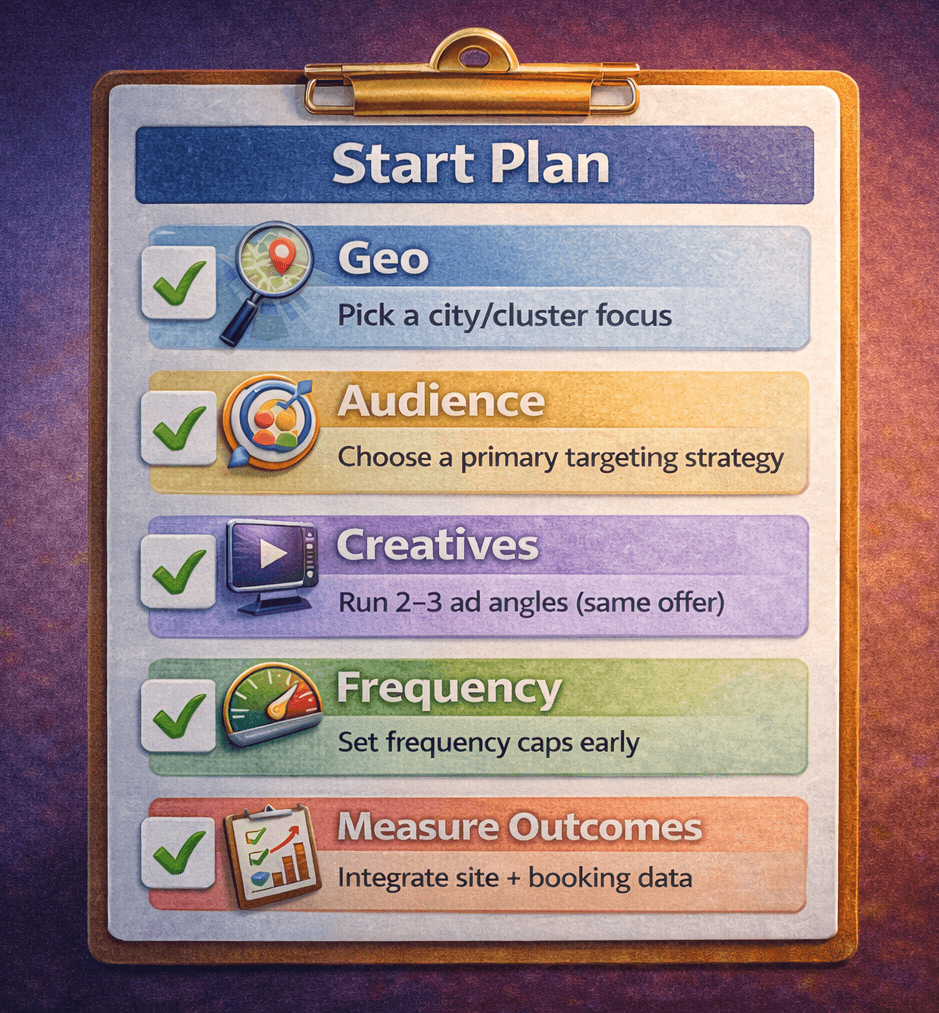
A simple, low-regret starting plan:
- Pick one geographic focus (one city/cluster) with enough households to reach consistently
- Choose one primary audience strategy (broad + geo, or contextual + geo)
- Run 2–3 creatives (same offer, different hook/angle)
- Set frequency controls so you don’t overserve a small pool
- Measure outcomes through your site/calls/booking flow—not just video completion
On Roku specifically, self-serve buying and campaign management are designed to make it easier for advertisers to build and measure streaming campaigns.
And Roku’s “Action Ads” format is built to add interactivity while the ad plays—useful when you want a clear next step like “learn more” or “book.”
How should eye care brands think about targeting on CTV without relying on sensitive health data?
You don’t need sensitive health data to run effective eye care CTV. In fact, the safest and most scalable approach is to combine geo + content context + practical life-stage proxies, then let your conversion layer (search, landing pages, calls) capture intent.
Privacy-safe targeting buckets that usually work for eye care:
- Geo targeting: zip codes, radius around clinics, commuter corridors
- Contextual/content category targeting: content genres that correlate with household routines (news, family, lifestyle—varies by inventory source)
- Life-stage proxies: families, households, new movers, high-level interest segments (depending on buying method)
- Dayparting: reach households during evening viewing windows when decision-making happens
The key rule: keep CTV targeting broad enough to learn, then tighten based on outcomes and frequency management—over-targeting can starve delivery and inflate costs.
What offers and messages drive the most appointment intent for eye care CTV campaigns?
CTV creative for eye care wins when it reduces uncertainty fast: Who are you? Why should I trust you? What do I do next?
Three message angles that consistently map to appointment intent:
- Convenience: online booking, evening/weekend availability, “same-week appointments” (only if true)
- Confidence: doctor expertise, modern technology, patient reviews (show the proof visually)
- Value clarity: insurance accepted, benefits reminders, transparent pricing, financing options (where relevant and compliant)
Service-specific hooks you can rotate by season:
- “It’s benefits season—use your vision plan before it resets.”
- “Dry eye relief options beyond drops—schedule an evaluation.”
- “Myopia control for kids—talk to a doctor about options.”
- “Contact lens fitting that actually fits your lifestyle.”
Avoid vague branding (“We care about your eyes!”) without a next step. CTV is expensive attention—earn it with a clear promise and a clean path to booking.
How do you build a CTV-to-appointment funnel that doesn’t waste your impressions?
A profitable eye care setup usually looks like this:
CTV creates demand → your capture channels convert it.
Practical funnel structure:
- CTV prospecting (Roku/Hulu): build awareness + familiarity at the household level
- Paid search coverage: ensure branded search and high-intent queries are funded (this is where CTV often “shows up”)
- Retargeting: re-engage site visitors and video-exposed audiences where available
- Landing page built for booking: one service focus, one primary CTA, fast page speed, reviews/credentials, insurance info, and friction reducers (parking, hours, what to expect)
What “good” looks like:
- Branded search volume and branded click share trend upward during the CTV flight
- Booking starts increase (not just page views)
- Qualified calls rise (not “wrong number” spikes)
- Appointment requests remain steady after creative refreshes (a sign your offer resonates)
Visual idea (1 of 2): A one-slide funnel graphic: CTV → Branded Search Lift → Landing Page → Booking/Calls, with 2–3 KPIs listed under each stage.
How much should connected TV advertising for eye care cost, and what budget is enough to learn?
CTV cost is typically driven by CPMs, your geographic scale, and how tight your targeting is. If you can’t reach enough unique households at a reasonable frequency, you won’t get stable learning—so the “right” budget is the one that buys meaningful reach, not the one that “feels safe.”
A practical way to think about budget:
- Your test budget should support consistent weekly delivery (so you can observe lift in branded searches, bookings, and call quality)
- If your geo is small, you’ll need stricter frequency control and more creative rotation to avoid fatigue
- If your geo is larger, you can test multiple service lines (exam vs specialty) without overserving the same households
Industry projections continue to show CTV growing rapidly (and getting more performance-oriented), which is why measurement discipline matters more than ever.
How do you measure Roku/Hulu performance for eye care if most patients don’t convert immediately?
Most eye care patients don’t see an ad and instantly book. That’s normal. CTV’s job is often to influence who gets chosen when the moment of intent arrives.
Your measurement stack should combine three layers:
- Outcome events you control
- Booking starts / booking completes
- Call tracking with “qualified call” rules (duration + intent tags)
- Form submits for consults or specialty services
- Demand signals that reflect CTV influence
- Branded search lift during flights
- Direct traffic and engaged sessions to service pages
- New-user growth in the target geo
- Incrementality checks
- Geo split tests (test area vs holdout area)
- Time-based on/off flights (with seasonality awareness)
- Matched-market approaches if you have multiple locations
The industry is also pushing toward more standardized, privacy-safe outcome measurement for CTV using server-to-server approaches like Conversion APIs, specifically because fragmented environments make “last click” an incomplete story.
What CTV creative formats and lengths work best for eye care, and what should the script include?
Most CTV environments center on 15s and 30s spots as common standards, and platform specs/guidelines should be followed closely when you upload or traffic creative. Hulu provides formal ad specifications and accepted formats through its spec documentation.
Roku also publishes creative guidelines to help ensure assets meet platform requirements.
A simple rule of thumb:
- 15s: one idea, one service, one CTA (best for “book an exam” and benefits reminders)
- 30s: one idea + proof (best for specialty services, positioning, and credibility)
What every eye care CTV script should include:
- Hook (first 2–3 seconds): a relatable problem or outcome (“Tired of squinting at screens?”)
- Proof: doctor expertise, modern tech, real reviews, community presence
- Friction reducer: insurance accepted, easy booking, flexible hours, what to expect
- Clear CTA: “Book online,” “Call today,” “Schedule an eye exam this week”
Visual idea (2 of 2): A fill-in-the-blank script template for a 15s and 30s eye care ad (hook, proof, offer, CTA), plus a checklist of on-screen elements (logo, URL/QR, phone, rating).
What are the most common mistakes in connected TV advertising for eye care, and how do you avoid them?
- Sending viewers to the homepage. A generic homepage dilutes intent; use a service-specific landing page built to book.
- Over-targeting. Tight segments can kill scale and jack up frequency; start broader and optimize from results.
- Measuring only video metrics. Completion rate can be fine—and still not grow appointments. Tie reporting to bookings/calls and branded demand signals.
- Creative fatigue. Eye care audiences are local; you’ll hit the same households repeatedly. Refresh hooks, rotate services, keep the offer consistent long enough to learn.
- No capture plan. If paid search budgets are capped or tracking is broken, CTV will look “unproven” even when it’s working.
When should an eye care brand not use CTV yet, and what should be fixed first?
Hold off (or run a very small pilot) if you don’t have:
- A fast, mobile-friendly site with a clear booking path
- Conversion tracking for bookings and calls
- A defined primary offer (what you want new patients to do first)
- Enough geo scale to reach unique households without overserving
Fix-first checklist:
- Build one landing page per top service line (exam, dry eye, myopia, contacts)
- Implement call tracking + booking events
- Create one “hero” 30s ad + two 15s cutdowns
- Make sure branded search coverage is protected while CTV runs
FAQ
Is connected TV advertising compliant for eye care and healthcare marketing?
It can be, but you need to be thoughtful about privacy, targeting choices, and how you use patient information. HIPAA’s marketing guidance is nuanced and depends on whether you’re a covered entity and what data is involved—when in doubt, run your plan by compliance counsel and avoid any approach that uses or implies protected health information for ad targeting.
Can connected TV advertising drive same-week appointments, or is it only for awareness?
It can drive near-term appointments when the offer is simple (eye exam booking), the geo is tight enough for repetition, and the landing page is frictionless. It’s still common for CTV to assist conversions that happen later through search and direct visits, so measure beyond last click.
How long does it take to see results from Roku or Hulu ads?
Many brands see early signals (branded search lift, direct traffic changes, engagement) within weeks, while reliable appointment trends usually take longer—especially if you need multiple creative rotations and enough reach to learn. Measurement frameworks designed for CTV help make those early signals actionable.
What’s a reasonable frequency cap for local eye care campaigns?
A reasonable cap is one that prevents overserving a small audience while still delivering enough repetition to build recall. Start conservative, watch reach and frequency distribution, and adjust based on geo size and creative fatigue signals.
Should eye care CTV campaigns send people to a landing page or the homepage?
A landing page almost always wins because it keeps one promise and makes one action easy: book, call, or request a consult. Match the page to the ad’s service and offer.
What’s the best way to coordinate CTV with paid search and retargeting?
Protect branded search budgets while CTV runs, build a retargeting layer to re-engage visitors, and report performance as a system: CTV for demand creation, search/retargeting for capture, landing pages for conversion.
Conclusion
Connected TV advertising works for eye care when it’s treated like a performance channel with a premium canvas—not a branding experiment you “hope” pays off. The winning approach is straightforward: run compelling, trust-building creative on Roku and Hulu, keep targeting privacy-safe but scalable, and make the next step unmistakable with a booking-first landing page.
If you can measure bookings and qualified calls, watch branded demand signals, and refresh creative before fatigue sets in, CTV becomes a repeatable way to grow—especially in markets where search costs keep climbing.
Why Visiclix is Your Ideal Choice for Connected TV Advertising Eye Care?
Visiclix builds CTV campaigns for eye care with one priority: turn streaming reach into measurable patient demand. That starts with a strategy that’s local enough to matter (geo + frequency control), but broad enough to perform (privacy-safe audience design that doesn’t rely on sensitive health targeting). Then we pair it with creative built for outcomes—clear hooks, real proof, and CTAs that lead somewhere that can convert.
Just as importantly, Visiclix treats measurement as part of the media plan, not a post-flight report. We help you define what success means (booking starts, kept appointments, qualified calls), instrument the funnel correctly, and read CTV performance through incrementality-friendly signals—so you can scale what’s working with confidence instead of guessing.
Get a Connected TV Growth Plan for Your Practice With Visiclix
If you want connected TV advertising eye care campaigns that don’t stop at impressions, Visiclix can map your first profitable launch: recommended geo, audience approach, creative angles, landing-page requirements, and a measurement checklist built around appointments—not vanity metrics.