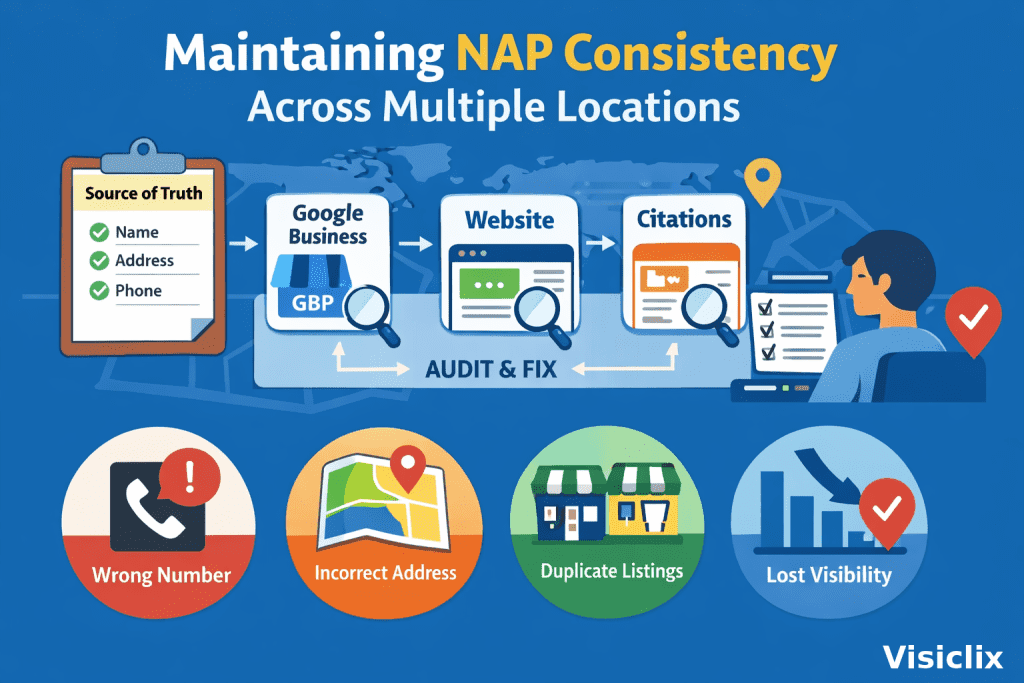
If you manage multiple locations, NAP consistency isn’t a “tidy up your listings” task—it’s an operational system. Without one, small variations (a suite format here, a tracking number there, a renamed storefront somewhere else) quietly multiply across Google Business Profiles, your site, and directories. The result is predictable: wrong calls, wrong directions, duplicate listings, and a harder time earning stable local visibility.
This guide shows you how to build a single source of truth, apply it across your digital footprint, and keep it consistent as locations open, move, rebrand, or close—without sacrificing attribution or speed.
What does NAP consistency mean in multi location local SEO?
NAP consistency means your Name, Address, and Phone number appear the same way everywhere customers and search engines encounter them—especially across your website, Google Business Profiles, and your most visible citations (directories, map apps, and niche platforms).
The “consistency” part is less about being aesthetically identical and more about being unambiguous. Search platforms want to recognize that “this location entity” is the same in every place it’s referenced. Google explicitly advises businesses to represent themselves “as it’s consistently represented and recognized in the real world,” which is the practical foundation behind why mismatched listings become a problem at scale.
For multi-location brands, the challenge isn’t understanding NAP—it’s governance. One-off edits work when you have three listings. They fail when you have 30, 300, or franchise owners making “helpful tweaks” independently.
Why can small NAP variations create outsized problems across multiple locations?
Small variations create big problems because they introduce conflicting identity signals. At a single-location level, this can be annoying. At multi-location scale, it becomes a compounding error: each inconsistency increases the chance that platforms create duplicates, merge entities incorrectly, or surface the wrong information to customers.
Operationally, the cost shows up as:
- Calls going to the wrong branch or an old number
- Customers arriving at the wrong address after a move
- Duplicate profiles that don’t rank (or worse, trigger compliance issues)
- Attribution confusion when PPC, SEO, and analytics disagree on what a “location conversion” is
From Google’s perspective, local results are largely driven by relevance, distance, and prominence. You can’t control distance, but you can reduce confusion and improve the quality of signals that support relevance and prominence—starting with accurate, consistent business information.
What counts as a NAP inconsistency (even if it “looks basically the same”)?
In multi-location management, the most dangerous inconsistencies are the ones teams dismiss as “close enough.” Common examples include:
Name
- “Brand + City” added to some profiles but not others
- Legal entity name used in one place, storefront name used elsewhere
- Department names treated like separate businesses without a clear structure
Address
- “Ste 120” vs “Suite 120” vs “#120”
- Different street abbreviations (“St.” vs “Street”) mixed across major listings
- Old addresses lingering after relocations, especially on directories that propagate data
Phone
- Old numbers still listed somewhere (often on high-visibility directories)
- One location accidentally using a shared corporate number
- Tracking numbers getting copied into citations and becoming the “dominant” number
If you want a quick mental test: if a customer could plausibly call the wrong place, arrive at the wrong place, or think two locations are the same—your NAP is inconsistent in a way that matters.
How do you create a “source of truth” NAP spec that every team follows?
Your source of truth is a single, controlled dataset that defines the canonical NAP (and related identity fields) for every location. This is the step most brands skip—and it’s why fixes don’t stick.
What your NAP spec should include
1) Canonical business name rules
Your naming standard should reflect what the business is called in the real world. Google’s guidance is straightforward: represent your business consistently as it’s recognized offline. That’s the north star for your naming decisions and a strong argument against “SEO keyword stuffing” inside location names.
2) Canonical address formatting policy
Decide and document:
- Suite/unit format (one standard, always)
- Whether you include floor/building details and where
- Service-area business rules (when an address is hidden vs shown)
3) Canonical phone policy (plus tracking rules)
Google encourages adding phone numbers so customers can reach you directly and ties it to trust/visibility benefits.
Separately, Google’s community guidance emphasizes that phone numbers should be under the business’s direct control and warns against “referral/redirect” style numbers that send users elsewhere.
Your spec should define:
- The primary location number (the identity anchor)
- Whether you allow additional numbers (when applicable)
- Where tracking is allowed (usually on-site via DNI, not as the canonical identity)
4) Location IDs + ownership fields
Add a unique location ID and assign owners for GBP, website, and citations. You’re building a system, not a spreadsheet.
A practical template (what to store per location):
- Location ID
- Canonical Name
- Canonical Address (line 1 + line 2)
- Canonical Phone
- Website location page URL
- GBP URL / identifiers
- Status (open, moved, temporarily closed, permanently closed)
- Last audited date + notes
How should NAP be implemented on your website for multi location local SEO?
Your website is where you have the most control, and it should reinforce your source of truth.
Build one canonical location page per location
Each physical location should map to one indexable page with:
- Visible NAP in a consistent format
- The correct location-specific phone number
- A location-specific URL that stays stable over time (even if content updates)
Add local business structured data (and keep it aligned)
Google Search Central’s documentation explains how LocalBusiness structured data can help Google understand business details and display them in richer ways in Search.
Schema.org defines LocalBusiness as a physical business or branch of an organization—exactly what a multi-location brand is managing.
The critical part isn’t “adding schema.” It’s ensuring that:
- The name/address/telephone in structured data match the visible NAP
- The location page content matches what you present on GBP
Store locator vs location pages
A store locator is helpful UX, but it shouldn’t replace location pages. Use the locator to help users find locations, then route them to canonical pages where NAP (and structured data) live consistently.
How do you align Google Business Profiles with your website NAP at scale?
If you only fix one place, fix Google Business Profiles first—then align your website.
Google’s best-practice guidance emphasizes consistent representation and warns that multiple profiles for the same business can cause display problems. When duplicates exist, Google notes that duplicate profiles may not show in Search/Maps and provides a resolution path for duplicate and same-address scenarios.
What “alignment” looks like in practice
- Every GBP uses the canonical name, address formatting, and primary phone
- Each GBP points to the correct location page (not the homepage)
- Your location page shows the same NAP as GBP (including suite formatting)
Don’t confuse “local ranking factors” with “local ranking hacks”
Google’s own explanation of local ranking factors is intentionally high-level: relevance, distance, and prominence.
NAP alignment won’t override distance. But it does reduce ambiguity, improves user trust, and supports the overall quality of the entity information that feeds local systems.
How do citations and data sources spread NAP errors across the local ecosystem?
Citations are structured mentions of your business data—often including NAP, sometimes including a URL. Whitespark describes local citations as listings that include some combination of business name, address, and phone number.
BrightLocal’s guidance stresses systematic citation optimization and highlights NAP consistency as a key factor in citation management.
Here’s the part multi-location teams learn the hard way: errors propagate. One incorrect listing can get copied to other platforms via data partners, scrapers, or user edits. That’s why citation cleanup needs a “stop the leak” approach:
- Establish the canonical NAP
- Fix the highest-impact sources
- Monitor to prevent re-contamination
How do you run a multi-location NAP audit that scales past 10, 50, or 500 locations?
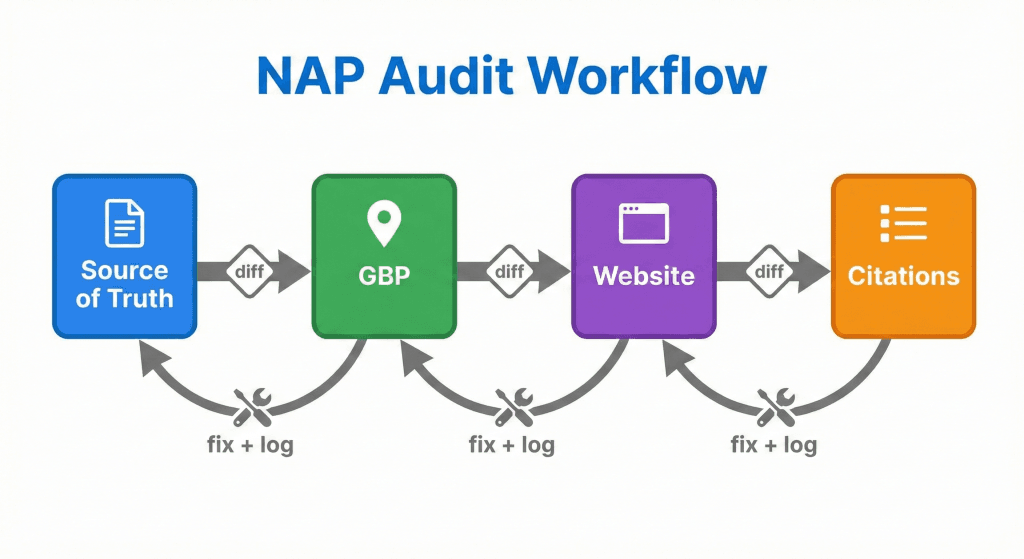
A scalable audit is a repeatable workflow that produces a diff (differences) between canonical data and what’s live in the ecosystem.
Step-by-step audit workflow
1) Export your source of truth
This is your baseline. If you don’t have one, you’re not auditing—you’re guessing.
2) Export GBP data and compare
Look for:
- Name variants
- Suite formatting differences
- Wrong or shared phone numbers
- Duplicates / same-address confusion
3) Crawl your website location pages
- Visible NAP matches canonical?
- Structured data matches visible NAP?
- Wrong location phone appearing in templates or footers?
4) Validate top citations first
Start with the listings that actually drive visibility and conversions (major directories, maps, and your vertical’s core platforms). Don’t waste weeks on long-tail directories before your top-tier sources are clean.
5) Detect duplicates and near-duplicates
Duplicates are especially common after moves, rebrands, and franchise ownership changes. Google provides specific guidance for resolving duplicates and co-located scenarios—use it instead of improvising.
How do you prioritize NAP fixes for the biggest ranking and conversion lift first?
Treat prioritization like revenue protection, not “SEO hygiene.”
A simple impact-based priority stack
Tier 1 (Fix immediately):
- GBP mismatches vs canonical NAP
- Wrong phone/address that misroutes customers
- Duplicate GBPs and ownership conflicts
Tier 2 (Fix next):
- Your top citations (the platforms customers actually use)
- High-authority, high-visibility directories
- Major mismatches that conflict with GBP/website
Tier 3 (Fix last):
- Long-tail directories with low visibility
- Minor formatting differences that don’t create ambiguity
Add a business lens
If you run PPC, prioritize locations with:
- Highest call volume
- Highest ad spend
- Highest lifetime value
Your goal is fast reduction in lead leakage and customer confusion.
Can you use call tracking in multi location local SEO without breaking NAP consistency?
Yes—but only if you treat tracking numbers as measurement tools, not identity.
Google’s phone guidance emphasizes helping customers reach you directly and building trust. Google’s community guidance also stresses that phone numbers should be under the business’s direct control and not redirect users elsewhere.
Practical rules that usually work
- Keep the canonical local number as the primary identity wherever your location is “defined” (GBP, key citations, and your core website NAP).
- Use dynamic number insertion (DNI) for on-site attribution when possible so the canonical number remains the entity anchor.
- If you must use tracking in listings, be extremely disciplined about where it appears—and monitor for spread.
For multi-location brands, the tracking pitfall isn’t the tracking itself. It’s when tracking numbers get copied into directories and become the “truth” elsewhere.
How do you prevent NAP drift when locations open, move, rebrand, or close?
Most NAP chaos isn’t created by marketers. It’s created by operations. So you need lifecycle playbooks.
New location launch checklist
- Create the location in the source of truth (ID + canonical NAP)
- Publish the location page first (with correct NAP + structured data)
- Create/verify GBP and ensure it matches canonical
- Seed core citations only after GBP + site match
Move/relocation checklist
- Update canonical NAP first
- Update website location page and structured data
- Update GBP (and monitor for duplicates)
- Then update citations systematically to prevent “old address resurrection”
Closure checklist
- Update location status in canonical dataset
- Handle GBP status correctly and avoid leaving orphan listings
- Clean citations that still send customers to a closed location
Google’s documentation on duplicate profiles and eligibility scenarios is especially useful during moves and co-located edge cases.
Who should own NAP governance: HQ, local managers, or an agency?
There’s no one right model, but there is a right principle: one source of truth + controlled editing rights.
HQ-owned (centralized)
Best for brands that value consistency and move fast with fewer surprises. HQ sets standards, controls the canonical dataset, and approves changes.
Hybrid (HQ standards, local input)
Often the best for franchises: local teams provide operational changes (new phone, temporary closure, suite changes), but edits flow through a controlled process.
Distributed (local ownership)
Works only when training and enforcement are strong. Otherwise it’s the fastest path to name stuffing, tracking number sprawl, and inconsistent location pages.
If you’ve struggled with constant drift, centralizing the source of truth (even if edits are distributed) is the first fix.
What does a monthly NAP maintenance SOP look like for multi-location brands?
A maintenance SOP is how you stop this from becoming an annual cleanup project.
Monthly
- Spot-check a rotating sample of locations
- Monitor for new duplicates and suggested edits
- Verify that high-priority listings still match canonical data
Quarterly
- Full diff audit against GBP + website location pages
- Review top citations for high-spend locations
- Validate structured data still matches visible NAP
Trigger-based (immediate audit)
- Moves/relocations
- Phone system changes
- Rebrands and acquisitions
- New call tracking vendor or attribution model
FAQ
What’s the fastest way to fix NAP inconsistencies for multiple locations?
Fix your source of truth → GBP → website first, then correct your highest-impact citations. This sequence prevents you from “fixing” citations only to have inconsistencies reappear from the places customers and algorithms check most often.
Should every location have a unique phone number?
Usually, yes—because shared numbers create customer confusion and muddy attribution. If you must share a corporate line, be deliberate about how it appears (and ensure customers can still reach the correct local team quickly).
Do suite number formats really matter for rankings?
The bigger issue is ambiguity. If inconsistent suite formatting creates mismatched entities or duplicates, it can matter a lot. If it’s purely cosmetic and consistent across your major surfaces, it’s less likely to cause harm.
How do you handle departments or practitioners at the same address?
Follow Google’s eligibility and duplicate guidance carefully, especially for co-located entities and departments. Poor structure here often creates duplicates and visibility problems.
What if Google changes my Business Profile info after I update it?
This happens. Monitor your key fields regularly, keep documentation, and be prepared to reapply canonical data. Google’s help resources and guidance around edits and verification processes are your best reference point.
Can a store locator replace location pages for multi location local SEO?
It shouldn’t. A locator is great UX, but canonical location pages are where you anchor NAP, structured data, and location-specific relevance.
How often should multi-location businesses re-audit citations?
Quarterly for most brands, plus trigger-based audits for operational changes. High-change businesses (franchises, healthcare groups, high turnover) often need monthly monitoring.
Conclusion
Keeping NAP consistent across many locations isn’t about perfection—it’s about control. The winning formula is a single source of truth, applied consistently to your website and Google Business Profiles, supported by systematic citation cleanup, and protected by a maintenance SOP that prevents drift.
When your location data is governed properly, everything else works better: local visibility becomes more stable, customers reach the right location faster, and PPC attribution becomes cleaner because your “location entity” is no longer moving under your feet.
Why Visiclix is Your Ideal Choice for Multi Location Local SEO?
Visiclix helps multi-location brands turn NAP consistency from a recurring cleanup project into a scalable operating system. We start by building (or repairing) your source of truth—then we align your website location pages, structured data, and Google Business Profiles so every location presents a consistent identity customers can trust and search platforms can interpret reliably.
From there, we prioritize fixes based on business impact: the locations that drive the most calls, leads, and revenue get addressed first, and we use a governance workflow that prevents drift during openings, relocations, and rebrands. The result is fewer duplicate listings, fewer misrouted calls, and less wasted spend—because your organic and paid efforts are finally measuring and reinforcing the same location reality.
Ready to clean up NAP across every location with Visiclix?
If you’re managing 10+ locations (or scaling fast), Visiclix can deliver a practical NAP consistency program: a canonical location dataset, a GBP + website alignment plan, a prioritized citation cleanup roadmap, and a maintenance SOP your team can actually follow.