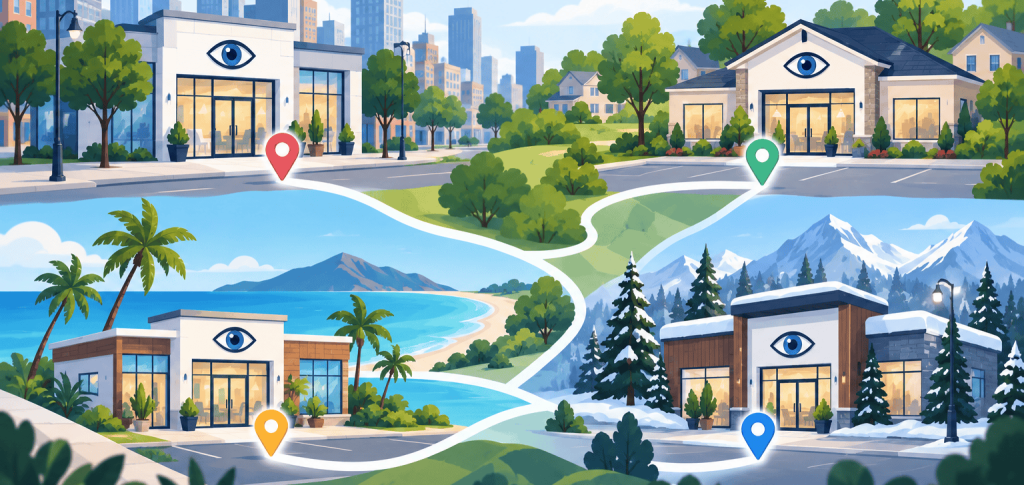
Eye clinics can create unique content for each location by focusing on what is genuinely different about that office: its providers, services, technology, patient population, nearby communities, scheduling details, directions, and local experience. Instead of copying one page and replacing the city name, each location page should answer the questions a patient would have before choosing that specific clinic.
For multi-location practices, strong eye clinic location service pages can also make the website easier for search engines and patients to understand. Google recommends maintaining accurate information for each real-world business location, and its Business Profile guidance says businesses should not create multiple profiles for the same location. For multi-location business links, Google also recommends sending users to a landing page for the specific location rather than a general or different location page.
The goal is simple: give each office a page that deserves to exist on its own.
What Information Should Be Unique on Every Eye Clinic Location Page?
Every clinic page should begin with information that belongs specifically to that location. That includes the doctors practicing there, the services patients can receive, office hours, contact information, available technology, and practical details about visiting the clinic.
Provider information is especially valuable. Patients may want to know which optometrists or ophthalmologists work at the office, what they specialize in, which languages they speak, and whether they treat particular age groups or conditions. Linking to detailed provider profiles can then give patients additional information without overloading the location page.
Services should also reflect reality. If one office offers dry eye treatment, specialty contact lens fittings, myopia management, or advanced diagnostic testing while another does not, the location pages should make that distinction clear.
This approach also supports a more organized SEO strategy for eye care practices. Visiclix recommends mapping different search intents to appropriate page types, including location pages for local searches and dedicated service pages for specific treatments.
How Can Clinics Make Location Content Useful Instead of Simply Changing the City Name?
Start with patient questions, not geographic keywords.
Someone visiting a location page is usually trying to make a practical decision. They may want to know whether the clinic provides the service they need, which doctor they can see, whether the location is convenient, and how to schedule an appointment.
A useful page might answer questions such as:
- Which eye care services are provided at this office?
- Which doctors practice here?
- What technology or diagnostic equipment is available?
- Is parking available?
- What are the office hours?
- Are same-day or urgent appointments offered?
- How can a patient request an appointment?
The page structure can remain consistent across a multi-location website. Consistency makes navigation easier. The copy itself, however, should reflect the experience at the individual clinic.
Google’s people-first approach to search also makes usefulness more important than mechanically creating pages for search engines. In eye care specifically, educational and commercial content should help users reach the right information at the right stage of their search. Visiclix similarly recommends separating appointment-focused pages from educational content and connecting them through a logical site structure.
Which Local Details Can Make an Eye Clinic Page More Relevant to Its Community?
Local relevance can extend well beyond an address and phone number.
An eye clinic can mention neighborhoods and communities it genuinely serves, nearby landmarks that help patients find the office, parking instructions, accessibility information, or public transportation options. Original photographs of the office, reception area, optical department, providers, and equipment can make the page more useful and recognizable.
Community involvement can add another layer of distinction. If a location participates in school vision programs, local health events, employer partnerships, screenings, or community organizations, those details belong on that office’s page when they are relevant.
Anagram’s eye care content guidance similarly encourages practices to create material relevant to their particular niche and community rather than publishing generic content.
The key is restraint. Do not add neighborhood names merely to create more keyword variations. Include local information because it helps a real patient understand the clinic.
How Should Services Be Presented When Different Locations Offer Different Care?
Multi-location clinics should clearly identify which services patients can receive at each office.
Suppose a practice has three locations, but only one provides advanced dry eye diagnostics. Listing dry eye treatment as though it were available at all three could create confusion and lead patients to the wrong office. The better approach is to explain the service available at each location and direct patients to the appropriate service page for deeper information.
Location pages do not need to repeat an entire treatment article. A short, location-specific explanation may be enough:
“This office provides comprehensive dry eye evaluations and treatment, including diagnostic testing used to identify factors contributing to persistent symptoms.”
A link can then take the reader to the main dry eye service page.
Clear website architecture matters here. Thoughtful eye care website design can connect location, provider, and service pages so patients can move through the site without having to search repeatedly for the right information.
How Can Eye Clinics Use Local Proof to Build Trust on Each Page?
Location pages should show patients that a clinic is a real place staffed by real professionals.
Start with original provider and office photography where possible. Add relevant doctor credentials, specialties, professional affiliations, or technologies available at that office. If insurance participation, payment options, accessibility accommodations, or appointment processes vary by location, explain those differences as well.
Location-specific patient feedback may also be useful when it is displayed appropriately and complies with applicable healthcare, privacy, advertising, and testimonial requirements.
The important point is not to fill the page with promotional claims. Useful proof reduces uncertainty. A patient should be able to look at the page and understand who they may see, what the office provides, and what to expect when they arrive.
How Can Eye Clinics Prevent Duplicate Content Across Multiple Locations?
Use the same framework, but not the same story.
Multi-location practices can standardize page structure without copying paragraphs. Each page might contain sections for providers, services, technology, directions, FAQs, and appointments. The facts filling those sections should come from the individual office.
Before publishing, compare location pages side by side. Look closely at introductions, service summaries, FAQs, calls to action, and community descriptions. If entire paragraphs are identical except for a city name, there is probably an opportunity to make them more useful.
Pages should also evolve. New providers join practices. Office hours change. Technology gets upgraded. Services expand. Community partnerships develop.
Regular updates turn location pages into living patient resources instead of static SEO assets.
What Should Clinics Measure After Publishing Location Pages?
Traffic alone does not show whether location content is working.
Track organic visits to individual location pages, calls, appointment form submissions, clicks for directions, engagement with provider profiles, and movement from location pages into service pages. If the clinic uses paid search, review whether location-specific landing experiences also contribute to stronger conversion paths.
That connection is particularly important when clinics invest in PPC Google Search Ads. A high-intent advertisement works best when the destination closely matches what the patient searched for rather than sending everyone to a generic homepage.
Visiclix notes that eye care content should ultimately connect visibility with patient acquisition, using service pages to capture appointment-focused intent while educational content supports earlier research.
Measure what happens after the click. Rankings can create opportunities, but appointments are what connect digital visibility to practice growth.
What Makes a Strong Location Page Worth Maintaining?
A strong location page saves patients from guessing.
They should not have to call simply to learn whether a particular doctor works there, whether a service is available, where to park, or whether another branch would better fit their needs. Good local content gives them enough information to confidently take the next step.
For eye clinics with several offices, that means treating every location as its own patient experience rather than another entry in a template.
Review existing pages one at a time. Look for copied language, missing provider information, inaccurate services, weak local details, generic photography, and unclear calls to action. Small improvements across several locations can create a much stronger website as a whole.
Why Visiclix Is Your Ideal Choice for Eye Clinic Location Content?
Visiclix specializes in digital marketing for optometrists and ophthalmologists, bringing together SEO, content, paid search, and website strategy for eye care practices. That industry focus matters when organizing locations, services, providers, and patient education into a website that supports both search visibility and appointment generation.
For multi-location practices, Visiclix can help build a scalable content strategy without turning every office page into a copy of the last one. The focus stays on useful local information, clear service targeting, logical website architecture, and measurable conversion opportunities. The result is a location content system designed around how real eye care patients search and make decisions.
Ready to Strengthen Your Eye Clinic Locations With Visiclix?
If your location pages are mostly duplicated templates, missing important local information, or failing to turn search traffic into inquiries, there may be significant room to improve.
Contact Visiclix for a consultation to review your location content, SEO structure, service targeting, and patient conversion paths.
FAQ
Should every eye clinic location have its own webpage?
Generally, yes. Each real clinic location can benefit from a dedicated page that provides its address, contact information, providers, available services, hours, directions, and other office-specific information. Google also recommends location-specific landing destinations for certain multi-location Business Profile action links.
How much content should an eye clinic location page include?
There is no universal word count. The page should contain enough original information to answer important patient questions without adding filler merely to make the page longer. A smaller office may need less content than a large location offering several specialties.
Can eye clinics use the same service descriptions on multiple location pages?
Clinics can use consistent terminology, but copying large blocks of identical service copy provides little additional value. Describe how the service applies to the individual location, then link to the main service page for comprehensive information.
What makes location content unique enough for local SEO?
Meaningful distinctions include providers, services, equipment, hours, local directions, office photographs, accessibility details, community involvement, and location-specific FAQs. Simply changing a city name does not provide the same level of usefulness.
How often should eye clinic location pages be updated?
Review them whenever providers, services, hours, contact information, technology, or other office details change. A periodic accuracy review can also catch outdated information before patients encounter it.