When someone searches “LASIK near me,” they’re not browsing. They’re usually trying to answer a short list of urgent questions: Where can I get this done nearby? Can I trust the clinic? What will it cost? How fast can I talk to someone?
Google Ads can capture that demand—but “near me” campaigns fail all the time because they’re built like generic PPC. The fix isn’t adding more keywords or more ads. It’s aligning three things: who you target, what you promise in the ad, and what the landing page delivers.
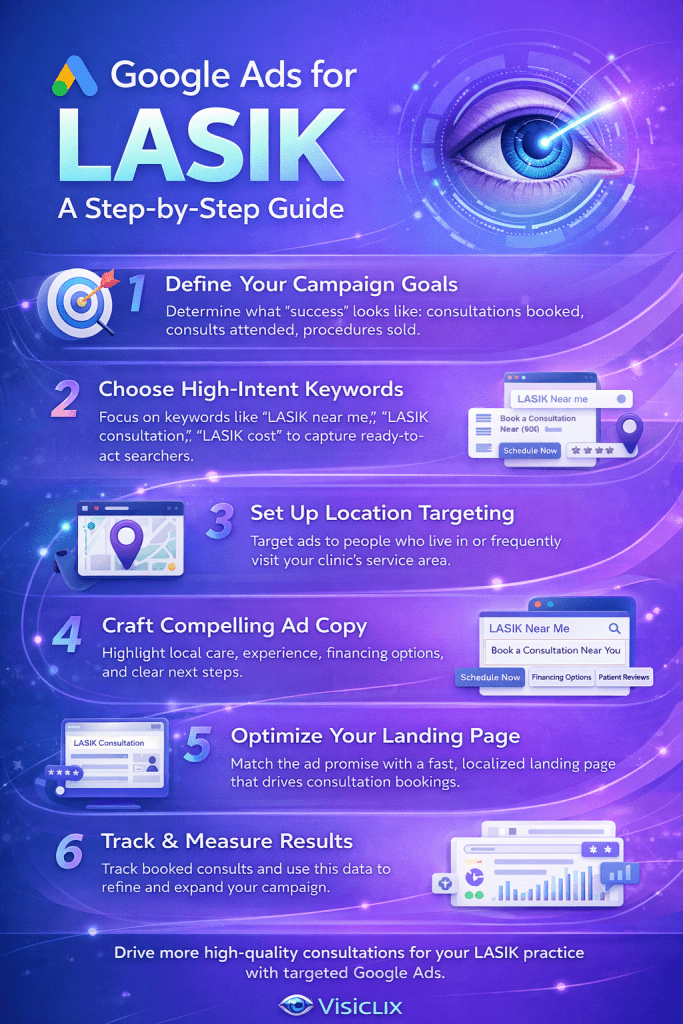
This guide walks through the “what is” and “how to” of building a near-me LASIK Search campaign designed to produce booked consultations (not just clicks and form fills).
What does “LASIK near me” intent mean for Google Ads?
“Near me” intent is a blend of local relevance and decision readiness:
Local relevance: the person expects the clinic to be within a reasonable drive, and they want proof (address, distance, local reviews, recognizable area cues).
Decision readiness: they’re open to taking action—calling, booking a consult, or submitting a candidacy form—if you reduce uncertainty quickly.
Comparison behavior: many searchers will check 2–4 clinics. Your ad and landing page have to make choosing you feel easy.
That’s why “near me” LASIK PPC is less about volume and more about precision. You win by matching the user’s expectation at every step: targeting → ad message → page experience.
How should you structure a Google Ads account for “LASIK near me” searches?
A clean account structure is how you keep control over lead quality and costs. It also helps you improve the three quality components Google evaluates in the auction—expected CTR, ad relevance, and landing page experience.
Instead of one campaign with a mixed bag of keywords, structure around intent so each group can have its own message and landing page angle:
1) Core high-intent LASIK
These are the “I want LASIK” searches that don’t explicitly say near me (but still convert locally with proper geo settings).
2) Near-me / local intent LASIK
This is your proximity layer—where location assets, convenience, and trust cues matter most.
3) Comparison intent
“Best,” “reviews,” “top,” and sometimes competitor terms. This layer often costs more per click, but can convert well if your page answers comparison questions without sounding defensive.
This structure isn’t about overengineering. It’s about making sure the ad and page can speak directly to why the person searched.
How do you choose keywords for “LASIK near me” without turning the campaign into a listicle?
Think in “why they searched,” not “what words exist.”
A near-me LASIK campaign typically needs four keyword themes. Each theme maps to a different motivation—and should map to different ad messaging:
1) Proximity motivation
They want something nearby and convenient. These are your “near me” and “clinic near me” variants.
2) Action motivation
They’re ready to schedule a consult, talk to someone, or confirm candidacy.
3) Trust motivation
They want reassurance: reviews, reputation, surgeon credibility.
4) Money motivation
They’re trying to understand cost, financing, or payment options.
When you build keywords this way, your ad copy becomes obvious: you’re answering the exact motivation behind the query.
How should match types work for “near me” LASIK campaigns?
Match types are less about “Google Ads theory” and more about controlling risk.
Google notes that broader match types can capture all the queries of narrower ones, plus more related searches. That’s useful for scale, but it’s also how junk traffic sneaks in if your controls aren’t ready.
A practical, near-me-friendly approach:
Start with Exact + Phrase for your highest-intent themes (near me, consultation, surgeon).
Use Phrase as your controlled discovery layer—still tight, but you’ll learn real search behavior.
Add Broad only when you’ve proven two things:
your conversion tracking is accurate enough to identify quality leads, and
your negatives and search-term hygiene are consistent.
If you can’t confidently answer, “Which searches produced booked consults?” Broad will often amplify the wrong thing.
How should location targeting be configured for “near me” intent?
Location settings are the silent killer of near-me performance.
Google’s advanced location options can include people in your area, people regularly in your area, and/or people who show interest in your area (depending on the setting).
For “near me” LASIK, you usually want targeting that reflects actual proximity, not vague interest. Otherwise you can pay for clicks from people who searched your city name from across the country.
A clean way to think about it:
Use a service-area radius or tightly defined cities/zips that match how far patients realistically travel.
Build exclusions for nearby regions that generate low-quality inquiries (commuter/tourist spillover happens a lot).
Ensure your ad and landing page reinforce locality (address context, map cues, scheduling details).
Near-me campaigns don’t just need the right keywords. They need the right geography logic.
How do you prevent wasted spend without obsessing over huge negative keyword lists?
Negatives should be built around intent you don’t want—especially early.
On day one, your goal isn’t “perfect coverage.” It’s stopping the obvious waste categories so your data is clean enough to optimize.
Most LASIK near-me waste comes from:
career/education intent (jobs, salaries, training)
research-only behavior (definitions, generic informational browsing)
non-offered treatments (terms that match other procedures you don’t provide)
extreme bargain intent (if you don’t compete on that positioning)
Then you refine negatives based on reality, not guesses: review search terms weekly during the first month and build a “do-not-pay-for-this” filter that matches your clinic’s actual positioning.
How do you write ad copy that matches “near me” intent without awkward geo-stuffing?
“Best LASIK in [City]” isn’t the only way to signal relevance. Near-me copy performs when it reduces uncertainty quickly.
You can do that with four persuasion levers:
Convenience: easy scheduling, accessible location, clear next steps
Trust: experience, credentials, patient reviews, safety-first tone
Clarity: what happens during the consult, what the process looks like
Affordability path: financing and payment options (only if real)
Responsive Search Ads make it easier to test combinations and learn which angles earn clicks and conversions.
Ad copy examples you can adapt (written as RSA ingredient sets)
Core “Near Me + Book” angle (Headlines)
LASIK Consultations Available
Book a LASIK Consultation
Local LASIK Team Near You
Talk With a LASIK Specialist
See If You’re a Candidate
Flexible Appointment Times
Convenient Location & Scheduling
Descriptions
Schedule a consultation to discuss candidacy, options, and next steps. Call or book online today.
Local care, clear guidance, and a simple booking process—get answers quickly.
Trust + Reviews angle (Headlines)
Highly Rated LASIK Care
LASIK Reviews Patients Trust
Experienced Vision Correction Team
Patient-First Consultation Process
Descriptions
Comparing local options? Explore reviews and book a consultation when you’re ready.
Get straightforward answers about candidacy and what to expect—before you decide.
Cost/Financing angle (Headlines)
LASIK Financing Options
Monthly Payment Plans Available
Discuss LASIK Costs in Consult
Clear Options, No Guesswork
Descriptions
Get a consult-focused breakdown of options and payment plans. Call or schedule online.
We’ll walk you through candidacy and costs so you can choose confidently.
Visual suggestion (use in this section): A swipe-file style graphic showing 4 ad angles (Convenience / Trust / Cost / Technology) with example headlines + descriptions.
How do assets and extensions support “near me” performance?
Near-me intent benefits when the ad itself supplies “local proof” before the click.
Location-driven assets help because they can show practical locality cues like where you are and how close you may be—exactly what “near me” implies. (Implementation varies by setup and eligibility, but the concept is consistent: local proof reduces uncertainty.)
Pair that with:
Call-forwarding/call measurement (so calls become optimizable outcomes)
Sitelinks that route to high-intent pages (financing, candidacy check, reviews, surgeon bio)
This isn’t decoration—it’s how you pre-qualify clicks and shift more users to the right action.
How do you build a landing page that converts “near me” LASIK clicks into booked consults?
A near-me landing page needs to do two jobs fast:
confirm the person is in the right place (local + relevant), and
make the next step feel safe and simple.
Google explicitly emphasizes that landing page experience is one of the quality components evaluated in the auction.
A strong “near me” LASIK landing page usually includes:
Message match with the ad (consultation vs reviews vs financing angle)
Local context (service area language, practical location cues, convenience details)
Trust proof (credentials, review highlights, process clarity, safety tone)
One primary action (book consult), plus a clear phone option for mobile users
Fast mobile experience (near-me traffic is commonly mobile, and slow pages leak money)
Visual suggestion (use in this section): A simple landing page wireframe (above-the-fold layout) labeled with “local proof,” “trust proof,” “primary CTA,” and “financing cue.”
How do you track what matters so you can optimize to booked consults?
If you only track leads, you’ll often scale the cheapest leads—not the best ones.
For LASIK, you typically want optimization to reflect the real business outcome:
consult booked
consult attended
procedure sold (when possible)
Google supports importing offline conversions, and also recommends enhanced conversions for leads as an upgraded approach that can improve durability and measurement accuracy.
A clean measurement path looks like this:
Track forms + calls as conversions
Feed back “booked consult” (and ideally attended/sold) as offline conversions
Use that data to guide bidding and budget expansion
That’s how you stop optimizing for activity and start optimizing for revenue.
What does a sensible “how to optimize” routine look like in the first 30 days?
A near-me LASIK campaign improves quickly when you treat the first month as a controlled learning phase:
Week 1: Confirm geo settings, conversion tracking, and landing page match.
Week 2: Review search terms, add negatives, adjust ad messaging by what’s actually showing.
Week 3: Split out high-performing themes into their own ad groups/pages.
Week 4: If lead quality is strong, expand carefully (more themes, slightly broader coverage, incremental budget).
This keeps you out of the two common traps: scaling too early, or “optimizing” without enough signal to know what changed.
Conclusion
“LASIK near me” Google Ads works when it feels like the clinic was the obvious local choice. That comes from alignment: tight location logic, intent-based keyword themes, match types that control risk, ads that reduce uncertainty, landing pages that deliver the promise, and tracking that ties spend to booked consults. Once those pieces are in place, scaling stops feeling like gambling—and starts feeling like multiplying what already works.
Why Visiclix is Your Ideal Choice for LASIK near me Google Ads?
Visiclix helps clinics turn near-me intent into booked consultations by building campaigns around patient motivations, not just keyword volume. That means separating “near me,” “consult,” “reviews,” and “financing” intent so every ad and landing page can answer the real reason someone searched—without generic messaging that attracts low-quality leads.
Visiclix also prioritizes measurement maturity so optimization reflects real outcomes. By setting up call and lead tracking correctly and feeding back offline results like booked consults, Visiclix helps you move beyond surface-level metrics and improve the numbers that actually matter: consult rate, show rate, and cost per booked appointment.
Ready to turn “LASIK near me” searches into booked consultations with Visiclix?
If you want a clear next step, Visiclix can provide a focused Near-Me LASIK Google Ads audit covering geo settings, match type risk, search-term waste, ad messaging gaps, landing page match, and conversion tracking quality—so you know exactly what to fix first.