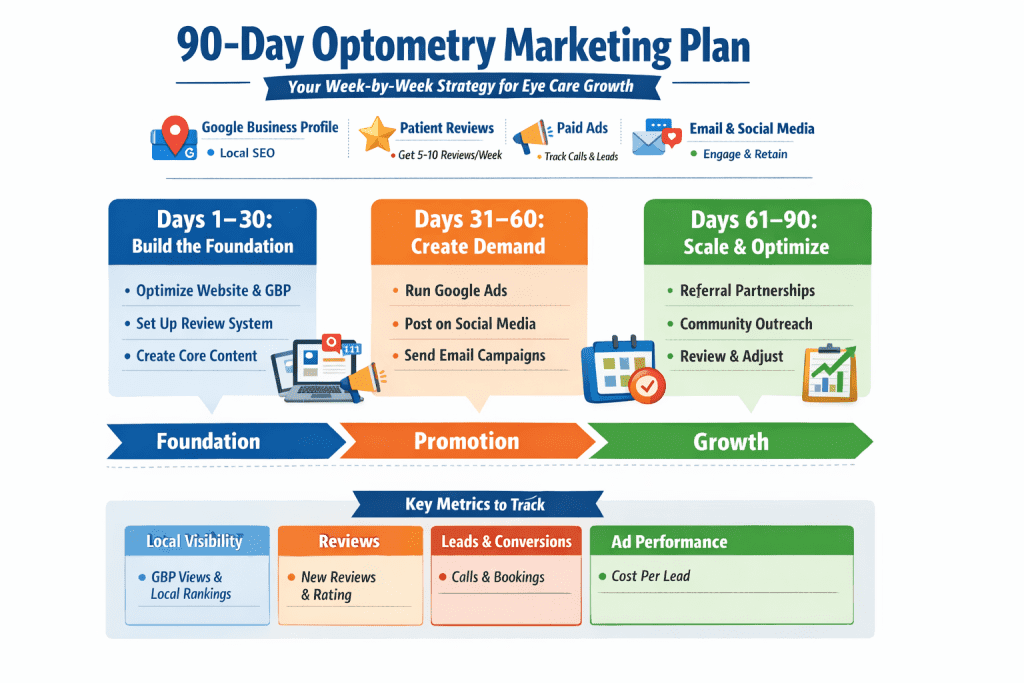
If you’re an eye care practice owner, you don’t need more random tactics, you need an optometry marketing plan you can actually execute.
Most competitor guides repeat the same truth: growth comes from a solid website foundation, Local SEO and Google Business Profile visibility, steady reviews, smart ads, consistent content, email follow-up, and community relationships.
This post turns those into a simple 90-day system.
Step 1: Choose one primary goal (don’t try to fix everything)
A strong plan starts with focus. A competitor strategy framework recommends choosing one main objective, supported by three key strategies, and then defining actionable steps under each.
Pick ONE 90-day goal, like:
- Increase comprehensive eye exam bookings by 20%
- Generate 30+ new patient leads/month from Google
- Add 10 dry eye consults/month
- Improve eyewear sales from existing traffic
Then choose three strategies to support it (example: Local SEO + Reviews + Google Ads).
Step 2: Track the right KPIs weekly (keep it simple)
Competitors repeatedly point out that “trying things” without tracking turns marketing into guessing.
Track these weekly:
Local Visibility
- Google Business Profile (GBP) calls, website clicks, direction requests
Trust
- New Google reviews/week
- Review response rate
Conversion
- Calls + form leads attributed to marketing
- Online booking completions (if enabled)
Paid (if running ads)
- Cost per lead / cost per call
- Landing page conversion rate
Your 90-Day Optometry Marketing Plan (Week-by-Week)
Days 1–30: Build the foundation (so everything works better)
1) Audit your website (your “24/7 front desk”)
Competitors emphasize your website should not be a brochure—it should quickly help people understand what you do and book fast.
Another strategy guide frames the website as the “foundation” and recommends auditing clarity, navigation, booking flow, and SEO readiness.
Action checklist
- Add a clear “Book Appointment” + “Call Now” above the fold
- Make services easy to find (especially high-revenue services)
- Use real photos (team, office) and visible trust elements (reviews/testimonials)
- Ensure fast mobile load speed
2) Local SEO: Optimize your Google Business Profile first
Competitor guidance consistently pushes Local SEO and GBP optimization as a top driver of discovery.
Action checklist
- Fully complete GBP (hours, services, booking link, photos, Q&A)
- Post updates regularly (availability, new frames, seasonal reminders)
- Ensure name/address/phone consistency across directories
3) Build a reviews system (not “ask sometimes”)
Reviews are repeatedly described as a modern version of word of mouth—and a differentiator in local choice.
Action checklist
- Create a simple front-desk script and ask after appointments
- Text/email the direct review link
- Respond to reviews (including negative ones)
4) Create a lightweight content plan (patient questions = traffic)
Competitors recommend content that answers real patient questions and supports trust/E-E-A-T.
Publish in the first 30 days
- 2 service pages you want to rank for
- 2 blog posts that match real search intent (FAQs and clear headings)
Examples
- “How often should you get an eye exam?”
- “Dry eye symptoms vs allergies”
- “Are blue light glasses worth it?”
- “What to expect at a kids’ eye exam”
Days 31–60: Create demand (ads + email + social systems)
5) Run Google Ads the right way (high intent + proper landing pages)
Competitor guidance highlights Google Ads as useful for fast results, but only when your foundation is strong and tracking is in place.
Action checklist
- Build campaigns around high-intent searches (service + city)
- Send clicks to a dedicated service page (not the homepage)
- Add call tracking + form tracking so you know what works
6) Use social media as reputation management (not random posting)
One competitor explicitly frames social media as “reputation management” and recommends using a posting calendar to stay consistent.
Simple weekly cadence
- 2 posts/week (education + trust)
- 3–5 Stories/week (clinic life, frames, quick tips)
7) Add email (simple, useful, consistent)
Competitor guidance emphasizes that email doesn’t need to be complicated—send 1–2 helpful emails/month with a booking link.
Another guide recommends newsletters weekly/bi-weekly/monthly if planned ahead.
Email themes
- Appointment reminders (“time for your annual exam?”)
- Seasonal eye issues (dry eye, allergies)
- Featured service (myopia control, specialty contacts)
- New frames + promos (if relevant)
Days 61–90: Scale what works (partnerships + optimization)
8) Build local partnerships for consistent referrals
Competitor guidance notes that some of the best referrals come from nearby professionals (pediatricians, family doctors, school nurses, coaches, etc.).
Action checklist
- Reach out to 1 partner/week
- Offer something easy: a screening day, a referral card stack, a co-branded flyer
9) Add an offline visibility play (only if it fits your market)
Competitor lists include offline options like flyers/billboards and community involvement, with a practical note that effectiveness depends on location and competition.
A smart “bridge” tactic: use QR codes on printed materials that drive to booking or a specific service page.
10) Run an optimization sprint (so next quarter performs better)
Competitor guidance is blunt: if you don’t know where patients came from, you can’t improve—track sources and review monthly.
Optimization checklist
- Improve your top 2 converting pages (headline, CTA, reviews, FAQs)
- Reallocate ad budget to the best-performing campaign
- Publish 2 more posts based on the questions you hear in your clinic
90-day weekly checklist
Weeks 1–2
- Website audit + booking CTA fixes
- GBP optimization + NAP consistency
- Reviews process setup
Weeks 3–4
- Publish 2 service pages + 2 blog posts
- Add tracking for calls/forms
Weeks 5–6
- Launch Google Ads + service landing pages
- Start social calendar
Weeks 7–8
- Send 1–2 email campaigns/month
- Optimize ads (keywords, negatives, page conversions)
Weeks 9–10
- Begin partnership outreach
- Add one offline visibility tactic (if it fits)
Weeks 11–12
- Monthly performance review + next 90-day plan
FAQ
How long does it take for optometry marketing to work?
Ads can work within weeks, while SEO and content typically build momentum over months. Competitors recommend using ads for speed while improving long-term foundations like Local SEO and website conversion.
What’s the most important part of a 90-day optometry marketing plan?
Start with your website + Google Business Profile + reviews, because they influence both organic discovery and paid conversion.
How often should an optometry practice post content?
Consistency matters more than volume; publish patient-focused answers that support trust and visibility.
Ready to Build Your 90-Day Optometry Marketing Plan With Visiclix?
Book a Visiclix Marketing Audit + 90-Day Roadmap and get:
- Tracking and conversion setup checklist
- Landing page + offer recommendations
- A week-by-week execution calendar
- A KPI scorecard for scaling decisions