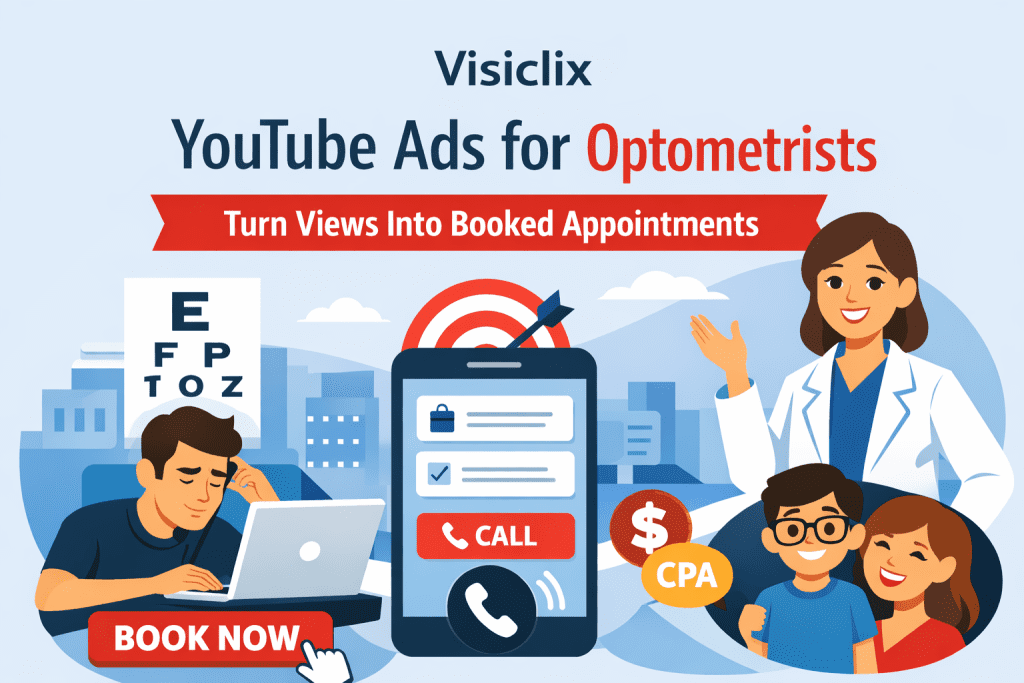
YouTube can drive real optometry appointments, but only when it’s built like a patient-acquisition system instead of a “video awareness” experiment. The clinics that get consistent results typically do three things: they choose a campaign setup designed for actions, they write creative that earns attention fast, and they track outcomes that actually matter (calls, forms, booking requests) so they can improve performance week by week.
This guide walks through how to make YouTube ads for optometrists convert—without turning your strategy into a pile of disconnected tips.
What are YouTube ads for optometrists, and why do they work for local patient growth?
YouTube ads for optometrists are paid video placements shown before/during/after YouTube content (and across Google video partners) to reach local people and drive actions like calling, booking, or visiting a clinic. Skippable in-stream ads, for example, run on YouTube and Google video partners and can be used to drive conversions—not just views.
They work well for optometry because:
Vision needs are frequent and “quietly urgent.” People may not search immediately, but they’ll recognize symptoms (blurry screen, headaches, dry eyes) when prompted.
Trust matters. Video helps patients quickly gauge friendliness, professionalism, and what the experience will feel like—especially for families and first-time patients.
Local intent can be shaped. With geo targeting and audience signals, you can reach people close enough to realistically choose your clinic.
Which YouTube ad formats make the most sense for optometry clinics?
For most clinics, start with skippable in-stream and build from there. Here’s how the main formats map to real optometry goals:
- Skippable in-stream (best default): Viewers can skip after 5 seconds. Great for testing hooks, offers, and driving site visits/calls while controlling cost.
- Non-skippable in-stream (selective use): Good for short, high-impact reminders (grand opening, seasonal push) if you already have strong creative and tight geo. (Use carefully; frequency can annoy.)
- Bumper ads (6 seconds): Great for reinforcement—remarketing to people who watched your longer ad or visited your website.
- In-feed video ads: Useful for educational or “choose-your-own” browsing moments when people are actively exploring content.
Rule of thumb: If you want appointments, build around formats and campaign types that support conversion measurement—not just reach.
How does YouTube pricing work (CPV, CPM, CPA), and what should optometrists expect to pay?
YouTube pricing depends on the objective and bidding. The key is understanding what you’re paying for:
- CPV (cost per view): With CPV bidding, you pay when someone watches 30 seconds, watches the full ad if it’s shorter than 30 seconds, or interacts—whichever comes first.
- CPM (cost per 1,000 impressions): Typically used when optimizing for reach/awareness.
- CPA (cost per action): Used in conversion-focused setups (when you’re optimizing for leads like calls/forms/booking actions).
Instead of chasing “average costs” from generic benchmarks, set expectations like this:
- If your offer and landing page are strong, YouTube can produce efficient top-of-funnel traffic and remarketing-assisted conversions.
- If you don’t track conversions properly, you’ll “win” on views while losing on appointments.
What should an optometry clinic promote first to get the best ROI?
Start with the service that is easiest to understand, easiest to book, and highest demand in your area. For most clinics, that means:
- Comprehensive eye exams (broad appeal, simple booking)
- Contact lens exams/fittings (clear pain points like dryness/comfort)
- Dry eye evaluations (high intent when framed around symptoms)
- Myopia management (family-focused, longer decision cycle—best with remarketing + education)
How to choose quickly:
- Pick one “hero offer” that can be booked in a single step.
- Ensure front desk and online booking can handle it cleanly (no friction, no confusion).
How do you build a high-converting YouTube ad funnel for an eye clinic?
A converting YouTube funnel is: Hook → Trust → Offer → Proof → CTA → Dedicated landing page → Tracked conversion.
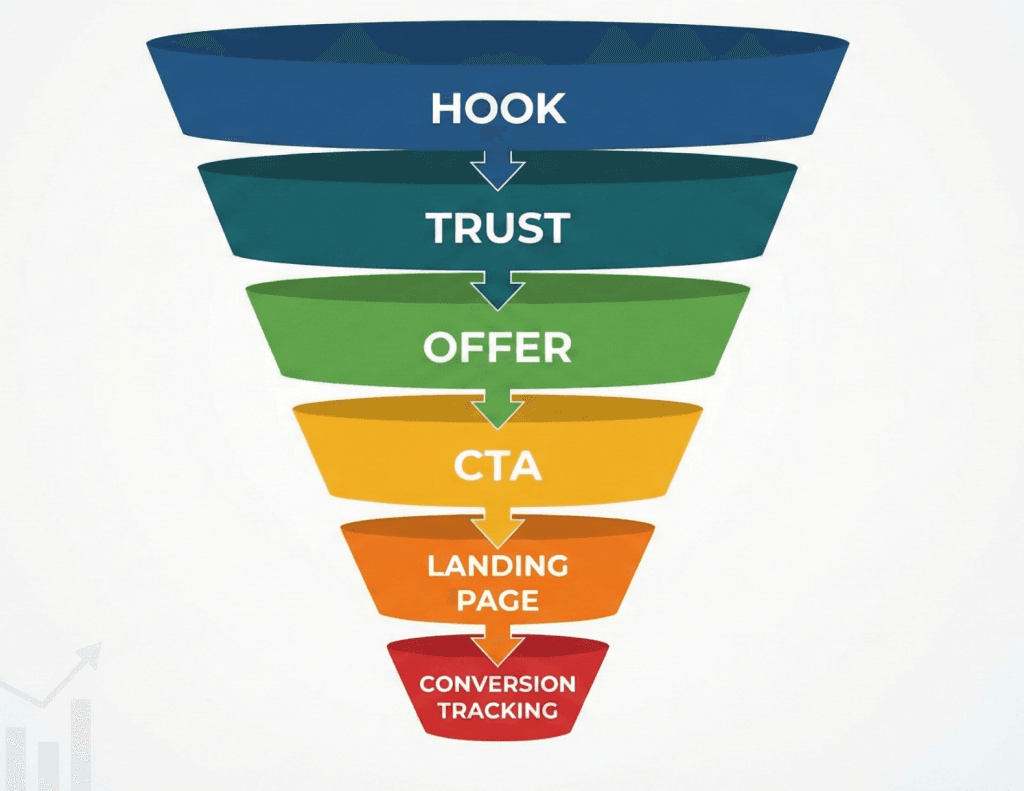
Here’s the structure that consistently performs:
Hook (0–2s): A symptom or situation the viewer recognizes instantly.
Trust (2–6s): A quick credibility cue (friendly doctor/staff, modern equipment, clear promise like “quick, thorough exam”).
Offer (6–12s): One service + one reason to act now (availability, convenience, simple benefit).
CTA (12–15s): “Book now” / “Call today” / “Check availability.”
Important: Don’t send YouTube traffic to your homepage. Send it to a single-purpose landing page for that service (exam, contacts, dry eye), with one primary CTA.
What targeting should optometrists use on YouTube to reach local patients without wasting spend?
Use tight geo first, then layer audiences—because location targeting works like an intersection with other targeting signals in video campaigns.
A practical targeting stack:
- Geo targeting (core):
- Start with a radius or specific zip/postal areas that reflect your real catchment area.
- Expand only after you’re getting consistent conversion signals.
- Demographics (light filters):
- Keep broad unless you have a clear service match (e.g., myopia management skews to parents).
- Intent/audience signals (where efficiency comes from):
- Custom segments around relevant searches/behaviors (e.g., “eye exam near me,” “dry eyes,” “contact lens fitting,” “kids glasses”).
- Remarketing to website visitors and past video viewers.
- Exclusions and safeguards:
- If you see junk traffic patterns, tighten placements and audiences rather than over-restricting too early.
How do you create 15-second YouTube ad creatives that patients actually watch (and act on)?
Assume most people will decide to skip within the first 5 seconds—so your message must land immediately. Skippable in-stream lets users skip after 5 seconds, which is why the hook is everything.
Three ready-to-run 15-second scripts (optometry-specific)
Script A: Eye Exam (direct booking)
- 0–2s: “Squinting at your screen more lately?”
- 2–7s: “A quick eye exam can catch changes early—often before you notice.”
- 7–12s: “At [Clinic Name], get a thorough exam and clear answers—fast.”
- 12–15s: “Tap to book your eye exam today.”
Script B: Contact Comfort (symptom-first)
- 0–2s: “Contacts feel dry by afternoon?”
- 2–7s: “We’ll fit lenses that match your eyes—and your day.”
- 7–12s: “Get options for comfort, clarity, and screen time.”
- 12–15s: “Book a contact lens fitting at [Clinic Name].”
Script C: Kids & School (family trust)
- 0–2s: “Not sure if their vision changed?”
- 2–7s: “A quick check can support learning and screen comfort.”
- 7–12s: “Friendly, kid-ready care—easy online booking.”
- 12–15s: “Tap to schedule at [Clinic Name].”
Creative rules that improve conversion rates
- Show the doctor/staff + real clinic early (trust signal).
- Put the CTA on-screen by 10–12 seconds (don’t wait for the end).
- Keep on-screen text simple: Symptom → Service → CTA.
What landing page elements increase bookings from YouTube traffic?
A YouTube landing page should behave like a booking assistant, not a brochure. Prioritize:
- A headline that mirrors the ad hook (“Blurry vision?” “Dry eyes?”)
- One primary CTA above the fold: Book Online or Call Now
- Clear expectations: what happens in the visit + how long it takes
- Proof: 2–3 review snippets + clinician credentials
- Convenience signals: hours, parking, insurance accepted (only if accurate)
- A short form or direct scheduler—avoid long forms
How do you track calls, forms, and booked appointments from YouTube ads?
If you can’t measure it, you can’t optimize it. Your baseline tracking should include:
- Google Ads conversion actions for calls and lead forms
- UTMs on final URLs to distinguish YouTube traffic
- A “booked appointment” proxy if true booking data isn’t accessible (e.g., completed scheduling confirmation page)
Also: conversion-focused video setups have evolved—Video Action Campaigns were upgraded/replaced by Demand Gen, with Google noting similar conversions at similar CPA on average, and better performance when using multi-format assets.
Translation: if your goal is conversions, align campaign type and assets accordingly.
What KPIs matter most for optometry YouTube campaigns (and what “good” looks like)?
Track in this order:
- Cost per lead (calls/forms/booking requests)
- Lead quality (front desk feedback: “real patients” vs spam)
- Cost per booked exam (best metric if you can measure it)
- View rate + CTR (supporting indicators, not the goal)
If you only optimize view rate, you can end up with “cheap views” that don’t book.
How do you optimize YouTube campaigns in the first 30 days?
A 30-day YouTube optimization plan is mostly creative iteration + targeting discipline.
- Week 1: Launch 2–3 creative variants (different hooks), one service offer, one landing page.
- Week 2: Pause the weakest hook, refine geo (tighten to best-performing areas), confirm conversions are firing correctly.
- Week 3: Add remarketing (site visitors + video viewers) and test a 6-second bumper to reinforce the CTA.
- Week 4: Introduce a second offer only after the first is stable (e.g., exam → contacts).
What compliance and patient-trust pitfalls should optometrists avoid in video ads?
Keep your messaging trust-first and avoid medical-style guarantees.
- Don’t promise outcomes (“We will cure…”, “Guaranteed relief”).
- Use safer language: “can help,” “may improve comfort,” “we’ll evaluate.”
- If using testimonials, ensure consent and avoid sensitive medical details.
FAQ
Are YouTube ads worth it for a small optometry practice with a limited budget?
Yes—if you run a single focused offer, tight geo targeting, and conversion tracking. Otherwise, it can become an “awareness spend” with unclear ROI.
How long should an optometry YouTube ad be—6, 15, or 30 seconds?
Use 15 seconds for acquisition (enough time for hook + trust + CTA). Add 6 seconds for remarketing reinforcement.
Can YouTube ads drive phone calls directly to my front desk?
Yes, when you use a conversion-focused setup and a landing experience designed for click-to-call, and you track calls as conversions.
Should optometrists run YouTube ads or Google Search ads first?
If you need immediate demand capture, search is often the first channel. YouTube becomes powerful when you want to create demand locally and then convert it with remarketing and strong landing pages.
What’s the best targeting radius for an eye clinic?
Start with your real catchment area (where most patients actually come from). Tighten first, then expand based on conversion data.
Conclusion
YouTube ads for optometrists work when you stop optimizing for views and start optimizing for bookings. Pick one service offer, build a simple funnel, write a hook patients instantly recognize, and track calls/forms/appointments so you can improve results every week.
Why Visiclix is Your Ideal Choice for YouTube ads for optometrists?
Visiclix builds YouTube campaigns the way a clinic experiences success in real life: not as “more views,” but as more scheduled patients. We focus on optometry-friendly creative that earns trust fast, then pair it with conversion-focused campaign structure and landing pages that make booking effortless.
Unlike generic agencies that treat YouTube like a branding channel only, Visiclix designs campaigns to prove ROI—tracking calls, forms, and appointment requests so you can confidently scale what works. And because video platforms reward strong creative, we don’t just “run ads”—we test hooks, offers, and scripts until performance is predictable.
Book a Visiclix YouTube Ads Audit for Your Eye Clinic
Get a conversion-first plan built for optometry: the best offer to promote, 2–3 ready-to-film 15-second scripts, targeting recommendations, and a tracking checklist that ties spend to booked appointments.