SEO reporting for optometry is the process of measuring how well your website and local presence turn search visibility into patient interest. A useful report does not stop at rankings. It connects what people see in Google Search and Google Maps to what they do next, such as visiting your website, clicking to call, submitting an appointment request, or booking care. Google’s own reporting ecosystem already supports much of this view through Search Console, Google Analytics 4, and Google Business Profile performance data.
That distinction matters because many SEO reports still overemphasize vanity metrics. A practice can rank for more keywords and still fail to produce more calls or appointment requests. Strong SEO reporting instead shows whether increased visibility is reaching the right searchers, landing them on the right pages, and leading them toward actions that matter to the practice. Search Engine Land’s reporting guidance makes the same point: reporting should prove value, uncover insights, and align performance with outcomes, not just display disconnected metrics.
For optometry practices, that business-focused view is especially important because local intent drives so much of the patient journey. Someone searching for an eye exam, contact lenses, pediatric eye care, or dry eye treatment is often choosing a nearby provider. That means SEO reporting should reflect both website performance and local profile interactions, because searchers may convert from either path. Google Business Profile performance data specifically tracks how customers find a profile and what actions they take, including clicks and other interactions on Search and Maps.
What is SEO reporting for optometry?
SEO reporting for optometry is a structured way to track search visibility, website engagement, and lead activity for an eye care practice. In practical terms, it means combining Google Search Console data like clicks, impressions, click-through rate, and average position with GA4 key events and Google Business Profile interactions. Those sources help a practice understand not just whether it is visible, but whether visibility is producing patient intent.
The best way to think about it is as a measurement system for the patient acquisition journey. Search Console helps explain how often pages appear in Google and how often users click them. GA4 helps show what users do after they arrive, including whether they complete an important action that you have marked as a key event. Google Business Profile helps fill in the local layer by showing calls, website clicks, and other profile-driven interactions from Search and Maps.
That makes SEO reporting for optometry more specific than a generic marketing report. A good optometry report should answer questions like: Are we improving visibility for service-based searches? Are our location and service pages attracting qualified traffic? Are people calling us from our profile or site? Are more appointment requests coming from organic search than last month or last quarter? Those are the questions that turn SEO from “interesting” into “actionable.” This approach also addresses a gap in many optometry SEO articles, which often explain optimization tactics well but spend less time on how to connect them to reporting and business outcomes.
Why does SEO reporting matter for optometry practices?
SEO reporting matters because it gives practice owners a clearer way to evaluate marketing performance. Without reporting, it is easy to assume SEO is working because traffic is up, or because an agency says rankings improved. With proper reporting, the practice can see whether that visibility is actually generating patient interest through calls, website clicks, and appointment-related actions. Google Search Console, GA4, and Business Profile performance were built to surface those signals in different parts of the search journey.
It also improves decision-making. If the report shows that pediatric eye care pages drive strong impressions but weak click-through rates, the practice may need better title tags and meta descriptions. If traffic to a contact lens page is rising but appointment requests stay flat, the issue may be page design, trust signals, or scheduling friction rather than rankings. If map-driven calls are healthy but organic landing pages underperform, local profile optimization may be stronger than the site experience. Search Engine Land recommends using reporting to connect data to diagnosis and action in exactly this way.
For optometry specifically, reporting also helps separate service demand. Eye exams, eyewear, dry eye treatment, myopia management, and specialty lenses do not always perform the same way in search. A strong SEO report can reveal which services attract the most impressions, which pages pull the most qualified traffic, and which pathways produce the highest-intent leads. That makes reporting a planning tool, not just a scoreboard.
What should an optometry SEO report actually include?
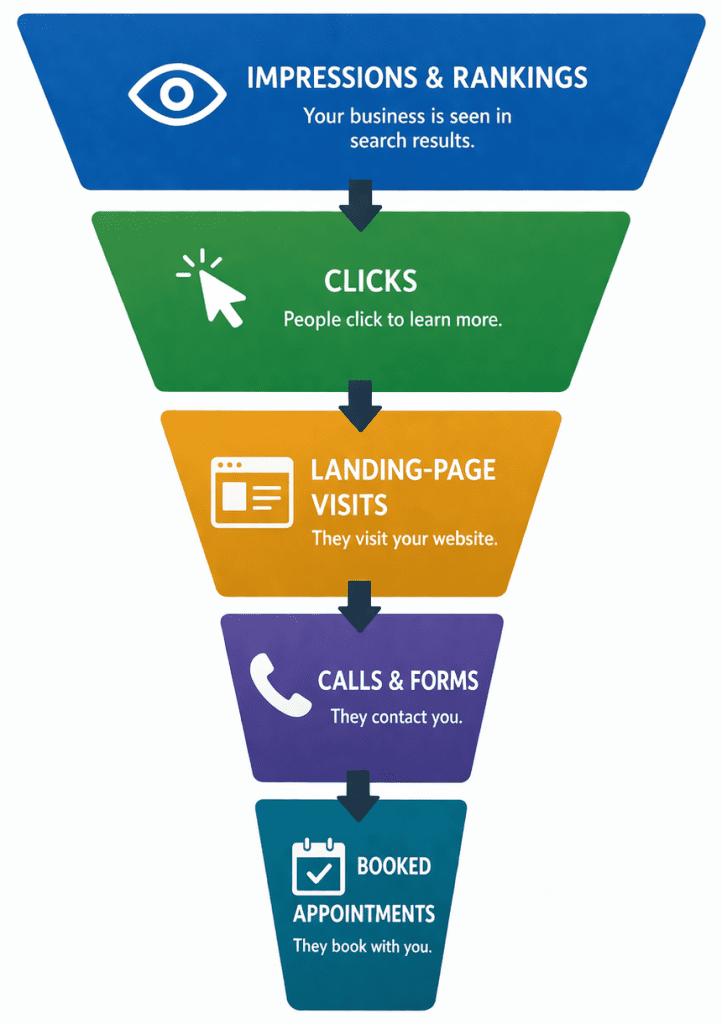
A strong optometry SEO report should include four layers: visibility, traffic, engagement, and conversion. Visibility includes metrics like impressions, average position, and click-through rate from Search Console, plus local interactions from Google Business Profile. Traffic includes organic sessions and landing-page performance in GA4. Engagement includes which pages hold attention and which pages lose visitors before they act. Conversion includes key events such as appointment-form submissions, click-to-call actions, and other patient-intent events that the practice chooses to track.
The report should also separate website SEO from local profile SEO. Search Console and GA4 largely explain what happens through the website. Google Business Profile performance explains how people interact with the practice directly on Search and Maps. Since GBP performance includes calls and website clicks, it belongs in the same monthly conversation as organic landing-page traffic and on-site lead actions.
A practical monthly report usually includes: top-performing queries, top landing pages, movement in average position, organic clicks and impressions, call clicks from the Business Profile, website clicks from the profile, appointment-form completions from GA4, and a short explanation of what changed and why it matters. Search Engine Land and AIOSEO both emphasize that SEO reporting should combine rankings, traffic, conversions, and ROI-oriented interpretation rather than presenting numbers without context.
Technical health belongs in the report too, but only in a focused way. The point is not to drown stakeholders in audit details. Instead, report the technical issues most likely to affect visibility or user experience, such as indexing problems, broken critical pages, or Core Web Vitals issues. Google explains that Core Web Vitals measure real-world user experience and that Search Console’s Core Web Vitals report groups URLs by status and field performance, which makes it useful for spotting page-template problems that may affect multiple service or location pages.
How do keyword rankings help measure SEO performance for an optometry practice?
Keyword rankings help because they show whether the practice is becoming more visible for the searches it wants to win. Search Console’s performance reporting includes average position, clicks, impressions, and CTR, which together provide a more complete picture than rank tracking alone. If impressions are rising for “eye exam” or “optometrist near me” style searches but clicks remain weak, the visibility may be improving while messaging still needs work.
That said, rankings should be treated as directional, not final. Google notes that average position is a calculated metric, and Search Console itself explains nuances around how impressions and position are counted. In other words, ranking movement matters, but it should be read alongside click data, landing-page performance, and conversion activity. A page that moves from position 9 to 4 and starts producing more clicks is more meaningful than a keyword report that simply shows “green arrows” without business impact.
For optometry, rankings are most useful when grouped by intent. Branded terms show how often people already aware of the practice find it. Non-branded terms show whether SEO is expanding reach to new potential patients. Local service terms show whether the practice is becoming more discoverable for nearby, treatment-related demand. A good report separates those buckets so leadership can see whether SEO is defending brand, growing awareness, or driving acquisition.
How should optometry practices evaluate organic traffic in SEO reports?
Organic traffic should be measured by relevance before raw volume. Google Analytics can show which organic landing pages attract users, and key events can show whether those users take actions that matter to the business. That means a service page that gets 150 organic visits and 12 appointment requests may be far more valuable than a blog post with 1,500 visits and no clear conversion activity. GA4’s key event framework is built to measure actions that are particularly important to a business’s success.
This is why page-level reporting matters so much in optometry SEO. The pages that deserve the most attention are usually service pages, location pages, doctor pages, insurance-related pages, and scheduling pages. Educational blog content can still help by expanding topical relevance and attracting early-stage searchers, but it should be evaluated in context. Search Engine Land’s reporting guidance recommends using landing-page and conversion analysis to connect SEO work to growth objectives rather than relying on traffic totals alone.
The smartest way to report traffic is usually with both trend and segmentation. Month-over-month comparisons can show near-term progress, while year-over-year comparisons help account for seasonality. Segmenting by page type can show whether content, service, and location pages are all contributing or whether growth is concentrated in one weak area. That makes the report much more useful when deciding what to optimize next. This is an inference from how Search Console and GA4 data are structured and from reporting best practices that emphasize trend analysis, page-level insights, and decision support.
Why are calls one of the most important SEO metrics for optometry?
Calls are one of the most important SEO metrics for optometry because they often represent high-intent patient behavior. Many people do not want to browse multiple pages before booking vision care. They want to confirm insurance, ask about appointment availability, clarify urgent symptoms, or schedule quickly. Google Business Profile performance explicitly includes call activity, and Google notes that this metric represents clicks on the call button from the profile.
That matters because a report that ignores calls may understate SEO’s real value. A practice could receive strong map visibility and call-click growth even if some users never visit the website. In local healthcare categories, that path can be very important. Google Business Profile performance is designed to show what actions customers take after finding the practice on Search and Maps, which is why it should sit next to website analytics in a monthly SEO report.
It is also important to interpret call data correctly. Google’s Business Profile documentation notes that the number of calls shown is the number of call-button clicks, and that discrepancies can occur if a user copies the number, dials manually, or ends the call before it connects. That means SEO reporting should treat GBP calls as a strong intent signal, while internal phone-system data or call tracking can help validate what actually reached the practice.
How can SEO reporting connect calls and appointment requests to patient acquisition?
The cleanest approach is to define a short list of measurable lead actions and track them consistently. In GA4, any event can be marked as a key event if it reflects an action that matters to the business. For an optometry practice, that might include an appointment form completion, a “call now” click on mobile, a request for directions, or another scheduling-related interaction. GA4 is specifically designed to surface how many users perform those actions and to evaluate performance across channels that lead to them.
Then connect those site actions to landing pages and organic channels. Search Console shows which queries and pages generated visibility and clicks. GA4 shows what users did after arriving. Google Business Profile fills in the off-site local layer with profile interactions such as website clicks and calls. When those three sources are viewed together, a practice can get much closer to understanding whether SEO is producing patient leads rather than just visits.
The final step is operational rather than technical: distinguish between a lead and a booked patient. An appointment request is not always a completed appointment. A call click is not always a successful conversation. The best SEO reports make this difference explicit, then pair marketing metrics with scheduling or front-desk outcomes wherever possible. That principle aligns with Search Engine Land’s view that SEO reporting should prove performance in terms stakeholders actually value.
What role does local SEO play in SEO reporting for optometry?
Local SEO should have its own place in the report because optometry is location-dependent. People usually choose an eye care provider within a manageable geographic range, so visibility on Search and Maps is not a side issue. It is central to new-patient discovery. Google Business Profile performance is built around showing how customers find a business on Search and Maps and what they do next, which makes it a core local reporting source.
A local SEO section should usually include profile views or discovery metrics, website clicks, calls, and any booking-related interactions available through the profile setup. It should also note whether core business information is accurate and current, since Google Business Profile is intended to surface a business’s hours, phone number, website, and location details to customers. For a practice, that accuracy is not just a local SEO best practice. It is basic conversion hygiene.
This local layer is one reason generic SEO reports often feel incomplete for healthcare practices. A report that focuses only on website traffic can miss meaningful patient intent happening directly in the business profile. For optometry, that is a reporting gap worth fixing immediately. Competitor optometry SEO guides highlight the importance of local search and reviews, but a stronger reporting article should show how those local signals are measured and interpreted month to month.
What does a good SEO reporting dashboard for an optometry practice look like?
A good dashboard is simple enough for leadership to scan and detailed enough for marketers to act on. The first panel should be an executive summary with the few numbers that matter most: organic clicks, organic sessions, call clicks, appointment-related key events, and a short statement about whether patient-intent activity improved or declined. Search Engine Land recommends reports that highlight ROI, surface insights, and align stakeholders, which is exactly what an executive summary should do.
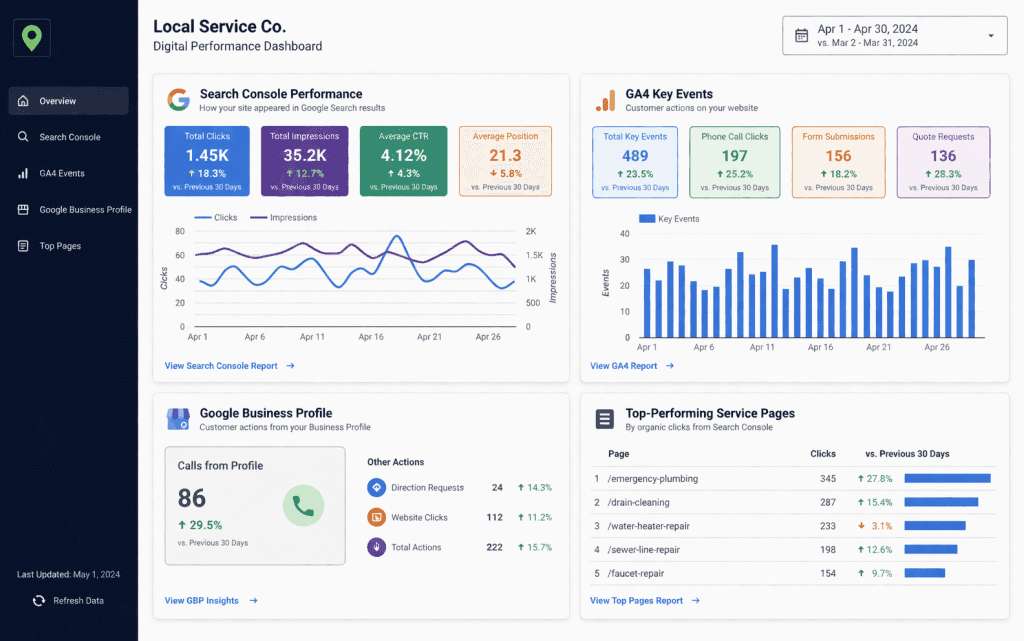
The next panels should answer the obvious follow-up questions. Which queries and pages gained or lost visibility? Which landing pages drove the most organic traffic? Which pages produced the most key events? What happened in the Business Profile on Search and Maps? Search Console and Business Profile performance already provide the inputs for those sections, while GA4 provides the on-site outcome layer.
The best dashboards also include interpretation, not just charts. A practice owner should not have to guess why traffic dropped or which action matters next. If a location page lost clicks because CTR fell while position stayed steady, the next step may be improving search snippets. If key events fell while traffic stayed level, the problem may be page experience or scheduling friction. Google’s page experience and Core Web Vitals guidance supports the broader idea that user experience still matters even beyond direct ranking effects.
How often should optometry SEO reporting be reviewed?
Most optometry practices should review SEO reporting monthly and then take a deeper quarterly look at trends. Monthly review is frequent enough to spot meaningful changes in visibility, calls, and conversion activity without overreacting to short-term fluctuations. Quarterly review is better for evaluating whether content, local optimization, and technical improvements are compounding into stronger patient acquisition over time. This cadence is an inference from how SEO reporting is typically used and from guidance that emphasizes ongoing trend analysis rather than isolated snapshots.
Daily rank checking is rarely the best way to judge progress. Search Console itself notes that some data can be preliminary and that performance reporting is aggregated. SEO should be measured through patterns, not panic. For most practice owners, a monthly report tied to clear actions is far more valuable than constant ranking refreshes that lack context.
A good monthly rhythm usually includes three questions: What improved? What underperformed? What should we change next? Keeping the report centered on those questions prevents SEO from becoming a stack of disconnected screenshots and helps make it part of actual marketing management. That framing is consistent with modern reporting advice that prioritizes insight and next actions over raw metric dumps.
What common mistakes make optometry SEO reports less useful?
The most common mistake is focusing only on rankings. Rankings matter, but without clicks, traffic quality, or conversion activity, they tell an incomplete story. Google Search Console’s own performance framework pairs average position with impressions, clicks, and CTR for a reason: the combined view is more informative than rank alone.
Another mistake is ignoring local interactions. If the report excludes Google Business Profile performance, it may overlook call clicks and website clicks from Search and Maps. For an optometry practice, that can hide some of the highest-intent behavior in the entire search journey. Google’s Business Profile performance documentation makes clear that these interactions are available and meaningful.
A third mistake is failing to define conversions clearly. GA4 now uses key events to measure actions that are important to the business. If a practice has not marked appointment-related actions properly, the report may show traffic growth without a dependable way to judge lead quality. The result is usually confusion, not accountability.
Finally, many SEO reports lack business context. They show what changed but not why it matters. Search Engine Land argues that SEO reporting should bridge strategy, stakeholder understanding, and ROI. For an optometry practice, that means explaining whether changes are likely to affect new-patient demand, service-line growth, or scheduling volume.
How can better SEO reporting improve marketing decisions for optometrists?
Better reporting helps a practice invest more intelligently. If organic clicks and key events are growing on dry eye treatment pages, that service line may deserve additional content, stronger internal linking, or more local page support. If pediatric eye care pages attract impressions but weak CTR, the issue may be search presentation rather than demand. Good reporting narrows the problem and helps prioritize work with less guesswork.
It also improves channel comparison. When key events are defined clearly in GA4, a practice can compare how organic search contributes against other sources without reducing everything to raw traffic. If Google Business Profile interactions are rising at the same time as organic landing-page conversions, that can indicate stronger overall search visibility. Search Engine Land’s guidance on reporting and goal KPIs supports using conversions and landing-page data to tell this broader performance story.
Over time, better SEO reporting builds trust inside the business. It gives owners and managers a clearer way to judge what is working, what is stalling, and what deserves more budget. That is especially valuable in local healthcare marketing, where the ultimate question is not “Did traffic go up?” but “Did we create more qualified opportunities for patients to book care?”
Is SEO reporting different for single-location and multi-location optometry practices?
Yes. A single-location practice can usually work from one combined view of Search Console, GA4, and Business Profile performance. The focus is often on total local visibility, top service pages, call clicks, and appointment-related key events. That setup can still be sophisticated, but the reporting structure is relatively direct.
A multi-location practice needs segmented reporting by office, market, and page set. Location pages, business profiles, and service demand can perform very differently from one area to another. Because Business Profile performance can be accessed for individual or multiple profiles, and Search Console plus analytics can be analyzed by page and page group, the underlying platforms support that more granular approach.
The practical takeaway is that multi-location optometry groups should avoid overly blended reports. When all data is rolled up too early, underperforming locations can hide behind stronger ones. A segmented report makes it easier to spot where local optimization, content, or conversion-path fixes are needed most. That is an inference from how these reporting tools expose data and from common reporting best practices around stakeholder clarity and actionability.
FAQ
What is the most important KPI in SEO reporting for optometry?
There is rarely just one. The best answer is usually a small group of related KPIs: organic clicks, call clicks, and appointment-related key events. Search Console measures search visibility and click activity, Google Business Profile measures local interactions like calls and website clicks, and GA4 measures the actions users take on the site. Together, those metrics tell a fuller story than any single KPI on its own.
Should optometry practices prioritize rankings, traffic, or calls?
Calls and appointment-related actions are usually closest to business value, but they should be interpreted alongside rankings and traffic. Rankings indicate visibility, traffic indicates whether users are arriving, and calls or forms indicate whether that attention is turning into intent. A balanced report uses all three layers.
Can SEO reporting show which eye care services drive the most leads?
Yes, if the practice tracks landing pages and key events properly. GA4 can show which pages generate important actions, and Search Console can show which queries and pages drive clicks and impressions. When those are grouped by service type, the practice can estimate which services attract the strongest search demand and lead activity.
How do Google Business Profile calls fit into SEO reporting?
They should be included as a local conversion-intent metric. Google reports call-button clicks from the Business Profile and notes that discrepancies can occur between call clicks and actual calls received. That makes GBP calls valuable for measuring intent, while internal call systems can help validate completion.
How often should an optometry practice review SEO reports?
Monthly is the most practical baseline for most practices, with a deeper quarterly review for strategic decisions. That cadence is usually frequent enough to show trend movement without encouraging overreaction to short-term noise. Search performance data is most useful when interpreted as a pattern over time.
What tools are best for SEO reporting for optometry?
For most practices, the core stack starts with Google Search Console, Google Analytics 4, and Google Business Profile performance. Search Console measures search visibility and clicks, GA4 measures on-site actions, and Business Profile performance measures Search and Maps interactions. Those platforms cover the essential reporting layers for most local optometry SEO programs.
Conclusion
SEO reporting for optometry should do more than show whether rankings moved. It should explain whether search visibility is producing better traffic, stronger local engagement, more calls, and more appointment-related actions. That is the difference between a report that looks busy and a report that actually helps a practice grow.
The most useful setup usually combines three sources. Search Console explains what happened in Google Search. GA4 shows what users did after arriving on the site. Google Business Profile performance captures the local actions that happen directly on Search and Maps. When those sources are interpreted together, an optometry practice gets a much clearer picture of SEO’s real business value.
Why Visiclix is Your Ideal Choice for SEO Reporting for Optometry?
Visiclix is an ideal partner for optometry SEO reporting because this kind of reporting only works when the numbers are connected to real patient acquisition. A practice does not need another vague dashboard full of rank screenshots and generic traffic charts. It needs a reporting approach that shows whether local visibility is improving, whether service pages are attracting qualified visitors, and whether those visits are turning into calls and appointment intent. That is where a focused, healthcare-aware reporting strategy becomes far more useful than a standard SEO summary.
Visiclix can also bring clarity to a part of marketing that often feels overly technical. Good reporting should make it easier to see which services deserve more investment, which pages need conversion improvements, and which local signals are producing patient action. When rankings, traffic, calls, and appointment-related behavior are tied together in one view, leadership gets a much stronger basis for decision-making. For an optometry practice, that means less guesswork and a more accountable path to growth.
Ready to Improve SEO Reporting for Your Optometry Practice with Visiclix?
If your current SEO reports stop at rankings or traffic, Visiclix can help you build a clearer view of what actually matters. The right reporting framework can show how your search visibility connects to calls, appointment requests, and measurable patient growth.